

2018, Jared Klein, Brian Joseph, Matthias Fritz (Eds.), Handbook of Comparative and Historical Indo-European Linguistics. Vol. 3. (HSK 41/3.) Berlin/Boston: de Gruyter.
https://doi.org/10.1515/9783110542431…
21 pages


AI
This chapter explores the phonological characteristics of the Balto-Slavic languages, focusing on the internal subgrouping within Balto-Slavic and the phonemic systems of Proto-Balto-Slavic. It examines the evolution of dialects from a continuum and outlines key vowel and consonant systems, including the effects of metatony and sound changes influencing the languages. The research context draws on existing literature, particularly Mayrhofer's 1986 systemization of Proto-Indo-European phonology.
AI

Baltica & Balto-Slavica, 2009
Journal of Slavic Linguistics, 2019
Baltistica 47/2, 5–48., 2012
The article is a critical review of the evidence regarding the reflexes of Proto-Indo-European long vowels in Baltic and Slavic. It is argued that in Balto-Slavic, inherited long vowels receive circumflex intonation in all positions in the word. Examples like Lith. várna ‘raven’, žvėrìs ‘wild animal’ and grė́bti ‘to rake’ that are traditionally thought to show that an Indo-European long vowel obtained acute intonation must be explained differently. A number of verbal roots forming a yod-present can be shown to have undergone metatony rude in Lithuanian and Latvian and metatony douce in Lithuanian. There is no evidence for the thesis that Balto-Slavic monosyllables always had circumflex intonation. Lithuanian examples that would show this development can be shown to be due to inner-Lithuanian innovations. Finally, Balto-Slavic ā-stems and intensive verbs with long vocalism generally have circumflex intonation and can be shown to reflect Proto-Indo-European formations containing a long vowel.
In the following presentation, I will try to outline a theory of how the three Common Slavic accent paradigms (a, b and c) can be derived from accentual patterns in Proto-Indo-European, for both nouns/adjectives and verbs. A central assumption will be that Balto-Slavic had three accent paradigms, not two, as is usually assumed.
Accent Matters: Papers on Balto-Slavic …, 2011
After the very well-organized Leiden conference for which we must be grateful to Tijmen Pronk, it seems appropriate for me to review some of the papers, as I did after the previous conferences in Zagreb and Copenhagen. The aim of this review is merely to point out some of the differences of opinion which require further debate. Mislav Benić presents a detailed description of verbal accentuation in the dialect of Kukljica on the island of Ugljan. The dialect has no tonal distinctions but does have vowel quantity in stressed and pretonic syllables, with large-scale lengthening of short vowels under the stress. It has preserved the Common Slavic distinction between original pretonic long vowels, which were shortened as a result of the rise of the new timbre differences, and new pretonic long vowels which arose as a result of Dybo's law (cf. Kortlandt 2005: 126-128), e.g. jazȋk 'tongue' (with secondary lengthening of the stressed vowel) versus nạ̄ rȍd 'people'. It has also preserved the distinction between simplex verbs with mobile stress, e.g. budȋn 'wake up', gasȋn 'turn off', and compound verbs where the prefix lost the stress to the root in accordance with Dybo's law, e.g. prebȗdin, ugȁsin (ibidem, 127). Moreover, it has preserved the accentual mobility of the original nasal present in nȅ znon 'don't know' (cf. Kortlandt 1985) and the retracted stress of the original imperative in vȗci, cȋdi of vūčȇn 'pull', cidȋn 'filter' (cf. Kortlandt 1979: 53). Miguel Carrasquer Vidal proposes a derivation of acute and circumflex tones from the syllable structure of the proto-language. His account involves tones on unstressed syllables, resyllabifications, analogical replacements, ad hoc rules for different stem formations and for different languages, secondary developments, unexplained exceptions for which he posits a PIE distinction between *i and *j, and structural ambiguity of the postvocalic ending *-ns. He lists a number of Slavic Auslautgesetze in order to arrive at the correct output. Since I have discussed all of the issues elsewhere, I shall not return to the many points of disaggreement here. Vladimir Dybo compares the West Caucasian, Balto-Slavic and Japanese accent systems in terms of "dominant" and "recessive" morphemes expressed in syllables and contours. In my review of last year's conference in Copenhagen, I have shown how the class of dominant suffixes originated from several retrac
Baltistica 55 (2020), 5-42.
Baltistica, 2011
Вопросы языкового родства / Journal of Language Relationship, 2017
Jay H. Jasanoff. Prehistory of Balto-Slavic Accent. Brill’s Studies in Indo-European Languages & Linguistics. Leiden/Boston: Brill, 2017. X + 268 pp. [download the file to see all diacritics]
Thomas Olander (Ed.), The Indo-European Language Family: A Phylogenetic Perspective. Cambridge: Cambridge University Press, 269-292., 2022
Since the times of Bopp and Schleicher, Baltic and Slavic have been treated as a single branch of the Indo-European language family. Throughout the nineteenth century, this view remained unchallenged, and it is presented as received wisdom in Brugmann’s Grundriss. At the beginning of the twentieth century, however, Meillet challenged the idea of a Balto-Slavic unity and argued that those similarities between Baltic and Slavic that are not archaisms inherited from (dialectal) Proto-Indo-European are due to parallel innovations. Throughout the twentieth century, the matter remained controversial. During the last quarter of a century, the communis opinio appears to have moved firmly in favour of the idea that there was indeed a period of shared innovations between Baltic and Slavic directly following the disintegration of the Proto-Indo-European parent language. This chapter discusses the evidence in favour of the reconstruction of a Balto-Slavic clade and its implications.

Loading Preview
Sorry, preview is currently unavailable. You can download the paper by clicking the button above.
AI
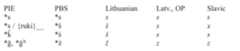
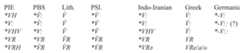
The study reveals that *s had a variant allophone, possibly suggesting pre-Balto-Slavic dialectal variations, particularly in East IE dialects. Additionally, the palatalization of PIE stops likely started in eastern areas, aligning with Indo-Iranian developments.
Research indicates that while Proto-Balto-Slavic retained distinct *a and *e, geographic variations led to instances of their merging in later Slavic and Lithuanian languages. Significant examples include OCS novŭ and Lith. tãvas, which reflect these vowel transformations.
Proto-Balto-Slavic demonstrated a complex system where long vowels could carry acute and circumflex intonations, influencing stress patterns across descendant languages. Modern dialects still reflect this dynamic, maintaining a layered understanding of Proto-Slavic accentual paradigms.
The phonological shifts primarily took place during the last centuries BCE to the early 1st millennium CE, as dialects began to differentiate. These shifts are vital for understanding the dialect continuum of West Baltic, East Baltic, and Slavic branches.
The findings suggest that Baltic languages do not form a distinct subgroup but have complex isoglosses indicating intertwined development with Slavic. Specific examples include shared verb forms and changes in numeral terms across these language branches.
Baltistica, 2011
Elsewhere I have proposed the following relative chronology of early sound changes (1989a: 42-47, 2005a: 115-118): (1) Neutralization of the opposition between palatovelars and labiovelars after *u and *s, yielding a palatovelar before *i and a plain velar elsewhere (cf. Steensland 1973: 34, Kortlandt 1979: 58). This development belongs to the Proto-Indo-European period (stages 1.2 and 1.3 of my chronology). (2) Rephonemicization of the opposition between fortes ("voiceless") and lenes ("voiced aspirates") as an opposition between voiceless and (plain) voiced stops. This was a shared innovation of all Indo-European languages except Anatolian and Tocharian and therefore belongs to the dialectal Indo-European period (my stage 2.1). The (lenes) glottalic stops (traditionally called "plain voiced") became preglottalized voiced at this stage (cf. Kortlandt 1978a: 110). (3) Retraction of *s to *ṣ after *i, *u, *r, *k in Balto-Slavic, Albanian, Armenian, and Indo-Iranian. The highly specific character of this sound change points to a common, dialectal Indo-European development (my stage 2.2).
Baltica & Balto-Slavica
Professor Hamp has recently returned to the problem of PIE *eu in Balto-Slavic (1976). I take the matter up again because his analysis has certain implications for the relative chronology of sound laws. After a detailed study of the earlier literature, Endzelin concludes that both prevocalic and preconsonantal *eu have a twofold reflex in Balto-Slavic, viz. *ev and *jau (Slavic ju) if the following vowel is front, but *av (Slavic ov) and *au if the following vowcl is front, but *av (Slavic ov) and *au (Slavic u) if the following vowel is back (1911 : 78-104). This point of view is often repeated in the more recent literature (e. g., Vaillant 1950 : 110 and 123, Stang 1966 : 32 and 74). I agree with Hamp that it cannol be correct. The Slavic dat. sg. synovi < *-euei and nom. pl. synove < *-eues suffice to show that prevocalic *eu yielded Slavic ov before front vowcls äs well. Since H. Pedersen's conclusive discussion of Lith. tau (1935), it can hardly be doubted that the only phonetic reflex of preconsonantal *eu was *jau in Balto-Slavic. If the Balto-Slavic reflex of PIE *eu was *av (or rather *ov) before vowels and *jau (or tarher *jou) before consonants, the occurrence of ev requires an explanation, especially in Lith. devyni, Slavic devgtt. The Suggestion that de-was borrowed from desimtjdesgtb cannot be maintained. As Hamp points out, ev must have been reintroduced in the cardinal *dovin < *Η^ neun on the model of the ordinal *deuno-, which was subsequently replaced by *devino-on the model of the new cardinal *devin. 1 It follows that preconsonantal *eu had becn preserved at a stage which was posterior to the phonetic elimination of prevocalic *eu and that the latter development was early Balto-Slavic. This chronology is in contradiction with the one given by Zupitza, who dates the Slavic development of *ev to *ov after the first palatalization (1907 : 251). The latter chronology i s based on Czech navsteva ,visit', Old Czech vscieviti ,to visit', which is derived from *(s)keu-, cf. Gothic usskaws, Latin caveo (Matzenauer 1884 : 179 and Mikkola 1904 : 96). Though Machek does not even mention this etymology (1968 : 392), I think that it is correct. It is certainly preferable to the proposed connections wAh Lith. svecias and Slavic posetiti, which do not fit phonologically, or PIE *ueid-(Berneker), which cannot be identified without violating Winter's law (sce below). I assume that ev was restored in this word on the basis of preconsonantal *eu, e. g. in cuti, in the same way äs in devgtb.
Scando-Slavica, 2019
Wiener Slavistisches Jahrbuch, 2010
Balto-Slavic accentuation revisited There is every reason to welcome the revised edition (2009) of Thomas Olander's dissertation (2006), which I have criticized elsewhere (2006). The book is very well written and the author has a broad command of the scholarly literature. I have not found any mistakes in Olander's rendering of other people's views. This makes the book especially useful as an introduction to the subject. It must be hoped that the easy access to a complex set of problems which this book offers will have a stimulating effect on the study of Balto-Slavic accentology. The purpose of the following observations is twofold. On the one hand, I intend to show that what the author evidently regards as his main result, the "mobility law", cannot be accepted because it is incompatible with the data. On the other hand, my aim is to pinpoint the essential differences between Olander's theory and mine (e.g. 1989a, 2005b, 2008a) in order to clarify where progress can be made. In the following, bracketed numbers which do not denote the Lithuanian accent classes (1) through (4) will refer to the pages of the book under discussion (Olander 2009). The origin of the mistaken analysis which has resulted in Olander's "mobility law" must be sought in his reconstructions of Proto-Indo-European and Proto-Slavic. Following the German (Brugmannian, pre-structuralist) tradition, Olander reconstructs five short and five long vowel phonemes *i, *e, *a, *o, *u, *ī, *ē, *ā, *ō, *ū, of which *i and *u had non-syllabic variants which were "probably in complementary distribution" but are nevertheless distinguished in the reconstructions, four resonants *r, *l, *m, *n with "syllabic realisation between consonants" distinguished by a ring underneath, "four fricatives" *s, *h 1 , *h 2 , *h 3 , the latter of which had "vocalic variants" *ə 1 , *ə 2 , *ə 3 , three labial stops *p, *b, *b h , three dental stops *t, *d, *d h , three palatal stops *k • , *g• , *g• h , three velar stops *k, *g, *g h , and three labiovelar stops *k w , *g w , *g wh (83), i.e. a total of 10 vowels, two of which had consonantal realizations, and 23 consonants, seven of which had "vocalic variants". This large and complex phonological system, which allows an impressive number of 425 CV and 10625 CVC sequences, is clearly at variance with Olander's professed "methodological choice to attach considerable weight to simplicity" of reconstructed syn
1985
According to the traditional doctrine, Ihere are three types of long vowels in Indo-European languages: (1) Full-grade long vowels. These have acute tone in Lithuanian, and also in Greek final syllables, e. g. alga 'salary', άλφή 'gain'. (2) Contracted long vowels. These have circumflex tone in Lithuanian, and also in Greek final syllables, e. g. gen, sg. algös, άλφής. (3) Lengthened grade vowels. These have acute tone in Greek final syllables, e. g. ποιμ,ήν 'shepherd'. It is usually assumed that the circumflex tone of the Lithuanian cognate piemuo is the result of a secondary development. This point of view is not supported by the material. In the following I intend to show that circumflex tone is regulär on lengthened grade vowels in Balto-Slavic. The origin of the lengthened grade has largely been clarified by J. Wackernagel in his Old Indic Grammar [1896, 66-68]. He distinguishes [three categories with seven subdivisions: (a) Secondary nominal derivatives. Wackernagel accepts Streitberg's Suggestion [1894, 380] that lengthened grade in this category arose from analogical extension of lengthened grade in monosyllabic word forms. (b) Roots in monosyllabic nouns, before primary suffixes, in the singular of athematic presents, and in the active s-aorist, e. g.-härd-, härdi 'heart', märsti 'wipes', ajaisam 'conquered'. The long root vowel of these words originated from phonetic lengthening in monosyllabic word forms, e. g. *härd, *jais. (c) Final syllables of nom. sg. and loc. sg. forms of nominal stems in a resonant, e. g. sakhä 'friend', agna 'in fire', both with loss of the formative *-z. Here I assume phonetic lengthening before a word-final resonant and subsequent loss of the resonant. If we want to establish the tonal reflex of lengthened grade in Balto-Slavic, we have to examine what has remained of these categories in Lithuanian, Latvian, and Serbo-Croatian. I think that the following evidence is relevant.
The position of the so-called ‘Baltic’ languages Lithuanian, Latvian and Old Prussian within the Balto-Slavonic branch of Indo-European is still a matter of debate. Within Balto-Slavonic, the Slavonic sub-branch is clearly identifiable due to an exclusive set of phonological and morphological innovations not shared by ‘Baltic’. The ‘East Baltic’ languages Lithuanian and Latvian are similarly separated from both Slavonic and the ‘West Baltic’ language Old Prussian by a set of characteristic innovations. What remains to be clarified, is the exact position of Old Prussian. Traditionally, Old Prussian is either grouped with ‘East Baltic’, thus implying a common Proto-Baltic stage after the disintegration of Proto-Balto-Slavonic, or it is seen as a separate sub-branch of Balto-Slavonic. The situation is additionally complicated by several nontrivial features shared by ‘East Baltic’ and Slavonic but not found in Old Prussian. Such features point to a third possible position on the sub-branches of Balto-Slavonic, i.e. grouping East Baltic together with Slavonic which implies a particularly early separation of Old Prussian from the rest of the branch. The paper intends to foster the theoretical discussion by pointing out two nontrivial phonological developments which must be assumed for both ‘East’ and ‘West Baltic’ but not for Slavonic and therefore may constitute evidence for Proto-Baltic as a parent language of both ‘Baltic’ branches.
Indogermanische Forschungen, 2004

 Ronald I Kim