

…
31 pages

GENEVA CENTRE FOR THE DEMOCRATIC CONTROL OF ARMED FORCES (DCAF) WORKING PAPER NO. 111, February 2003

AI
2021
The purpose of the study was to summarize the legislative and institutional efforts on reforming the Security and Intelligence Service of the Republic of Moldova. This study followed the 2013 Parliament’s Strategy of reform and focused on the 2014 Association Agreement between the European Union and the Republic of Moldova, with the subsequent Associations Agendas, and results of its implementation. Out of the three basic objectives of the 2013 Strategy, the independence of the Security and Intelligence Service creates the most confusion, and the other two – institutional capacities and accountability, although targeting two important issues, have several flaws in their more specific objectives and goals. The Association Agreement set the most clear strategic objectives for the reform process, and the Association Agendas/included other significant objectives for a firm reforming, which, however, were not accomplished. The reform of the intelligence service in Moldova has not begun yet, despite being discussed and promoted for 7 years. The new democratically elected Parliament, with an unprecedented pro-European majority, must restart the reform process of a pillar that is important for the national and regional stability and security, as well as establish a new National Intelligence Service.
Deutsche internationale Zeitschrift für zeitgenössische Wissenschaft nr. 97, 2025
Amid the outbreak of diversionary-terrorist attacks across Romania on the evening of 22 December 1989, the way in which the newly established political authority—the Council of the National Salvation Front (CFSN)—handled relations among the country’s security structures (the Army/Ministry of National Defence, the Securitate/Department of State Security – DSS, and the Ministry of the Interior) constitutes another controversial episode in the history of the December 1989 Romanian Revolution. Examining these fraught, bloody relationships from December 1989 sheds light on how the CFSN and, later on, the National Salvation Front (FSN), together with various military figures, would engage in the political battles up until 20 May 1990, as well as their subsequent involvement in Romania’s post-December political stage.
How to Unbind the State Capture in Serbia? Towards Security Institutions and Foreign Policy in the Service of Citizens, 2024
In this paper I briefly present the most important grey areas and veto points in the security and intelligence sector of Serbia and explain how those disputed elements and aspects of the work of the security services must be re(organised) to prevent those with political power in the future from being able to instrumentalise them so easily. These solutions are relevant regardless of whether the future authorities will dissolve the existing security intelligence services and form new ones, or decide to restructure and reorganise them. Although this paper is focused on the most important gray areas in the security-intelligence system, the future government should regulate all important aspects of the work of civil and military security intelligence services and the security-intelligence system in one comprehensive law, as we have already recognised in our earlier research.
2013
Turkish- Soviet Collaboration, the Strategi of the Turkish General Staff, and the Turkish Relationship to Romania in the Sovietic-War Period
2005
: As Hungary made its transition to democracy, it had to overhaul its political, economic and defense system. The shift to a democratic form of government and free enterprise economy depends on a military that is firmly under civilian authority. Within the defense sector, the endurance of such a new democracy requires reforming its intelligence system. Hungary must choose the intelligence system that best serves its goals and needs. Despite the relatively strong success in implementing a democratic system, market economy and civilian control of the military since 1989, the transformation of its intelligence agencies is incomplete. The intelligence organizations holds fast to the old concept of an oversized, hyper bureaucratic intelligence system, and still lack appropriate, Western-type civil control and oversight. The system itself has been changing but not at the adequate speed and to some extent, it has kept the baggage of its past. Recent international terrorism also presents an...
The present study examines the ability of small states to influence the balance of power at the international level, using their intelligence services. Romania's involvement in the Cold War superpower competition and its international posture after the collapse of communism corroborate the core assumption put forward in the neorealist theory of intelligence: that the structure of the international system can bolster the effectiveness of a small state's intelligence service.
Information & Security: An International Journal, 2013
This article examines the evolution of intelligence and counterintelligence services in selected Eastern European countries, formerly part of the Soviet Union, in the two decades of independence. It emphasises transitional influences, the high level of secrecy and the lack of effective parliamentary oversight. In this environment, a common feature of the transition process is the general lack of integrity. Not surprisingly, instead of serving as a guardian against corrupt practices in government, they turn into a major conduit of political and economic corruption.
National security and the future, 2000
The purpose of this article is to discuss the changes in the tasks and roles of the Hungarian Military Intelligence Office (MIO). The introductory paragraphs give a short view of the historical roots of Intelligence, then go on to cite milestones of MIO history, and end with an outline of the organization of the MIO, stressing its strong link to Intelligence gathering and decision making. The major parts of the article explain first, how the MIO has adapted and responded to the challenges facing modern-era Intelligence agencies; and, second, its proposed restructuring, the result of Hungary's NATO accession. The concluding portion contains a summary of the MIO's goals. Intelligence gathering is old business The Old Testament Book of Numbers contains a narrative of description Moses' sending men to gather information about the land of Canaan; i.e. the customs of the people, their military strength, fortresses and towns. Twenty-three hundred years ago in China, Sun Tzu wrote The Art of War, considered a masterpiece of military science. One chapter (of 13) states that "Intelligence is the most important branch of military science, because there can be no effective military planning without ample information about the enemy. Organizing Intelligence is therefore one of the most important preconditions for victory."
WORKING PAPER NO. 111
Larry L. Watts
Office of the National Security Advisor of the Romanian President, Bucharest, Romania
lwatts3728@aol.com
Geneva, February 2003
GENEVA CENTRE FOR THE DEMOCRATIC CONTROL OF ARMED FORCES (DCAF)
WORKING PAPER NO. 111
Larry L. Watts
Office of the National Security Advisor of the Romanian President, Bucharest, Romania
lwatts3728@aol.com
DCAF Working Papers constitute studies designed to promote reflection and discussion on civil-military relations and issues of democratic control over defence and security sector. These studies are preliminary and subject to further revisions. The publication of these documents is in an unedited and unreviewed format.
The views and opinions expressed are those of the author(s) and do not necessarily reflect those of the Geneva Centre for the Democratic Control of Armed Forces.
DCAF Working Papers are not for quotation without permission from the author(s) and the Geneva Centre for the Democratic Control of Armed Forces.
Larry L. Watts
According to March 2002 poll, 60% of the Romanian population believe that their intelligence services - in particular the SRI (Serviciul roman de informatii - domestic security intelligence) and the SIE (Serviciul de informatii externe - foreign intelligence) - have been “transformed into democratic institutions on the western model.” believe that the services are serving national interests in a politicallyneutral fashion as opposed to partisan aims of the sitting government (32%), and had a generally “good opinion” concerning their performance. of the population believes that the services do not have too much power, and half of those believe they have too little power, while believe that intelligence specialists remaining from before 1989 - about 15% of the SRI and 18% of the SIE - should be retained. Periodic polling by other agencies regularly rank the SRI just behind the church and the army, and ahead of the government and police, in terms of public trust.
The strength of this public approval came as a shock for the intelligence services, which were conditioned by the overwhelmingly negative portrayal they receive in Romania’s print media to consider themselves as social pariah. These polling results indicate a veritable revolution of public attitudes since 1989, when the Department of State Security - the dreaded Securitate - was not only considered an institution whose repressiveness rivaled that of the Soviet KGB and the East German Stasi, but was also commonly perceived as the primary villain responsible for the 1,000 casualties of Romania’s December 1989 Revolution. The reasons for this shift are several, including the timing and degree to which control and oversight of the
The poll was commissioned by Romania National Television and carried out by the private polling agency IRSOP (Institutul Roman de Sondaj si Opinia Publica). See Sondajul IRSOP privind opinia romaniilor despre rolul si activitatea serviciilor de informatii realizat pentru televizunea romana in perioada 16-20 martie 2002. The result were presented during a prime-time discussion with the SRI and SIE directors, Romanian journalists, and American consultants from the U.S. NATO Committee on TVR1 and TV Romania International, 1800-2000, 23 March 2002.
See e.g., seven polls conducted by Metro Media Transylvania since 1998 that include reference to the SRI. In terms of relative standing, a recent poll of July 2002 indicated that of the population believe half or more of all police officials are corrupt, while only consider the SRI as mostly corrupt. See also, C. D., “SRI intra in topul increderii romanilor. Biserica ramane pe primul loc,” Azi, 30 September 2002.↩︎
intelligence services were introduced, observable improvement in the effectiveness of parliamentary oversight bodies, the continued existence of regional instability and risks along Romanian borders, public perception of the main factors responsible for the institution and strengthening of domestic stability within the country, and the public debate initiated by the services prior to their wide-ranging reform in 20012002.
Romania currently disposes of six services and ministerial sub-structures that are specifically charged with covert intelligence collection: SRI, SIE, SPP (Serviciul de Pază si Protecție - the Guard and Protection Service, concerned with the protection of Romanian and foreign VIPs), DGIA (Direcția Generală de Informații a Apărarei the General Directorate of Defense Intelligence of the defense ministry), the DGIPI (Direcția Generală de Informații şi de Protecție Internă - the General Directorate of Intelligence and Internal Protection of the interior ministry), and the SIPA (Serviciul Independent de Protecție şi Anticoruptie - the Independent Protection and AntiCorruption Service) of the justice ministry. The SRI, as the principal intelligence service responsible for internal security, and the sub-ministerial DGIPI, which has a history of exceeding its criminal intelligence remit and whose membership and competencies have steadily grown since 1990, are the main objects of this study.
The sudden and violent nature of Romania’s revolution greatly conditioned its subsequent intelligence reform process. Unlike Poland and Hungary, it did not overthrow communist dictatorship as the result of long negotiation and consensusbuilding and, thus, had much less continuity in security intelligence structures and personnel. Unlike Czechoslovakia, the violence of its revolution and the perceived negative role played in it by the security apparatus made the severe curtailment of its powers, and the firm control and effective oversight of its successor services central and immediate priorities.
On 21 December 1989, Ceausescu attempted to escape an angry populace, marking the end of his dictatorship. The next day, in the midst of widespread firefights that
The DGIA combines both military intelligence and counterintelligence functions. The DGIPI - known in its previous incarnations as UM 0215 and UM 0962 - absorbed the operational intelligence directorate (DSOI) of the police inspectorate in 2002. The Special Telecommunications Service (STS) is often erroneously cited as an intelligence service but is occupied with critical communications infrastructure protection and has never had covert intelligence gathering powers or responsibilities.↩︎
lasted until the dictator’s execution several days later, the new authorities of the Council of the National Salvation Front (CFSN) shut down the wiretapping and recording centers, opened them to public inspection, and outlawed the interception of private communications - a provision that remained in force until July 1991. On 26 December, the Securitate was transferred from the interior ministry to an unsympathetic defense ministry, simultaneously losing all of its law enforcement powers of arrest, detention and interrogation. Four days later, on 30 December 1989, the Securitate was entirely dismantled.
Within a month of the December 1989 revolution, the former the Directorate for Military Counterintelligence, the Security and Guard Directorate, the Criminal Investigations Directorate, and the Deception Compartment were all dissolved, as were the Bucharest Security Unit (Securitate Inspectorate for the Municipality of Bucharest - ISMB) and the territorial units of Brasov, Cluj, Timisoara and Sibiu. These structural changes resulted in 2,859 redundancies, while an additional 3,637 personnel were dismissed from the central units and country structures. The uniformed paramilitary Securitate Troops and the Airborne Unit - a total of 2,899 personnel - were transferred to the defense ministry (and later to the interior ministry), and 449 communications and software technicians were transferred to a transmission unit within the defense ministry.
Systematic vetting was carried out by the defense ministry’s chief of personnel. By the end of January 1990, over 10,000 of the 15,312 personnel employed by the Securitate were excluded from the personnel pool that provided the SRI with its manpower. Of the 4,944 personnel initially judged suitable for the new service at the end of January, another 806 were cut on 1 February 1990, leaving a pool of 4,138 vetted personnel - about 28% of all former Securitate’s personnel as of 22 December 1989 .
While the need for intelligence services was generally recognized by the new leaders, they were not anxious to risk duplicating the Securitate experience by quickly reconstituting a security intelligence agency. Nor did the public trust the new authorities not to abuse whatever executive power they acquired. This fear and
Press Communique, Romanian Ministry of National Defense, 21 February 1990.
SRI Director Magureanu’s report to parliament containing these details was televised on TVR 1, 27 November 1990 and partially reproduced in BBC Monitoring Service, Summary of World Broadcasts, EE/0932 (27 November 1990), B/10.↩︎
mistrust were reflected in the ‘hands off’ attitude of central authorities towards wiretapping during the critical first 18 months of Romania’s transition. Although an understandable reaction to the years of Securitate intrusiveness so fresh in the Romanian memory, the exclusion of such a basic intelligence collection technique denied authorities the ability to prevent or even foresee domestic crises and external provocations. This critical intelligence gap was magnified by the lack of public order bodies, which had been dismantled as symbols of repression. Together, their absence left the fledgling institutions of government extremely vulnerable, and uncontrolled demonstrations repeatedly culminated with the storming of central government buildings during January and February 1990. When communications interception was finally authorized in the July 1991 National Security Law, it was restricted in six separate articles.
A violent ethnic clash in the Transylvanian town of Tirgu Mures on 19-20 March 1990 again caught central authority unawares. The potential for igniting broader ethnic conflict that could result in national disintegration was strongly sense rather than completely understood in Bucharest, particularly given the parallel degeneration of Serb-Croat relations in the neighbouring Socialist Federated Republic of Yugoslavia that had not yet led to the break-up of that country. The Tirgu Mures incident, which branded Romania as an ethnic powderkeg throughout the first half of the 1990s, underscored the urgent need for a domestic security service to provide forewarning and permit contingency planning. In the immediate aftermath of Tirgu Mures, the military advisory team headed by Colonels Ioan Talpes and Mihai Stan was charged with drawing up the decree that would establish the new service. Borrowing basic structural and organizational elements from U.S., Canadian, and European intelligence models, Decree no. 181 of 26 March 1990 creating the SRI also reflected the preoccupation with domestic instability. Article 1 established that the SRI’s mandate was "to gather data and information pertaining to the activities carried out by espionage services, extremist and terrorist organizations directed against Romania, by elements intending to organize and carry out diversions and criminal
See articles 4, 13, 16, 19, 20 and 21, Legea 51/1991 privind siguranta nationala a Romaniei, in Monitorul Oficial, no. 163, 8 July 1991.
Stan was made first deputy director of the SRI. Talpes became SIE director in April 1992. Both were military officers. The advisory team also included two police officers, Eugen Donose, a legal expert, and Alexandru Kilm, an anti-terrorist expert. They resumed their specialties within the SRI as head of the justice division and chief of intelligence for the Anti-Terrorist Brigade, respectively.
President Illiescu made explicit reference to the order of priority of western models used as templates for the SRI in his presentation of the new service.↩︎
attempts, and pertaining to actions directed at undermining the national economy and destabilizing the rule of law."
Parliamentary oversight was designated an aim of first priority, even before the existence of parliament, in article 2, which stipulated that the SRI was “responsible for all of its activities” before Romania’s first elections scheduled for 20 May 1990 to the ad hoc legislative body - the Provisionary Council for National Unity (CPUN) formed in February 1990 - and afterwards to the Parliament. The SRI director was obliged to “submit regular reports regarding the main issues resulting from its specific activity and directly answer questions regarding the service” to the legislature, and the CPUN and future Parliament were expressly authorized to set up specific “committees for the oversight of the SRI’s compliance with constitutional principles and norms, and the fundamental rights and liberties of citizens”. Article 3 established the SRI as a state body subordinated to the president, empowered the CPUN to approve its organizational structure, and set down that the personnel status of SRI officers would be governed by the Law on the Status of Military Personnel (a new version of which was passed five years later.) Article 8 set up a public relations department and empowered the president to authorize the SRI to establish relations with foreign counterparts.
In order to be as effective as possible as soon as possible the SRI relied substantially on former-Securitate officers, which formed of the SRI’s personnel in 1990, together with young officers and command personnel from the defense ministry. Subsequent vetting and turnover reduced the presence of ex-Securitate personnel to less than by 1994, and about by the end of the decade. This percentage dropped to during 2001-2002, with more than two-thirds of SRI central and territorial unit chiefs appointed since the spring of 2001. Over 5,500 of the 6,800 personnel comprising the SRI in March 1990 have since left the service while new recruits have replaced them, lowering the average age of SRI manpower to 37 years.
Decree Regarding the Establishment of the Romanian Intelligence Service, CPUN Decree no. 181, 26 March 1990, article 2.
See e.g., press conference of SRI Director Magureanu in Romania Libera, 30 March 1994.
Press conference of SRI Director Radu Timofte on occasion of NATO-MAP conference “Intelligence and Security Services and the Security Agenda of the Century,” Sinaia, 10-14 April 2002.
See the remarks of Radu Timofte on TVR1 and TV Romania International, 1800-2000, 23 March 2002↩︎
Although uniformly ridiculed by the political opposition, a serious effort was made to identify and punish perpetrators of the revolution’s casualties. The lion’s share of responsibility for counter-revolutionary violence fell upon the Securitate and the interior ministry. The first trial, broadcast almost entirely over Romanian TV, was initiated on 27 January 1900 against the former interior minister and three senior members of the party central committee. A second trial commenced two weeks later against 22 Securitate and interior ministry militia defendants from the headquarters established in Timisoara in December 1989. By August 1990, charges had been filed against 1,456 alleged perpetrators, of which 834 were resolved.
Although 687 of the accused could not be tried because of lack of evidence, the 147 that were tried included 9 generals, 34 Securitate officers, 47 officers and 6 noncommissioned officers from the interior ministry, 3 officers, 1 NCO and 3 soldiers from the defense ministry, and 44 civilians - of which 33 were former state and party leaders. Almost all - 134 out of 147 - were held in detention prior to and during trial. As of 2001, the trials of 79 were concluded, 30 received prison sentences, 7 were acquitted, 15 were undergoing further investigation, 1 was amnestied, and 69 were in the appeal process. The public nature of the trials did much to debunk the myth of an all-powerful Securitate.
One of the primary obstacles in realizing all of the benefits of extensive personnel renewal was the continuity of the SRI’s first director, Virgil Magureanu, during 19901997. Magureanu concealed his Securitate background from Iliescu when he was named to the post, thereby compromising the effort to fully break with the past and perpetuating the old institutional mentality within the newly-restructured organization. Consequently, the SRI remained isolated internationally until the mid-1990s (with NATO’s Office of Security preferring to conduct its relations with the SIE rather than the domestic security intelligence SRI before 1997.)
Just as Ceausescu’s hyper-centralization prompted Romanians to choose a semipresidential system which split executive power between a president and a prime minister, the hyper-politicization of the security sector provoked a similar
For the opposition attitude, see the work of Dennis Deletant, e.g., “The Successors to the Securitate: Old Habits Die Hard,” in Keiran Williams and Dennis Deletant, Security Intelligence Services in New Democracies: The Czech Republic, Slovakia and Romania (New York: Palgrave, 2001), pp. 212-216.↩︎
preoccupation with the political neutrality of the military and security services. The non-partisanship of military personnel is thus embedded in Decree-Law no. 81 of 30 December 1989, the 1991 National Security Law which stipulates that intelligence employees “cannot be members of a party or of any organization with a political or secret character and cannot be employed for political aims” (article 26), in the 1991 Romanian Constitution article 37(3), in section 3, articles 28 and 29 of the July 1995 Law on the Status of Military Personnel, and in article 4(1) of the 1996 Law on Political Parties.
The SRI Law of February 1992 underscores political neutrality in several articles including the SRI oath (article 23). To this end, the first deputy director and all other deputy directors, which have the rank of government state secretaries (deputy ministers) are appointed not by the party-based government but by the president (article 24). Article 36 reiterates the National Security Law prohibition against membership in political organizations and against behaviour with a political aim, further specifying that “the SRI does not undertake any action which promotes or damages the interests of any political party or physical or legal person, with the exception of those whose activities contravene national security.”
In general, there have been few complaints of the SRI behaving as a partisan political police - and all of those have been amply covered in the press. This does not mean that the SRI has been devoid of serious politicizing influences. SRI Director Magureanu displayed a strong penchant for playing an independent political role throughout his tenure, on several occasions stepping outside the bounds of the law. For example, his public speech to the miners in 1992 exhorting them not to go to Bucharest in the future, in the partial publication of his own Securitate file in order to preempt media revelations regarding his background in 1992, and in his public stance against the candidacy of Ion Iliescu during the 1996 election. Immediately after he was dismissed as SRI chief in April 1997, Magureanu started his own political party - the National Alliance Party (ANP) - substantially composed of other ex-Securitate officers. Obligatory vetting before the 2000 parliamentary elections indicated that 8 of the ANP candidates were either ex-Securitate officers or Securitate informers.
Constitution articles 80(2) and 84(1) also require the president to be non-partisan and to act as a mediator between the government and non-governmental sectors of society.
Cotidianul and Curierul National, 25, April 2001. In 2001 the ANP fused with the PD.↩︎
Another sort of politicization was manifest under the administration of President Emil Constantinescu during 1997-2000. For the first time since 1989 party politicians were appointed to operational deputy director posts within all of the services (including the STS), resulting in diminished expertise among the leadership and the inflation of nonprofessional personnel at other levels. For example, PNTCD member Mircea Gheordanescu was named first deputy director of the SRI, while both PNTCD and PNL members were named to the SIE.
The status quo ante restored after the December 2000 elections amounted to personnel cuts of between 10 and The new SRI director, Radu Timofte, has been a member of the SRI oversight committee in parliament since its founding in 1993 - heading it in 1993-1996 and again in 2001 before his appointment. One indicator of the current status of political neutrality is the cooperation and support that the SRI lends to the National Anti-Corruption Prosecutor - an independent entity set up in July 2002. The SRI helped to set up a sting operation in December 2002 (the “Pavalache Affair”) that netted the principal economic counselor to the Secretary General of the government eliciting a million bribe. The counselor was also one of the largest contributors to the ruling party’s campaign fund.
In order to further insulate the service from party struggles and politicization, and render its use against political opponents more unlikely, it was decided not to subordinate the SRI (or the SIE or SPP) to party-based government. In keeping with plans to create a semi-presidential system where the president held primary responsibility for national security, public order and foreign policy, the SRI was established in March 1990 as "a central body of the state administration…directly
Deputy director posts were envisioned to be the most senior position for active service intelligence officers.
Gheordanescu was a non-professional political appointment to a professional intelligence leadership post, even if he did publicly renounce his party affiliation after his posting. For discussion of the other non-professional appointments see Cristescu Radu Constantin, Serviciile Secrete din Romania si Scandalurile de Coruptie: 1989-2001 (Bucharest: Antet XX Press, 2002).
See Raport privind activitatea desfasurata de Serviciul de Telecomunicatii Speciale pe anul 2001 si principalele directii de actiune pe anul 2002 (Bucharest: 2002), pp. 1-7, and Special Telecommunications Service, Medium and Long Term Strategy for Special Telecommunications (Bucharest: 2002), pp. 1-25. In the SIE, employment of political friends and family had driven manpower of the medical branch to more than a quarter of the entire service.
Viorel Dobran, “SRI a interceptat convorbirile lui Pavalache,” Cotidianul, 30 October 2002.
The same reasoning was later applied to the STS as well.↩︎
subordinated to the CPUN’s president and, after the 20 May 1990 elections, to the President of Romania."21
The Supreme Defense Council of the Country (CSAT) was subsequently charged with organizing the SRI and coordinating its activities (as well as those of the SIE and SPP), and assisting in its tasking. CSAT’s ten voting members include the president (chair), prime minister (vice-chair), the ministers for economic reform (now industry), defense, interior and foreign affairs, the president’s political analysis advisor (now national security advisor), the directors of the SRI and SIE, and the chief of the general staff. To be effective, coordination must be active. Although the CSAT is obliged to meet at least quarterly, it has met almost monthly on average over the last eleven years (with the fewest meetings during 1998-2000).
The state-government membership of the CSAT reflected the fact that state institutions, government, and a variety of ministries were all primary consumers of the intelligence product. It was also intended that joint coordination and tasking by state and government institutions would further diminish the possibility of the service being used for partisan interests by either the government or presidency. In order to meet government intelligence needs while avoiding the pitfalls of policy-driven intelligence, SRI (and SIE) liaison officers attend weekly cabinet meetings at government request, but tasking is reserved to the presidency and CSAT.
Although the March 1990 SRI decree stipulated legislative oversight, the ad hoc CPUN was primarily concerned with preparing Romania’s first free election in over half a century, making its oversight of the SRI perfunctory at best. After the May 1990 elections, committees for defense, public order and national security were among the first to be set up in both chambers of Parliament. However, competing priorities in the national security domain, particularly the major restructuring of the army and the
CPUN decree-law no. 181, 26 March 1990, article 3. Article 4 stipulated that active service officers could not be appointed director of the SRI, while article 8 created the precedents for public and international outreach by establishing a public relations department and granting the president the power to authorize the SRI to establish relations with foreign counterparts.
Law on the Establishment, Organization and Functioning of the Supreme Defense Council, no. 39, 13 December 1990, article 1 and Law no. 51/1991 on National Security, article 7, and Romanian Constitution, articles 92 and 118.
The Bulgarian National Security Council, Czech State Defense Council (1990-3)/Security Coordinating Council (1993-4)/Board for Intelligence Activities (since 1994), and the Slovak State Defense Council all have similar membership, as do most other coordinating councils.↩︎
reconstruction of a police force, coupled with a combined lack of parliamentary experience and intelligence expertise, kept oversight superficial on many levels throughout 1990-1992. To some degree, public obsession with a possible Securitate restoration counterbalanced the drawing power of other priorities and the committee did manage to ensure that SRI director Magureanu reported to Parliament, for the first time in November 1990.
The ability and willingness of parliament to perform this function was bolstered by Romania’s semi-presidential system. Party-dependent parliamentarians were thus overseeing a state agency subordinated to a non-party president (who, according to the Romanian Constitution, renounces party affiliation on election) rather than an institution under the control of the prime minister - the hierarchical boss of majority parliamentarians along party lines. According to polls conducted in 2002, Romanians consider that the tensions arising between the prime minister and the presidency because of this division of executive power are a small price to pay for the added checks and balances against the over-centralization of power that it provides.
The National Security Law adopted in July 1991 more explicitly delineated the threats to national security (article 3) which came under the SRI remit and reaffirmed parliamentary control over the services (article 8). The December 1991 Romanian Constitution also provided for “close scrutiny by the Parliament of defense and security matters,” requiring that both chambers meet in joint session "to appoint on proposal of the President of Romania, the director of the SRI, and to exercise control over the activity of this service. After the creation of a constitutional basis, the adoption of a law for establishing and regulating the SRI was one of parliament’s first priorities. The SRI Law of February 1992 set down a more “concrete and permanent” oversight by "joint Committee of the two Chambers."27 It also stipulated parliament’s authority in naming the SRI director based on the report of the joint committee after
Magureanu’s report, delivered to parliament on 22 November 1990, covered the status of exSecuritate files, controlling and vetting of SRI staff, the prohibition against electronic surveillance, the legal framework of SRI activity, foreign espionage activities against Romania, the University Square and miner’s events of June 1990, and the issue of transparency regarding the SRI. Apparently in response to the superficial quality of oversight at that time, the SRI director “requested that the defense and public order parliamentary committee carry out oversight activities related to questionable issues and publicly announce the results of their assessments.”
See e.g., “Iliescu si Nastase se bat pe serviciile secrete: Potrivit institutului britanic Oxford Analytica,” Evenimentul Zilei, 3 June 2002.
Ian Leigh, “The Legal Norms of the Geneva Centre for the Democratic Control of Armed Forces (DCAF) and Security Sector Reform,” paper presented at International Security Forum, “Setting the Century Security Agenda,” 14-16 October 2002, Kongresshaus, Zurich, p. 5.
Law no. 14 on the Organization and Functioning of the SRI, 24 February 1992, article 1.↩︎
hearing the president’s nomination (art.23), as well as the committee’s control over the SRI budget (art. 42). The process of defining the structure, functioning and methods of exercising that control was delayed by Romania’s second national elections in 1992 and completed in mid-June 1993.
The effectiveness of oversight is directly related to the frequency with which oversight bodies meet and the scope of their authority. It is also dependent on the number of administrative and expert staffers that assist them in their work, and on the degree to which committee members must divide their attention among other committees. Ceteris paribus, committees specialized by service will develop more extensive expertise regarding that service than committees which must oversee other services as well. Likewise, committees that meet frequently will be more effective than those which seldom convene, and committees whose members serve exclusively will be able to exercise more serious oversight than those whose members are compelled to divide their time and attention among multiple committees. And finally, committees that have both administrative and expert staff will be more effective than those which lack requisite staff support.
As a permanent joint committee, the SRI oversight committee has met at least once a week during the parliamentary schedule, and two or three times a week throughout 2001-2002. The Committee is composed of nine members, allocated according to the parliamentary representation of their parties. In 2001-2003 there were 4 members of the ruling party (PSD), 2 members of the opposition PRM, and 1 member each of the opposition PD, PNL and UDMR. SRI Oversight Committee members do not serve on any other parliamentary committees. The Committee has three administrative staffers and, in December 2002, doubled its expert staff to four.
The SRI Committee’s responsibilities as established by parliamentary decision are to:
Parliament was also given control over the non-intelligence units of the SRI - commercial production associations, and health, cultural and sports institutions (art. 43).
Parliamentary Decision No. 30 on the Organization and Functioning of the Senate and Chamber of Deputies Joint Standing Committee for the Exercise of Parliamentary Control on SRI Activity, 16 June 1990.↩︎
The Committee is empowered to request reports, informative notes, handwritten accounts, data and other information from the SRI, except when they involve current operations, the identities of agents and sources, and the specific means and methods employed in intelligence activities (so long as they conform to Constitutional provisions and current laws.) The SRI is obliged by law to make requested reports, information, data, and personnel (who are SRI employees) available within a reasonable period of time. The Committee may summon the SRI director and senior officers, and anyone else suspected of having some connection with issues under examination. It is also empowered to visit the SRI’s central or territorial offices unannounced for inspection and monitoring purposes, and the SRI is obligated to grant it full access when it undertakes these inspections.
During 2001, the Committee carried out 7 field inspection in the SRI’s central offices and 10 in territorial officers. It conducted 4 special investigations and held twentythree hearings of the SRI director and other SRI officials. It also requested and received fifty-five reports, accounts and documents. As of result of these controls, the Committee identified the need to improve the legal framework for countering corruption and organized crime, for protecting civil rights and liberties against abusive
Communication to the author by loan Stan, Chairman of the Joint Parliamentary Committee for the Oversight and Supervision of the SRI, Romanian Parliament, 18 July 2002.↩︎
incursions by private security agencies - particularly regarding illegal surveillance and wiretapping, and for strengthening the nation’s anti-terrorist defense system.
Prior to 1990, Romanian telecommunications were limited to the centrally controlled fixed line telephone system (installed by ITT in the 1930s). Wiretapping and recording were thus a simple matter of identifying target lines and re-routing them through three central offices in Bucharest and a dozen other offices in the central telephone exchange. On 22 December 1989, these centers were shut down. Following the revolution there was virtually no control of new technologies for clandestine surveillance that entered the country. This became increasingly problematic with the rapid introduction of the even more vulnerable cellular phone technology during the early and mid 1990s.
The 1991 National Security Law attempted to address the issue by establishing restrictions and sanctions ranging from 1 to 7 years imprisonment for illegal possession, fabrication or use of surveillance equipment (article 19), and against surveillance without or exceeding legal warrant (article 26). Similar sanctions were stipulated for public use of ancillary information regarding the private life, honour or reputation of citizens gathered in the course of legal surveillance (article 21). However, allegations of illegal surveillance by the SRI under Magureanu and Georgescu were commonplace and, in more than one instance, credible.
Enforcement of surveillance restrictions has been poor, particularly, but not only, regarding unauthorized surveillance by private security companies and other third parties. This is partly the result of a weak and vulnerable justice system and partly due to confused public and media attitudes as to the boundary between punishable invasions of privacy, freedom of information, and the public interest. While there have been credible allegations of illegal wiretapping, the issue as to the responsible parties is complicated by repeated cases where one agency or individual has misrepresented itself/themselves as an SRI (or SIE) authority in order to carry out illegal surveillance activity.
The media, the opposition, and opposition sympathizers consider the overwhelming majority of such allegations credible. See e.g., Deletant in Williams and Deletant (2001), especially pp. 215-16, 231-34, and 236-37.
Ibid. Such “cover” is used by those pursuing other illegal activities as well. For example, the son of the head of personnel in the DGIPI caught running a drug trafficking ring in December 2002 had license↩︎
The National Security Law categorized the illegal interception of communications as a national security threat. According to the 2002 special SRI report on The Danger of Illegal Communications Interception, the illegal interception of communications is primarily “aimed at information that damages national security” with most illegal wiretapping oriented towards “comprising and blackmailing” entities and individuals "by undermining the constitutional rights of free communication and protection of one’s image and privacy."33 Article 195 of the Romanian Penal Code also criminalizes the violation of private communications, while article 7 of the SRI Law obligates the service to monitor and counter attempts to illegally “fabricate, possess or use means of intercepting communications, as well as the collection and transmission of secret or confidential information.”
Unfortunately, this legal framework has failed to discourage the phenomenon. According to media and SRI sources, during 1992-2001 "the number of cases of illegal telephone wiretapping and of the interception of other types of communication in which security firms and telephone company employees are implicated has undergone a worrying increase. In the opinion of the SRI, the legal framework is "incomplete, obsolete, ambiguous, confused and maladapted to technological progress and to the new forms which illegal interception activities have taken. Principally, the law fails to (1) identify specific technical means of communications interception; (2) clearly establish under what conditions their use constitutes an infraction; or (3) firmly impose interdictions or obligations on economic agents which sell them.
However, the weakness and inconsistency of the legal system is also clearly at fault. As the SRI report notes:
…because of the various interpretations which can be given to the legal provisions in this domain, criminal investigative and judicial bodies have adopted contradictory solutions in cases which the SRI has presented to the Prosecutor’s Office, the majority being acquitted. Most of the time, they have
plates falsely suggesting SIE affiliation (B 01 SIE). Christian Levant and Mihai Boeru, “Fiul colonelului MI Gaina, prins cu droguri,” Evenimentul Zilei, 28 November 2002.
See SRI, Percolul Interceptarii Ilegal a Comunicatilor: documentar, March 2002, at www.sri.ro.
Mediafax, “SRI ingrijorat de amploarea ascultarilor ilegale: se fac interceptari prin centrale telefonice, dar si prin obiecte de uz casnic,” Curierul National, 21 March 2002.
Percolul Interceptarii Ilegal (2002), www.sri.ro.↩︎
acquitted the accused because they considered that the acts committed did not present a danger to society.
This failing has in turn created a favourable environment for the further proliferation of the phenomenon that only began to be addressed in 2002, with an SRI-led drive to regulate interception equipment and private security firms. Although the declassified version of the SRI report did not mention other public agencies as part of the problem, the uncontrolled acquisition of interception means by the interior ministry’s DGIPI has drawn media criticism as enabling levels of domestic surveillance above and beyond the institutional and legal mandate of that body.
Judicial oversight is generally limited in practice to the consideration and issuing of warrants for technical surveillance that infringe on civil rights and liberties. By requiring the approval of judicial authorities - whether judicial commissioners, prosecutors, or judges - a pre-emptive control is established. However, even in developed democracies these judicial authorities are not known for “high rates of refusal” when warrants are requested and there appears to be little cause for preferring one legal authority over another.
The 1991 National Security Law, which first re-empowered the SRI and the SIE to undertake technical surveillance, also stipulated judicial authorization. Article 13 states that requests for warrants must be approved by the General Prosecutors’ office and must contain details regarding the:
Ibid.
The interior ministry acquired a GSM Cellular Phone Monitoring System from an Israeli firm for the DGIPI without observing legal guidelines in the summer of 2002. See e.g., M. Batca, “MI face politie politica,” and “Zaharia prins cu teapa,” Ziua; Gabriela Stefan, “Sub pretextul integrarii in NATO si EU, Ministerul de Interne achizitionarea aparatura de ascultare a telemobilelor de la un sereleu de apartament,” Adevarul, 13 August 2002; Radu Tudor, “Serviciul secret al premierul: UM 0962 vrea sa asculte tot,” and M.A.B., “Zaharia incalca legile,” Ziua, 16 August 2002. Prior to this, the police were compelled both by law and lack of alternative means to rely on the SRI when they needed and had a warrant for electronic surveillance. Agentia FairPress, "Ministrul de interne, despre scandalul telefonelor: “Numai marilor hoti, unor patroni din mass-media, ar trebui sa le fie frica,” Jurnalul National, 21 August 2002.
Leigh (2002), p. 11.↩︎
Warrants are valid for six months, although they can be extended when cause is shown for three month intervals. The number of warrants issued annually between 1993 and 1999 in accordance with article 13, range from 371 in 1993-1994 to a high of 526 in 1997-1998.
Surveillance Warrants 1993-99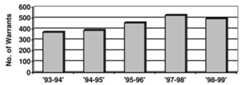
According to SRI oversight committee Chair Ioan Stan, checking the legality and propriety of warrants and surveillance procedures is one of the most frequent oversight tasks carried out by his committee.
Article 13 of the 1991 National Security Law stipulates that citizens “who consider themselves unjustly targeted by the activities authorized in the warrant…may address a complaint against the designated prosecutor who issued the warrant” directly to his hierarchical superior." It is further stipulated in article 16 that any citizen “who considers that their rights or liberties have been broken through the use of means” employed in obtaining information “may notify either of the permanent commissions for defense and public order of the two chambers of Parliament.” Citizens may also address complaints directly to the SRI (by mail, in person, or
Ibid.
Communication to author from Ioan Stan, Chairman of Joint Parliamentary Committee for Oversight and Supervision of the SRI, 15 July 2002.↩︎
through the internet via the SRI’s website: www.sri.ro). In 2001, the Committee addressed the problems raised in 142 complaints, heard 62 citizens, and conducted 11 investigations based on citizen’s complaints. In several cases, SRI personnel were brought to trial.
The role of the Romanian print media in signalling real abuse has often been critical in starting internal SRI investigations and SRI Committee inquiries. At the same time, their role has not been entirely positive, largely because of penetration by the former Securitate, the predominance of economic interests, and low levels of professionalization. In the aftermath of the revolution, many former Securitate officers and their collaborators entered the press or actually acquired newspapers. In some cases, they brought with them expertise in deception, disinformation, and blackmail.
Indeed, press blackmail was signalled as a major problem in an international study of the Romanian media in 1999, and again in the international and domestic media in 2002. According to one Romanian newspaper director, the increasing use of blackmail by the Romanian press seriously undermines its ability to police political power. According to both western and Romanian observers much of the print media is compromised by its “tendentiousness” and "low reporting standards."45 In a 1999 comparative study of Albanian, Bulgarian, Croatian and Romanian press, the
Ibid.
The former category includes Curentul owner-editor Mihail Iacob while the latter category is broader, including both informers like Sorin Rosca Stanescu, the director of Ziua, and pre-1989 economic collaborators such as Jurnalul National owner Dan Voiculescu. For press revelations of this problem see Silviu Achim, “In Presa si Biserica Ortodoxa se gaseau si urmariti, si turnatori la Securitate,” Adevarul, 6 October 2001; “Emil Constantinescu: Securistii epurati de mine sint azi patroni de ziare,” Evenimentul Zilei, 4 October 2002; Mihai Belu, “Generalul Mihai Caraman, fost sef al SIE pana in 1992, confirma: 'Voiculescu a fost unul dintre cei mai importanti clienti ai firmei Securitatii, ICE Dunarea,” Cotidianul, 26 June 2001.
International Federation of Journalists, Money, Power and Standards: Regulation and Self-Regulation in South-east European Journalism. Practices and Procedures in Albania, Bulgaria, Croatia and Romania (Brussels: European Initiative for Democracy and Human Rights, November 1999), p. 26; and Phelim McAleer, “The high cost of a free press in Romania,” Financial Times, 30 September 2002. Another troubling aspect of the Romanian press is a generalized practice to “go after” persons who try to avail themselves of their right of reply and who publicly criticize the press.
See the statement of Cornel Nistorescu, director of Evenimentul Zilei, in Alina Voaides, “Presa - si criticata, si cu banii luati: Investitori straini acuza, in Financial Times, ziarele romanesti de santaj,” Cotidianul, 1 October 2002.
Thomas Carothers, Assessing Democracy Assistance: The Case of Romania (Washington, DC: Carnegie Endowment for International Peace, 1996), pp. 85. Carothers was referring specifically to Romania Libera. J. F. Brown singled out the same journal as his example of poor journalism two years earlier in Hopes and Shadows: Eastern Europe After Communism (Durham: Duke University Press, 1994), p. 101. Regarding their irresponsibility in treating intelligence issues, see TV Romania 1, 23 March 2002, 1800, “Romania Politica,” intervention of Cristian Parvulescu, president of Pro-Democracy.↩︎
International Federation of Journalists judged the Romania print media the “least responsible” and least professional.
The slightly schizophrenic role of the Romanian press is well-illustrated in its portrayal of the “Timofte-KGB” affair. The media began reporting alleged links between Radu Timofte and the KGB shortly before the 2000 elections when his name was put forward as a possible future director of the SRI. The press reiterated these allegations immediately prior to Timofte’s appointment as SRI chief, demanding his withdrawal from consideration for the post. On the contrary, as a career soldier until the mid-1980s, Timofte was harassed by the SRI after his sister emigrated to the U.S. and eventually forced his dismissal from army.
Not having a reputation of overweening sympathy for the services, he was named as the first chair of the new Joint Standing SRI Oversight Committee in 1993 and served continuously on it until his appointment as SRI director in 2001. Deemed a threat by some SRI officers in 1993, a report alleging a KGB-tie was forged to discredit him under the directorship of Virgil Magureanu. Timofte’s persistent attention to and criticism of the cover-up surrounding the 1998 Tigareta II affair, which involved senior political and military leaders, provoked a further elaboration of the “evidence” during Costin Georgescu’s tenure as SRI director.
The press allegations prompted an extensive parliamentary investigation, during which all former SRI directors and the head of the pre-1990 anti-KGB unit were heard, as well as an internal SRI investigation that uncovered the conspirators and resulted in the dismissal of 7 senior officers including the first deputy director, one division chief, and two regional heads. However, throughout the investigation, press coverage was overwhelmingly prejudicial against Timofte, reaffirming the "Timofte-
International Federation of Journalists, Money, Power and Standards (1999), p. 26.
See e.g., Romulus Georgescu, “Radu Timofte a fost acuzat ieri in plenul Parlamentului ca a colaborat cu KGB,” Romania Libera, 8 February 2001.
Oana Sima, “Virgil Magureanu pune pe tapet o noua problema: scurgerile de informatii din cadrul Serviciul Roman de Informatii,” Curierul National, 26 April 2001; and Dan Bucura, “Radu Timofte victima a Securitatii,” Adevarul, 26 April 2001.
Costel Oprea, “Directorul SRI nu a colaborat cu KGB,” Curierul National, 27 April 2001; Dan Bucura, “Scandalul ‘Timofte - agent KGB’ a fost declansat din interiorul SRI,” Adevarul, 7 May 2001; Mihai Diac, “Cazul ‘Timofte-KGB’ este inchis, dar in interiorul SRI au mai fost ‘fabricate’ si alte dosare,” Adevarul and Laura Ciobanu, “Parlamentul cere SRI sa mai efectueze o ancheta,” Cotidianul, 10 May 2001.
Emil Berdeli, “Stafia rosie din conacul SRI,” Cotidianul, 11 May 2001.
Razvan Belciuganu, “Timofte ordona o ancheta totala in SRI,” Jurnalul National, 16 May 2001; Diana Toma and O.C. Hogea, “Directorul SRI a fost lucrat de sefii contraspionajului,” Cotidianul, 16 May 2001; Gabriela Stefan, “Destituiri si treceri in rezerva in randul generalilor si coloneilor SRI: Diviziunea B Contraspionaj a fost folosita in scopuri politice,” Adevarul, 16 May 2001.↩︎
KGB" linkage before, during, and in some cases even after the investigation was concluded. The same tactic and similar allegations were employed against President Iliescu in 1995-1996 and revivified in 1999-2000, including forged documents and non-existent interviews with fictitious KGB officers.
Along with the external oversight exercised by executive, parliamentary and judicial organs, the capacity for self-policing is a key development in democratic evolution. An essential corner has been turned when services develop and exercise the capacity to police themselves. One partial example was the internal investigation in the Timofte-KGB affair. Another example was the arrest of the Director of RADET the state company that provides heat and hot water to Romanian cities - along with that of a senior SRI officer in league with him by the National Anti-Corruption Prosecutor’s Office (PNA) for bribery. After investigating the SRI officer for over a year, the Internal Security Department of the SRI informed the PNA of the case and turned over it’s the results of its investigation, enabling the arrests and further criminal investigation. The SRI has been most active in assisting legal and judicial authorities in significant corruption cases.
Although the SRI began developing a website at the end of the 1990s, the project was moribund until 2002. The SRI website is now updated every 3-4 days. It contains SRI communiqués and information on the SRI, its history and attributions, education system and career opportunities, as well as major press coverage. Unclassified versions of the annual SRI report are posted on the website, the report for 1998-1999 being the most current. The reports for 1999-2000 and 2000-2001 will be posted after they are released by Parliament, which still held them as of December 2002. Unclassified versions of special reports originally prepared for the
This was revealed in a court trial which Ziua lost in 1996. Emil Constantinescu vacated the sentence after his election at the end of 1996, so that “Iliescu-KGB” allegations could resurface before the 2000 elections. The Romanian electorate did not find the allegations credible. The same sorts of charges were leveled against Iliescu’s candidate for the SIE directorship, Gheorghe Fulga, in 2001.
Tomita Petcu and Lucian Gheorghiu, “Directorul RADET si un ofiter SRI - arestati,” Cotidianul, 6 December 2002.
Radu Tudor, “Filiera RADET-SRI: PNA a arestat la sesizarea Directiei de Securitate Interna a SRI,” Ziua, 6 December 2002; and Matei Serbanescu, “SRI-stul Carali a fost urmarit, un an, pas cu pas,” Adevarul, 10 December 2002.
All the services are obliged to lend this assistance but the SRI and SIE have out-performed the rest. See, e.g., Camelia Popa, “Serviciile secrete - obligate sa puna la dispozitia PNA informatii neprelucrate,” Romania Libera, 18 April 2002.
Doru lordache, “Serviciul Roman de Informatii are pagina pe Internet,” Cotdianul, 20 July 2002.↩︎
oversight committee are also posted on the website once they are released by parliament.
The post-2000 SRI leadership identified the broader lack of security expertise related to intelligence and its legitimate functions among civil society as constituting one of the most significant challenges to the effective performance of the SRI. The problem was closely akin to the lack of civilian defense expertise that confronted political and military authorities immediately after the 1989 revolution. In order to redress this shortcoming, the SRI (and SIE) created the Higher National Security College (HNSC) on the model of the National Defense College (CNA). The HNSC provides instruction on security and intelligence issues to public authorities and parliamentarians, other intelligence structures, civic organizations (particularly those with preoccupations in the defense and security sector), journalists, and independent analysts. It opened its doors to students in April 2002.
An attempt was made by Magureanu to modernize the recruitment and training of SRI officers through the creation of the SRI’s own university - the National Intelligence Institute. However, recruiting was still accomplished mainly through talent spotters with young people were recruited directly from high school (16-18 years of age). These recruits were then further educated over a standard four-year university program in a ‘hothouse’ intelligence environment. Although extremely costly, the experiment did not yield the general levels of sophistication necessary for successful intelligence work or even for effective incorporation into the SRI institution. In 2001, the Institute was dissolved as a university, open recruitment was introduced, and restricted to university graduates, and training was modified to conform to the much shorter (less than one year) professional courses characteristic of NATO state intelligence service officers.
In 1999, parliament adopted a law permitting citizens access to their own Securitate files. As a result, the National Council for the Study of the Securitate Archives (CNSAS - Consiliului National pentru Studierea Arhivelor Securitatii) was
As of December 2002 there were 18 special reports on the website, including: Islamic Fundamentalism in the Balkans: History and Present Reality, The Protection of Classified Information: A Practical Guide, Financial Fraud, and The Danger of Illegal Communications Interception. Christian Levant, “SRI a publicat pe site-ul sau lista organizatiilor teroriste,” Evenimentul Zilei, 25 October 2002.
There is a parallel indirect recruitment with shorter training schedules but the bulk of the SRI personnel are directly recruited.
Details are available at www.sri.ro.
Legea nr. 187/1999 privind accesul la propriul dosar si deconspirarea Securitatii ca politie politica.↩︎
established. Although some 140,000 files were destroyed during and immediately after the revolution, the SRI still holds about 20 linear kilometers of former Securitate archives (with others held by the ministries of the interior and justice), of which it has already transferred some 65,000 files to the CNSAS. Political and bureaucratic struggles, and poor management, continue to characterize the operations of the CNSAS and it is the frequent star of media scandals, often blaming the SRI and/or the SRI oversight committee for its difficulties. During 2002, the leadership of the CNSAS divided, virtually freezing its operations, with both sides demanding the replacement of the other for the good of the institution.
Intelligence sharing became an essential element of alliance cooperation with the shift of terrain after the Cold War, from interstate military conflict to combating the non-national and cross-border threats of terrorism, organized crime and trafficking in arms, persons and narcotics. Multinational intelligence cooperation, extremely rare before 1990, also provides a new realm of oversight. Cooperation, joint training, and joint operations transfer expertise and experience not only in operational domains - the main focus of such cooperation - but in terms of oversight and control expectations as well. The SRI cooperates regularly and closely with NATO member services, especially since it established a new department to counter-terrorism in 2002. The SRI now has bilateral institutional relationships with over 60 states.
Romania pioneered a number of intelligence cooperation initiatives. In April 2002, the Romanian presidency, the SRI, and the SIE jointly organized the first conference of NATO member and candidate member (MAP) security and intelligence services with the participation of 14 states. Bucharest hosted a second NATO-MAP conference, with 21 states participating in September 2002, with a third scheduled for the early
See e.g., Oana Dobre, “Peste ‘Dosarul CNSAS’, linistea nu are timp sa se astearna,” Curentul; and “Securitatea, puterea invizibila,” Colidianul, 12 July 2002; and “Romanian Parliament Commission Head Denies Attempts to Obstruct the Work of CNSAS…” RFE/RL Newsline, vol. 6, no. 115, part II, 20 June 2002.
Aside from the post-Cold War informal Club of Berne, almost all exceptions of intelligence cooperation belong to the Anglophone world: the US-UK “special relationship,” US-Canadian cooperation in signals intelligence, and the UKUSA cooperation which also includes Australia and New Zealand.
Monica Iordache and Luminita Castali, “SRI isi face centru de Coordonare Operative Antiterorista,” Jurnalul National, 14, March 2002. See also The National Strategy on Preventing and Combating Terrorism, Bucharest, Romanian Intelligence Service, 2002.
The conference, “Intelligence and Security Services and the Security Agenda of the Century” was organized by the Romanian Presidency, the SRI and the SIE, under NATO Headquarters auspices, and co-sponsored by the Grand Duchy of Luxembourg on 10-14 April 2002 at Sinaia.↩︎
spring 2003. In May 2002, the SRI was one of the main organizers of the first meeting of the “Conference of South-East European Intelligence Services” outside of Bucharest, with the participation of services from Albania, Bulgaria, Croatia, Greece, Macedonia, Slovenia, Turkey, and Yugoslavia (Serbia and Montenegro). This was the first meeting bringing together the intelligence services from the successor states of the former Yugoslavia.
Romania’s semi-presidentialism resulted in a de facto division of authority over covert intelligence gathering. While the primary national security intelligence services SRI and SIE came directly under the popularly-elected president’s subordination and were thus subjected to direct coordination by the CSAT (where both directors sit) as well as to direct oversight by dedicated parliamentary committees, criminal intelligence bodies such as the interior ministry’s DGIPI came under the sole control of the party-appointed government with only very limited indirect coordination and oversight by either the CSAT or the Parliament.
To some degree, this was inevitable given that sub-ministerial intelligence structures are several times removed from the highest levels of political power and responsibility. The legal framework of the DGIPI and its predecessor, Military Unit 0215, is sparce and ambiguous. It operates on the basis of articles 6 and 9 of the 1991 National Security Law, which merely note that the interior ministry can set up presumably criminal intelligence sub-structures, since national security intelligence is reserved for the SRI, SIE and SPP. The 1990 law no. 40 on the organization and functioning of the Ministry of the Interior does not contain any specific provision on intelligence gathering. However, Law no. 26 of 1994 states that “[p]olice may act for collecting information with a view to learning, preventing and fighting crime, as well as whenever data and evidence indicate that illegal actions may be under preparation.” At the same time, the nature of recruitment policy, the pattern of
The second NATO-MAP conference “Security and Intelligence Services in the Security Environment of the Century” was held on 25-28 September 2002 at Lake Snagov.
“Intelligence services in Balkans to meet periodically to exchange information,” Nine O’Clock, 27 May 2002.
The same problem exists regarding the justice ministry’s SIPA, but its very specific mandate regarding penitenciaries also renders it less of a risk for democratic control.
Manuela Stefanescu, “Security Services in Romania,” presentation for In the Public Interest: Security Services in a Constitutional Democracy, Project of the Helsinki Foundation for Human Rights, Warsaw Poland, in cooperation with the Center for National Security Studies, Washington, D.C., USA↩︎
DGIPI behaviour, and the unwillingness of its government masters to sanction its apparent transgressions suggest that it was intentionally set up and continues to act as a government service whose mandate is not limited to criminal intelligence only.
The personnel genesis of the DGIPI’s predecessor structures was not propitious for a structure whose remit was advertised as limited to criminal intelligence. Securitate officers dismissed as the result of the dissolution of their directorates in December 1989-January 1990, along with those vetted out of other departments because of their unsuitability for the SRI, were freely recruited into a new sub-ministerial security intelligence unit in the interior ministry: UM 0215. The new organization was neither authorized by acting President Ion Iliescu nor by then-Defense Minister Nicolae Militaru, under whose ministry the entire security apparatus had been temporarily subordinated.
Vice-Premier Gelu Voican Voiculescu began forming UM 0215 for Prime Minister Petre Roman in January 1990. By recruiting about 400 officers from the political police categories excluded from the SRI by the vetting process (from the Bucharest office - ISMB - and the Directorate for military counterintelligence, primarily), UM 0215 imported the political police mentality and institutional culture of the Securitate virtually unchanged. Allegations that the unit was “a haven for officers from the notorious political police of the communist era” employing political policing methods similar to those of the pre-1990 security apparatus were largely confirmed throughout the 1990s. For example, UM 0215 was accused of infiltrating opposition demonstrations in 1990 and of releasing Securitate files to compromise targeted politicians before the May 1990 election. During the miners’ march of June 1990 two of its officers were caught breaking into and ransacking the home of one opposition party leader, for which they were finally convicted and imprisoned in February 1994.
By the time of Roman’s resignation in September 1991, UM 0215 had around 1,000 officers, increasing to 1,500 by 1998. Although public promises were made in 1998 by Interior Minister Gavril Dejeu to cut back the size of the organization by 10%, it resurfaced the following year undiminished under the new Interior Minister,
Voiculescu, unknown to Iliescu before the revolution, was a friend of Petre Roman. On 26 December 1989 the National Salvation Front Council appointed him ad interim head of the Securitate, but he was replaced three days later, immediately prior to the dissolution of the Securitate. He then set about building an intelligence service within the interior ministry - UM 0215.
See V. G. Baleanu, The Enemy Within: The Romanian Intelligence Services in Transition, Camberely: Conflict Studies Research Centre, January 1995, pp. 11-12, and Romania Libera, 26 May 1998.
Baleanu (1995), p. 16; Cuvintul, 10 March 1992.↩︎
Constantin Dudu lonescu, as the newly renamed UM 0962 - General Directorate for Intelligence and Internal Protection. It continued to grow in strength to about 2,400 in 2002. Although there are no estimates as to the percentage of ex-Securitate personnel in the DGIPI, it is presumed that their numbers continue to be predominant.
As a sub-ministerial department, UM 0215/0962/DGIPI was kept “below the radar” of CSAT coordination and parliamentary oversight and treated as another element of the criminal justice system. But along with its steady growth in size it has made numerous attempts to aggrandize authority, often with the encouragement of sitting governments. In July-August 2002, when the police were officially demilitarized, the unit shed its military designation - UM 0962. Since the interior minister answers to the Committee for Defense, Public Order and National Security and participates in the CSAT meetings while the head of the DGIPI, General Virgil Ardelean, is not compelled to answer to these authorities, the DGIPI continues to remain below the radar of democratic control and oversight.
Despite the glaring need to rethink the powers, subordination, oversight, and even existence of the DGIPI, the unit has proven resilient even when caught with the reddest of hands. In March 1994, operational manuals of the unit were leaked to the press indicating that UM 0215 had self-arrogated national security intelligence responsibilities which neither the 1991 Law on National Security nor the 1991 Constitution granted it. These included gathering intelligence other than for criminal prosecution purposes by monitoring Romanian citizens, dual citizens, and foreigners, both at home and abroad, in the absence of any crime or criminal intent - the sine qua non of launching criminal intelligence activities.
The degree of political protection extended to the unit was reflected in the failure to take action even after the chief of the national police formally complained to the Romanian Senate in March 1994 that that he could not reign in the UM 0215. Further excesses by the UM 0215 prompted the SRI director to make formal complaint to the Senate Committee for Defense, Public Order and National Security in December 1995. In May 1998, broader domestic and foreign criticism compelled the Democratic Convention government to announce the restructuring and division of UM
Ziua, 9 December 1995.↩︎
0215 into an intelligence unit and an internal affairs division. In spite of this pledge, it reemerged unscathed as UM 0962/DGIPI in August 1999.
When the head of the Government’s Control and Anti-Corruption Department (DCAG) reported in 2001 how his department was surveilled and shadowed by the UM 0962/DGIPI throughout the course of their investigations, no action was taken against the DGIPI. Instead, the leadership of DCAG was changed immediately, its former chief was posted to Brazil, and the department was subordinated to the prime minister’s office directly.
In March 2001, Prime Minister Adrian Nastase pushed through Government Emergency Ordinance (OUG) no. 29, granting broad powers to the UM 0962/DGIPI including national security intelligence collection (article 17) and wiretapping, surveillance, search and seizure without a warrant from the General Prosecutor’s office. The ordinance (article 21) also stipulated that the UM 0962/DGIPI could obtain any information that it desired, and that citizens were required to give that information - a power reminiscent of the former police state. By not providing for any means of democratic oversight, the ordinance granted the unit greater powers than those of either the SRI or the SIE. Although it dealt explicitly with national security issues, the intelligence mandate, and presidential powers, Nastase chose not to send it to the CSAT or to the parliamentary commission on defense, public order and national defense for their feedback beforehand, electing instead to pass the ordinance and publish it in the Government’s Official Gazette so that it became effective immediately.
The public reaction was immediate and universal. Government-party and opposition parliamentarians were virtually unanimous in condemning the ordinance, as was the presidency, civic groups, the media and the general population. Parliamentarians characterized the ordinance as "an attempt to legislate a new intelligence service with an extremely broad mandate beyond any sort of control. The presidency sent it back to the government for reanalysis maintaining that its powers were too broad
Oana Sima, Costel Oprea and Robert Lorenz, “Nu accept sa fiu supravegheat si filat de organe de informatii specializate’: Declaratia lui Grecea face valuri in lumea politica,” Curierul National, 12 March 2001.
George Radulescu, “Comisia parlamentara SRI semnaleaza pericolul aparitiei unei politii politice: Declarindu-se impotriva maririi prerogativelor UM 0962, prin promovarea OU 29/2001,” Curierul National, 22 March 2001.
Ion M. Ionita, “Parlamentarii Puterii si ai Opozitiei s-au ridicat impotriva infiintarii unui SRI parallel al Guvernului,” Adevarul, 22 March 2001.↩︎
and judicial oversight lacking. Civic groups criticized it for imperiling the rule of law and rights of privacy and secrecy of correspondence, and reestablishing a political police. The ordinance was withdrawn by the end of the month. Lack of transparency and persistent scandal continued to characterize the DGIPI throughout 2001-2.
While the legal framework for democratic oversight and control is robust in Romania, the weakness and vulnerability of the legal and justice system, particularly in the poor enforcement of existing laws and constitutional provisions, is still a significant obstacle to effectiveness and generator of other intelligence-related problems. On the general level, the Constitutional Court, the General Prosecutor’s office, and magistrates need to become much more proactive and independent in their behaviour from governmental leadership. This is particularly evident in the realm of illegal wiretapping, not only among private security companies, economic agents and third parties, but also among all intelligence services and sub-structures.
Intelligence coordination could be improved by creating a more specialized substructure that meets weekly - a special commission or advisory group - within the presidency’s Department of National Security or the CSAT in order to institutionalize an “intelligence community.” This need has become more obvious since the terrorist attack against the U.S. on 11 September 2001, given the need to coherently address a wide range of non-traditional and non-military cross-border threats in a timely manner. The military, interior ministry and justice ministry sub-structures should be included among the participants of such a group.
Laura Ciobanu and Lucean Gheorghiu, “lliescu il loveste pe Nastase in ‘doi si-un sfert’: Solitictand reanalizarea ordonantei prin care UM 0962 a capatat puteri sporite,” Cotidianul, 22 March 2001.
77 “Talpes este hotarat sa taie din atributiile UM 0962: organizatiile neguvernamentale denunta pericolul transformarii Romaniei in stat politienesc,” Cotidianul, 27 March 2001.
78 “‘La nivelul conducerii UM 0962 exista o lipsa de transparenta’: constata deputatul PDSR Razvan Ionescu, presedintele Comisie de aparare, ordine publice si siguranta nationala a Camerei,” Adevarul, 2 May 2001; Alina Raita and Mona Lazar, “Informatiile secrete furate la Constanta era despre politisti corupti: Agenti SRI nu exclude posibilitatea ca maiorul Alecu sa-si fi simulate furtul,” Curierul National, 26 February 2002; See e.g., Alina Grigore, “Patru firme romanesti vor echipa 5,500 de politisti: In regim de urgenta, societatile au fost alese prin negociere directa si ‘puricate’ de oamenii generalului Ardelean,” Evenimentul Zilei, 23 October 2002; For an interesting, although often inaccurate, account, see Cristescu Radu Constantin, Serviciile Secrete din Romania si Scandalurile de Coruptie: 1989-2001 (Bucharest: Antet XX Press, 2002), pp. 205-223.↩︎
Romania’s semi-presidential system has proven itself capable of blocking the overaccumulation and over-centralization of power by government executives. If anything, it should be strengthened by moving the monitoring and anti-corruption agencies as far as possible from that part of the executive that controls the finances and budget and is most closely tied to partisan political competition. Real sanctions should be introduced and enforced against institutional actors and leading political figures with authority over the security and intelligence domain who disregard the legal stipulations regarding political neutrality.
Regarding the DGIPI specifically, the first problem is for executive and parliamentary authorities to openly recognize the problem. As one of the initial steps, the long overdue vetting of its personnel should be undertaken, with those officers who were excluded from the SRI entering immediate retirement. The DGIPI should be radically restructured, with operational intelligence being clearly restricted to criminal intelligence and moving back to professional control under the police inspectorate and away from the political appointees in the interior ministry. The “internal protection” functions of the DGIPI should be split off and re-projected as an internal affairs division capable of in-house investigations. The parliament should also create a dedicated committee to address the problems of police surveillance and abuse.
Established in 2000 on the initiative of the Swiss government, the Geneva Centre for the Democratic Control of Armed Forces (DCAF) encourages and supports States and non-State institutions in their efforts to strengthen democratic and civilian control of armed and security forces and promotes international cooperation in this field, with an initial focus on the Euro-Atlantic area.
The Centre collects information, undertakes research and engages in networking activities in order to identify problems, establish lessons learned and propose best practices in the field of democratic control of armed forces and civil-military relations. The Centre provides its expertise and support to all interested groups, in particular governments, parliaments, military authorities, international organisations, non-governmental organisations, academic circles.
Geneva Centre for the Democratic Control of Armed Forces (DCAF):
Rue de Chantepoulet 11, P.O.Box 1360, CH-1211 Geneva 1, Switzerland
Tel: ++41 2274177 00; Fax: ++41 227417705
E-mail: info@dcaf.ch
Website: http://www.dcaf.ch
AI
A 2002 poll revealed that 60% of Romanians perceived their intelligence services as transformed into democratic institutions, indicating a significant shift from the negative view held pre-1989. This marked a revolution in public attitudes, reflecting confidence in national security following the 2001-2002 reforms.
The 1990 SRI Decree established that the SRI was to be accountable to Parliament, which defined oversight roles through specially formed committees after Romania's first elections. By 1991, the National Security Law reinforced this oversight, detailing the Parliament's authority over the SRI's activities and budget.
Political appointments in SRI leadership, such as Magureanu's tenure from 1990-1997, largely perpetuated old practices diminishing the push for reform. The presence of ex-Securitate personnel remained significant, constituting 60% of the SRI's workforce in its early years, complicating efforts for institutional integrity.
The 1991 National Security Law re-empowered the SRI for electronic surveillance under judicial oversight; however, enforcement remained lax. By 2002, the SRI began initiatives to regulate illegal surveillance practices and private security activities that proliferated unchecked in the 1990s.
Despite legal frameworks for oversight, the 2000s saw ineffective enforcement of rules regarding political neutrality and surveillance, leading to corruption. Parliamentary committees often lacked resources and expertise, restricting their effectiveness in monitoring activities of agencies like the SRI and DGIPI.
Intelligence and National Security, 2009
The twenty-first century's security environment has triggered a phenomenon of 'proliferation' of intelligence and security cooperation, both domestically and internationally. After the ousting of the communist regime (whose intelligence system served the regime) in 1989, Romania embarked upon democratic reform of its new intelligence system (including strengthening cooperation), to better tackle the current security challenges. This has been a rather onerous process, yet worthwhile: Romania's intelligence is presently cooperating well with national and international partners, to counter national, regional, and global security threats. This paper assesses Romania's efforts in developing intelligence cooperation, after the demise of the communist regime. 'Preparing to Meet New Challenges' in Steve Tsang (ed.
Surveillance & Society
Since 1989, reforms have sought to align the Romanian post-communist intelligence community with its counterparts in established democracies. Enacted reluctantly and belatedly at the pressure of civil society actors eager to curb the mass surveillance of communist times and international partners wishing to rein in Romania’s foreign espionage and cut its ties to intelligence services of non-NATO countries, these reforms have revamped legislation on state security, retrained secret agents, and allowed for participation in NATO operations, but paid less attention to oversight and respect for human rights. Drawing on democratization, transitional justice, and security studies, this article evaluates the capacity of the Romanian post-communist intelligence reforms to break with communist security practices of unchecked surveillance and repression and to adopt democratic values of oversight and respect for human rights. We discuss the presence of communist traits after 1989 (seen as cont...
Defense & Security Analysis, 2018
Romania faced one of the most dramatic transitions from authoritarian communism to become a democracy and a member of the North-Atlantic Treaty Organization (NATO) and the European Union (EU). The backbone of building a democratic society has been civilian control of the military. This article briefly describes the norms and institutions of democratic control of the intelligence services in Romania and assesses how the mechanisms of democratic control have worked in practice after almost three decades of reform. We argue that many of the post-1989 reforms have been only superficial implemented and monitored, particularly after Romania joined NATO and the EU. The article concludes that the democratic control of intelligence in Romania is an unfinished business. There are structural shortcomings embedded in the process of democracy consolidation that need to be addressed.
International Journal of Intelligence and CounterIntelligence, 2009
As a former host of thousands of university students from a score of Arab countries, post-communist Romania can tap into a pool of sympathetic Middle Eastern citizens. These privileged relations were put to good use after three Romanian journalists were kidnapped while on an assignment in Baghdad in early 2005. The Romanian secret intelligence services were able to successfully negotiate their release in a relatively short period of time.
International Journal of Intelligence and CounterIntelligence, 2014
The accuracy of the Content should not be relied upon and should be independently verified with primary sources of information. Taylor and Francis shall not be liable for any losses, actions, claims, proceedings, demands, costs, expenses, damages, and other liabilities whatsoever or howsoever caused arising directly or indirectly in connection with, in relation to or arising out of the use of the Content. This article may be used for research, teaching, and private study purposes. Any substantial or systematic reproduction, redistribution, reselling, loan, sub-licensing, systematic supply, or distribution in any form to anyone is expressly forbidden.
Western Balkans Security Observer, 2007
The draft Law on of the security services regulates the over-sight and coordination of the security agencies. The issues important for the functioning of the security agencies, such as the operation, the role and the sphere of activity, will addition-ally be regulated by separate laws on civil and military agencies. The ability to holistically, purposefully and precisely systemise the entire Serbian security intelligent system can not be fulfilled by this approach. However, the draft law, aside from the mentioned shortcomings of general nature, contains few specific solutions to which this observation was directed.
Christopher Jones' review of the two volumes by Larry L. Watts on Romania in the Cold War.
The challenge that still remains a concern for societies in transition and particularly by knowing the past for traumatized society of Kosovo, is the creation of confidence among citizens and within the civil society, which contribute significantly on the advancement of the quality within the democratic system of governance, its role for the good in general and particularly the security and intelligence sector. It became seven years since KIAs (Kosovo Intelligence Agency) law came into force on 21 May 2008, and with a delay of about one year, namely on 4 February 2009, former Prime Minister Thaci with a former President Sejdiu, as they had a constitutional authority, they had appointed the first KIAs director. Later in the middle of October of 2009, was announced the admission vacancies to KIA. The issue of control or democratic oversight, its incentive between "transparency and secrecy" of legal intelligence service in a democratic and consolidated state which obviously refers to a higher degree of a democratic society with consolidated institutions, which in our case is related to control and democratic oversight of intelligence agencies.
Connections: The Quarterly Journal, 2021
The reform of intelligence and state security services in the 'new' democracies that emerged since the end of the Cold War has remained under-documented and under-analyzed for a long time. This is especially true for smaller countries. Whereas this fact certainly can be explained with the sensitive nature of the business, the lack of data resulted in important lacunae for understanding these services, and obviously also for lessons to be drawn from the transformation processes. This special issue of Connections intends to fill some of the gaps. The editors are delighted to present studies on transformation processes in the structures, legislation, management, and oversight of intelligence and state security services in Hungary, Indonesia, Poland, the South African Republic, and Ukraine. 1 Various contributors felt encouraged to share data and analysis on ongoing processes of intelligence reform and the evolution of surveillance. Whereas the security of states and alliances remains the main challenge for the established services in democratic states, surveillance technologies have been developed and deployed for business and private use. The dimensions and importance of such commercial surveillance programs do not seem to be sufficiently understood, and therefore remain unrestrained by national legislation and governmental oversight. This collection also presents forward-looking analysis on possible consequences and governance challenges of pandemic surveillance and "surveillance capitalism."

 Larry L Watts