

…
59 pages


AI
This paper discusses the construction practices and architectural terminology associated with Elamite temple building, particularly focusing on the analysis of various terms used for materials and construction methods. It reviews historical interpretations, analyses brick dimensions as presented in scholarly studies, and examines the significance of specific terms within the context of Elamite religious architecture, culminating in a discussion of their implications for understanding the broader architectural culture of Elam.
AI
2021
Newly Found Inscribed Elamite Bricks of Untaš-Napiriša in the Čahār Fasl Museum of Arak 2021
Iraq, 2006
This chapter summarizes the incised pebbles and seals from Sha'ar Hagolan and all other known Pottery Neolithic sites of the Yarmukian Culture.
Journal of the American Research Center in Egypt, 2020
The Egyptological truism that mud brick was simply mundane limits our understanding of the material and how it functioned in architecture. In order to explore the possible meanings of the brick medium beyond its tie to the mundane and its practical functions, this study focuses on the symbolism of brick objects. This can be seen in the presence of model bricks and brick molds in foundation deposits, in the molding of bricks by the king in foundation rituals, in the personification of bricks as a goddess of birth and the use of ritual birth bricks, and in the placement of magical bricks in tomb walls. Together with textual references that speak of the connection of mud to the inundation and the creation of the world, this symbolism suggests an association of the mud-brick architectural medium with creation and life cycles, and thus neheh time, as well as archaic architecture. This reinterpretation will be used to re-evaluate the employment of bricks in the specific contexts of the Middle Kingdom pyramids, temple annexes, and royal palaces. The architectural use of bricks will also be contextualized in matters of materials choice more generally, highlighting the need for both brick and stone in cosmologically significant architecture.
The 1980s and 1990s excavations of the archaeological site of Go Thap in the Mekong Delta resulted in unearthing a number of brick structures. In association with the structures precious objects were found, including over three hundred gold leaves. More than half of the gold leaves were decorated with pictures of men, gods, animals, weapons and auspicious objects, and some of them were inscribed. In addition to the precious objects, the structures were also reported to contain human-ashes. In the first part of this paper, I will examine the objects closely, especially the gold leaves, discovered at Go Thap. I will then compare them with similar objects originating from other archaeological sites of Southeast Asia and with objects described in traditional Indian manuals written in Sanskrit and dealing with temple architecture and temple building rituals. On the basis of this comparison, I will propose the hypothesis that the ‘brick structures’ unearthed in Go Thap are not tombs but remains of Hindu shrines, and the associated materials are not crematory remains but traces of consecration ceremonies performed for shrines and temples.
Sacred hieroglyph/metaphor: kole.l 'temple' Rebus: kole.l 'smithy, forge' finds parallels in archaeometallurgical tradition, the evolution of temple architecture, iconographic/Agama traditions venerating divinities in temples. It is possible that the hieroglyph shown on the text of Mohenjo-daro seal m297 may signify a temple: kole.l. The text of the inscription is read rebus: meD 'body' rebus: meD 'iron' kanka 'rin of jar' rebus: kanga 'brazier' aya 'fish' rebus: aya 'iron' ayas 'metal' aMs 'fins' rebus: ams'u, ancu 'iron' (Samskritam, Tocharian) kole.l 'temple' rebus: kole.l 'smithy, forge'konda 'young bull' Rebus: kondar 'turner' PLUS veṛhā 'octopus, said to be found in the Indus' (Jaṭki lexicon of A. Jukes, 1900) Rebus: beṛɔ m. ʻpalaceʼ, beṛā m. id. beṛā ʻbuilding with a courtyardʼ (Western Pahari) vāṛo m. ʻ cattle enclosure ʼ (Sindhi) மேடை mēṭai, n. [T. mēḍa.] 1. Platform, raised floor. Thus the hieroglyph-multiplex signifies a workplace (maybe, circular platform?) for the 'turner' artisan, metalworker). See: http://bharatkalyan97.blogspot.in/2016/01/ficus-crab-multiplex-archer-indus.html Ficus, crab multiplex, archer Indus Script hieroglyph connote distinct details of mintwork catalogues I suggest that the early temples with S'ivalinga were relatable to regions with ancient mintwork. This hypothesis has to be further tested and validated by archaeo-metallurgical researches. Some leads are provided by finds of ancient punch-marked and cast coins in the context of yajna kunda called syenaciti, as in Purola. Syena-citi: A Monument of Uttarkashi Distt. EXCAVATED SITE -PUROLA Geo-Coordinates-Lat. 30° 52'54” N Long. 77° 05'33” E Notification No& Date;2742/-/16-09/ ... The ancient site at Purola is located on the left bank of river Kamal. The excavation yielded the remains of Painted Grey Ware (PGW) from the earliest level alongwith other associated materials include terracotta figurines, beads, potter-stamp, the dental and femur portions of domesticated horse (Equas Cabalus Linn). The most important finding from the site is a brick alter identified as Syenachiti by the excavator. The structure is in the shape of a flying eagle Garuda, head facing east with outstretched wings. In the center of the structure is the chiti is a square chamber yielded remains of pottery assignable to circa first century B.C. to second century AD. In addition copper coin of Kuninda and other material i.e. ash, bone pieces etc and a thin gold leaf impressed with a human figure tentatively identified as Agni have also been recovered from the central chamber. Note: Many ancient metallic coins (called Kuninda copper coins) were discovered at Purola. cf. Devendra Handa, 2007, Tribal coins of ancient India, ISBN: 8173053170, Aryan Books International." See: http://bharatkalyan97.blogspot.in/2011/11/syena-orthography.html Data mining of Indus Script Corpora and archaeometallurgical researches yield the knowledge of sacredness associated with Vedic tradition of Yupa Skambha and the metaphors of Samudramanthanam and दशावतार, daśāvatāra, ten incarnations of Vishnu. The incarnations are Matsya,Kurma, Varaha, Narasimha, Vamana, Parashurama, Rama, Buddha, Krishna, and Kalki. It is notable that the first three: fish, tortoise and ligatured lion can be elaborated as metaphors for archaeometallurgical advances and also compared to Indus Script hieroglyphs of aya 'fish' rebus: aya 'iron' ayas 'metal'; kamaTha 'tortoise' rebus: kammaTa 'mint, coiner' and muh 'face' rebus: muha 'quantity of meta produced from a furnace'.(i.e. lion 'face' ligatured to the body of a person as सांगड (p. 840) [ sāṅgaḍa ] m f (संघट्ट S) f A body formed of two or more (fruits, animals, men) linked or joined together. Rebus: That member of a turner's apparatus by which the piece to be turned is confined and steadied.सांगडीस धरणें To take into linkedness or close connection with, lit. fig. Rebus 1: sangara 'fortification'. Rebus2: sanghAta 'vajra, adamantine glue', a metallurgical term in creating alloys. Indian sprachbund yields a word kole.l which signifies a 'temple'. This is read rebus as koe.l 'smithy, forge'. A temple is signified by a S'ivalinga, an uniconic form of Yupa. Sometimes, the S'ivalinga is signified by ekamukhalinga: muh 'face' rebus: muha 'ingot, quantity of meta taken out of a furnace' -- thus signifying a smelting process. The accompanying metaphors of gaNes'a and Skanda are also relatable to the hieroglyphs: ibha'elephant'; rebus ib 'iron' karabha 'trunk of elephant' rebus: karba 'iron' Skanda is rebus for Skandha 'pillar' relatable to the following glosses to signify, 'post, stake'. In relation to the veneration in a temple, Skandha is Karttikeya, son of S'iva: skandhá m. trunk of tree, mass (esp. of an army) ʼ MBh., skándhas<-> n. ʻ branching top of a tree ʼ RV. [Absence of any trace of initial s -- in Kafiri and Dardic supports possibility of IA. *kandha -- beside sk° (unnecessarily assumed in ODBL 438 for NIA. k -- which is dissim. from kh<-> before dh as prob. in Aś. agi -- k(h)aṁdha -- )]Pa. khandha -- m. 'tree -- trunk ʼ, °aka<-> m. ʻ Pk. khaṁdha -- , ka° m. ʻtree trunk, wall ʼ; Ash. kándä ʻ stem, trunk ʼ, L.awāṇ. khaddhā ʻ multitude ʼ, P. khandhā m. ʻ mass, multitude, flock of sheep or goats, herd of buffaloes ʼ(CDIAL 13627) skandhāvāra m. ʻ a king's camp or palace ʼ MBh. [skandhá -- , āvāra -- ] Pa. khandhāvāra -- m. ʻ stockade, fortified camp ʼ; KharI. kadhavara -- m. ʻ encampment ʼ, Pk. khaṁdhāvāra -- , °dhavāra -- , °dhāra -- m., OAw. khaṁdhārū m.; Si.kan̆dayura ʻ fortification outside a city, fort ʼ.skandhika -- ʻ bearing on the shoulders ʼ lex. [skand(CDIAL 13635) This is rebus for 'fire-altar' and 'fortification' in the context of Skanda as Senapati with ArupaTaivITu 'six palaces of army camps with armour'.Pk. kaṁḍa -- , °aya -- m.n. ʻ knot of bough, bough, stick ʼBhoj. kaṇḍā ʻ reeds ʼ; H. kã̄ṛī f. ʻ rafter, yoke ʼ, kaṇḍā m. ʻ reed, bush ʼ (← EP.?); G. kã̄ḍ m. ʻ joint, bough, arrow ʼShum. kō̃ṛ, kō̃ ʻ arrow ʼ, Gaw. kāṇḍ, kāṇ; Kho. kan ʻ tree, large bush CDIAL 3023):Kuwi (F.)gundṛa piece; (S.) ganḍra trunk of a tree;(DEDR 1176) Rebus: Tu. kandůka, kandaka ditch, trench. Te. kandakamu id. Konḍa kanda trench made as a fireplace during weddings. Pe. kanda fire trench. Kui kanda small trench for fireplace. Malt. kandri a pit.(DEDR 1214) Thus, it is posited that any temple with S'ivalinga and veneration of Ganes'a/Skanda (Karttikeya) is celebration of metalwork in mints in the region signified by kammaTa, kammaTi 'coiner, mint'. The mintwork is signified by the hieroglyph and metaphor of a 'pillar, stake': kammaTa is cognate with Skambha 'yupa, post, stake' venerated in Atharva Veda Skambha Sukta. A number of variant glosses of Indian sprachbund are cognate with Skambha as Sacred Post on a smelter or Yajna Kunda for Soma Yaga: for e.g. Pk. khaṁbha -- m. ʻ post, pillar ʼN. khã̄bo ʻ pillar, post ʼdarkámbat ʻ door -- frame ʼ. kamhãṛ, kamhaṛ, kamhaṇḍā ʻ wooden frame suspended from roof which drives home the thread in a loom ʼ -- all glosses relatable to the 'pillar, post' hieroglyph of Yupa Skambha Another hieroglyph for kammaTa 'mint, coiner' is kAmAThayo 'archer'. Notethe suffix -ayo which may be a reflex of aya 'iron', ayas 'metal' used in mintwork. http://bharatkalyan97.blogspot.in/2016/01/data-mining-techniques-decipherment-of.html http://bharatkalyan97.blogspot.in/2016/01/data-mining-of-indus-script-corpora_17.html

Loading Preview
Sorry, preview is currently unavailable. You can download the paper by clicking the button above.
AI
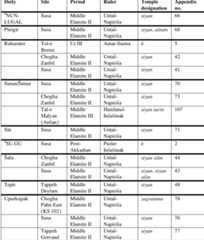
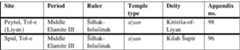
The research reveals varied temple types including siyan and kukkunum, each associated with specific deities, indicating a complex religious landscape. Over 120 bricks from Chogha Zanbil document significant temple constructions for Inåuåinak, such as the high temple during Untaå-Napiriåa's reign.
Malbran-Labat's study indicates considerable variability in brick dimensions at Susa and Chogha Zanbil, including shapes like square and semi-circular. However, without a statistical analysis, no significant patterns in size relative to architectural function can be discerned.
The term 'ziqqurrat' refers to an elevated temple structure, with significant constructions recorded at Susa and Chogha Zanbil. Notably, one text states that Untaå-Napiriåa built a ziqqurrat for Inåuåinak, highlighting the cultural significance of these monumental buildings.
The Acropole of Susa features a massive terrace area of approximately 5000 m², believed to support early temple structures. The sacred precinct was indicated by inscribed bricks, suggesting ongoing religious activities dedicated to multiple deities.
From the early second millennium BC, the term 'ziyan' replaced 'é/É' for temples in Elamite inscriptions. This reflects a linguistic evolution that coincides with the architectural complexity seen in contemporaneous religious structures.
A Wonder to Behold: Craftsmanship and the Creation of Babylon’s Ishtar Gate. Edited by A. Amrhein, C. Fitzgerald, E. Knott, 2019
A mere three centuries before the construction of the Ishtar Gate, King Ashurnasirpal II of Assyria (r. 883-859 BCE) praised himself by declaring, "I had baked bricks glazed in lapis lazuli color." 1 Both Ashurnasirpal II and Nebuchadnezzar II (r. 605-562 BCE), the builder of the Ishtar Gate, were part of a long tradition of rulers who promoted royal building projects that incorporated brilliantly glazed molded bricks to monumentalize an otherwise generally dull-colored mud brick architecture. As early as the fifth millennium BCE, the prevailing form of exterior building decoration had been the vertical articulation of the walls with projecting and recessed elements to create a niched architecture with coloristic effects based on light and shadow, which responded to the desire for a dynamic façade. Thus, projections and recesses are key features of ancient Near Eastern sacred architecture. This building decoration is found primarily on exterior and courtyard façades, materializing the demarcation between the sacred and the profane. Emphasizing the important façades of a building could be achieved using different techniques. The oldest form of plastic façade decorations are buttresses and recesses, which could be easily realized by halving and quartering rectangular clay bricks. More complicated façade structures, such as semicolumns and figurative decorations, were achieved either by molded bricks (fired and unfired) or through relief plaster covering. In the case of molded bricks, the clay was pressed into a specially made mold, whereas in the case of plaster reliefs, the decor was cut into the plaster coating of the bricks. It is noteworthy that different manufacture techniques can be found in one region at the same time. Cone mosaics of clay and stone , characteristic of the Uruk culture, emerged in the second half of the fourth millennium BCE as a further embellishment technique in the decorative articulation of architectural façades. This complex wall decoration is mainly found in Mesopotamia, but also in southeastern Turkey and Iran. 4 Since the Middle Bronze Age (ca. 2000-1550 BCE), relief-faced brick decorations have been made of both molded and cut mud bricks. During the Late Bronze Age (ca. 1550-1100 BCE), epigraphic evidence indicates that the earliest glazed building decorations appeared in Mesopotamia and Iran. In the Iron Age (ca. 1100-539 BCE), the first glazed mud bricks are archaeologically documented. However, the development of shaped and glazed bricks is far less linear 2.
Extraction & Control: Studies in Honor of Matthew W. Stolper, 2014
The article deals with a large collection of stamped bricks dating to the Ur III period and bearing short in inscriptions of Šulgi and Š -sîn. On the basis of parallel inscriptions, it is suggested that these bricks most probably stem from Tell al-Wilaya. A comparison of the various exemplars of each inscription reveals that they were not made by the same stamp, and that the various stamps were not produced from one mould. This sheds light on some of the stamping techniques in the Ur III period. In the appendix to the article a large collection of brick inscriptions of Nebuchadnezzar II is discussed. All exemplars bear the same standard inscription dealing with the building of the Ebabbar temple of Larsa. Unlike the Ur III brick inscriptions these Neo-Babylonian inscriptions were all produced by the same stamp.
We are particularly grateful to the organizers of the workshop, Maud Devolder, Igor Kreimerman and Jan Driessen, for their invitation to collaborate in the very fruitful and stimulating meeting, and for the translation into English of our contribution. 2 On the use of cut stone in the architecture of other sites on the Syrian coast, see notably:
Opuscula. Annual of the Swedish institutes at Athens and Rome, 2016
For centuries antiquarians and archaeologists have tried to reconcile the terminology of ancient writers on architecture, such as Vitruvius, with the perceived realities of the material record. One particular issue of debate concerns the interpretation of different words for "brick" in Latin. In this paper it is argued that earlier attempts to settle this question are unsatisfactory and leave several problems unresolved. A thorough examination of literary and epigraphic sources, combined with new insights in Hellenistic brick usage, suggests that primary distinctions in Latin brick terminology were based on shape and size, rather than on a mere division between fired and unfired bricks. Thus, it is argued that later basically signified a large moulded block, but normally was used to indicate mud bricks; that laterculus changed over time from being a diminutive (a small later) to becoming the standard term for the, relatively thin, fired bricks of the Roman Imperial period; and that testa originally and primarily signified a fragment of a roof tile (or a potsherd), but from the 1st century AD also may designate typical Roman Imperial bricks, after they have been divided into smaller, often triangular, pieces.
Historia i Świat, 2024
This study examines an inscribed brick from the reign of the Middle Elamite King Untaš-Napiriša (ca. 1275-1240 BCE). The brick, unearthed in Choγā Zanbil not long ago, is currently under the ownership of a privately held collection in Shiraz. Its current location allowed us to thoroughly examine and decipher the text inscribed on it. By conducting a basic analysis and comparing it with other similar bricks, it becomes evident that this brick is identical to the one documented in MDP 41 as "12 (Pl. V, 2)". https://www.czasopisma.uph.edu.pl/historiaswiat/article/view/3736
The Institute of Archaeology of Tel Aviv University, 2022
Glazed Brick Decorations in the Ancient Near East, 2020
Preliminary assessment of the famous glazed brick decorations from both the Berlin Babylon Project and other research. Discussion of the basic glazed brick types at Babylon as well as the main buildings they once ornamented. Special attention is given to the Ishtar Gate, the Processional Way, and the Throne Room Facade, with regard to both the originals and the reconstructions.

 D.T. Potts