

2006
…
343 pages

Globalism, Nationalism, Tribalism establishes a new basis for understanding the changing nature of polity and community and offers unprecedented attention to these dominant trends. The book charts the contradictions and tensions we all encounter in an era of increasing globalization, from genocide and terrorism to television and finance capital.Globalism is treated as an uneven and layered process of spatial expansion, not simply one of disorder, fragmentation or rupture. Nor is it simply a force of homogenization. Nationalism is taken seriously as a continuing and important formation of contemporary identity and politics. The book rewrites the modernism theories of the nation-state without devolving into the postmodernist assertion that all is invention or surface gloss. Tribalism is given the attention it has long warranted and is analyzed as a continuing and changing formation of social life, from the villages of Rwanda to the cities of the West. Theoretically adept and powerfully argued, this is the first comprehensive analysis that brings these crucial themes of contemporary life together. Contents PART ONE: RETURNING TO A THEORY OF SOCIAL FORMATION / Social Relations in Tension / Contending Approaches in Outline / Theory in the Shadow of Terror / PART TWO: RETHINKING FORMATIONS OF PRACTICE AND BEING / Constituting Customary Community / Communication and Exchange, Money and Writing / Time and Space, Calendars and Maps / Bodies and Symbols, Blood and Milk / PART THREE: REWRITING THE HISTORY OF THE PRESENT / State Formation: From Kingdoms and Empires to Nation-States / Nation Formation: From the Medieval to the Postmodern / Global Formation: From the Oecumene to Planet Exploitation / Conclusion: Principles for a Postnational World April 2006 · 392 pages Cloth (0-7619-5513-5) Paper (0-7619-5514-3) ""
The Nation Form in the Global Age
This chapter makes a set of three interconnected arguments. The first argument, which critically binds the volume together, is that rather than seeing contemporary politics in terms of globalization eroding the nation state or its persistence regardless of globalization, what characterizes the world is the globalization of the nation form. Second, by showing nationalism’s relationship with violence it underlines the need to interrogate the efficacy and morality of the nation state as a form of polis. Third, in dialogue with Arjun Appadurai’s productive criticism of nationalism, it makes the contention that instead of being informed exclusively by the present and the diaspora (as in Appadurai’s writings), imaginings of a postnational world should equally account for the pre- and anti-national forms of thoughts prior to the World War II. To this end, it discusses Muhammad Iqbal (d. 1938), poet-philosopher of undivided India, and Hasan al-Banna (d. 1949), activist-reformer and founder ...
Washington, DC: CRVP, 2021
2014
Globalization has been a disputed concept among social theorists who diverge in defining the time-line, the contents or even the consequences of global processes, whether they refer to transnational capitalism, to liberal democracy, to cultural encounters, mass-media, fashion or the internet. Traditionally, globalization has been either viewed as the spread of western modernity, as an eroding force against the nation-state or, perhaps more importantly, as an uneven and contradictory system of fluxes between centre and periphery, which is often associated with the historicallybounded dichotomy between the west and the rest. Rather than a reified substance, contemporary globalization is broadly the heuristic device which connects the global and the local supporting the continued relations between old colonizers and postcolonized societies. From imperialist days to nowadays, globalization brings into play a history of violence and domination, but also of resistance, change and creativi...
European Journal of Social Theory, 1999
SPIRIT is an interdisciplinary doctoral school for the systematic study of themes and theoretical issues related to the intertwining of political, transnational and intercultural processes in the contemporary world. It is dedicated to examining-from the combined vantagepoint of both the human and the social sciences-cultural, political and communicative issues on a spectrum ranging from the local dimension over the national and the regional to the processes of globalisation that increasingly impinge on the organisation of life and the structure and dynamics ofthe world. The thematic issues range from questions of European identity and integration; over transnational processes of migration, subcultures and international marketing; to transatlantic problems or nationalism and religion in Eastern Europe or the USA. What ties them together within the framework of SPIRIT is the school's distinctive features: Analysing themes in the context of the meanings and implications of internationality, and taking cultural/communicative as well as political/sociological aspects into account. Considerable emphasis is placed on Europe-its history, politics, social anthropology, place in the world, relations to global issues, and trajectories for the future. On this background research is conducted within four thematic areas: 1. Studies of Identity, Mentality and Culture 2. Intercultural Cooperation in International Markets and Organisations 3. Migration, Spatial Change and the Globalisation of Cultures 4. International Politics and Culture
Revitalising Communities in a Globalising World, 2018
Globalization implies multiple processes that are not uniform, as they take place in a dierentiated manner in time and place. They are also of a multi-faceted and contradictory nature. The diverse and paradoxical nature of globalization processes has given rise to new identities with dierent levels of aggregation, such as global identities and has given renewed importance to ethnic and religious identities in the shaping and reordering of global, regional, national and local spaces. Paralleling these trends has been a resurgence of theoretical debate about the challenges posed by globalization, such as the identity and freedom of the individual vis-aÁ-vis community and belonging; justice vis-aÁ-vis membership ; diversity and pluralism; collective identities and religion; and the changing scope of the private and public spheres. The author explores some of the new challenges and trends and their expression in the theoretical debate. La globalisation implique de multiples processus qui prennent place de diverses facË ons dans le temps et l'espace et qui, deÁs lors, sont heÂteÂrogeÁnes. Ils sont aussi multi-faces et de nature contradictoire. Ce caracteÁre dieÂrencie et paradoxal des processus de globalisaiton a donne naissance aÁ de nouvelles identiteÂs s'expri-mant aÁ divers niveaux d'agreÂgation, telles que les identiteÂs globales. Il a en outre amene un regain d'importance aux identiteÂs ethniques aÁ travers le remodelage et le reÂordonnancement des espaces globaux, reÂgionaux, nationaux et locaux. ParalleÁlement aÁ ces tendances, on a assiste aÁ une reÂsurgence du deÂbat theÂorique aÁ propos des de®s que souleÁve la globalisation, concernant des questions telles que l'identite et la liberte de l'individu vis-aÁ-vis de la communaute et de l'appar-tenance; celles aussi de la justice face au membership, de la diversite et du pluralisme; celles encore des identiteÂs collectives et de la religion et des change-ments de perspective dans la distinction des spheÁres priveÂe et publique. L'auteure entend explorer certains de ces nouveaux de®s et de ces nouvelles tendances, ainsi que les expressions qu'ils reveÃtent dans le deÂbat theÂorique.

Loading Preview
Sorry, preview is currently unavailable. You can download the paper by clicking the button above.
Communal-Plural, 2001
What is the relationship in the contemporary world between the abstract global `peace’ of state-initiated violence from above and the embodied violence of persons hacking into others with machetes as they lay on the ground? Can this be explained simply in terms of the difference between the rationalising modern nation-state and resurgent tribalism? This article explores the contradictions associated with peace and violence in a globalising- localising world, both generally and in relation to violence in Rwanda and Bosnia-Kosovo. The article is intended predominantly as a political essay opening up lines of understanding. It argues that the postmodernists’ hopes that postnationalism will offer a way out of the mess is thoroughly misplaced. This is particularly so given that those states that swept militarily into Kosovo from above now project themselves across the globe with the same new enthusiasm for pax postnationalism as the postmodernists themselves.
Palgrave Macmillan., 2022
This is an Open Access Book. https://doi.org/10.1007/978-3-030-85580-2 As a borderless virus, if Covid-19 marks a form of globalization none had probably predicted, responses to it showed not only the persistence but also intensification of nationalism. Against the dominant views that stress nationalism unaffected by globalization or globalization undermining the nation-state, this volume argues that what characterizes the contemporary world is globalization of the nation form. Based on long-term fieldwork in China, Germany, India, Iran, Pakistan, South Africa and the Netherlands and drawing on multiple theoretical sources, notably Peter van der Veer’s significant work on religion and nationalism, twelve chapters by anthropologists critically and variously dwell on tension-laden dynamics of nationalism in a comparative way. Attentive to politics, they historically discuss the nation form in relation to such diverse themes as urban migration, rituals of animal sacrifice and prayer, music, media, e-commerce, Islamophobia, bare life, secularism, literature, violence and atheism. By foregrounding the non-West as a conceptual rather than simply a geographical space, this volume offers new ways of understanding culture and politics of nation and nationalism in a broader perspective. It also charts arenas for future decolonial works on imaginings alternative to the nation form.
In this paper I will draw some observations from recent world and Arab regional developments, with special focus on the Riyadh May Summit of May 2017, as well as from anthropological insights on the role of kinship in the contemporary forms of Arabian governance and new perspectives on the origins of state formation and global trade. Considering these sights of knowledge I challenge the usefulness of the overly reified duality globalism-nationalism, the theme of this conference which poses a choice to us between a borderless world without nation states or a world partitioned into bordered states, keeping in mind of course that the partitioning into the present nations states was imposed by European world strategists. The conference puts forth this question: " Are we all going to live in a globalized, borderless world in which nation states have been abolished, or continue with a world that remains partitioned into separate states? Will it be Globalism or will it be Nationalism? Time has come to choose a side " (International Conference Abstract: Globalism vs Nationalism, 2016. As it turns out, the situation is not that simple. First, I question the validity of the oppositional quality posing globalism against nationalism as two discrete categories, and second, I contend that integrating other factors, such as tribe and kinship, can enhance our understanding. Perhaps if we de-abstract and re-configure the paradigm we would be spared needing to choose between them. Recent Events and the Political Landscape Balkanizing the Arab region first then trying to remap it along different borders, terrorizing and displacing populations, violating sovereignty of nations, produced a landscape of fear and terror since the 1990s. Bush's " war on terror " was an unprovoked invasion of Iraq bringing about destabilization, and fragmentation, reducing this advanced civilizational country to a fragile, divided, dependent shadow
1996
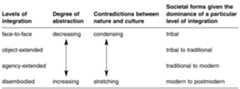
The nation is at once assumed to be a rich and inalienable relationship of specifiable compatriots, at the same time it connects anonymous strangers most of whom will probably never even pass each other in the street. It is lived as a ‘concrete’ relationship which each individual takes to his or her grave, and yet it is abstracted across time and space in ways that leave us culturally oblivious to the particular deaths of any other than those persons who are our immediate associates or who in some way have publicly walked the national stage. National community is subjectively experienced as a ‘primordial’ relation which, except for a few late arrivals who have to be naturalized, is said to be traceable deep into the past as a complex though specific genealogy. Yet the bounding of such ties by the nation state is objectively quite modern: most of us in the contemporary nation state, must now self consciously rediscover our own personal genealogies our roots back into the dead generations. Such contradictions, themselves historically specific, form the background to my attempt to characterize the nation as a changing but distinctive kind of abstract community. Since this entails something of a new departure, or at least a new emphasis in method, the book begins by outlining a theoretical approach for describing the changing dominant social forms of the national community. It argues that the commonly acknowledged failure of commentators to theorize the nation adequately is partly due to an inattention to the complications ensuing from the necessarily abstracting nature of theorizing as an intellectual technique. More broadly, it is due to an inattention to the implications of contradictions arising out of the wider, material abstractions of social relations. How can the nation be experienced as a concrete, gut-felt relation to common souls and a shared landscape, and nevertheless be based upon abstract connections to largely unknown strangers and unvisited places? As part of the ‘nation of strangers’ we live its connectedness much more through the abstracting mediations of mass communications and the commodity market than we do at the level of the face-to-face, but we continue to use the metaphors of the face-to-face to explain its cultural power.
Nationalism Handbook, 2006
Just as the nation-state did not die at the end of the twentieth century — despite claims of its imminent demise — its emergence as a social form in the nineteenth century was neither a creation ex nihilo nor a specifiable moment of birth. In that period we saw for the first time the uneven merging of national communities and state polities to form nation-states, but ‘the nation’ as a social form has a much longer history. In other words, nations and states can only be understood in the long run of uneven and changing global history. This essay suggests that understanding the matrix of nationalism, the nation and the nation-state requires as one line of enquiry a recognition that different kinds of nation formation have emerged across world history in the context of the dominance of different ways of living and being: traditionalism, modernism and postmodernism. Traditional nations — the medieval natio, for example — arose in the context of communities of persons lifted out of place and thrown together in a contexts such as universities, courts, monasteries and barracks that brought them face to face with people from other cultures. Traditional nations cannot be understood by simply reading backwards from our understanding of modern nations. As I will argue, modern nations are much more abstract communities and formed in the context of globalizing practices of production, exchange, communication and enquiry, practices that change the nature of how people live in time and space. Postmodern nations have yet to emerge as such, but in the present, we are seeing continuing structures of modernism increasingly overlayed by practices and subjectivities of postmodernism, including postmodern nationalism. This is evidenced, for example, in the ideology that the extension of the national interest has no spatial limits and a particular nation can be exemplary for all.

 Paul James