

…
19 pages

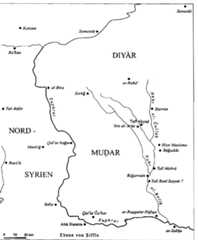
During the 6th century several fortified cities, Edessa/al-Ruhāʾ, Carrhae/Ḥarrān and Kallinikos/al-Raqqa, marked the Byzantine border with the Sāsānian empire. Edessa remained the capital of the Osrhoene and its military headquarters during the Sāsānian occupation and afterwards. Numerous monasteries were built and prospered during that period.The first phase, spanning from Byzantine rule to the early ʿAbbāsids, is that of steady agricultural investment and development: Life went on during the transition period, through the Sāsānian occupation and the Arab conquests in the first half of the seventh century, without any disruption detectable so far. In the early Umayyad period in the northern plain the two cities, al-Ruhāʾ and Ḥarrān, remained the dominant economic and administrative centres. Ḥarrān took over from al-Ruhāʾ as the provincial centre and capital of the Umayyad northern super province and later even as the residence of an Umayyad caliph. During the Umayyad period the ruling family had acquired land in the Diyār Muḍar and invested in its cultivation and irrigation, thus further stimulating the prosperous agriculture, as witnessed by the numerous estates, among them were Ḥiṣn Maslama and Bājaddā. In the early ʿAbbāsid period Ḥiṣn Maslama may have changed its character from a self sufficient rural estate, owned by a leading member of the Umayyad family, to a small rural town with a local market using petty coinage for day-to-day transactions.The second phase saw the economic impacts from the demand of large metropolises such as Baghdād founded 145/762 and al-Rāfiqa founded 155/772. In 180/796-7 the caliph Hārūn al-Rashīd transferred his court and government to al-Raqqa. This shifted the centre of economic growth from the fertile northern plain to the delta of the Balīkh in the south. The demand of the new metropolises for services and industrial products thus stimulated industry and provided a growing population with income. Their need to be fed, in turn, fostered the growth of agricultural settlements. Even after the return of the court in 193/809 to Baghdād, al-Raqqa remained the capital of the western half of the empire and a garrison city. In 221/836 the foundation of Sāmarrāʾ on the banks of the Tigris and the new even increasing demand of this urban agglomeration for foodstuffs gave the northern plain around Ḥarrān and the Wādī Ḥamar with the rural centres al-Jārūd and Ḥiṣn Maslama an economic advantage and made agricultural production there highly profitable. Sāmarrāʾ-style stuccos from al-Jārūd, Ḥiṣn Maslama, al-Rāfiqa and al-Raqqa al-Muḥtariqa are witnesses for a flourishing region in the middle of the 3rd/9th century.The last dated coins from Ḥiṣn Maslama and al-Jārūd from the last third of the 3rd/9th century indicate a decline beginning with the decreasing demand of Sāmarrāʾ and the suffering of the region from the Tūlūnid and Qarmaṭian wars. The final blow for the smaller rural towns and villages may have occurred during the devastating rule of the Ḥamdānids and the immigration of superficially Islamicised Arab nomads, namely the Banū Numayr, in the middle of the 4th/10th century. From being one of the richest agricultural areas of the empire, with a system of irrigation canals, nomadic pastoral life now prevailed.

AI
Water History, 2022
Following its foundation in the 630s CE, medieval Basra rapidly expanded to became one of the most populous cities of southern Iraq and the wider Gulf region. At its foundation, the city’s surrounding environment appears to have been poorly suited to sustaining a large urban population. This paper examines the different ways in which the early Islamic population of Basra transformed the immediate environs of the city to improve the urban water supply and the agricultural potential of the city’s hinterland. In particular, this included the construction of substantial canals connecting Basra with sources of water such as the marshes to the north of the city and the Shaṭṭ al-cArab—the river which forms at the confluence of the Tigris and Euphrates and flows past Basra to the Gulf. The tidal influence of the Gulf causes the water level of the Shaṭṭ al-cArab to rise and fall daily and, by exploiting this characteristic, the medieval population of Basra could irrigate large swathes of land surrounding the city. Analysis of historic satellite imagery reveals possible evidence for the infrastructure that made this possible—including the remains of field systems bounded by, and interspersed with, canals as well as large raised linear ridge features which occur in tandem with relict canal systems. This paper critically assesses the evidence for the dating of these features, potential scenarios for how they functioned and their relationship to the medieval city of Basra.
Archaeobotanical research in the southern Levant has focused on the development of agriculture and urban societies, but less so on how agriculture sustained long-lived cities during the 1st millennium ce. Recent empirical evidence for agriculture during the Early Islamic period (636–1099 ce) has resulted in the development of new models for urban agricultural economies for that period. This study draws on the spatial analysis of plant remains including wood charcoal collected from domestic, industrial, and refuse contexts in Early Islamic deposits at the city of Ashkelon to (1) characterize the agricultural system in place; (2) investigate local cultivation or importing of crops; and (3) determine preferential use of plants for food or fuel, as well as construction and craft applications. We identify household-based storage of cleaned wheat and barley, and the preferential use of pine and cedar of Lebanon timber in construction of a large residence. We also identify an overlap in discard location of waste from craft industries and kitchens, and a co-occurrence of fruit remains and wood charcoal that we interpret as evidence for local arboriculture, the cultivation of trees and vines for fruit and nuts. Our identification of the use of fruit endocarps as industrial fuel reveals the connection between artisan and agricultural economies.
THE BYZANTINE AND EARLY ISLAMIC NEAR EAST 11 LAND USE AND SETTLEMENT PATTERNS , 1994
A Companion to Islamic Art and Architecture, Volume I and II edited by Finbarr Barry Flood and Gülru Necipoğlu, 2017
It is a well-known phenomenon that at the end of antiquity, the ordered structure of the Roman cities of the east disappeared and was replaced by narrow winding streets and crowded markets with tiny booths (Bennison and Gascoigne 2007; Kennedy 1985). The grids of streets were abandoned and the broad colonnaded avenues filled in with shops and houses. This process is not to be described as a decline, rather a change of needs. Indeed it could be described as a return to the practices of the Ancient Near East. Certainly, it was significant that wheeled vehicles were no longer used; instead the camel was a much more flexible method of transport than a cart. The process is not necessarily linked to the appearance of Islam as a religion in the seventh century; some elements can be already identified up to three centuries earlier. The grid plans of Roman cities were laid out in the first to third centuries, on the Hellenistic plan, and simple usage and rebuilding led to disorganization of the plan. A second factor in these changes is that the Islamic state was centered on the continental Middle East, whereas Rome was centered on the Mediterranean. Needs changed and numerous Roman cities were slowly abandoned. As a result many fine Roman city sites are still available to be excavated, and have been. Others, such as Damascus, have remained great centers; however, they were slowly transformed over a number of centuries. New cities were also required. At the beginning of Islam, they were patterned after the needs of Arabia, but that slowly changed when the caliphate was transferred to Damascus in 661 and then to Baghdad in 762. As everywhere at the time, old cities died slowly and continued long after their function had disappeared. One should not forget that in the Middle East many cities are founded in hostile desert or steppic terrain for particular reasons, such as commerce, religious, or political needs. For the commercial side, one can quote Palmyra in Syria or Siraf
Bulletin d'études orientales, 2012
"Between the mid. 5th/11th and the mid. 6th/x12th century, the domination of the Saljuq sultans over the ʿAbbāsid caliphate caused important social changes in Baghdad. Based mainly on Arabic chronicles and biographical dictionaries and making use of prosopography, this paper focuses on these social changes and on the consequences they had on the development of the city. In the first part it examines the impact of the madrasa-endowment policy, often considered as a characteristic of the period, on the three main madhāhib present in Baghdad, as well as the impact of the numerous ribāt foundations on Baghdadi Sufis. During the Saljūq period, the main judicial, administrative and political positions in Baghdad were held by a limited number of families. The study presents the most influential of them: newcomers such as the Dāmaghānī or families of local origin such as the Zaynabī. Both the Saljūq and ʿAbbāsid ruling elites were great patrons of building activity in Baghdad. They founded madrasa and ribāṭ endowments, but also private constructions, religious and public works. The second part of the paper focuses on the vigor of urban construction in Baghdad at that time, when different groups of patrons (Saljūq orʿAbbāsid officials and Baghdadi civilian elites, including women sponsors) were responsible for the urban development of different parts of the city. In fact, far from being in the ruined state sometimes described by historians on travelers’ accounts, mainly based on the view of Ibn Jubayr, Baghdad appears as a dynamic city, still an important cosmopolite metropolis in the region. Entre le milieu du Ve/XIe et le milieu du VIe/XIIe siècle, la domination des sultans seldjoukides sur le califat abbasside engendra d’importantes mutations sociales à Bagdad. Le présent article, fondé essentiellement sur les chroniques arabes et les dictionnaires biographiques et ayant recours à la méthode prosopographique, s’intéresse à ces changements sociaux et à leurs conséquences sur le développement urbain. Il examine tout d’abord l’impact du mouvement de fondation de madrasas, souvent considérée comme caractéristique de la période, sur les trois principaux maḏhab-s représentés à Bagdad, ainsi que l’impact des nombreuses fondations de ribāṭ-s sur les soufis locaux. Durant la période seldjoukide, les principales fonctions judiciaires, administratives et politiques étaient aux mains d’un certain nombre de lignages. Les plus puissants sont présentés ici, qu’ils soient de nouveaux venus comme les Dāmaġānī ou des familles d’origine locale comme les Zaynabī. Les élites gouvernantes, seldjoukides comme abbassides, patronnèrent volontiers des activités de construction à Bagadad. Ils fondèrent des madrasas, des ribāṭ-s, mais financèrent également d’autres constructions de nature privée, publique et religieuse. La seconde partie de l’articule s’intéresse à l’intense activité de construction qui prit place à Bagdad à cette période, différents groupes de mécènes (hauts fonctionnaires seldjoukides ou abbassides, mais aussi élites civiles bagdadiennes incluant un certain nombre de femmes) étant à l’origine du développement urbain dans différentes parties de la ville. De fait, loin d’être la ville en ruine parfois décrite par les historiens en raison du témoignage négatif de quelques voyageurs, et en particulier de celui d’Ibn Ǧubayr, Bagdad apparaît à l’époque comme une ville dynamique, n’ayant pas totalement perdu le caractère de métropole cosmopolite qui fut le sien pendant les premiers siècles de son existence."
Antiquity, 2007
The Fertile Crescent of the Ancient Near East is well known for its early cities in irrigated farming regions. Here the authors describe the recent discovery and investigation of a planned, circular, mid/late-third millennium BC city beyond the limit of rain-fed cultivation in the arid zone of inner Syria. Founded on the initiative of an unknown power and served by pastoralists and cultivators, the research at Al-Rawda demonstrates how environmental constraints were overcome in order to establish and sustain new centres in demanding regions at a time of maximum urbanisation.
Journal of World Prehistory, 2014
This paper employs data from selected sample survey areas in the northern Fertile Crescent to demonstrate how initial urbanization developed along several pathways. The first, during the Late Chalcolithic period, was within a dense pattern of rural settlement. There followed a profound shift in settlement pattern that resulted in the formation of large walled or ramparted sites ('citadel cities') associated with a more dynamic phase of urbanization exemplified by short cycles of growth and collapse. By the later third millennium BC, the distribution of larger centres had expanded to include the drier agropastoral zone of northern and central Syria, termed here the 'zone of uncertainty'. This configuration, in turn, formed the context for Middle Bronze Age settlement, and the pattern of political rivalries and alliances that typified the second millennium BC. Evidence is marshalled from archaeological surveys and landscape analyses to examine these multiple paths to urbanization from the perspectives of (a) staple production within major agricultural lowlands; (b) the shift towards higher risk animal husbandry within climatically marginal regions; (c) changes in local and inter-regional networks (connectivity); and (d) ties and rights to the land. Textile production forms the core of the proposed model, which emphasizes how the demand for wool and associated pasture lands opened up new landscapes for agro-pastoral production and settlement. The resultant landscapes of settlement are then compared with the picture in the southern Levant where a more restricted zone of uncertainty may have limited the opportunities for agro-pastoral production.
Journal of Anthropological Archaeology, 2024
Early agricultural practices are often viewed as such a radical transformation that they not only structured and drove the long-term development of subsistence economies, but also required a dramatic reorganization of how community-wide economic relations were reckoned and enacted. This article examines how data derived from loci of economic production can inform us about the structure of economic relations in early agricultural communities, so as to better test such claims of political-economic disruption against the archaeological record. It does so by analyzing the site of al-Khayran in the west-central Jordan. Al-Khayran dates to the southern Levantine Middle Pre-Pottery Neolithic B, the time period when predominantly agricultural economies first emerge in the region. Results show that a typical village-based residential group temporarily and repeatedly inhabited a substantially-built in-field structure while practicing intensive agricultural production. These results indicate that the site's inhabitants carried out a form of dual residence mobility with heavy investment on-site in perimetrics via landesque capital. Such behavior suggests that at least some residential groups in this time period were indeed corporate groups that agentively intervened in economic systems to actively assert and enact the private holding of the means of production during the emergence of agricultural economies.
2020
As time progressed Iraq witnessed the transfer of power from the hands of the Umayyad dynasty in Syria to the Abbasids who established their State in Iraq. The following developments are detailed. ...

Loading Preview
Sorry, preview is currently unavailable. You can download the paper by clicking the button above.
AI
The study reveals that Byzantine agricultural practices led to a flourishing landscape, reflected in significant archaeological finds, including 37 identified sites from the Roman-Byzantine period by Karin Bartl in 1994.
The establishment of Baghdad in 145/762 stimulated economic growth, creating exceptional demand for food production in Diyar Mudar, highlighting the region's agricultural significance.
Al-Rafiqa's establishment in 155/772 fostered agricultural and industrial growth, transitioning the economic center of activity from Harran to al-Raqqa, enhancing local market dynamics.
The shift from large Umayyad estates to early Abbasid urban towns, particularly at Hisn Maslama, manifests the transformation through archaeological evidence uncovering urban structures and coin finds.
The research utilized a combination of historical texts, extensive surveys, and archaeological excavations, led notably by scholars like Jan-Waalke Meyer, to reveal significant findings across the Diyar Mudar region.
The methodological problems of the period of the „settlement gap (Siedlungslücke)“ have become more evident. This period is best approached with the help of different disciplines. During the 4th/10th century the Banu Numayr moved into northern Mesopotamia as part of the second great migration of Arab tribes. The cultivated land of settled people diminished and the routes between the villages, towns and cities became endangered. During the period of Bedouin domination the seat of rulership was transferred from the city to the tribal camp (hilla). The interest of the Bedouins lay in the fiscal exploitation of the cities. The emirate of Mani' ibn Shabib constitutes a brief interlude in the development of the Banu Numayr. During the time of the rebellion of al-Basasiri in Iraq, the Fatimids integrated Mani' into an alliance. Thus, the Fatiimids created political stability among the hostile tribes from northern Syria to the Euphrates valley. Then Mani' ibn Shabib began to represent himself as an urban ruler: he built the citadel in Harran. As proof of rulership he had coins struck not only in Harran, as his predecessors had done, but established a mint in ar-Raqqa as well. The evidence marshalled here also suggests that he undertook the restoration of the most representative urban building in ar-Raqqa, the congregational mosque. He extended his territory into the Khabur valley. Manî' ibn Shabib’s rule corresponds to that type of nomadic authority which Michael Rowton calls a ‘dimorphic state’. This constitutes a state led by a nomadic ruler accommodating himself to urban forms of rulership, or at least to urban forms of projecting sovereignty but who simultaneously maintains his power base within the pasture: a ruler who has to balance between the interests of the settled people and the demands of the nomads. These favourable conditions for the revival of urban life in the Diyar Mudar ended soon after the rebellion of al-Basâsîrî in the year 451/1060.
Al-Jami'ah: Journal of Islamic Studies, 2009
Abbasid caliphate in the fourth/tenth century suffered from a sharp economic decline. This was the result of several factors, mainly civil wars, the Zanj and Qarmatian revolts, political interference by the Turkish and Daylamite soldiers, military iqta‘ and the activity of the ‘ayyarun. The civil wars had a destructive effect on the city of Baghdad and its citizens, ruined most of the land and caused a devaluation of dirham and dinars. The revolts of the Zanj and Qarmatians paralyzed trade in southern Iraq leading to a stagnation of currency and the banking system and a decrease in financial activity. The involvement of the Turkish and Daylamite soldiers in politics, and rivalries among them to gain power, led to the devastation of canals, dams and consequently ruined the agricultural sector. In addition, the introduction of military iqta‘ during this period resulted in the damage of cultivated lands due to their excessive exploitation and abandonment of their irrigation system. Fin...
Drawing the Threads Together: Studies on Archaeology in Honour of Karin Bartl, ed. Alexander Ahrens, Dörte Rokitta-Krumnow, Franziska Bloch, and Claudia Bührig, 2020
2007
New work over the last thirty years on the archaeology of Syria-Palestine in the later sixth and seventh centuries has significantly questioned the once-accepted view of an economy in decline, seen in part as a contributory factor to the supposed “easy” conquest of the region. Coinage, ceramics, and settlement profiles depict, rather, an economic resilience that successfully weathered the political and military disruptions of the seventh century. The relative soundness of the economy at the end of the seventh century gave crucial support to ʿAbd al-Malik during the succession dispute with Ibn Zubayr, and following its resolution ʿAbd al-Malik’s reforms were to ensure decades of continuing economic prosperity in Syria-Palestine. In the eighth century, a standardized coinage ensured monetary confidence, townbased industries were built up on a major scale to supply regional markets, while improvements to the infrastructure of agriculture—rather than the introduction of new crops—and the exploration of natural resources promoted settlement in the countryside. Over two centuries, the economy had changed, bringing significant shifts in urban and rural settlement patterns, but had not, to any significant extent, failed.
Residences, Castles, Settlements. Transformation Processes Between Late Antiquity and Early Islam in Bilad al-Sham. Edited by K. Bartl & A.R. Moaz, Rahden (OrA 24)., 2008
The Umayyad World, edited by Andrew Marsham, 2020
Orientalistische Literaturzeitung, 2023
2010
When Al-nĀṢIr lI-DĪn AllĀH, ABU ʾl-ʿABBĀS AḤMAD came to the throne in 575/1180, he was the 34 th ʿAbbāsid caliph. The wordly power of the ʿAbbāsid caliphate had been restricted for centuries because of the dominance of the shīʿite Būyids. The dynasty of the Saldjūḳs even succeeded in making it disappear completely, but al-nāṣir restored ʿAbbāsid's sovereignty. He strengthened and consolidated the caliphate against all kinds of military, political and ideological attacks. for the period of his reign (575-622/1180-1225), and down to that of his grandson al-Mustanṣir, he restored this specifically Islamic institution to its former prestige. yet, he unintentionally contributed to the fall of Baghdād's caliphate at the hands of the Mongols.
2014
Ancient Arabia has promptly been pictured as a vast empty desert. Yet, for the last 40 years, by digging out of the sand buried cities, archaeological researches deeply renewed this image. From the second half of the 1st millennium BC to the eve of Islam in East Arabia, and as early as the 8th century BC in South Arabia, the settlement process evolved into urban societies. This study aims at reviewing this process in South and East Arabia, highlighting the environmental constraints, the geographical disparities and the responses of the human communities to ensure their subsistence and to provide for their needs. Evolution was endogenous, far from the main corridors of migrations and invasions. Influences from the periphery did not cause any prominent change in the remarkably stable communities of inner Arabia in antiquity. The settlement process and the way of life was primarily dictated by access to water sources and to the elaboration of ever-spreading irrigation systems. Beyond common traits, two models characterise the ancient settlement pattern on the arid margins of eastern and southern Arabia. In South Arabia, the settlement model for the lowland valleys and highland plateaus results from a long-term evolution of communities whose territorial roots go back to the Bronze Age. It grew out of major communal works to harness water. Into a territory of irrigated farmland, the south-Arabian town appeared as a central place. Settlements constituted networks spread across the valleys and the plateaus. Each network was dominated by a main town, the centre of a sedentary tribe, the capital of a kingdom. In East Arabia, the settlement pattern followed a different model which emerged in the last centuries BC along the routes crossing the empty spaces of the steppe, in a nomadic environment. Each community spread over no more than one, two or three settlements. These settlements never grew very large and the region was not urbanised to the same degree as in the southwest of the Arabian Peninsula. Permanent settlements were places for exchanges and meetings, for craft productions, for worship, where the political elites resided, where the wealth from long-distance trading was gathered, and where surplus from the regional economy was held. Each town was isolated, like an island in an empty space.

 Stefan Heidemann