Wrecks & shipfinds in Denmark:
The earliest nomadic settlers arrived in Denmark at the end of the Ice Age, ca 11,000–8,000 BC. During the Ertebølle Culture 5200–4000 BC, people were hunting and fishing, using logboats.
- Tybrind Vig logboats. Located in a submerged Stone Age settlement. Three logboats have been found, dated to c 4000 BC. the longest is 10 m long and made of lime wood. It is now conserved and displayed at the Århus Museum. Described by Detlev Ellmers inThe Earliest Ships (Conway Maritime Press 1996).
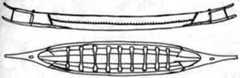 Hjortspring boat. Found in a bog on the island of Als in 1921/22. Constructed with stitched planks and the age has been estimated to early 3rd century BC. It is 14 m long and may have been a warship. Displayed at the National Museum, Copenhagen. The peculiar hull shape corresponds to the ship images on Nordic Bronze Age rock carvings. Ref Ellmers:Frühmittelalterliche Handelsshiffahrt in Mittel- und Nordeuropa.Link.
- The Slusegård logboats, Bornholm Island. Found during excavations of grave sites around 1960. All wood had perished, but impressions of boats were left in the sand. The original boats has been dated to 1st-4th centuries AD.Report in German. In 2000-2001, one of the boats has been reconstructed by the Swiss boat builder J.-Ph. Mayerat.
- TheNydam boats. Perfectly preserved from 3rd-5th centuries AD, found in a bog in 1863.
- Gredstedbro boat. Fragments of a boat were found in 1945. Total length may have been 20-25 m. Dated by J.S. Illsley to 7th century AD. Dated by Detlev Ellmers to 550 ±100 AD. Ref Ellmers:Frühmittelalterliche Handelsshiffahrt in Mittel- und Nordeuropa.
- Ladby ship.22 m long Viking ship (warship type) from 10th century found in a grave mound at Kerteminde, Fyn, in 1935. All wood had rotted away but the rivets were in place, outlining the hull shape, just like the Sutton Hoo ship.
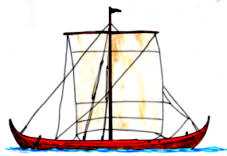 This is the only known ship burial in Denmark. The remains are displayed in a museum.
 - TheSkuldelev ships. Five Viking ships that were sunk in the 11th century at Skuldelev to make a barrage across a narrow channel. Excavated 1957-1969 and the ships are now on display in Roskilde.
- TheRoskilde ships. When theViking Ship Museum in Roskilde was expanded in 1997, remains of another 9 ships were found underneath. The ships are are now being conserved. They are dated to the period from ca 1025 to 1336. But should these new finds be displayed that emerged because of the museum expansion. Suppose that the museum now has to expandagain for these new finds – will they find even more ships?Link.
- Eltang Vig ship. In 1943 this ship was found in the Koldingfjord. Investigated in 1947. The 18 m long clinkered construction indicates a cog from 12th century or later. Ref Ellmers: Frühmittelalterliche Handelsshiffahrt in Mittel- und Nordeuropa.
- Kollerup cog. Stranded at Kollerup. First dated to 13th century, but later dendro dating places it to c 1150. Found and investigated on land in 1978. Ca 20 m long. RefSkalk4/79
- Kolding cog. This ship was found in 1943. Loose parts were recovered in the same year, measured and then reburied. Both position of the reburied parts and the ship were lost. In 1999-2000 it was found again, and lifted in 2001. Investigated by Fred Hocker. The planks have been dendro dated to the winter 1188-1189. The parts are being conserved at the Kollinghus Museum. The ship may have been c 16 m long.
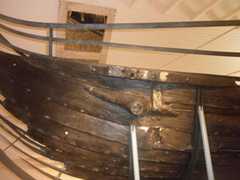 RefMarinarkæologisk Nyhedsbrev14/2000 and 16/2001.
 - TheEllingå ship. Found 1922, lifted in 1968, and brought to the Bangsbo Museum. Made of clinkered oak, 14 m long and dated to 1163. Ref Ellmers:Frühmittelalterliche Handelsshiffahrt in Mittel- und Nordeuropa. Photo by Axel Nelson.
- Aggersund boat. 12 m long clinker built ship from 13th century. Discovered in Limfjorden in 1996. The hull is up side down in the mud. To be excavated in 2000. Described inMaritime Archaeology Newsletter8/97.
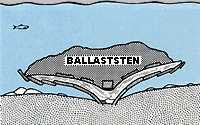 Vejby cog. Originally perhaps 12-18 m long cog found in 1976 at Vejby strand. Only a bottom mid-section remained on 2 m depth. On board were ceramics and c 100 English gold coins dated 1351–1377. Thanks to the coins, the ship is dated to after 1377. RefSkalk 6/76.
- TheB&W shipyard wrecks, Copenhagen. 8 wrecks were found in 1996. They were from early 17th century. RefMaritime Archaeology Newsletter8/97.
- Stinesminde kravel. Located off Jutland on 10-12 m depth. Two-masted kravel ship from first half of 17th century, possibly Dutch. The hull is preserved. One mast still rises 1½ m above the deck level. Ref: Dansk Sportsdykker Forbunds Arkæologiske Udvalg, marinarkæologisk konference 2003.
- Brederode. Dutch frigate sunk near Helsingör in 1658. Parts were salvaged in 1909 and in the 1940s and 50s.
- Den förgyllda solen. Swedish ship going from France to Sweden, sunk in 1673 off Bornholm. Found in 1969. RefSkalk 2/70.
- Dannebroge. Danish 78 or 82 gun warship sunk in 1710 during battle against a Swedish navy. Despite fire onboard she kept fighting until she exploded. Sank with Admiral Huitfeldt and 500 men on 12 m depth in Köge Bay. Some of the valuable bronze guns were salvaged in 1711-1714 and 1873-1875. The site is being investigated since 1985. Finds are on display in the Orlogsmuseum, Copenhagen.
- Prinds Christian Frederik. This happened during the war between Denmark and England 1801-1814. On 22 March 1808 this Danish battleship encountered a larger English unit at Sjællands Odde. After an uneven battle the ship was sunk, being the last large Danish battleship.
- St George. English warship beached at Thorsminde in 1811. In 1980 the main deck and lower gundeck were discovered, protruding ca 1-4 m above the sand bottom. At a storm in 1981 the gun deck broke apart. RefHistoriske vrag og søforter(Det Arkæologiske Nævn 2001)
 .
. - Birger Jarl. Swedish Navy frigate, 42 guns. In 1813 she was on a routine patrol in the south Baltic Sea. Off Møn Island, she suddenly started to leak and finally sank, despite calm weather. There were not enough lifeboats and about 160 men drowned. It is assumed that a plank had loosened, since she had ran aground shortly before. The wreck was discovered on 25 m depth in 1974. According to reports she was well preserved, the hull in one piece and the guns neatly in position. According to recent reports, the hull has now partly collapsed, but the guns are still in position on the gun deck. Described inIJNA7.1 1978, andLooking for Leads & Spår av hav, yxa och penna both by Christian Ahlström.
- U-251. German submarine of type VII C sunk in April 1945 in Kattegatt, between Denmark and Sweden. Discovered in 1993 on 32 m depth
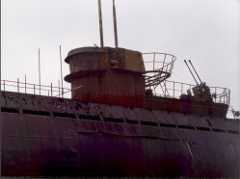 .
. - U-534. German submarine of type IX C sunk in 1945 off the Danish coast. Lifted and brought to the UK as a museum piece in 1993.


Related link:
- Thewreck list of The St George Shipwreck Museum, Denmark