
Bild published pro-Netanyahu disinformation. Where is the outcry?
The role of Germany’s largest newspaper in the ‘Bibileaks’ scandal highlights the need for a broader reckoning on Israel-Palestine in German media.

The so-called “Bibileaks” scandal has caused a firestorm in Israel in recent months. After it emerged that classified material was leaked from the Israeli military to a spokesperson for Prime Minister Benjamin Netanyahu and then manipulated and passed to foreign media outlets — in an apparent attempt to influence the Israeli public’s perception of the ceasefire negotiations, while bypassing the military censor — the spokesperson and a military reservist were arrested in November and face charges that could carry significant prison sentences.
In the UK, meanwhile, there has been a major public outcry against the Jewish Chronicle after it was revealed — in part throughreporting by +972 Magazine — that the newspaper had published entirely false material via this pipeline, causing several of its leading writers to quit in protest. Yet in Germany, where the country’s biggest newspaper, Bild, similarly published misinformation fed to it by the Netanyahu aide, there has been very little inquest at all.
The scandal began on Sept. 6, when Bild published what it described as an “exclusive”report, claiming to reveal the contents of a secret Hamas document allegedly outlining the group’s strategy vis-a-vis negotiations with Israel toward a ceasefire and hostage-exchange deal. According to Bild’s report, the document — supposedly discovered on the computer of Hamas leader Yahya Sinwar in a tunnel in Gaza — was proof that Hamas was “not aiming for a quick end to the war,” and thus carried full blame for the stalling of negotiations.
The report, which effectively absolved the Israeli government of any responsibility for the breakdown of the talks, aligned with Netanyahu’s interests not only with its content but also its timing. It came in the wake ofmassive protests across Israel demanding a ceasefire, after news that Hamas hadkilled six Israeli hostages in Gaza as Israel’s military advanced nearby. In a cabinet meeting two days after the Bild report was published, Netanyahu referenced it to portray those demonstrating as unwitting pawns of the supposed Hamas strategy.
It wasn’t long before the story began to unravel. Israeli military sourcestold the news site Ynet that the army had indeed found such a document in Gaza — several months earlier, nowhere near Sinwar’s personal computer (it was apparently authored by a mid-ranking Hamas official), and with no indication that it was adopted as policy.
Most damningly, the specific sentence quoted by Bild that lies at the heart of the story — alleging that Hamas was deliberately prolonging negotiations since it wasn’t interested in reaching a deal — doesn’t appear at all in the original document. Indeed, since the very start of the war, Hamas has repeatedly signaled its willingness to release Israeli hostages in exchange for Palestinian prisoners and an end to Israel’s onslaught on the Strip — a fact that Bild has worked hard to obscure.

By making itself a willing accomplice in Netanyahu’s propaganda campaign against his own population, Bild helped to jeopardize not only the release of remaining Israeli hostages held by Hamas, but also an end to the ongoing atrocities that the Israeli military is committing against Palestinians in Gaza on a daily basis. Yet, to this day, the newspaper has faced no accountability whatsoever.
Shaping the terms of debate
For years, Bild has played a central role in crafting reductive narratives on Israel-Palestine in Germany, as well as stoking anti-Palestinian sentiment and silencing voices critical of Israel’s policies.
In 2021, the papertargeted German-Palestinian journalist Nemi El-Hassan over images that emerged of her participating in a 2014 protest against Israel’s assault on Gaza, resulting in El-Hassan being fired from a position at Germany’s public broadcaster WDR’s science show before she even started the job. A year later, moderatorMatondo Castlo was cut from another public broadcaster’s children’s program after Bild exposed his participation in a festival in the Palestinianecovillage of Farkha in the occupied West Bank, which included a demonstration against settler and military violence.
Since October 7, Bild has visibly ramped up its pro-Israel campaign, regularlysingling out critics of Israel’s military actions — be they Palestinians, migrants, or Jews — as antisemites or Israel-haters. Indeed, its influence extends to shaping the responses to the Gaza war on the ground in Germany.
In May, riot police forcibly dismantled a pro-Palestine student encampment at Berlin’s Free University protesting theimpending Israeli invasion of Rafah. When over 100 academics — including Holocaust scholar Michael Wild — signed anopen letter urging dialogue and non-violence, Bild retaliated with an article branding the signatories as “Universitäter,” an abbreviated smear combining the words “university” and “perpetrators.” Germany’s education minister, Bettina Stark-Watzinger, rushed tocondemn the open letter in an interview with Bild.
Such episodes underscore the paper’s outsized power: German politicians, acutely aware of Bild’s reach in the German public, tread carefully around it or even use it to solidify their position and shield themselves from suspicion of being overly critical of Israel’s policies. In October, to mark the anniversary of the October 7 attack, Foreign Minister Annalena Baerbock chose Bild’s front page toreaffirm her support for Israel, underscoring the publication’s role as the go-to platform for pro-Israel messaging even for liberal politicians.

Arecent contribution from the public broadcasting radio station Deutschlandfunk on a controversial Bundestag resolution on antisemitism noted growing complaints from German political leaders about the relentless pressure they face. “The fear of being defamed as an antisemite or Israel-hater by Bild reverberates through politics, reaching the highest echelons,” the reporter explained.
Bild’s pro-Israel stance is nothing new; in fact, it is a pillar of its publisher Axel Springer’s ideological framework,enshrined in its German outlets’ work contracts. But over the past year, this stance has become more explicit.
In June, Bildformalized an alliance withIsrael Hayom, a historically pro-Netanyahu and pro-Likud daily in Israel. The partnership between the two outlets reportedly includes joint articles, investigations, and media projects published simultaneously in Germany and Israel.
The first product of this alliance was a June 2024 article titled “The Hamas Method,” co-authored by Israel Hayom reporter Itai Ilnai and Bild’s politics chief Filipp Piatov — one of the two authors of the falsified Bild report on Hamas’ alleged negotiations strategy. The June article describes how Hamas carried out its October 7 attack on Israel, drawing questionable parallels between the Palestinian group and the Nazis during the Holocaust.
Israel Hayom’s editor-in-chief, Omer Lachmanovitch, praised the partnership earlier this year, emphasizing the two publications’ ideological alignment: “The cooperation with Bild … is based on standing uncompromisingly with the State of Israel. Cooperation is important at all times, and doubly important now, when Israel is under great attack from its enemies.”
A deep-rooted problem
Notably, while the revelations about the “Bibileaks” scandal sparked a major political crisis in Israel, the reaction in Germany has been muted — despite the key role played by Bild. Only afterinternational reporting on the arrests of Netanyahu confidants did major German newspapers begin to cover the story.
To this day, Bild faces little scrutiny in Germany over the “Bibileaks” affair. In mid-November, its deputy editor-in-chief, Paul Ronzheimer, who stands at the center of the scandal, received the prestigiousWerner Holzer Prize for Foreign Journalism — a recognition that raises serious questions about the standards applied in Germany to journalism alleged to be complicit in state propaganda. The article, which Ronzheimer co-authored with Piatov,remains online and uncorrected.
Freue mich riesig über den Werner Holzer Preis für Auslandsberichterstattung, mit dem ich heute in Frankfurt ausgezeichnet worden bin. Eine große Ehre! Und ich freue mich besonders, dass meine Eltern dabei waren! ❤️pic.twitter.com/eQixMnT50C
— Paul Ronzheimer (@ronzheimer)November 15, 2024
The episode raises serious questions about journalistic ethics. While Bild insists its sources are credible, its evasive responses to questions about the affair undermine transparency. Inquiries by +972 Magazine were met with a carefully worded statement from a Bild spokesperson: “Please understand that we do not comment on our sources,” they said. “The authenticity of the document known to us was confirmed by the IDF immediately after publication.” Notably absent from this response was any clarification regarding the document’s origin, or the allegations of its dubious nature.
The revelations surrounding Bild and Netanyahu highlight the need for a reckoning in German journalism on Israel-Palestine. After all, this is not just a story about leaks and fabrications; it is a stark reminder of the immense power and influence wielded by establishment media outlets, and the dangers of failing to scrutinize that power as it continues unchecked.
The German media landscape bears significant responsibility for perpetuating skewed narratives on the war in Gaza over the past 15 months. Dominated by outlets like Bild, this landscape has failed to deliver accurate and balanced coverage on Israel-Palestine for years — a failure that became glaringly obvious after the Hamas attack on October 7 and the subsequent Israeli military campaign in Gaza.
Several stories from October 7 — including discredited claims such as the beheading of 40 babies —remain uncorrected in German media. Such narratives have been disseminated not only by conservative and liberal outlets but also by supposedly left-wing publications like Die Tageszeitung (commonly known as “taz”), the newspaper founded in 1980 by veterans of the West German student movement to counter the right-wing Springer press.
The silencing of dissent against the war, the deliberate omission of historical context, the passive framing of Palestinian deaths and targeted killings in Gaza, and a near-blind credulity toward Israeli and German state narratives — particularly in Germany’s public broadcasters — have fostered a dangerously simplistic and one-sided view of Israel’s military campaign among the German public.
Many major media outlets in Germany continue to rely on claims “verified” by the Israeli military, effectively manufacturing consent for war crimes. While skepticism toward Axel Springer’s outlets as sources on this topic is growing among a more educated public, Bild remains a dominant force in shaping public opinion on the issue.
Most read on +972

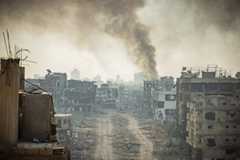

The consequences of Bild’s actions thus extend beyond its own newsroom. As Europe’s largest newspaper under its most powerful publishing house, Bild sets a troubling precedent for how news outlets handle reporting on Palestine and Israel. It perpetuates a distorted understanding of the political realities on the ground, silencing debate about Israel’s documented war crimes in Gaza and the West Bank.
If anything, this scandal should be a wake-up call. As Gazan journalists on the ground continue to be targeted by the Israeli military and international journalists remain barred from entering the Strip, the price of media complicity couldn’t be higher.
Subscribe to The Landline
+972's weekly newsletter
Hanno Hauenstein is a Berlin-based independent journalist and author. His work has appeared in publications including The Guardian, The Intercept, and Berliner Zeitung.
If you believe these stories are important,become a +972 member today to make sure we can keep telling them.
For those who care deeply about the people living between the Jordan River and the Mediterranean Sea, this is your opportunity to move from despair into action.
The effects of Israel’s genocidal assault on Gaza are still being felt: much of the Strip lies in ruins, millions remain displaced with nowhere to return to, tens of thousands have been killed, and many more are believed to be buried beneath the rubble.
In the West Bank, the Israeli army has displaced tens of thousands of Palestinians from refugee camps, while state-sponsored settler violence is wiping rural communities off the map on a weekly basis. At the same time, Israel’s ever-escalating regional aggression threatens to drag the entire Middle East into the inferno.
We are here on the ground — from Gaza to Tel Aviv to Masafer Yatta — exposing the crimes, reporting the horrors, and amplifying the voices of those resisting injustice to an audience of millions around the world. If there was ever a time the world needed +972 Magazine, it is now.
As a binational team based in Israel-Palestine, we are best placed to cover this pivotal moment in a way that no other outlet can — but we need your help to do it.Join us as a member to become part of our mission, and support independent journalism that really makes a difference.