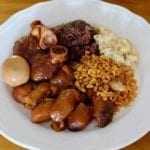
Kare Kare

Kare kare is a traditionalFilipino meaty stew that is often prepared with oxtail.
Filipino cuisinemakes use of a lot of meat, often pork, and seafood. Definitely not avegetarian friendly cuisine likeIndian or Mediterranean cuisine.
How to cook kare kare
Filipino kare kare (orkare-kare) is an oxtail stew complemented by a thick peanut-based sauce, where a number of sautéed vegetables like bok choy, eggplant, string beans, daikon or banana flower are added to create a very comforting and hearty dish.
The stew can also be prepared with pork hocks, calves feet, pig feet, beef stew meat, and sometimes offal or tripe. The kare kare ingredients may also include seafood like prawns, squid, and mussels, or just with vegetables.
Banana flower is a unique ingredient that is also used in the Laotiankhao poon soup. Banana flower, when cooked, looks like artichoke and has a texture similar to the one of barely cooked eggplant.
Related Posts:


The Filipino stew recipe recipe is flavored with ground roasted peanuts which give this very characteristic aroma similar to a number of popular recipes such asWest African mafé, South Americansalsa de mani, Chinese soupfa sang woo, Indonesian saladgado gado, orsatay, the famousSoutheast Asian meat skewers coated with a peanut sauce.
Kare kare is then colored with annatto, a spice that is often used as food coloring in dishes likearroz con pollo orpicadillo de chayote.
It is finally thickened with toasted ground rice, another traditional South Asian ingredient that is also used in the Thai salad calledlarb kai, for example.

What is the origin of kare kare?
There are several stories about the origins of this very unusual and distinctlyFilipino recipe.
The first one comes fromPampanga, a province in the Central Luzon region, which is often considered the Culinary Capital of the Philippines.
Since their version of kare kare is known all over the country as being one of the best, they are often credited with the invention of this unique stew.
Another possible story mentions the regal dishes of the Moro elite (Bangsamoro people), who settled in Manila before theSpanish arrival between the thirteenth and fourteenth centuries, and are thought to have brought this nutty dish with them.
Kare kare is a very popular and traditional dish in Sulu and Tawi-Tawi, which are regions of the Philippines where the early Moro settlers first arrived, thus giving credibility to this story.
A third story and probably one of the most popular theories for the origin of kare kare talks about the Sepoy conscripts from SouthernIndia who settled in the Philippines province of Rizal during the British Occupation in the seventeenth century.
They improvised their own cuisine with the ingredients they could find, since they could not get access to the spices they were used to, including turmeric or coriander. They called it kari-kaari (as in curry), which eventually became kare kare.
It is one of those Filipino recipes that is supposed to go from the stove to the table. It is prepared in a clay pot and this same clay pot is used to serve the dish at the table.
The stew, which is a favorite ofFilipino celebrations and festivities, is often served with a small dish of fermented shrimp paste called bagoong on the side.

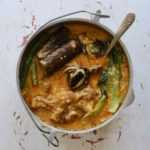
Kare Kare (Filipino Oxtail, Vegetable & Peanut Sauce Stew)
Ingredients
- 3 lb oxtail , cut in 2 inch (5 cm) slices
- 1 banana flower , quartered
- 3 baby bok choys
- ½ lb green beans , cut into 2 inch (5 cm) long pieces
- 2 Thai eggplants , cut in 2-inch (5 cm) long pieces
- 1 cup ground peanuts
- ¼ cup annatto seeds , soaked in 1 cup (250 ml) of hot water
- ½ cup toasted ground rice
- 2 cloves garlic , chopped
- 1 onion , chopped
- Salt
- Pepper
- ½ cup shrimp paste
Equipment
- Pressure cooker
Instructions
- In a pressure cooker, bring 4 cups (1 liter) of water to boil. Add the oxtail and the onion, then cook under pressure for about 45 minutes.
- Alternatively, it is possible to simmer the oxtail on low to medium heat in a large pot for 3 hours or until the meat is tender.
- Add the ground peanuts, the water from the soaked annatto seeds, and simmer for 10 minutes.
- Add the toasted ground rice and simmer for another 5 minutes.
- In a separate large pan, sauté the garlic then add the banana flower, eggplant, and green beans. Sauté for 5 minutes.
- Transfer the sautéed vegetables to the large pot with the oxtail stew. Add salt and pepper to taste.
- Serve hot with shrimp paste on the side.

Mike is “the devil” of the 196 flavors’ duo. Nicknamed as such by his friends, he is constantly in search of unusual recipes and techniques with impossible to find ingredients. The devil is always pushing the envelope, whether it is with humor or culinary surprises.
Reader Interactions
Comments
Barbrasays
I really liked the combination of the oxtail and the peanut butter, but maybe because I love peanut butter to begin with
Authentic Kare-kare has no banana flower
Some areas in the Philippines don’t use banana flower due to in-availability of such banana flower variety, instead other vegetables are being used, bok choy for pechay, french beans for string beans round eggplant for long eggplant and sometimes okra.
Guys try to cook karekare with coconut milk!its so yummy
You got this recipe on point. Thank you for that! Sometimes I see recipes that says it’s authentic and it’s not. I am from Pampanga and my parents taught me how to cook. Thanks again!