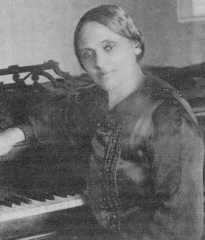
 JuliaHooks, one of Memphis' most prominent musicians of color and one ofthe city's pioneer social workers, was born in 1852 in Kentucky, whereher talent in music was recognized at an early age. She was educated inKentucky and attended Berea College, where she received further musicaltraining.
Establishing herself in Memphis well before the turn ofthe century, she became active in musical groups such as Liszt MullardClub, which performed classical music concerts in the city during the 1880s.Other members of the group included Mrs. R. R. Church, Sr., who frequentlyplayed piano duets with Mrs. Hooks, and Mrs. Josiah T. Settle, Sr., knownfor her beautiful soprano voice.
Mrs. Hooks also was involved with various churches becauseof her expertise in playing the organ and her talent for directing choirsand choral groups. In addition, she taught music, and every year her studentsappeared in recital at Zion Hall, Beale Street Baptist Church, and, afterChurch's Park and Auditorium was completed, they appeared in Roberta Churchwas one of Mrs. Hooks's piano pupils.
For a while, Julia Hooks served as a teacher and principalin the Memphis city schools; she later operated a private kindergartenand elementary school in her home on South Lauderdale Street. Among herpupils, in addition to her sons, Henry and Robert, were Robert Church,Jr., and his sister, Annette, Allison Vance, Nellie Bowles, Edgar Mitchum,and Fred L. Hutchins. Julia Hooks loved children and had an unusual capacityto relate to them; they returned her affection. Frequently, she would organizegroups of youngsters for picnics, play activities, or musical programs,arriving at rehearsals for recitals with an ice cream cone for each child.
A dignified, compassionate woman, her sincerity and gentlemanner inspired confidence and trust. These qualities served her well whenshe became an officer of the Juvenile Court, and often she was able tomodify the attitude of wayward youngsters and help them cope with theirproblems. She also was known to provide religious inspiration and spiritualcomfort to adult prisoners on occasion.
Around 1907, the city opened a small Juvenile DetentionHome next to her residence, which she and her husband, Charles, a truantofficer, supervised. Mr. Hooks was killed by one of the wards, but Mrs.Hooks continued her efforts to help young people. At times Judge CamilleKelly, a well-known judge of the Juvenile Court, would invite Julia Hooksto sit with her when certain cases concerning Negro youths were presented.
Although her primary interest and occupation was music,throughout her lifetime Julia Hooks maintained an interest in the underprivilegedof all ages. She initiated the founding of the Old Folks and Orphans Home,located on the old Hernando Road. Using her talent as an accomplished pianist,she played in concerts to help pay for the home.
Two sons, Henry and Robert, were born to Mr. and Mrs.Hooks. Both sons became expert photographers and established a studio knownas Hooks Brothers Photographers. The interest in photography was passedon to the next generation, and Charles Hooks, son of Robert Hooks, andHenry Hooks, Jr., operated the family business. Henry Hooks, Sr., was amember of the Iroquois Club, a well known social club organized by a groupof young men in Memphis. Henry Hooks, Jr., and his father, Charles, weresigners of a petition circulated by a group of prominent black and whiteMemphians endorsing Robert Church, Jr., as Surveyor of Customs for thePort of Memphis. The petition was sent to President Theodore Rooseveltin 1908.
Julia Hooks died at the age of ninety and, according toher obituary, was able to play the piano until a few weeks before she passedaway. She is survived by several grandchildren, including Julia Hooks Gordon,a retired employee of the federal government; Robert, Jr. and Raymond Hooks,both employees of the U. S. Post Office; Mildred Hooks, an employee ofthe Shelby County Government; Benjamin Hooks, who in 1972 became the firstblack member of the Federal Communications Commission and served as executivesecretary of the NAACP; and Bessie Hooks, an employee of the Internal RevenueService. A great-grandson, Michael Hooks, is a member of the Memphis CityCouncil.
