Alert
Cette page n'est pas intégralement disponible en français, vous pouvez la consulter en anglais.
Measuring Culture’s Contribution to Sustainable Development.

Data for Culture. Evidence for Policy. Action for Sustainable Development.
What are the Culture|2030 Indicators?
TheUNESCO Culture|2030 Indicators is a framework of 22 thematic indicators designed tomeasure andmonitor the role and contribution of culture to the goals and targets of the 2030 Agenda for Sustainable Development.
Culture contributes both as a sector in its own right and transversally across many other sectors. The framework helps governments, policymakers, and cultural institutions gather reliable data on culture’s impact—making itvisible,measurable, andactionable. 
Participated in the programme for implementation and capacity building for culture data (2021–2025)
Participated in implementation (2021–2025)
National & local capacities strengthened for culture data
Organized into 4 dimensions & 2 cross-cutting dimensions
Available to provide technical assistance via the Expert Facility
Publication volumes showcasing results and advocacy for culture
Approach
The lack of reliable data collection, measurement and monitoring processes has represented a significant and criticalobstacle adequately recognizing the importance of cultural heritage and creativity.
This insufficiency of evidence, as well as the fragmentation of culture related data, produced by different institutions, have tended to marginalize culture in national and local development strategies and policies as well as providing evidence for funding through multilateral funding mechanisms.
Bringing the data together and setting up more reliable measurement systems is essential to provide a better understanding of the multiple ways culture contributes to the economic, social and environmental dimensions of sustainable development.
Implementation of the UNESCO Culture|2030 Indicators is on a voluntary basis by countries and cities. The thematic framework of indicators provides evidence of culture’s transformative role, making it more visible and tangible.
Rather than monitoring the contribution of culture to each relevant SDG Target and SDG indicator, theUNESCO Culture|2030 Indicators consider the contribution of culture across several of the Goals and Targets, with a view to linking them thematically.
By making visible through qualitative and quantitative data the contribution of culture to the Goals and Targets of the 2030 Agenda, theUNESCO Culture|2030 Indicators helps build a coherent and strong narrative on culture and development that is evidence-based and a support to decision makers for evidence-based policies and actions.
The Methodology
The methodology has been developed in close collaboration with UNESCO Institute of Statistics as well as the number of international agencies and experts building on UNESCO’s past achievements in culture related data and statistics – notably the Culture for Development Indicators Suite (CDIS) and the Framework for Cultural Statistics (FCS 2009), developed by the UNESCO Institute for Statistics (UIS).
Data Sources
The UNESCO Culture|2030 Indicators aims to reap the benefits of UNESCO's unique expertise in collecting and analysing quantitative and qualitative data in the field of culture.
While relying in priority on national statistical institutes, the UNESCO Culture|2030 Indicators methodoligy seeks to bring together a variety of data sources, including from different ministries, observatories and public agencies, information systems for culture, specific barometers, specific national and regional surveys, and professional volunteer organizations. Implementing the framework also allows countries and cities to analise existing data within the UNESCO Culture Conventions and Recommendations periodic reporting as well as the cultural data produced by UIS.
Once the framework is implemented by a city or a country, the data, analytical material and good practices help to build a better understanding through the knowledge base of theCulture|2030 Indicators databank.
The data also contributes to the formation of a global management platform overview of the state of progress of the contribution of culture to the 2030 Agenda and provides evidence-based and analytical material to support the participation of UNESCO in UN-wide reporting mechanisms related to the 2030 Agenda as well as to the Resolutions of the UN General Assembly pertaining to Culture and Development.

UNESCO’s Culture Conventions & Recommendations
TheUNESCO Culture|2030 Indicators framework integrates data from reporting on UNESCO Culture Conventions, Recommendations and programmes. Concepts of sustainable development lie at the core of the UNESCO Culture Conventions and programmes, each of them bringing a specific perspective or focus in line with its individual scope and conceptual framework. With the adoption of the 2030 Agenda, all of the Conventions have incorporated relevant SDGs within their implementation and monitoring mechanisms by aligning their concepts and identifying specific SDGs or Targets to be integrated into their results framework.


See also: 2011 Recommendation on the Historic Urban Landscape.
Learn more →


See also: 1980 Recommendation on the Status of the Artist.
Learn more →
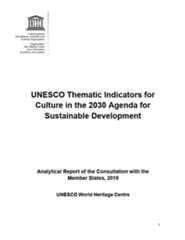
First Consultation on the UNESCO Thematic Indicators for Culture in the 2030 Agenda for Sustainable Development by Member States, 2019
The Culture Sector gratefully acknowledges the work of the Member States in carefully preparing their detailed and meticulous responses and the numerous individuals and organizations who have contributed to the consultation. The Member States of UNESCO, their delegations and the relevant ministries, and agencies in each of the responding countries have provided valuable inputs to the survey. The Culture Sector gratefully acknowledges the contribution of the UNESCO Institute of Statistics as well as the Secretariats of the Six Culture Conventions and Recommendations.
The summary of the consultation outcomes is included in an Information Document for the occasion of the 207th session of the Executive Board,
(9 - 23 October 2019).
Resources
The Publication
TheUNESCO Culture|2030 Indicators was launched on the occasion of the Culture of Ministers Forum on 19th November 2019 with more than 120 Ministers of Culture (over 900 participants).The final publication is available online inEnglish,French,Arabic,Spanish, Chinese,Russian andThai.
Read the publication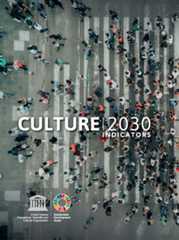

Implementation Video
The video presents the main five steps for the implementation of theUNESCO Culture|2030 Indicators and it is available online inEnglish,French,Arabic, andSpanish.
Viewthe video
Technical Resources
UNESCO Institute for Statistics (UIS)
TheUNESCO Culture|2030 Indicators has been developed in collaboration with the UNESCO Institute for Statistics (UIS).
Visit UIS
UNESCO Culture for Development Indicators (CDIS)
TheUNESCO Culture|2030 Indicators builds on the past achievements of the CDIS.
Learn more
Related frameworks


Links