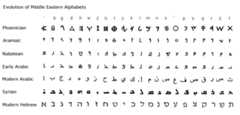
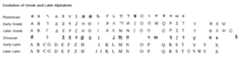
All the letters were for consonants, which is reasonable for Semiticlanguageslike Phoenician, Hebrew, Arabic, and even Egyptian. Even aleph andayin actually represent the glottal sounds that preceded the A's. Greek(and most other languages) desperately need to represent vowels aswell,so they took a few of the consonants they didn't need, and turned themintovowels -- aleph being the obvious example. They then added a fewsymbolsof their own to represent extra sounds they needed. Three unusedletterswere retained in the Greek numbering system.
The Phoenicians, like the Hebrews and Arabs today, wrote from right toleft. The Greeks originally did the same, then changed to a systemwherethey changed direction every line, and finally to the present system ofleftto right. This has passed down to all the modern European alphabets.
The Latin alphabet, ancestor of most western European alphabets, isderivedfrom the Greek, but was also influenced by the nearby Etruscan versionofthe alphabet. Over the centuries, extra letters were invented byvaryingolder ones, or reintroducing Greek letters such as K and Y. Itwasn'tuntil the middle ages that small letters came into being, usually basedonmore cursive versions of the capital letters.
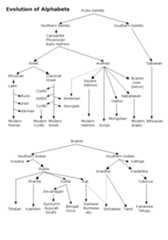
The alphabets of south and southeast Asia are all derived from theBrahmi alphabet, which in turn is loosely based on the Aramaic. With a far greater number of consonants, the ancient Indians createdmany of their letters, and organized them phonetically. Thecreativity continued as the idea moved eastward, and many of the lateralphabets bear little resemblance to the earlier ones(see below).
Another way in which alphabets have developed involves the creativity of one or two specific inventors. Examples incluid the pre-cyrillic alphabet glagolitic, and the alphabets for Armenian and Georgian:
Theonlyindependently invented "true" alphabet is the beautiful Koreanhangul. One very noticable feature is that the letters are arranged to fit inside a "box". For example, la Korean word for honeybee (kkulbeol) is written as 꿀벌, not ㄲㅜㄹㅂㅓㄹ.
There are also a number of syllabaries (where each symbolrepresents a syllable rather than a single phoneme) that wereindependently invented, including two for Japanese, one for Cherokee,and one for the Cree and Inuit of Canada.


Examples of the variety of Brahmi-derivedscripts of south and southeast Asia:

