
COLLECTED BY
Collection:Wikipedia Eventstream Outlinks
TIMESTAMPS


* The first development in the Wizard War was radar. Although most of themajor combatants discovered radar at almost the same time, the British wereleaders in realizing its potential. By the outbreak of war, Britain had afully operational air-defense system based on radar, and was exploiting radarin other applications.
* World War I had introduced electronics to combat in the form of radio, aswell as the "radio direction finding (RDF)" systems the British used tolocate German ships and submarines at sea. World War I electronics systemswere crude, clumsy, and unreliable, but after the war great progress was madein the art.
The evolution of electronics in warfare was accelerated by the parallelevolution of combat aircraft, particularly bombers. Aerial bombing was notmuch more than a military nuisance during World War I, but after the warbombers became bigger and faster, with heavier bombloads and longer range.Many strategic thinkers began to believe bombers could be the decisive factorin the "next war".
The only means of detecting attacking bombers was with ground spotternetworks, sometimes augmented by listening horns. As bombers became faster,such means of detection were obviously inadequate to give timely warning ofattacks and permit an effective defense. In 1932, British Prime MinisterStanley Baldwin, in an address to Parliament, said there was no hope ofdefense against bombers: "The bomber will always get through." The only wayto prevent such attacks, in this view, was to have the capability toretaliate in kind. This prediction seemed to be borne out by British RoyalAir Force (RAF) air exercises in July 1934, when at least half the day bomberattacks in the maneuvers managed to reach their targets without beingattacked by fighters.
The Nazi aerial bombings of Spanish cities during the Spanish Civil War in1936 were a shock to the public. As a wider war approached, the raids ledEuropean governments to fear that waves of enemy bombers would level theircities with a rain of bombs.
* Not everyone in the British Air Ministry felt that the bomber would alwaysget through. In June 1934, a junior Air Ministry official named A.P. Rowewent through whatever he could find on plans for the air defense of Britain,and was disturbed to learn that although work was going into development ofimproved aircraft, little other work was being done to consider a broaddefensive strategy. Rowe wrote a memo to his boss, H.E. Wimperis, explainingthe situation and saying that the lack of adequate planning was likely toprove catastrophic.
Wimperis took the memo very seriously, and did the natural and properbureaucratic thing: he proposed that the Air Ministry set up a committee toinvestigate new technologies for defense against air attacks. Wimperissuggested that the committee be led by Sir Henry Tizard, a prestigiousOxford-trained chemist, rector of the Imperial College of Science &Technology. The "Committee for the Scientific Survey of Air Defense (CSSAD)"was duly formed under Tizard's direction, with Wimperis as a member and Roweas secretary.
Wimperis also independently investigated other possible new militarytechnologies. The Air Ministry had a standing prize of a thousand pounds tobe awarded to anyone who could build a death ray that could kill a sheep at180 meters (200 yards). The idea seems a bit silly in hindsight, but someBritish officials were worried that the Germans were working on such weapons,and Britain couldn't afford to be left behind. Some studies were done onintense radio and microwave beams, something along the lines of modern"electromagnetic pulse" weapons.
Wimperis contacted a Scots physicist named Robert Watson-Watt, supervisor ofa national radio research laboratory, to see what he thought about deathrays. Watson-Watt, a descendant of James Watt, inventor of the firstpractical steam engine, was a cheery, tubby man with lots of drive andintelligence, though he had an annoying tendency to talk on at length in aone-sided fashion. He had established a reputation for himself in developingradio systems to pin down the location of thunderstorms, which generate radionoise, by triangulation.
After some quick "back of the envelope" studies and conversations withmembers of his lab, Watson-Watt replied to Wimperis that he thought deathrays weren't very practical. The most powerful radio beams that could begenerated in those days wouldn't even make an enemy aircrew feel warm.However, Watson-Watt added that radio beams could be bounced off enemyaircraft to detect them, though not destroy them. Wimperis realized thatsuch a concept meshed neatly with the CSSAD's mandate, and ran the idea pastthe committee's members. They were interested, and in response Watson-Wattfleshed out his ideas in a memo dated 12 February 1935.
The memo outlined the basic physics involved, used simple calculations toshow the idea was well within the limits of possibility, and described howsuch a system could be implemented. Watson-Watt suggested that a network ofsuch "radio echo detection" systems could be built that would have a range ofup to 300 kilometers (185 miles). He also cautioned that the scheme he hadoutlined could determine the distance to an aircraft, but a practical systemwould also need to determine its "azimuth", or horizontal location, andaltitude as well.
The CSSAD was enthusiastic, but they needed a proof-of-concept demonstrationbefore they could pry development funds out of the British Air Ministry.Watson-Watt and his team worked overnight to improvise a radio detectionsystem, using a receiver to pick up the echo of transmissions from aconvenient BBC tower off a target. On 26 February 1935, the demonstrationsystem managed to pick up a Handley-Page Heyford bomber being used as a testtarget. The bomber flew through the beam and the reflected signal was easilyvisible. The demonstration impressed people in high places, particularly AirMarshal Hugh Dowding, known as "Stuffy" since he was notoriously humorless.On 13 April, the Air Ministry agreed to provide 12,300 pounds, a generous sumat the time, for development of the new radio echo detection system.
The group working on the concept searched for a name, and finally settled on"RDF", which strongly implied "radio direction finding" to the uninitiatedand helped ensure security. In 1941, they would rename the scheme"radiolocation".
In fact, there was a wide range of candidate names for the new technology.The US Army's Signal Corps called it "radio position finding (RPF)", whilethe US Army Air Corps called it "derax". The term "radar", an acronym for"Radio Detection And Ranging", was invented in 1940 by US Navy researchers,and wasn't adopted by the British until 1943. However, for the sake ofsimplicity, the term "radar" will be generally used in the rest of thisdocument. Incidentally, some sources claim the Australians called it a"doover" -- but this appears to be a misunderstanding, "doover" being an oldAustralian slang term along the lines of the Yank term "thingamajig" or"wachamacallit" that could be applied to almost anything.
* The BBC transmitter used in the proof-of-concept test could only send out acontinuous signal. Watson-Watt's scheme actually specified that thetransmitter send out a short pulse. Half the time delay between thetransmission and reception of the pulse, multiplied by the speed of light(300,000 kilometers / 186,000 miles per second) would give the range to thetarget. The time delay would be very short, but it could be measured usingan oscilloscope.
The oscilloscope would be connected to the receiver to display the pulse echoon its "cathode ray tube (CRT)", essentially much like a modern TV picturetube. The oscilloscope's sweep would be triggered when the transmitter sentthe pulse. The farther away the target was, the longer the delay would bebetween transmission and reception of the pulse, and this delay could bemeasured by the distance of the pulse across the oscilloscope screen. Thescreen could be directly calibrated with the appropriate distance markings.This sort of radar display became known as an "A-scope"
The idea behind pulsed radar was straightforward, and in fact Watson-Watt wasnot the first to come up with it. Crude radars had been around for decades.A radar had been demonstrated and patented by a German engineer namedChristian Huelsmeyer as far back as 1904. Although Huelsmeyer's radargenerated a periodic output using a spark gap transmitter, it was not apulsed radar as described above since he had no means of electronicallytiming the echo. It could simply detect that something was there and ring abell, though Huelsmeyer was able to use the location of his transmitter,knowledge of the configuration of a target, and a little rough geometry toobtain crude range estimates. The spark gap was used simply becauseHuelsmeyer had no other reasonable way of obtaining an output of adequatepower at the time.
A comparable crude radar, using a continuous-wave oscillator, was invented in1922 by two US Navy researchers, Albert Hoyt Taylor and Leo C. Young, butthey dropped the idea for over a decade. By 1934, Germany, Italy, the SovietUnion, France, and other countries had all demonstrated primitive continuouswave radar systems. There was also some tinkering with "interferencedetectors" that had a widely separated transmitter and receiver and couldsense an aircraft flying through the beam between the two. As withHuelsmeyer's radar, these systems could detect that something was there, butcould not give a direct estimate of its range. A continuous wave radar couldbe used to find range by varying the frequency of the signal, but such"frequency modulation" techniques were still being developed at the time.
Watson-Watt's proof-of-concept demonstration with an improvised continuouswave system was basically just showmanship, and anyone with real knowledge ofsuch ideas would have laughed at it as trivial. However, the number ofpeople who knew enough to laugh were few in number, and Watson-Watt'saudience appears to have been suitably impressed. After all, it did get thebasic idea across: radio waves could be used to spot airplanes.
Pulsed radar had to wait until the invention of electronic pulse generationand pulse timing circuitry made it possible. Once those tools wereavailable, development of a pulsed radar system was a fairly obvious nextstep, and the British weren't the only ones on to the idea. In the early1930s Taylor and Young, then at the Naval Research Laboratory (NRL) inWashington DC, also came up with the idea of pulsed radar. Taylor assignedone of his engineers, Robert Page, to implement a demonstration system, andin December 1934, Page's demonstration system detected a small airplaneflying up and down the Potomac.
The Americans had actually beaten the British to the first demonstration ofpulsed radar by several weeks. However, the British were the first to graspradar's potential, quickly envisioning a national network of radar stationsto provide advance warning of an attack. That gave Britain a step ahead inwhat would turn into a race for electronic supremacy.
BACK_TO_TOP* Robert Watson-Watt decided to establish a radar development team stationedat an isolated and deserted airfield on a coastal isthmus at Orfordness, inSuffolk, where the work could be conducted without attracting much notice.There were four people on the team, which was led by Arnold F. "Skip"Wilkins, who had done much of the "grunt work" for Watson-Watt since thebeginning of the radar investigation. A bright young Welshman named EdwardBowen, with a fresh doctorate from King's College, became Wilkins' right-handman. Watson-Watt dropped by almost every weekend to keep up with theirprogress.
After intense brainstorming, late night sessions, and hard work, the teamfinally came up with a workable radar system in June 1935. The transmitterarray consisted of two tall towers with antenna wires strung between them,while the receiver array consisted of two similar arrays arranged inparallel. By July, the team was able to detect aircraft flying welloffshore. They worked to drive down the radar's operating wavelength toavoid interference with commercial radio transmissions, reducing it from anoriginal wavelength of 26 meters (a frequency of 11.5 megahertz / MHz) to 13meters (23.1 MHz).
Early on, the RDF team had thought that the signal should have a wavelengthcomparable to the size of the bombers they were trying to detect in order toobtain a resonance effect, but this bought little in practice. Shorterwavelengths would reduce interference and provide greater accuracy, but forthe moment it was difficult to generate radio waves with adequate power atshort wavelengths. The team also developed schemes to allow determination ofazimuth and altitude.
By September 1935, the system had matured to the level where it could be putinto operational service. The government authorized the construction of aninitial network of five radar stations. The research project expanded, andquickly outgrew the primitive facilities at the Orfordness airfield.
Watson-Watt searched the Suffolk coast for a more capable facility that stillhad a degree of isolation, and found a coastal estate named "Bawdsey Manor",which the government purchased before the end of the year. Although BawdseyManor was a bit run-down, it was still incredibly luxurious in comparison tothe primitive accommodations at Orfordness, with such extravagances as apipe organ and a billiards table. The government hadn't wanted to keep thebilliards table, but Eddie Bowen bought it from the previous owners for 25pounds, and it stayed put.
The move to Bawdsey Manor was complete by May 1936. By August 1936 the staffwas up to 20 people, including a sharp young physics student from ImperialCollege named Robert Hanbury Brown. Watson-Watt focused on recruitingscientists for the effort, which encouraged "thinking outside the box", butlater on the researchers would be embarrassed to find out that theirelectronic designs were naive by industry standards. They were, however, abright and energetic group, and Watson-Watt proved to be a fine and respectedtechnical manager who got the best out of them.
Most of the work was on developing the network of radar stations, which werenamed "Chain Home (CH)", though in 1940 they would also be assigned theformal designation "Air Ministry Experimental Station (AMES) Type 1". Bowenalso worked in a part-time fashion on a pet project, a radar system thatcould be carried by an aircraft. Work on Chain Home didn't go well throughthe rest of 1936. After a disappointing demonstration in September thatprovoked strong criticisms from Tizard, the group redoubled its efforts.
By April 1937, Chain Home was working much more reliably and was detectingaircraft 160 kilometers (100 miles) away. By August 1937, three CH stationswere in operation, one at Bawdsey itself, and the other two at Canewdon andDover, with the network blanketing the western approaches to London.
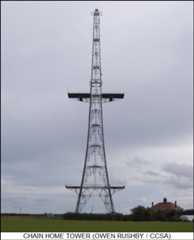
* The stations could be tuned to four different wavelength bands in the rangefrom 15 meters to 10 meters (20 MHz to 30 MHz). The bandwidth could be setto 500 kilohertz (kHz), 200 kHz, or 20 kHz. A CH station did not look like amodern radar station, instead resembling a "farm" of radio towers. Therewere four (later reduced to three) metal transmitter towers in a line, andfour wooden receiver towers arranged in a rhomboid pattern.
The transmitter towers were about 107 meters (350 feet) tall and spaced about55 meters (180 feet) apart, with cables strung from one tower to the next tohang a "curtain" of horizontally positioned half-wave transmitter dipoles,transmitting horizontally polarized radio waves. The curtain included a mainarray of eight horizontal dipole transmitting antennas above a secondary"gapfiller" array of four dipoles. The gapfiller array was required becausethe main transmitter array had a "hole" in its coverage at low angles. Theoperator could switch between the two arrays as needed.
The transmitting antenna arrangement not only simplified construction, it wasalso felt that a horizontally polarized wave would give a better indicationon an aircraft, which was a horizontal target when in normal flight. Theoutput stage of the transmitters used special tetrode "valves" (vacuum tubes)built by Metropolitan Vickers of the UK that were water cooled. An air pumpsystem was used to maintain a vacuum in these valves, permitting them to beopened up so the filaments could be replaced when they burned out. Acomplete backup transmitter unit was provided to ensure that the radar stayedin operation at all times.
The wooden towers for the receiving arrays were shorter, about 76 meters (250feet) tall. Each wooden receiving tower initially featured three receivingantennas, in the form of two dipoles arranged in a cross configuration,spaced up the tower. Additional crossed dipoles would be fitted later in thewar to deal with German jamming.
The transmitter did not send out a nice narrow beam, instead pouring outradio waves over a wide swath like a floodlight. The direction of the echoesreturning to the receiving towers could be determined by comparing therelative strengths of the echoes picked up by different crossed dipoles.Comparison of the receiving strength between crossed dipoles on differenttowers gave the horizontal angle to the target, while comparison of thereceiving strength between the crossed dipoles arranged vertically on a towergave the vertical angle. Only the two top dipoles on each tower were used todetermine the horizontal direction, while all three were used to determinethe vertical direction. The receiver design owed much to Watson-Watt's oldlightning location system.
The pulse width was very long by radar standards, ranging from 6 to 25microseconds, which meant a corresponding uncertainty in the range of atarget. Even a 6-microsecond pulse of radio energy, traveling at 300,000kilometers per second (186,000 miles per second), is 1.8 kilometers (over amile) long, leading to at least that much uncertainty in the range of thetarget. Pulse power was high, with a peak power of 350 kilowatts (kW)initially, then 800 kW, and finally 1 megawatt (MW).
One of the major problems with Chain Home was false or "ghost" echoes fromdistant, fixed targets. If radar sent out a pulse and the echo didn'tcome back until after the radar sent out a second pulse, then the echo would seem to have come from the second pulse, indicating a target that wasvery close when it was really a long ways away. To work around the ghosts, alow pulse repetition frequency (PRF) of 25 Hz was used, allowing echoes to bereturned from targets up to 6,000 kilometers away before a second pulse wasemitted, ensuring that all the echoes from a pulse would be gone before thenext pulse was sent out. That was half the British power grid frequency of50 Hz, which allowed multiple stations to synchronize their pulse broadcasts,reducing mutual interference. The disadvantage of such a low PRF,ridiculously low in hindsight, was that it reduced the amount of energy theradar was throwing out to detect intruders, and correspondingly reduced theradar's sensitivity.
* Although the concept had its clever bits, Chain Home was a dead-end design.The floodlight scheme wasted transmitter power, since only a small fractionof the transmitter beam, if "beam" was exactly the right word for it, wouldstrike a target, much less be reflected back to the receiving antenna. Itwas also not very accurate. Range detection was good, to within a kilometeror two, but altitude determination was difficult, and azimuth estimates couldbe off as much as twelve degrees.
To achieve even that much required not only a lot of engineering work but alot of calibration, with the radar stations tracking RAF aircraft flying onpredetermined courses and operators logging the radar observations. Each CHstation required its own calibration, and each was eventually provided with asimple electronic analogue computer designed specifically for the task ofprocessing inputs along with the calibration data into something that couldbe used. The computer was known as a "fruit machine", a British expressionfor a slot machine; the computer had three rotating switches that werevaguely reminiscent of the three drums on a one-armed bandit. Despite allits limitations, Chain Home worked, and worked effectively, while continuedrefinements kept it effective for a surprisingly long time.
The RAF took over control of the Chain Home stations from the boffins, andalso developed a fighter-control network using radar and observer stations,of which much more is said later. Initial attempts in early 1938 to use theradar system to direct RAF fighters to discreetly intercept airliners didn'tgo very well, but everyone learned, and CH proved its usefulness during HomeDefense exercises in mid-1938. Ground controllers successfully directedinterceptors to their targets three-quarters of the time, in both day andnight conditions.
CH stations began to be set up overseas as well. Of course that meant thatthey had to be called "Chain Overseas (CO)" and not "Chain Home", and hadsome minor differences from CH.
* By that time, Watson-Watt was no longer in charge at Bawdsey Manor. He hadbeen promoted to a high-level technical management job at the Air Ministry inMay 1938, and direction of Bawdsey Manor passed on to A.P. Rowe, whose memoof four years earlier had put everything in motion.
Bawdsey staffers were not entirely happy about the change in management.Rowe was not a technical person and was a humorless, no-nonsense type. Inconsiderable compensation, however, he was conscientious with his people andhad a high regard for their abilities, if stuffy about the rules. He wasalso a very efficient administrator, and skilled at organizational politics.Finally, he believed in the unchained exchange of ideas, organizing "SundaySoviets" where staff could say what they liked and trade ideas, even crazyones, among themselves and with users in the military services.
BACK_TO_TOP* The inaccuracy of Chain Home led to Eddie Bowen's interest in airborneradar, which he named "Airborne Interception (AI)". CH was able to guidefighter pilots to the general vicinity of intruders, but it was up to thepilots to find and attack them after that. In clear weather the pilots couldsee intruders easily enough, but the weather in the UK doesn't stay clear forlong, and of course the pilots were almost helpless at night. Bowen feltthat AI would help them cut through the murk and the dark.
A more experienced engineer might have been reluctant to take on such a job.The electronics for a CH station filled up rooms and soaked up massiveamounts of electrical power, and both space and electrical power were at apremium on fighter aircraft. Another problem was that to keep antennas to asize that could be carried on a fighter, the operating wavelength had to besqueezed down to a meter or so. Finally, an AI set was essentially fieldcombat gear, and so it had to be rugged, reliable, and easy to use.
Although Bowen had been forced to set his AI project aside while he hammeredout the bugs in Chain Home, he was able to return to it as the stations cameon line. His objective was an airborne radar system that would weigh no morethan 100 kilograms (220 pounds), consume no more than 500 watts, and useantennas no longer than a meter (3 feet 3 inches).
Initial experiments were conducted in June 1937 with a system operating at6.7 meters (44.8 MHz), a selection prompted by the availability of a new,very compact and effective, EMI-built television receiver that operated atthat wavelength. Bowen modified the receiver for his purposes, installingthe kit on a Heyford bomber. The bomber didn't carry a transmitter, insteadpicking up signals broadcast by a ground station. The receiver system onboard the bomber was to pick up the ground transmitter pulses and the echoesand try to make sense of them. Bowen was enthusiastic about the scheme, butit was tricky to get to work, and Watson-Watt told him to give up on it.
However, the idea was basically sensible in itself, if far beyond thetechnology of the time. Building a "bistatic" radar with separate fixedtransmitter and receiver was straightforward, and in fact it was a commonconfiguration for early radars, including Chain Home. Using a fixedtransmitter and moving receiver would require capabilities that wouldn't beavailable in the lifetimes of the Bawdsey researchers.
Bowen went back to the drawing board and managed to put together a full AIset, using miniaturized "acorn" vacuum tubes developed by the RadioCorporation of America (RCA), and operating at 1.5 meters (200 MHz). Somesources claim this initial set operated at 1.25 meters (240 MHz), but if sodevelopment quickly switched to the longer wavelength.
Bowen was visiting his parents in Wales when the AI set was given its firstflight test in a twin-engine Avro Anson utility aircraft on 17 August 1937.The test didn't detect any aircraft, but spotted a few ships. Thisimmediately turned the focus of the airborne radar project from AI toairborne ocean surveillance, or what was termed "Air to Surface Vessel(ASV)". Watson-Watt quickly proposed that Bowen's airborne radar be used toobserve Royal Navy maneuvers, which began on 6 September 1937. Eddie Bowenwas part of the flight crew this time, and the tests were highly successful,with the radar finding warships in weather so foul that other aircraft hadbeen grounded.
BACK_TO_TOP* While Bawdsey worked on different radar technologies and the RAF organizedthe air defense of Britain around Chain Home, the other British armedservices were conducting radar development on their own. The division ofefforts greatly annoyed Watson-Watt, who wanted to centralize all suchresearch in his own organization.
The Royal Navy had set up their effort at HM Signal School in Portsmouth in1935, making little progress until a new commandant was assigned to theschool in the summer of 1937. Official interest and support increaseddramatically, and work on the naval radar, the "Type 79", finally began toconverge towards a solution.
Although the Type 79 had originally been designed to operate at a wavelengthof 4 meters (75 MHz), development didn't really get rolling until thewavelength was switched to 7.5 meters (40 MHz). Generating signals at thatwavelength was less challenging, and it also allowed the Royal Navyresearchers to leverage off the same EMI television receiver technology usedby Bowen, which they may have learned about through the Royal Navy liaison atBawdsey Manor.
A prototype version of the Type 79 radar was successfully demonstrated inearly 1938. By the end of the year, the Type 79 had been installed on thebattleship HMS RODNEY and the cruiser HMS SHEFFIELD. It would be soonfielded on other vessels and be upgraded to the improved "Type 279".
The Type 79 and Type 279 were similar, both using separate transmitting andreceiving antennas mounted on their own masts but rotating insynchronization. The antennas were small, resulting in a wide beam, whichwas adequate for detecting aerial intruders at ranges of up to about 80kilometers (50 miles), but not so good at targeting naval vessels. It wasalso not very good at picking up low-flying aircraft.
* The need for more precise targeting led Royal Navy researchers to hastilydevelop a 1.5 meter (200 MHz) radar, the "Type 286", based on the technologyBowen had developed during his AI work. The initial "Type 286M" used a fixedantenna, meaning the ship had to change direction to point the radar beam.The Type 286M could pick up a surfaced submarine at a distance of no morethan a kilometer if the vessel carrying the radar was pointed in the rightdirection.
In March 1941, a Royal Navy destroyer managed to spot a German submarine atnight using the Type 286M and then rammed the submarine, sending it to thebottom. However, that was basically nothing more than a stroke of luck. A"Type 286P" with a steerable antenna would be introduced in mid-1941.
* The Royal Navy was working on a better solution even as the Type 286 wasgoing into service, in the form of a 50 centimeter (600 MHz) radar for navalgunfire direction. A prototype set was available by the end of 1938, and putthrough successful sea trials in mid-1939. Designs for a production set forsurface fire control, the "Type 284", and for anti-aircraft fire control, the"Type 285", were in place in 1940 and were being delivered to the Royal Navyin 1941.
Both the Type 284 and Type 285 used "Yagi" antennas, essentially a row ofdipoles of increasing size mounted on a rod, with the beam generated alongthe axis of the rod. The antennas, which workers also called "fishbones" fortheir appearance, were arranged at slightly different angles away from thecenterline of the radar, with each side driven in an alternating fashion.The returns to each side would be different until the target was on thecenterline. This technique, known as "lobe switching", could provide veryprecise azimuth angles.
Both the Type 284 and Type 285 had horizontal lobe-switching. It is unclearif the Type 285 had vertical lobe-switching, which would have been handy foran air-defense radar.
All radar users learned sooner or later that such a powerful tool was oflimited use without the proper procedures in place to make good use of it.Radar was a new thing and the Royal Navy had to learn by doing. At first,the Admiralty imposed strict limits on the use of radar, restricting it toone sweep every five minutes, in order to confound German radio directionfinding equipment. Captains soon began to ignore the restrictions since theusefulness of radar outweighed its liabilities, and eventually therestrictions were formally lifted. Resourceful Royal Navy officers began tosee the variety of things they might accomplish with radar, and began toorganize central electronic command posts on their vessels.
The value of radar would be proven on the night of 27 March 1941, when theBritish battleship VALIANT and the cruisers ORION and AJAX, all equipped withradar, jumped an Italian force consisting of three cruisers and fourdestroyers off the southern coast of Greece at Cape Matapan. All the Italianwarships, except for two of the destroyers, went to the bottom.
* The British Army also set up their own radar lab in October 1936, sited atBawdsey Manor, and directed by Dr. E.T. Paris and Dr. A.B. Wood. Theirinitial work was on a "Mobile Radar Unit (MRU)", which was basically aversion of Chain Home that could be bundled up and moved. It used much ofthe same electronics gear, but of course used transportable masts about 20meters (66 feet) tall -- instead of the big towers used by fixed-site CHstations -- and operated around 7 meters (42.9 MHz).
The MRU was picked up by the RAF in 1938, acquiring the formal designation of"AMES Type 9" in 1940. British Army researchers then moved on to thedevelopment of "Coastal Defense (CD)" sets to direct coastal artillery, and"Gun Laying (GL)" sets to direct anti-aircraft guns and searchlights.
The CD set was based on Bowen's AI work, operating at 1.5 meters (200 MHz).It was operational by the spring of 1939 and went into production soon after.It used a steerable antenna with lobe switching and had much better accuracy,though only half the range, of Chain Home. The CD set was put into servicewith air defense sites, as well as coastal defense sites, acquiring theformal designation of "AMES Type 2" in 1940.
It was quickly realized that the CD set could just as easily be used to pickup low-flying intruders that would escape CH. In August 1939, onWatson-Watt's recommendation, the Air Ministry decided to install one at eachChain Home station. In the air defense role, the set was known as "ChainHome Low (CHL)", with those used outside of Britain referred to as "ChainOverseas Low (COL)" or formally "AMES Type 5". It could be put on a tower toperform the functions of both CH and CHL. Early models of the CHL hadseparate transmit and receive antennas, and an A-scope display.
* The GL effort proved less impressive. About 400 GL Mark I sets were made,followed by about 1,600 GL Mark IIs. They were crude radars, operating at inthe band of from 5.5 to 3.5 meters (54.6 to 85.7 MHz). They were capable ofranging but not targeting, which still had to be done by eye. Thelimitations of GL reflected the entire army radar effort. For the firstyears of the war, the British Army lived up to the stereotype of stodginessthat the Air Ministry had transcended.
The GL Mark II did have its fans. When the Soviet Union joined the waragainst Hitler after the Nazi invasion of the USSR in June 1941, the Britishwould send the Soviets a large quantity of GL Mark IIs. While the Sovietshad developed relatively crude "RUS-1" and "RUS-2" fixed-station radar setsand fielded them in small numbers, the GL Mark II was simple, effective to adegree, and far better than anything else the Soviets had. They designatedthe set the "SON-2", produced a limited number themselves, and were givenhundreds of GL.IIs by the British. They would be handed improved Westernradars later.
* The South Africans also developed radar in parallel with British efforts.Dr. Basil Schonland, Director of the Bernard Price Institute in Johannesburg,learned about British radar from a highly-placed visitor in 1939. By the endof that year, the institute had developed a working experimental prototype.By March 1940, they had an operational coastal-defense set, designated "JB"for "Johannesburg", ready for service.
The JB operated at 3.5 meters (85.7 MHz) with a peak power of 5 kilowatts,and used a steerable dipole array. It was built entirely fromlocally-manufactured components. Improved versions of the JB would followSouth African forces to the Mediterranean.
BACK_TO_TOP* The deployment of radar as an operational system and not just anexperimental toy led the British to confront a problem that acquired thedesignation "identification friend or foe (IFF)". IFF was just what it said,figuring out who was friend and who was foe, so friends could shoot foes andnot shoot other friends.
IFF was a particular problem with aircraft. Picking out a proper target inthe sky during a fast-moving dogfight was difficult, and in the First WorldWar all the combatants had developed distinctive national insignia for theiraircraft to protect them from friends. Radar greatly compounded the IFFproblem, since a target appeared as no more than a featureless blip on ascreen. There had to be some way for the radar to perform IFF, and tocomplicate matters any scheme used should not reveal the aircraft's presenceor location to an enemy, or be easily duplicated by an enemy intruder.
Even before the introduction of radar, the RAF had developed a trackingsystem for directing fighters known as "Pip Squeak", which useddirection-finding stations to triangulate the position of a fighter based ona tone emitted by the fighter's radio for 14 seconds out of every minute,unless the pilot was talking over the radio.
The problem with Pip Squeak was that it wasn't easy to integrate with theradar network. It would be preferable to have an IFF on an aircraft that theradar itself could identify. In 1938, Bawdsey researchers had tinkered witha "passive" radar reflector mounted on fighters and tuned to Chain Homefrequencies as a means of marking friends. That was supposed to ensure thatfriendly fighters were brighter to CH than foes, but it was too simplistic anapproach. The magnitude of radar reflections depends not only on a largenumber of environmental factors but on the angle at which the radar beam hitsthe aircraft, and it proved impossible to consistently determine whichaircraft were carrying passive reflectors and which were not. Clearly, amore sophisticated "active" electronic IFF system was needed.
The result was "IFF Mark I", which was the first IFF "transponder". Onreceiving a radar pulse in the proper wavelength range, it would transmit aresponse pulse that rose in amplitude, allowing a radar operator to identifyit as belonging to a "friend". IFF Mark I went into operation in late 1939,with a thousand sets built. It was triggered by CH radar transmissions. Itwas, however, difficult to use, since aircrew had to adjust it in flight toget it to respond properly, and it didn't respond properly about half thetime.
It was quickly followed by "IFF Mark II", which had been in development evenbefore the introduction of Mark I. Mark II could respond not only to ChainHome signals, but also to 7-meter (42.9 MHz) signals from the MRU, the1.5-meter (200 MHz) signals of Chain Home Low and Navy sets, and the3.5-meter (86.7 MHz) signals of Army sets. Unfortunately, though it workedbetter than IFF Mark I, Mark II was overly complicated and still requiredinflight adjustments. IFF was a sticky problem and getting to work right wasgoing to take some effort.
Incidentally, the British designation "IFF" has stuck to the technology tothis day, probably because it was hard to think of any more sensible name tocall it. That partly compensates for the triumph of Yank terms like "radar"and "sonar" over the British terms "RDF" and "ASDIC".
BACK_TO_TOP