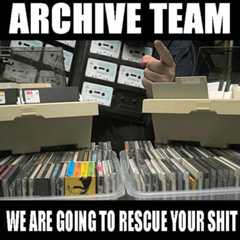
Formed in 2009, the Archive Team (not to be confused with the archive.org Archive-It Team) is a rogue archivist collective dedicated to saving copies of rapidly dying or deleted websites for the sake of history and digital heritage. The group is 100% composed of volunteers and interested parties, and has expanded into a large amount of related projects for saving online and digital history.
History is littered with hundreds of conflicts over the future of a community, group, location or business that were "resolved" when one of the parties stepped ahead and destroyed what was there. With the original point of contention destroyed, the debates would fall to the wayside. Archive Team believes that by duplicated condemned data, the conversation and debate can continue, as well as the richness and insight gained by keeping the materials. Our projects have ranged in size from a single volunteer downloading the data to a small-but-critical site, to over 100 volunteers stepping forward to acquire terabytes of user-created data to save for future generations.
The main site for Archive Team is atarchiveteam.org and contains up to the date information on various projects, manifestos, plans and walkthroughs.
This collection contains the output of many Archive Team projects, both ongoing and completed. Thanks to the generous providing of disk space by the Internet Archive, multi-terabyte datasets can be made available, as well as in use by theWayback Machine, providing a path back to lost websites and work.
Our collection has grown to the point of having sub-collections for the type of data we acquire. If you are seeking to browse the contents of these collections, the Wayback Machine is the best first stop. Otherwise, you are free to dig into the stacks to see what you may find.
The Archive Team Panic Downloads are full pulldowns of currently extant websites, meant to serve as emergency backups for needed sites that are in danger of closing, or which will be missed dearly if suddenly lost due to hard drive crashes or server failures.
This category looks at the impact of explosive violence in Ukraine since 2014. In that time, of all civilian casualties by explosive weapon use recorded, 88% were in populated areas.
At least three people were killed and 19 injured in a Russian airstrike on schools in Novhorod-Siverskyi, Chernihiv, on Thursday 12 May. Russian troops reportedly fired several missiles at a school and boarding school, damaging an administrative building and some residential houses in the ensuing fire.
The siege of Mariupol is proving to be one of the deadliest episodes in Russia’s invasion of Ukraine, with the lack of definitive data on casualties proving to be a “big black hole” in terms of accessing corroborated information. On 16 March 2022, a Russian airstrike hit the theatre in Mariupol, causing the roof and some of the exterior walls to collapse inwards. Communications were disrupted and there were conflicting reports on survivors. For many days, authorities were unable to provide a casualty count, but on 25 March they confirmed, from witness reports, that around 300 people had been killed. This made the airstrike the deadliest attack since the beginning of the invasion. However, since then, Associated Press (AP) have come forward with revised evidence, suggesting that the death count is closer to 600. The strike on Mariupol’s theatre remains the single deadliest attack against civilians during Russia’s war on Ukraine.
At least 62 people were killed in a Russian airstrike on a school, on Saturday 7 May 2022. 90 people were using the school as a shelter in the village of Bilohorivka, and following the strike, 30 have been pulled from the rubble.
On the morning of 8 April 2022, two powerful rockets struck Kramatorsk railway station, killing at least 39 people and injuring 87 more, most of whom were families of women, children, and the elderly.
AOAV is proud to be one of the endorsing NGOs for the Civil Society Statement on the Protection of Civilians in Urban Conflicts, ahead of the UN's annual open debate on the protection of civilians (POC) in armed conflict. Over the past year, the devastating impact of urban warfare on civilians has been made increasingly clear, especially the parallel direct and indirect, short-term and long-term nature of urban warfare's effects on civilians and civilian infrastructure.
On the evening of Thursday 12 May, one person was killed and 13 were injured when an IED exploded in Karachi, Pakistan. The bombing was reportedly targeting a van carrying Pakistan security forces in the city’s Saddar neighbourhood. Two members of the security forces were amongst the injured. The rest of the casualties were civilians.
At least four people were killed and seven injured in a suicide attack near Mogadishu airport, on Wednesday 11 May 2022. Two security personnel are amongst the dead. The attack took place at the site of Somalia’s upcoming presidential election, which is to be held on Sunday.
Dr Matthew Spreadbury is a surgery resident currently living and working in Norway. Here, he shares with us his experiences working as a surgeon in Myanmar, performing emergency and trauma response interventions for civilians injured by explosive weapons in Karenni State. He shares a story of pain and catastrophic human impact, but also of hope.
This category looks into militaries and militarism, with a focus on Great Britain. From how the UK became one of the world’s leading arms exporters, to why we continue to export to nations with serious human rights concerns, to investigations into the UK’s armed forces, it seeks to challenge the contradictions and failures of British militarism, and the failure of other nations militaries, today.
New data about the lack of black representation in top army positions raises concerns about how much the British military reflects the population it serves to protect
Russia has been accused of planning to use thermobaric weapons - vacuum bombs - in its attack of Ukraine. This article examines what these weapons are.
The impact of explosive violence on children is devastating and commonplace. This section examines the short- and long-term effects of explosive weapon use on children around the world.
Since the 10 May, at least 75 children have been reported killed in the Gaza strip and in Israel. Their deaths were mostly by explosive weapons. 73 of these children were killed in Gaza. 2 were killed in Israel.
We know that when explosive weapons are used in populated areas over 90% of those killed or injured will be civilians. What is less known is the impact on men and women from such violence. AOAV here examines explosive violence in its different forms, looking especially at its gendered impact on communities
Afghanistan continually ranks among the most dangerous places in the world to be a civilian. The psychological impact of this on Afghani civilians is profound.
Since 2011, AOAV has been recording the global harm wrought by explosive weapons on civilians. Through monitoring English language media reports, we demonstrate consistent patterns of harm arising from the use of explosive violence, in particular their effects on civilian populations. These reports are issued annually with monthly updates.
In April 2022, Action on Armed Violence recorded 2, 143 deaths and injuries from 237 incidents of explosive violence around the world, as reported in English-language media. Civilians accounted for 80% (1, 722) of the deaths and injuries recorded.
In March 2022, Action on Armed Violence recorded 2,856 deaths and injuries from 216 incidents of explosive violence around the world, as reported in English-language media. Civilians accounted for 73% (2,074) of the deaths and injuries recorded.

 Formed in 2009, the Archive Team (not to be confused with the archive.org Archive-It Team) is a rogue archivist collective dedicated to saving copies of rapidly dying or deleted websites for the sake of history and digital heritage. The group is 100% composed of volunteers and interested parties, and has expanded into a large amount of related projects for saving online and digital history.


