
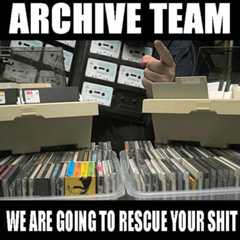
 Formed in 2009, the Archive Team (not to be confused with the archive.org Archive-It Team) is a rogue archivist collective dedicated to saving copies of rapidly dying or deleted websites for the sake of history and digital heritage. The group is 100% composed of volunteers and interested parties, and has expanded into a large amount of related projects for saving online and digital history.

Web 2.0
Our editors will review what you’ve submitted and determine whether to revise the article.
JoinBritannica's Publishing Partner Program and our community of experts to gain a global audience for your work!Web 2.0, term devised todifferentiate the post-dotcom bubbleWorld Wide Web with its emphasis onsocial networking, content generated by users, andcloud computing from that which came before. The 2.0 appellation is used inanalogy with commoncomputersoftware naming conventions to indicate a new, improved version. The term had its origin in the name given to a series of Web conferences, first organized by publisherTim O’Reilly in 2004. The term’s popularity waned in the 2010s as the features of Web 2.0 becameubiquitous and lost their novelty.
At the first conference in 2004, the term was defined by “the web as platform.” This, however, was augmented the following year with a still morenebulous expression incorporating the idea ofdemocracy anduser-driven content, especially as mediated by theInternet. In particular, many of the most vocal advocates of the Web 2.0 concept had an almost messianic view of harnessingsocial networking for business goals.

One of the most influential concepts of democratization was due toChris Anderson, editor in chief ofWired. In “The Long Tail,” an article from the October 2004Wired, Anderson expounded on the new economics of marketing to theperiphery rather than to the median. In the past, viable business models required marketing to the largest possibledemographic. For example, when there were fewtelevision networks, none could afford to run programs that appealed to a limited audience, which led to the characteristic phenomena of programming aimed at the lowest common denominator. With the proliferation of satellite andcable networks, however, mass marketing began to splinter into highly refined submarkets that cater better to individual tastes.
Similarly, where traditional brick-and-mortar bookstores could afford to stock and display only a limited range of titles, Internet bookstores such asAmazon discovered that total sales ofniche titles actually exceed those of mass-market best sellers. The vast quantity of niche books makes up for the greater sales of a few popular titles—makes up, that is, in the new digitalenvironment ofe-commerce, where counter space is no longer limited.
Amazon.com was also a leader in adopting user-created content. One of the appeals to shopping at Amazon’s site was the inclusion of amateur book reviews, with users being able to leave personal perspectives and interact with other reviewers. An even more successful business example of user-created content came fromelectronic games. Many companies found that, by including simple programming tools with their games, ordinary gamers could create modifications, or mods, and new scenarios that generate as much or more interest as the original game and thereby extend its lifetime sales. This strategy proved especially effective in conjunction with Web sites that host players’ games and forums for exchanging ideas and files.
An exact definition of Web 2.0 proved ratherelusive, in part because the conceptencompassed different goals and expectations for the future of the Internet and of electronic publishing in general. A leading critic of the Web 2.0 concept was Web inventorTim Berners-Lee, who pointed out that
Web 1.0 was all about connecting people. It was an interactive space, and I think Web 2.0 is of course a piece of jargon, nobody even knows what it means. If Web 2.0 for you isblogs andwikis, then that is people to people. But that was what the Web was supposed to be all along.
That is, social networking had always been central to the Web, for, according to Berners-Lee,
Web 2.0…means using the standards which have been produced by all these people working on Web 1.0. So Web 2.0…means moving some of the thinking client side so making it more immediate, but the idea of the Web as interaction between people is really what the Web is. That was what it was designed to be as a collaborative space where people can interact.
In contrast, Berners-Lee advocated the development of theSemantic Web, which some visionaries call part of Web 3.0.