
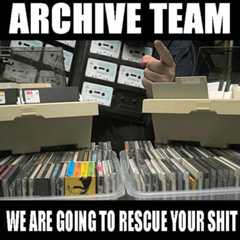
 Formed in 2009, the Archive Team (not to be confused with the archive.org Archive-It Team) is a rogue archivist collective dedicated to saving copies of rapidly dying or deleted websites for the sake of history and digital heritage. The group is 100% composed of volunteers and interested parties, and has expanded into a large amount of related projects for saving online and digital history.

cloud computing
Our editors will review what you’ve submitted and determine whether to revise the article.
JoinBritannica's Publishing Partner Program and our community of experts to gain a global audience for your work!
cloud computing, method of running application software and storing related data in central computer systems and providing customers or other users access to them through theInternet.
Early development
The origin of the expressioncloud computing is obscure, but it appears to derive from the practice of using drawings of stylized clouds to denote networks in diagrams of computing and communications systems. The term came into popular use in 2008, though the practice of providing remote access to computing functions through networks dates back to themainframetime-sharing systems of the 1960s and 1970s. In his 1966 bookThe Challenge of the Computer Utility, the Canadian electrical engineer Douglas F. Parkhill predicted that the computer industry would come to resemble apublic utility “in which many remotely located users are connected via communication links to a central computing facility.”

For decades, efforts to create large-scale computer utilities were frustrated by constraints on the capacity oftelecommunications networks such as the telephone system. It was cheaper and easier for companies and other organizations to store data and run applications on private computing systems maintained within their own facilities.
The constraints on network capacity began to be removed in the 1990s when telecommunications companies invested in high-capacityfibre-optic networks in response to the rapidly growing use of the Internet as a shared network for exchanging information. In the late 1990s, a number of companies, calledapplication service providers (ASPs), were founded to supply computer applications to companies over the Internet. Most of the early ASPs failed, but their model of supplying applications remotely became popular a decade later, when it was renamed cloud computing.
Cloud services and major providers
Cloud computingencompasses a number of different services. One set of services, sometimes calledsoftware as a service (SaaS), involves the supply of a discrete application to outside users. The application can be geared either to business users (such as an accounting application) or to consumers (such as an application for storing and sharing personal photographs). Another set of services, variously called utility computing, grid computing, and hardware as a service (HaaS), involves the provision of computer processing and data storage to outside users, who are able to run their own applications and store their own data on the remote system. A third set of services, sometimes called platform as a service (PaaS), involves the supply of remote computing capacity along with a set of software-development tools for use by outside software programmers.
Early pioneers of cloud computing includeSalesforce.com, which supplies a popular business application for managing sales and marketing efforts;Google, Inc., which in addition to itssearch engine supplies an array of applications, known asGoogle Apps, to consumers and businesses; and Amazon Web Services, a division of online retailerAmazon.com, which offers access to its computing system to Web-site developers and other companies and individuals. Cloud computing also underpins popularsocial networks and other online media sites such asFacebook,MySpace, andTwitter. Traditional software companies, includingMicrosoft Corporation,Apple Inc.,Intuit Inc., andOracle Corporation, have also introduced cloud applications.
Cloud-computing companies either charge users for their services, through subscriptions and usage fees, or provide free access to the services and charge companies for placing advertisements in the services. Because the profitability of cloud services tends to be much lower than the profitability of selling or licensing hardware components and software programs, it is viewed as a potential threat to the businesses of many traditional computing companies.
Data centres andprivacy
Construction of the large data centres that run cloud-computing services often requires investments of hundreds of millions of dollars. The centres typically contain thousands ofserver computers networked together into parallel-processing or grid-computing systems. The centres also often employ sophisticated virtualization technologies, which allow computer systems to be divided into many virtual machines that can be rented temporarily to customers. Because of their intensive use of electricity, the centres are often located near hydroelectric dams or other sources of cheap and plentifulelectric power.
Because cloud computing involves the storage of often sensitive personal or commercial information in centraldatabase systems run by third parties, it raises concerns about data privacy and security as well as the transmission of data across national boundaries. It also stirs fears about the eventual creation of data monopolies or oligopolies. Some believe that cloud computing will, like other public utilities, come to be heavily regulated by governments.
Nicholas Carr