
Movatterモバイル変換


[0]ホーム

URL:


Wayback Machine
700 captures
04 Jan 2021 - 12 Feb 2026
DecJANFeb
23
202020212022
success
fail
COLLECTED BY
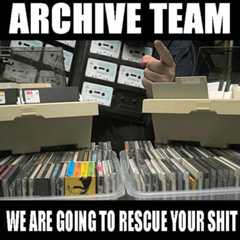
Organization:Archive Team
Formed in 2009, the Archive Team (not to be confused with the archive.org Archive-It Team) is a rogue archivist collective dedicated to saving copies of rapidly dying or deleted websites for the sake of history and digital heritage. The group is 100% composed of volunteers and interested parties, and has expanded into a large amount of related projects for saving online and digital history.

History is littered with hundreds of conflicts over the future of a community, group, location or business that were "resolved" when one of the parties stepped ahead and destroyed what was there. With the original point of contention destroyed, the debates would fall to the wayside. Archive Team believes that by duplicated condemned data, the conversation and debate can continue, as well as the richness and insight gained by keeping the materials. Our projects have ranged in size from a single volunteer downloading the data to a small-but-critical site, to over 100 volunteers stepping forward to acquire terabytes of user-created data to save for future generations.

The main site for Archive Team is atarchiveteam.org and contains up to the date information on various projects, manifestos, plans and walkthroughs.

This collection contains the output of many Archive Team projects, both ongoing and completed. Thanks to the generous providing of disk space by the Internet Archive, multi-terabyte datasets can be made available, as well as in use by theWayback Machine, providing a path back to lost websites and work.

Our collection has grown to the point of having sub-collections for the type of data we acquire. If you are seeking to browse the contents of these collections, the Wayback Machine is the best first stop. Otherwise, you are free to dig into the stacks to see what you may find.

The Archive Team Panic Downloads are full pulldowns of currently extant websites, meant to serve as emergency backups for needed sites that are in danger of closing, or which will be missed dearly if suddenly lost due to hard drive crashes or server failures.

ArchiveBot is an IRC bot designed to automate the archival of smaller websites (e.g. up to a few hundred thousand URLs). You give it a URL to start at, and it grabs all content under that URL, records it in a WARC, and then uploads that WARC to ArchiveTeam servers for eventual injection into the Internet Archive (or other archive sites).

To use ArchiveBot, drop by #archivebot on EFNet. To interact with ArchiveBot, you issue commands by typing it into the channel. Note you will need channel operator permissions in order to issue archiving jobs. The dashboard shows the sites being downloaded currently.

There is a dashboard running for the archivebot process athttp://www.archivebot.com.

ArchiveBot's source code can be found athttps://github.com/ArchiveTeam/ArchiveBot.

TIMESTAMPS
loading
The Wayback Machine - https://web.archive.org/web/20210123174525/https://www.cia.gov/spy-kids/
Think you know the real CIA?

Secret gadgets? Sneaking around in trench coats? Danger around every corner? There’s a little of that, but the real CIA is more complex and interesting than you can imagine.

Arrow Down Icon
Pigeons as… spies?!

Yes we did! In one of our more “feather-brained” schemes, we sent pigeons out with secret cameras to gather intel during the Cold War. Learn more about these birdshere.

Who are we?

A lot of people think that CIA employees lurk around in trench coats, send coded messages, and use exotic equipment like hidden cameras and secret phones to do their job. (You know, all those things you see in movies or read about in spy novels.)

There’s a little of that, but that’s only part of the story. The CIA is a US government agency that provides information (what we call “intelligence”) on foreign countries to the President, the National Security Council, and other US government officials to help them make good decisions about national security issues.

We were created by President Harry S. Truman and the National Security Act of 1947. He wanted to create a central hub to coordinate all of America’s intelligence activities. That’s why we’re called the Central Intelligence Agency.

We are the Nation’s first line of defense. We accomplish what others cannot accomplish and go where others cannot go.

Where do we get our intelligence?

We collect intelligence from all kinds of places! Once we figure out an issue of national security concern to our government, we look for ways to collect information about that problem. We have tons of different methods for collecting intelligence, but a few big ones are: recruiting people in foreign countries to provide us with information; translating foreign newspapers, magazine articles, radio shows and TV programs; studying images taken by satellites; and cracking codes and secret messages sent by other countries.

After we collect the information, we have experts (called intelligence analysts) who try to figure out what is really happening, why it’s happening, what might happen next, and what it means for our country.

It’s like solving a giant jigsaw puzzle—except with a bunch of missing pieces, a bunch of extra pieces, and not knowing what the final image will be before you solve it.

Once our analysts have solved enough of the puzzle and have good answers to those questions, they provide their assessments to US government officials, sometimes even the President! It’s kind of like turning in a big research project or book report to your teacher at the end of the semester.

The government officials then use the information we provide to help them make policy toward other countries.

We can see in the dark

Night vision goggles are just one of the many cool inventions CIA uses on missions. In fact, we have secret gadgets so advanced, they’re classified.

Meet Virginia

She snuck behind enemy lines during WWII. She ran secret missions and was hunted by the Nazis. And she did it all with a wooden leg. Meet a true American hero,Virginia Hall.

We don’t make policy

One very important thing to remember is that we do not make policy or even make policy recommendations. That’s the job of the US executive branch, such as the State Department and the Defense Department. We provide these leaders with the best information possible to help them make policy involving other countries.

And although we have a lot of missions, we’re not a law enforcement organization. That’s the job of the FBI (Federal Bureau of Investigation) or your local police. But the CIA and the FBI do cooperate on many issues, such as counterintelligence (preventing our enemies from obtaining our secret information).

Something else that might surprise you about the CIA is that we are just regular people like you. Our work may be secret, but our lives are pretty normal. We have kids and pets, we exercise, watch movies, eat out, spend time with friends, and do volunteer work.

Want to learn some CIA secrets?

Explore our site and read the latest excitingstories at CIA and meet our cuddliestfour-legged spies. When you’re ready for a secret mission of your own, check out ourgames section. Help us crack codes, solve puzzles, and find secret clues to solve intelligence mysteries.

Click image to play k-9 video from YouTube

Pigeon ops

In the 1970s, we created a camera so tiny that a pigeon could carry it! The camera was strapped to the bird’s chest with a little harness, and the bird would be released over a secret area in a foreign country that we wanted to know more about. The camera would snap pictures as the bird flew back home to us.

Pigeons were perfect because they are such common birds! Who would ever think a pigeon was actually a secret spy-bird taking photographs for the CIA?

Be the hero of your story

Virginia Hall’s life reads like a spy movie. She worked for America’s first spy agency, the Office of Strategic Services, during WWII.

Virginia organized spy networks, assisted escaped prisoners of war, and provided essential information to help us win the war. She had to stay one step ahead of the Nazis, who desperately wanted to capture her.

For her cunning and courage, she was awarded the Distinguished Service Cross—the only civilian woman in America to be so honored.

After WWII, Virginia joined the CIA. She continued to work on secret operations, one of only a few women at the time to do so, until she retired in 1966. And she did it all despite having a prosthetic leg, which she named Cuthbert.


[8]ページ先頭

©2009-2026 Movatter.jp