
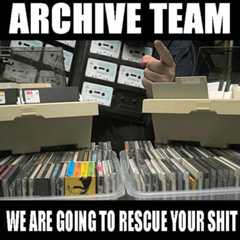
Formed in 2009, the Archive Team (not to be confused with the archive.org Archive-It Team) is a rogue archivist collective dedicated to saving copies of rapidly dying or deleted websites for the sake of history and digital heritage. The group is 100% composed of volunteers and interested parties, and has expanded into a large amount of related projects for saving online and digital history.History is littered with hundreds of conflicts over the future of a community, group, location or business that were "resolved" when one of the parties stepped ahead and destroyed what was there. With the original point of contention destroyed, the debates would fall to the wayside. Archive Team believes that by duplicated condemned data, the conversation and debate can continue, as well as the richness and insight gained by keeping the materials. Our projects have ranged in size from a single volunteer downloading the data to a small-but-critical site, to over 100 volunteers stepping forward to acquire terabytes of user-created data to save for future generations.
The main site for Archive Team is atarchiveteam.org and contains up to the date information on various projects, manifestos, plans and walkthroughs.
This collection contains the output of many Archive Team projects, both ongoing and completed. Thanks to the generous providing of disk space by the Internet Archive, multi-terabyte datasets can be made available, as well as in use by theWayback Machine, providing a path back to lost websites and work.
Our collection has grown to the point of having sub-collections for the type of data we acquire. If you are seeking to browse the contents of these collections, the Wayback Machine is the best first stop. Otherwise, you are free to dig into the stacks to see what you may find.
The Archive Team Panic Downloads are full pulldowns of currently extant websites, meant to serve as emergency backups for needed sites that are in danger of closing, or which will be missed dearly if suddenly lost due to hard drive crashes or server failures.
To use ArchiveBot, drop by #archivebot on EFNet. To interact with ArchiveBot, you issue commands by typing it into the channel. Note you will need channel operator permissions in order to issue archiving jobs. The dashboard shows the sites being downloaded currently.
There is a dashboard running for the archivebot process athttp://www.archivebot.com.
ArchiveBot's source code can be found athttps://github.com/ArchiveTeam/ArchiveBot.

| Legislator | ![]() | ![]() | Loyalty Index | Ranked | Letter Grade |
|---|---|---|---|---|---|
| Smith, Cary | 461 | 13 | 100 | 1 | A |
| Vance, Gordon | 456 | 14 | 98 | 2 | A |
| Sales, Scott | 449 | 23 | 84 | 3 | A |
| Regier, Keith | 447 | 23 | 84 | 4 | A |
| Hinebauch, Steve | 447 | 24 | 82 | 5 | A |
| Osmundson, Ryan | 417 | 25 | 78 | 6 | A |
| Fielder, Jennifer | 424 | 27 | 76 | 7 | A |
| Blasdel, Mark | 433 | 30 | 72 | 8 | B |
| Brown, Dee | 415 | 32 | 67 | 9 | B |
| Kary, Doug | 431 | 34 | 66 | 10 | B |
| Keenan, Bob | 423 | 35 | 63 | 11 | B |
| Howard, David | 427 | 36 | 62 | 12 | B |
| Webb, Roger | 427 | 36 | 62 | 13 | B |
| Lang, Mike | 427 | 38 | 59 | 14 | B |
| Vincent, Chas | 414 | 44 | 49 | 15 | C |
| Hinkle, Jedediah | 422 | 46 | 47 | 16 | C |
| Olszewski, Albert | 411 | 52 | 36 | 17 | C |
| Thomas, Fred | 390 | 50 | 35 | 18 | C |
| Moore, Frederick | 391 | 55 | 28 | 19 | C |
| Swandal, Nels | 383 | 70 | 5 | 20 | D |
| Fitzpatrick, Steve | 372 | 83 | -16 | 21 | F |
| Buttrey, Edward | 361 | 88 | -26 | 22 | F |
| Jones, Llew | 356 | 96 | -39 | 23 | F |
| Tempel, Russel | 340 | 112 | -65 | 24 | F |
| Richmond, Tom | 339 | 113 | -67 | 25 | F |
| Hoven, Brian | 328 | 111 | -69 | 26 | F |
| Ankney, Duane | 335 | 118 | -75 | 27 | F |
| Welborn, Jeffrey | 337 | 121 | -77 | 28 | F |
| Connell, Pat | 332 | 119 | -77 | 29 | F |
| Small, Jason | 321 | 117 | -80 | 30 | F |
| Gauthier, Terry | 317 | 117 | -81 | 31 | F |
| Salomon, Daniel | 314 | 131 | -100 | 32 | F |
More than 500 floor votes came up as partisan and were used for the calculations.
The numbers are automatically generated by legistats Inc. Software, the goal is an objective statistical evaluation of legislators party loyalty portrayed in the party loyalty index (which political party are they most ideologically committed to work with).
For the party loyalty index only partisan bills are used for the calculations. (This index does not reflect a legislators voting record based on specific issues in relationship to party platforms or their own social, constitutional or fiscal ideology)
Partisan is defined as: over 50% (the Majority) of the votes "FOR" are from one party, and over 50% of the votes "AGAINST" are from the other party.
Each partisan vote falls into one of two categories the Loyal Republican Column or Anti-Republican Column.
In each category the difference between the highest and lowest number of votes generates the 100 point index.
The index of both categories are then combined to generate the Loyalty rating. the Anti-Republican votes are reflected as a negative number.
A ratings are considered exception party loyalty,
B ratings are considered strong party loyalty,
C rating is considered a loyalist,
D rating reflects a weak Republican,
F ratings indicate a negative index, basically a Republican that the Democrats can consistently count on to swing partisan votes.
The information on this website is © Legistats, Inc 2018. No information, formulae, or content can be reproduced without written permission. All rights reserved.

Legistats is continued in honor of its founder, Trevis Butcher, who believed in the importance of transparency in government and arming the people with the information they need to make an informed decision about who they put into office.