
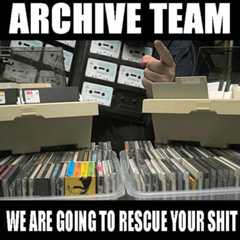
Formed in 2009, the Archive Team (not to be confused with the archive.org Archive-It Team) is a rogue archivist collective dedicated to saving copies of rapidly dying or deleted websites for the sake of history and digital heritage. The group is 100% composed of volunteers and interested parties, and has expanded into a large amount of related projects for saving online and digital history.History is littered with hundreds of conflicts over the future of a community, group, location or business that were "resolved" when one of the parties stepped ahead and destroyed what was there. With the original point of contention destroyed, the debates would fall to the wayside. Archive Team believes that by duplicated condemned data, the conversation and debate can continue, as well as the richness and insight gained by keeping the materials. Our projects have ranged in size from a single volunteer downloading the data to a small-but-critical site, to over 100 volunteers stepping forward to acquire terabytes of user-created data to save for future generations.
The main site for Archive Team is atarchiveteam.org and contains up to the date information on various projects, manifestos, plans and walkthroughs.
This collection contains the output of many Archive Team projects, both ongoing and completed. Thanks to the generous providing of disk space by the Internet Archive, multi-terabyte datasets can be made available, as well as in use by theWayback Machine, providing a path back to lost websites and work.
Our collection has grown to the point of having sub-collections for the type of data we acquire. If you are seeking to browse the contents of these collections, the Wayback Machine is the best first stop. Otherwise, you are free to dig into the stacks to see what you may find.
The Archive Team Panic Downloads are full pulldowns of currently extant websites, meant to serve as emergency backups for needed sites that are in danger of closing, or which will be missed dearly if suddenly lost due to hard drive crashes or server failures.
To use ArchiveBot, drop by #archivebot on EFNet. To interact with ArchiveBot, you issue commands by typing it into the channel. Note you will need channel operator permissions in order to issue archiving jobs. The dashboard shows the sites being downloaded currently.
There is a dashboard running for the archivebot process athttp://www.archivebot.com.
ArchiveBot's source code can be found athttps://github.com/ArchiveTeam/ArchiveBot.


King and general of the Huns; died 453. Succeeding in 433 to the kingship of Scythian hordes disorganized and enfeebled by internal discords, Attila soon made of his subjects a compact and formidable people, the terror ofEurope andAsia. An unsuccessful campaign inPersia was followed in 441 by an invasion of theEastern Roman Empire, the success of which emboldened Attila to invade the West. He passed unhindered through Austria andGermany, across the Rhine intoGaul, plundering and devastating all in his path with a ferocity unparalleled in the records of barbarian invasions and compelling those he overcame to augment his mighty army. In 451 he was met on the Plains of Chalons by the allied Romans under Actius and theVisigoths under Theodoric and Thorismond, who overcame the Huns and averted the peril that menaced Western civilization. Turning then toItaly, Attila, in the spring of 452, laid wasteAquileia and manyLombard cities, and was approachingRome, whitherValentinian III had fled before him, when he was met nearMantua by an embassy the most influential member of which wasPope Leo I which dissuaded Attila from sacking the city.
Attila died shortly after.Catholic interest in Attila centers chiefly in his relations with thosebishops ofFrance andItaly who restrained the Hunnish leader in his devastating fury. The moral power of thesebishops, more particularly of thepope during the dissolution of the empire, is evidenced as well by the confidence in which thefaithful looked to them for succour against the terrible invader as by the influence they sometimes exerted in staying that invader's destroying hand. St. Agnan ofOrléans sustained the courage of his people and hastened the reinforcements that saved his apparently doomed city; atTroyes, St. Lupus prevailed upon Attila to spare the province of Champagne, and gave himself as a hostage while the Hunnish army remained inGaul; whenRome seemed destined to meet the fate of theLombard cities which Attila had pillaged, it wasPope Leo the Great who, by his eloquence and commanding personality, overawed the conqueror and saved the city. The terror which for centuries after clung to the name of Attila, "the Scourge ofGod", as he came to be called, and the gratitude of the people to their deliverers combined in time to encumbermedievalhagiography withlegends of saints reputed to have overcome Attila by their imposing presence, or stayed his progress by theirprayers. But these fictions serve to emphasize the import of the facts which inspired them. They enable us to appreciate how widespread must have been that sentiment expressed in the recently discovered appeal ofEusebius of Dorylaeum toPope Leo I: "Curavit desuper et ab exordio consuevit thronus apostolicus iniqua perferentes defensare . . . et humi Jacentes erigere, secundum possibilitatem quam habetis [see Harnack,History of Dogma (Boston, 1903), II, 168]. National pride, too, came in time to invest the person of Attila with a halo of fiction. MostEuropean countries have their legends of the Hunnish leader, who is diversely depicted, according as the vanity of nations would represent Attila as a friend who had contributed to their greatness or as a foe to whose superhuman strength it had been no discredit to succumb. Of these legends the best known is the story of Etzel (Attila) in the "Niebelungen-lied".
APA citation.Peterson, J.B.(1907).Attila. InThe Catholic Encyclopedia.New York: Robert Appleton Company.http://www.newadvent.org/cathen/02061b.htm
MLA citation.Peterson, John Bertram."Attila."The Catholic Encyclopedia.Vol. 2.New York: Robert Appleton Company,1907.<http://www.newadvent.org/cathen/02061b.htm>.
Transcription.This article was transcribed for New Advent by Joseph P. Thomas.
Ecclesiastical approbation.Nihil Obstat. 1907. Remy Lafort, S.T.D., Censor.Imprimatur. +John M. Farley, Archbishop of New York.
Contact information. The editor of New Advent is Kevin Knight. My email address is webmasterat newadvent.org. Regrettably, I can't reply to every letter, but I greatly appreciate your feedback — especially notifications about typographical errors and inappropriate ads.