Lucas learned from Kurosawa is how to translate movie ideas between America and Japan. Kurosawa had become famous partially for telling stories about Japanese samurai using ideas he borrowed from American Westerns and detective stories. Kurosawa'sYojimbo was based on Dashiell Hammett's 1928 bookRed Harvest. Hammett had been a real-life detective for the famous Pinkerton Detective Agency, so his crime stories had a ring of authenticity that readers loved.Red Harvest was Hammett's first novel. It told the story of an unnamed gunslinger who cleans up a crooked town mostly by pitting the bad guys against each other, though he wasn't above killing the bad guys himself when the situation demanded it. Kurosawa's remake starred Toshirô Mifune as The Man With No Name. Then in 1964 Italian director Sergio Leone remade Yojimbo asPer un pugno di dollari ("A Fistful of Dollars"), starring Clint Eastwood as The Man With No Name. Leone was probably inspired by John Sturges'The Magnificent Seven (1960), which had just earned a pile of money remaking Kurosawa'sShichinin no samurai ("The Seven Samurai", 1954). Leone's "spaghetti Western" (a Western made in Italy, partially to save production costs) was extremely popular, earned a lot of money, and made Eastwood a star (though it also typecast him in Man With No Name-like roles for the rest of his life). The Coen Brothers borrowed from Red Harvest/Yojimbo again in 1990, combining it with Hammett'sThe Glass Key (1931) to create the filmMiller's Crossing. Yojimbo was finally remade again in 1996, with Bruce Willis playing The Man With No Name character inLast Man Standing.
Star Wars borrows a lot of great stuff fromYojimbo, including the cantina scene: several men threaten the hero, bragging how wanted they are by authorities. There's a flash of blade and suddenly an arm lies on the ground. Mifune is offered "25 ryo now, 25 when you complete the mission." (A ryo is a gold coin.) Jeremy Bulloch, the actor who played Boba Fett, said the character was based on Clint Eastwood's version of The Man With No Name. You can hear a little cowboy-spur jingle when Fett enters the dining room inThe Empire Strikes Back, soft and subtle enough that it's probably meant to trigger our emotional association with the character without our conscious awareness.
Lucas' affection and admiration for Kurosawa may have influenced his decision to visit Japan sometime in the late 1960s, when he scouted for a potential location to shoot his first feature film,THX 1138 (released 1971). Lucas borrowed the name "Jedi" from "Jidai Geki" (literally "period dramas", movies about samurai). He may have found additional inspiration in Leiji Matsumoto'sUchu Senkan Yamato ("Star Blazers", 1974) and movies by Ishirô Honda (the inventor of Godzilla), in particularUchu daisenso ("Battle in Outer Space," 1959). Webmaster L. Mangue'sReverse References essay makes a convincing argument thatKairyu daikessen ("The Magic Serpent," 1966) is among the strongest influences on the basic story of Star Wars; A New Hope.
|
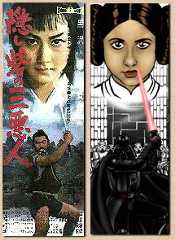
Hidden Fortress in Space poster created byJustine Shaw, used by permission.
Star Wars created by George Lucas, ©LucasFilm Ltd.
Star Wars: Origins © 1999-2006 byKristen Brennan,
part of theJitterbug Fantasia webzine.
|




