The Wayback Machine - https://web.archive.org/web/20150530233111/http://www.jugulator.net:80/judas_priest_history.htm
SEPTEMBER 1969: The original Judas Priest is formed


Pre-Judas Priest Members 1968 Judas Priest 1969
L-R: L-R:
Bruno Stapenhill - b Earnest Chataway - g
Al Atkins - v Bruno Stapenhill - b
John Perry - g - R.I.P. John Partridge - d
Alan Atkins - v
"I'd only played through an amplifier about five or six times. I suppose I was a little ambitious back then."
- K.K. Downing, HEAVY DUTY official biography, 1984
"We liked their name and so we searched for something in the same vain. Bruno came up with Judas Priest."
- Al Atkins, VICTIM OF CHANGES liner note, 1997
"The name JUDAS PRIEST came about I think just in trying to get the definition of listening to what we are musically, which I still think even today exists, which is that we can put across music that is very, very heavy and powerful and sinister in one respect, but also we can lighten up (and I use the word loosely) with the other types of music, such as the 'Beyond The Realms Of Death' or the 'Dreamer Deceiver's, the '(Take These) Chains' off... those mellower sides of the band. So I think the two words intermingle - the Judas and the Priest - the good and the bad, the light and the shade. We're not involved in Satanism. The name is just a name; it's been good to us."
- Rob Halford, 1983
"There was this old van going down the road with a spray aerosol on the side that said, 'JUDAS PRIEST'. There was actually a little blues group in the area called Judas Priest... I kept seeing the van as I was standing in bus stops around the place. I just knew that I thought it was a great name and I wished that I was in that band..."
- K.K. Downing, BBC Radio 1, April 5, 1991
"We started rehearsing and writing some of our own songs, classing ourselves as a progressive rock band. We also played covers of bands like Spirit and Quick Silver Messenger Service. We advertised for work in a local newspaper, and a guy called Alan Eade from Ace Management came to our rescue. He put some gigs our way and took us into the studios to record some of my songs. We recorded two songs, "Good Time Woman" and "We'll Stay Together" and sent them off to several record companies.
We had interest from Harvest and Immediate Record companies, so we did a live showcase for them at a local venue in Walsall, The George Hotel.
"Among the audience that night was another singer called Robert Plant (Led Zeppelin) who we were introduced to. Immediate Records liked the sound of us and gave us a deal. We signed a three-year contract (our manager gave us a champagne party at his house) and starting putting songs together for the first album.
"Two months later, the bubble burst when our manager Alan gave us the bad news that the record company had folded. This was a bitter blow for us. Back to the drawing board and back on the road touring.... We carried on touring into 1970, but started to drift apart musically, I wanted to explore the rock side and break away from the bluesy feel the band had developed. So, midway through 1970, we decided to split and go our separate ways."
- Al Atkins, VICTIM OF CHANGES liner note, 1997
"When Ernie left and I listened to the song 'Paranoid' for the first time, I imagined a similar sound for us."
- Al Atkins, May 1998
NOVEMBER 1970: Judas Priest, round 2


Ken and Ian - the new order of Priest John Ellis 1970
"It was a very famous place, and it would cost about five shillings (40 cents) to rent one of the old schoolrooms for a day. Everyone in the Midlands would use it, because there was nowhere else you could go and rehearse, turn up the volume as loud as you wanted, and blast out."
- K.K. Downing,Heavy Duty official biography, 1984
"One night at a local rehearsal room called Holy Joe's in Wednesbury (run by a Vicar called 'Father Husband'), I heard a band I liked the sound of. I put my head 'round the door to see three young head-banging, crazy, long haired guys, amps full up."
- Al Atkins,Victim Of Changes liner note, 1997
"...I heard this infernal noise caused by a band called Freight. Their guitarist was K.K. Downing and this time I snapped him up!"
- Al Atkins, May 1998
"We didnt have a vocalist in those days. We were just quite happy to go to rehearsal rooms and thrash out a few of our favorite songs."
- Ian Hill,Classic Rock Revisited, January 2002
"Alan was quite an experienced musician, and apart from being a vocalist he was also quite a good drummer, guitarist, and songwriter. We were over the moon that he was impressed by our playing and so we agreed to have him in the group."
- K.K. Downing,Heavy Duty official biography, 1984
"[The name Judas Priest] sounded like everything I wanted to be and do. To be recognized on a world-wide basis as 'somebody'..."
- K.K. Downing, HMPhoto Book, 1984
"The one good thing is it keeps coming back 'JUDAS PRIEST' - the name was one of the best things that happened to the band; it was something that was quite easy to remember."
- K.K. Downing,Metal Works video, 1993
"One of my earliest songs was 'Mind Conception' and our friend and manager David Corke decided it was time to go into the studios and cut a demo. We recorded two songs at Zella Records, 'Holy Is The Man' and 'Mind Conception' in July 1971, but never listened to the advice of sound engineers, recording them live with no overdubs and loads of overspill. Having a sore throat and being stoned out of my head didnt help either."
- Al Atkins,Victim Of Changes liner note, 1997
OCTOBER 1971: Ellis leaves, Moore joins briefly, Campbell joins
"I had a job so I could only gig on weekends. The big jump was asking ourselves, 'Do we quit our jobs or do we keep it as [just] a hobby?' That was the crucial point. Ken and I quit our jobs and John unfortunately didnt."
- Ian Hill,Classic Rock Revisited, January 2002
.


Atkins, Moore, Downing, Hill, 1971 Alan "Skip" Moor, 1972

Chris Campbell, K.K. Downing, Ian Hill, Al Atkins, 1972
FALL 1972: Taking the next step
"Caviar was our first big finale when we played live, but was cut short on the album..."
- Al Atkins,Victim Of Changes liner note, 1997
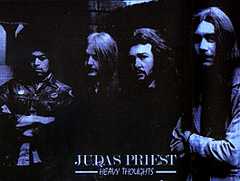
JANUARY 1973: Heavy Thoughts
contract
"We'd go off to a gig, hire a van, put our gear in it, pay a couple of roadies, perhaps cover the cost of a P.A., and if we were lucky we'd have enough for fish and chips and a bottle of pop on the way home."
- K.K. Downing,HM Photo Book, 1984
"We'd even sink to the level of getting girlfriends to go into some pub somewhere, and sort of charm a drink out of them, and bring it out to us."
- Ian Hill, VH1Behind The Music, September 2001
"In so many words, Alan said, 'I've either got to make more money or leave.' We told him that there was no way we could suddenly start earning more, so he quit. I think Campbell said more or less the same thing, so he left too."
- Ian Hill,Heavy Duty official biography, 1984
"Although there was plenty of work, the bigger we got, the more overheads there were, and we were still without that elusive record deal. Soon the financial situation became a problem - I had a baby daughter to support - so I said goodbye to Priest in 1973 and took a normal 9-to-5 job. Congo also left the band at this time, and our roadie Keith Evans left to join AC/DC as a personal roadie and technician to Angus Young. Everybody thought this was the end of the band, but K.K. and Ian decided to carry on with new members."
- Al Atkins,Victim Of Changes liner note, 1997
"When I left school, I did a little bit of amateur dramatics. I worked in a theater as a lighting electrician, but it's always been the draw of the stage. I was earning quite a good amount of money at the time for some one my age, so the decision to go into music professionally was a main one. My parents thought it was very silly, purely from an economic point of view..."
- Rob Halford, Sounds, February 11, 1978
"I'm afraid I know very little about Athens Wood, other than they were a local Birmingham outfit who sent information to the agency."
- Norman Hood, 2003


Thark, 1966 Athens Wood, circa 1971 Hiroshima, 1973
Young Rob with school teacher on guitar Looks like Rob stole
his teacher's tank top!
"The first band I was in was called Thark, T-H-A-R-K - don't ask me where the name come from - and then there was a group called Abraxis, and then there was a group called - this is the best one - Lord Lucifer! It was great - I had an old Francis Barnett motorcycle and I painted 'Lord Lucifer' on the petrol tank, you know with flames and things. I used to pull up behind people and mothers would pull their children down from the car and [go], 'Don't look at that, don't look at that!' Those are some of the names I remember - and Hiroshima - that was the one that really got me into the direction of Priest..."
- Rob Halford, BBC Radio 1, April 5, 1991
"I got together with Lord Lucifer and after that came Hiroshima. That's when I first really began to get a taste for rock. That lasted for about a year and then I joined Priest."
- Rob Halford,Heavy Duty official biography by Steve Gett, 1984
"K.K., Ian and I would jam at their apartment whenever we got the chance. We used to knock up tons of different ideas and make loads of cassettes. It was interesting because I think we were probably feeling our way as to how and what exactly Priest should be."
- Rob Halford,Heavy Duty official biography, 1984
"We were pretty adventurous and we tried to steer away from basic twelve-bar stuff, because we were more into progressive rock. On the rare occasions that we did anything slightly close to a twelve-bar, we'd try and alter it dramatically by putting in some unusual changes. Most of the other bands around were sticking to the same basic stuff."
- K.K. Downing,Heavy Duty official biography, 1984

Judas Priest 1973 L-R: K.K. Downing, Bob Halford, John Hinch, Ian Hill


David Howells 1990 The Gull Records logo
"Dave Corke, if I'm right, was already in contact (via Budgie) with Gull Records and got Dave Howells to come and see us at a gig in London..."
- John Hinch, Insight Series interview, 1995
"Gull had been down to see us at the Marquee club in London and although they probably didn't like our music, I think they were interested because of the tremendous reaction we got from the audience."
- K.K. Downing,Heavy Duty official biography, 1984
APRIL 1974: Priest sign with Gull Records; Tipton joins
"Kenneth Downing Jr. is my real name. A girl in Denmark couldn't pronounce it, so she called me 'K.K.' and it stuck."
- K.K. Downing, Rockline magazine, 1984
"We thought it was just another mouth to feed and that was pretty tough at the time."
- K.K. Downing,Heavy Dutyofficial biography, 1984
"We played them a song, I forget which one it was, and somebody says, That just begs for two guitarists'."
Classic Rock Revisited, July 1999
"I guess it came about, we were a four-piece, and we secured a record deal with a small company called Gull Records, who at the time didn't have many acts... They said, 'Well hang on a minute, we've just had Led Zeppelin, Free, and Black Sabbath, all with the same [type of] line-up. How about you guys add a keyboard player?' And we went, 'Nope!'. 'Sax player?' 'Definitely not!'. 'Well, you know, something else to change the line-up'. And I guess I did actually think about a second guitar player, because I was quite a fan at the time of a band called Wishbone Ash, and I quite liked obviously a lot of the harmony stuff that they did. So it seemed like a good, interesting idea to have a heavy rock band with two guitars. Also, that could be a really good idea because I was always quite conscious of the fact when I played lead solos, the sound on the stage got a bit empty. So I thought that would be pretty good."
-K.K. Downing, BBC Radio, 6 Music, August 3, 2002

"I had the original album master for Glenn Tipton's unreleased, pre-Priest, Flying Hat Band album, until I gave it to him recently. [These songs] were very, very heavy - not what you would expect from the band's name. Actually, it's a very depressing listen - heavier than early Sabbath in places. The history of rock would have been a bit different if the Vertigo label had released that album pre-Rocka Rolla. Would Glenn have even joined Priest then?"
-Rock Detector


L-R: Glenn Tipton - g, Steve Palmer - d, Live at 'Enry's Blues House, Birmingham
Mars Cowling -b
"I was actually in a band called The Flying Hat Band, and we toured Europe opening shows for Deep Purple around 1974, when Glenn Hughes was in the band anyway... The Flying Hat Band was a rock ´n´ roll band with me, Carl Palmer's brother Steve Palmer, and an old friend of mine called Mars Cowley, who used to play with Pat Travers. A three-piece band, and I was the single guitarist, which I can never quite believe, and we toured with Deep Purple. It was a scary experience at the time. Shortly after that, we got management problems over in England, and Judas Priest asked me to join. And that was before the first Judas Priest album..."
Atlantis Online, May 7, 1986
"We were at a place called Whats Music in Birmingham and Glenn walked in, and out of the blue, Ken went and asked him if he wanted to join the band. We were just standing there agog. After meeting us and having a couple of pints, he said, 'Yes'."
Classic Rock Revisited, January 2002
"I thought, 'I'll join Priest for a bit until I can do something else'."
- Glenn Tipton, Revolver, September 2003
"We were definitely one of the first heavy metal bands to have two lead guitarists. A lot of bands seem to have copied the idea since then, but in those days it was quite innovative."
- K.K. Downing,Heavy Duty official biography, 1984
"Every time I did a guitar solo, it sounded empty, so it made sense to recruit another guitarist to fill in the rhythm. But when Glenn joined the band, he was obviously a competent lead and rhythm player, so it was just automatic that he would take some solos. We would trade off solos and we also had the facility to harmonize with each other...it was just second nature for us."
Hard Radio Shockwaves, 1998
"The band asked me to join before the first album, so we thought, 'Well, we've got two guitar players - how can we expand on that and give ourselves another dimension?' The light and shade was something we experimented with very successfully. It makes a heavy number really heavy if you come in from a light passage. In those light passages we really experimented with melodies, one guitar complimenting the other. Not necessarily harmonies, but cross melodies. We can pat ourselves on the back and say we really knew what we were doing, but we didn't really - we just kicked stuff around until it sounded right.
"We messed around with harmony lead sections and, funnily enough, harmony chords, and they became the norm. But when we're really laying it down, we don't mess with too many frills. When it gets gritty, that's when it should get gritty."
- Glenn Tipton, Guitar One, November 2003
"The one thing I ended up being able to play really well were chords. Since then, I've had a few classical lessons and some piano lessons, but I'll never be a melodic guitarist. I'm more into aggression than runs and scales, although I could play melodic guitar if I wanted to".
- K.K. Downing,Point Of Entry tourbook, 1981
"How much we drew from each other, I don't really know, but we put something together that we thought was a pretty good blend. Glenn was predominantly more blues-oriented, where I was sort of progressive and a bit wild."
- K.K. Downing, Revolver, September 2003
"Glenn and I are both very much of the same temperament. We've always been aware that, 'If you try and overtake me or try and overstep the mark a little bit, I'm gonna come down on you.' And that's the way it's always been with us."
- K.K. Downing, Rockline magazine, 1984
"I'm very proud of the fact that we carved our own niche in metal and rock history, and people have been inspired by us".
- Glenn Tipton, Guitar One, November 2003
TOUR DATES 1972: | DATE | VENUE | CITY, STATE | COUNTRY | NOTES | | | | | | | | | | | | | | | | | | | | | | | | | | | | | | | | | | | | | | | | | | | | | | | | | | | | | | | | | | | | | | | | | | | | | | | | | | | | | | | | | | | | | | | | | | | | | | | | | | | | | | | | | | | | | | | | | | | | | | | | | 
| | | | | | | | | | | | | | | | | | | | | 
|
| | | | | | | | | | | | | | | | | | | | |
TOUR DATES 1973: | 
| "Priest had Al Atkins singing back then. They did a lot of gigs with us and they had this great drummer, a black guy called Chris Campbell. Their manager Dave Corke would always buy my clothes from me for some odd reason. I would walk into the agency office with a pair of jeans and a denim jacket and Dave would say "How much do you want for those?" So I'd sell them and walk out virtually naked."
Rockdetector: Ozzy Osbourne, 2002 | DATE | VENUE | CITY, STATE | COUNTRY | NOTES | | | | | | 
| | | | | | 
| | | | | | | | | | | | | | | | | | | | | | | | | | | | | | | | | | | | | | | | | | | | | | | | | | | | | | | | | | | | | | | | | | | | | | | | | | | | | | | | | | | | | | | | | | | | | | | | | | | | | | | | | | | | | | | | | | | | | | | | | | | | | | | | | | | | | | | |
TOUR DATES 1974: | | DATE | VENUE | CITY, STATE | COUNTRY | NOTES | | | | | | | 
- Rob Halford, Rolling Stone Story Tale, 2000
| | | | | | | 
|
Aftonbladetovember 2, 2003
| | | | | Support from Zippa Kids | | | | | | | | | | | Glenn's first gig with Priest | | | | | |  
| | | | | | | | | | | | | | | | | | | | | | | | | | | | | | | | | | | | | | | | | | | | | | | | | | | | | | | | | | | | | | | | | | | | | | | | | | | | | | | | | | | | | | | | | | | | | | | |
|
[8]ページ先頭