University History
Historical Quote
On May 13, 1954, the Privy Council, in the presence of the QueenMother and on behalf of Her Majesty the Queen, approved thegranting of a Royal Charter founding the University of Hull.
As the president of the National Union of Students was to noteat the celebration Charter Dinner a few months later...
"The difference between a university and auniversity college is not just the power of granting degrees tostudents. It is a difference of feeling, of independence, of beinga community in Hull rather than an adjunct to that vastness that isLondon."

In the beginning...
University College Hull was founded in 1927 through thesupport of local benefactors, such as Thomas Robinson Ferens (whogave the land and £250,000), G F Grant and the CityCouncil.

The Duke of York laying the foundation stone
Duke of York (George VI) laid the foundation stone in 1928 andthe College opened in October with 39 students and 14 ‘one-man’departments. There were 100 students in 1931.
Located on Cottingham Road in Hull, with just one building (nowthe Venn Building), the new University College Hull was an outpostof the University of London and offered courses in the arts andpure sciences.
During its early years, the College faced the changing economictrends of the 1930s and then the outbreak of war, which led tofalling student numbers, buildings being commandeered and booksbeing evacuated for safe-keeping.
[Back to top]
Royal Charter
The first Principal, Arthur Morgan, was succeeded in 1935 byJohn Nicholson (‘Nicky’), who led the campaign to achieve theCollege's independence, which eventuated on 13 May 1954. A RoyalCharter was granted and the University of Hull became a separateinstitution with the right to award its own degrees – it wasYorkshire’s third university and England's 14th.
The number of applications doubled within a year, and in 1956,the student population topped 1,000 for the first time.
[Back to top]

Part of the inside of the University library,June 1954
Expansion
A new library (later named after Sir Brynmor Jones, once theUniversity’s Vice-Chancellor) was opened by the Queen Mother in1960.
The Larkin and Wilberforce buildings, were guided by the MartinPlan of 1967, which envisaged a landscaped pedestrian centre forthe campus and ‘cascaded’ buildings diminishing in height towardsthe perimeter. The library tower extension opened in 1970.
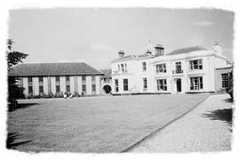
Needler Hall including first extension, August1952
No new academic buildings were built from 1974 to 1996. Studentnumbers more than doubled during that time, and Hull became a moreefficient user of space than other British universities.
The next big development was the University’s merger withUniversity College Scarborough in 2000. The college (originally ateacher training institution) became the University of Hull’sScarborough Campus. This now represented a significant extension ofthe University’s geographical reach and academic portfolio.
Scarborough offers specialist undergraduate and postgraduateprogrammes in the arts, business, coastal studies, education andinternet computing.
The biggest-ever single expansion occurred in September 2003with the acquisition of the University of Lincoln’s Hull campus(next door to the main campus on Cottingham Road), increasing thesize of the Hull campus by more than a third.
The site houses the recently-established Hull York MedicalSchool, a pioneering joint initiative involving the Universities ofHull and York, and the rapidly-growing Business School.
[Back to top]
Developments inResearch
Research excellence has developed alongside teaching from theUniversity's earliest days, particularly in the physical sciences.In 1979, the School of Chemistry received the Queen’s Award forIndustry for Professor George Gray's work in the development ofliquid crystals (which now have applications in everything fromscientific equipment to LCD displays on mobile phones).
In the late 1980s and early 1990s, the University’s ResearchCentre in Surface Engineering pioneered the development of a newdiscipline of crucial importance to the manufacturing industry. TheUniversity has also developed expertise in the field of roboticsand virtual reality systems. Research expertise is not confined topure science – History, Law, English, Geography, Asian Studies,Politics and Music were all awarded a Grade 5 ('internationallyexcellent') in the last national Research Assessment Exercise.
[Back to top]
A university for the21st century
The University of Hull is providing a cutting-edge educationalexperience for over 18,000 students a year. The academic portfoliocontains 50 disciplines across the arts and humanities, business,education, health, the sciences and the social sciences.
As one of the major players in the regeneration of Hull andScarborough, the University also has a significant impact on localeconomic and social growth.
Selection ofhistorical images
^ Top banner image: Venn building under construction andnow.

The Duke and Duchess of York,
the Archbishop of York, the President
(Mr Ferens) and the Principal, 1928

Aerial view of the University, May 1954.
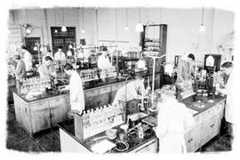
Old chemistry labs, 1954.
[Back to top]

