Movatterモバイル変換
[0]ホーム
COLLECTED BY
Organization:
Internet Archive The Internet Archive discovers and captures web pages through many different web crawls.At any given time several distinct crawls are running, some for months, and some every day or longer.View the web archive through the
Wayback Machine.
The seed for this crawl was a list of every host in the Wayback Machine
This crawl was run at a level 1 (URLs including their embeds, plus the URLs of all outbound links including their embeds)
The WARC files associated with this crawl are not currently available to the general public.
The Wayback Machine - https://web.archive.org/web/20141022114709/http://forts.org/history.htm
 By the end of the 17thcentury England, France and Spain had all laid claim to the landsand islands of the Caribbean. Imagining that great wealth wasto be found, the superpowers of the time scrambled for possessionand settlement of the region, with disastrous results for theindigenous people. The Amerindians of Grenada did hold off attemptsat occupation by English adventurers in 1609 and French colonistsin 1638, but the island was finally ‘settled’ in 1649by a privately raised military force from Martinique. As always,the European invasion was aided by the availability of musketsand cannon. The French invaders also appear to have brought adefensive weapon in the form of a prefabricated fort. Thoughtto have been transported in sections just small enough to be floatedashore and rapidly manhandled into position, the wooden "house",a palisade and a ditch, all called Fort Annonciation, providedsufficient shelter from Carib attacks to firmly establish thecolony. Tobacco and indigo were the first cash crops. The Grenadacolony (L’Isle de la Grenade) prospered, and in 1674, toprotect substantial economic interests, His Most Christian MajestyLouis XIV (1643-1715) took over the administration of Grenadafrom the various commercial enterprises which had been in chargesince the 1650’s.
The original town, port and a more substantialfort, "the Great Fort", all named St. Louis, ostensiblyafter his Majesty’s canonised predecessor, Louis IX (1226-1270)remained on the eastern side of Grenada’s natural (volcanic)harbour until an expanding town moved west. Another fort was builtin 1666 on the promontory opposite the original town and forts.Named Fort Royal, the new structure was designed by Engineer FrançoisBlondel and garrisoned by "independent" colonial infantrycompanies (Compagnies franches de la Marine) who were hutted outsidethe walls. These troops reported to the Ministry of Marine (NavyDepartment) which oversaw both the French navy and colonial administration.In 1705 a new Vauban-style fort was designed for Grenada by Jeande Giou de Caylus, Chief Engineer of the Islands of America (theFrench West Indies). It was built between 1705-10, on the siteof the first Fort Royal. It retained the Royal name and can beseen today.
 The second Fort Royal protected French interests for 50 more years.In 1762, Grenada was occupied by "...a small (British naval)squadron under Commodore Swanton, with the Fifth Brigade underBrigadier Walsh, and the corps of light-infantry, commanded byColonel Scott.", all sent by General Monckton who had justreduced Martinique. In 1763 Grenada was ceded to Britain by theTreaty of Paris. A British engineer described the former Frenchfort. "...Fort Royal (is) built at the entrance to the harbourwhich it defends. It is of an irregular figure with Four bastions& a kind of horn work toward the Country(,) the Curtain ofwhich is covered by a Ravelin.*[*the whole mounted with thirtyseven pieces of Canon (sic)."] "…The Fort itselfand the little outworks to it are built of masonry and there isno ditch (,) covered way (or) glacis to any part of them."
 Other18th century records located for Portcullis Limited in the BritishPublic Record Office reveal various requests for repairs to FortRoyal (the French name having been retained by the British). In1764, "To pointing, harling, Cleaning and Repairing the wallsand platforms of Fort Royal----£400". In 1769, "...Theparapets of Fort Royal and the revetment should be repaired...".In 1770, a letter from the local infantry commander, Major Bruce,70th Regiment of Foot, to Lord Barrington, Secretary at War, complainedthat the barracks for his troops were insufficient and that "...thingsin the Fort (,) as well as itself, which if not looked after andthe proper repairs done, it will soon cost the Government an immensesum, whereas taken in time it will be trifling.".
The Major added, "...I have made thestrongest representations to General Melville (the Colonial Governor),and he has, as far as is in his power, ordered the Engineer--notwithstanding,nothing is done--the Engineer Captain, H(arry) Gordon being constantlyin the Country at his Estate; pays no attention to the Fort atall." He might also have included a note about supplies inhis complaint, as an inventory of "...Ordnance Stores atFort Royal, Grenada...", dated April 1, 1773, reveals appallingdeficiencies in guns, ammunition and equipment.
The real test for Fort Royal began on February6, 1778, when the newest King of France, Louis XVI (1774-1792)signed a treaty of "Amity and Commerce" with those NorthAmericans in rebellion against the British Crown. Shortly thereafter,the Toulon fleet under Vice-Admiral the Count Charles-Henri d’Estaingdeparted for the American theatre of war. The British knew thatthe French fleet had disappeared into the Atlantic, but had noway of knowing where the invasion force was bound. An exchangeof letters between a new British Chief Engineer and the new BritishGovernor of Grenada shows that an attack on the British coloniesin the West Indies might be anticipated, and that no time wasto be lost in repairing Fort Royal and other fortifications wheremaintenance had been ignored for over a dozen years.
 15 May, 1778. "...Areturn of the work proposed and recommended to be immediatelyexecuted for the better defence of Fort Royal." Written byCaptain Robert Morse to Lord Macartney, the document says, "...Inthe Fort--The Banquets (sic) in the front toward Hospital Hillto be repaired and raised- The parapet of the Southeast Bastionto be raised & thickened to cover the buildings & Gunsin the South curtain, which are commanded by Monckton's Redoubt--Newdoors to be made to the Sally ports--The Banquets & platformsof the Ravelin to be repaired and two Guns mounted in it--A parapetof masonry to be built from the extremity of the East face ofthe Ravelin to the shoulder of the Bastion, to shut up that entranceinto the fort leaving only one through the Glacis--The brush woodweeds &ca. around the fort to be cleared away."
All who have experience with bureaucraciesknow that a request for work does not necessarily indicate approvalfor work to be done, much less guarantee funding to actually accomplishthat work. We can assume in the case of the effort proposed forFort Royal that it was of considerable importance, as GovernorMacartney responded to Captain Morse on the very next day! "May 16, 1778: I this day received and took into considerationyour Report, dated yesterday, of the Works proposed, and recommendedby you, to be immediately executed for the better Defence of FortRoyal; I am now to acquaint you, that I approve of the same anddesire that you will without delay carry into execution the workstherein proposed and recommended." The Governor also toldCaptain Morse that the Assembly of Grenada had voted £600"...for the purpose." The result was a series of defensivestructures, many of which can still be seen today! The "...threeEminences near the Fort..." which were "...to be occupied..."nearly 15 years earlier, were finally entrenched, and the occupantsof Fort Royal waited.
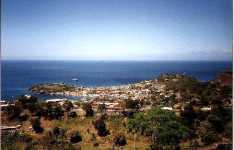 And d’Estaing did come to Grenada. His fleet of 24 shipsof the line, a dozen frigates plus auxiliaries, with over 1,300troops arrived off the coast on 2 July, 1779. British forces consistedof 130 officers and men of the 48th Regiment of Foot, two dozenArtillery recruits, 300 or 400 Grenada Militia and 200 volunteers,including sailors drafted from ships in the harbour. The British,realising that the "three Eminences" which "..overlook'd.."Fort Royal were to be crucial in a land operation, had finallyoccupied them all, leaving just a few troops in the fort, wherethe heaviest guns pointed out to sea. Most of the British troopswere stationed on Hospital Hill, the high ground 800 yards northand slightly east of the fort.
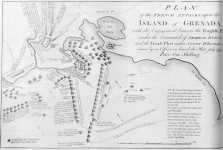 The Frenchlanding force, composed of Dillon’s Regiment, detachmentsfrom the Auxerrois, Martinique, Cambresis and Foix regiments andthe 1st Legion Volontaires-étrangers de la Marine; alongwith the grenadiers of the Viennois and Hanault regiments andthe chasseur companies of the Champagne regiment, landed northand west of Fort Royal (out of range of the fort’s guns)on 3 July, 1779. Early on the morning of the 4th, the French madea feint with 200 men on the western side of Hospital Hill, wherethey were expected. At the same time, three columns of 260, 300and 180 French troops, turned the British position and assaultedthe northeastern side of the hill, trampled the palisade at thebase and overcame three consecutive trench lines. The Hon. GeorgeBrizan, describes the result in his book, Grenada, Island of Conflict."The British forces finding themselves hopelessly outnumberedrushed down the side of Hospital Hill facing the sea, past theCatholic church (of 1690, the site of the Anglican church today)and ran for cover in (what is now) Fort George". In fact,the withdrawal was planned. The French concentrated their forcesand on the morning of July 5, 1779, turned abandoned and undestroyedBritish guns on the fort below, with predictable results. Thiseffort, combined with a fleet action on the 6th saw Grenada andFort Royal once again become French.
In September of 1779 Count d’Estaingleft an occupation force in Grenada, returned to the coast ofNorth America via Saint Domingue (now Haiti) and in cooperationwith an American army lay siege to British-occupied Savannah inthe Colony of Georgia. After many days of bombardment and a failedfrontal assault on October 9, 1779, the Americans marched northand the French withdrew to their ships. Among the French soldierswho distinguished themselves by covering the withdrawal of theattacking force, were the Corps de Chasseurs-volontaires de SaintDomingue. This volunteer unit, composed of free Black men, wasthe first such group in the annals of the French armed forces.Among the volontaires was a young Henry Christophe, later Kingof Haiti. After Savannah, most of the nearly 600 Chasseurs-volontairesreturned to Saint Domingue, but a detachment of 148 men of theCorps (including Christophe?) sailed directly from Savannah toGrenada, arriving in St. George’s and Fort Royal on 1 December,1779.
The eighth article of the Treaty of Versailles,signed in 1783, ended the American Revolution and returned Grenadato the British. French troops were withdrawn or discharged inplace. They were replaced by British troops who of necessity,had left the new United States. One of these units was the CarolinaCorps, raised in 1779 from American and Caribbean-born free Blackmen who had remained loyal to the Crown. 300 men (plus wives andchildren) of this corps landed in Grenada in 1783. They were stillthere in 1793. It was during this second British occupation thename of Fort Royal was changed to Fort George; probably in 1784or 1785 in honour of King George the III’s Silver Jubilee.

 Around 1790 the British seem to have built a hospital within FortGeorge. Service by European troops in the West Indies invariablyresulted in exposure to mosquito-borne Yellow Fever which whileendemic, was survivable. Unfortunately many new recruits, alreadydebilitated by a long sea voyage were infected and "finishedoff" by doses of raw rum (probably laced with lead from improperdistillation) which their comrades smuggled into the hospital.At least the patients at the Fort George Hospital were safer fromenemy fire than from rum, as the outside wall of the fort wasused for the rear wall of the hospital. Even their foodwas safer; the seaward wall of the hospital kitchen being twofeet thick. Hospitals notwithstanding, there were some 45,000soldier deaths from tropical diseases in the Caribbean between1796 and 1802. In 1796 alone, 41% of all British troops sent tothe region died of disease.
 In 1792 French Revolutionariesexecuted King Louis XVI. The new Republican Government sent Commissionersto the Windward Islands in 1794 to reorganise French armed forcesand promote revolutionary activity in the region. Some of Grenada’sFrench speaking citizens welcomed the opportunity to strike backat the British plantocracy and in 1795 Julian Fedon, a so-calledfree coloured and owner of Belvedere plantation, led an insurrectionby a mixed force of petit blancs, other free coloureds, his ownfreed slaves and other slaves, in a rising which the British wereat first unable to put down. Supported from French Guadeloupewith arms and ammunition, the insurgents quickly controlled theentire island, except for the capital, St. George’s and FortGeorge. In June of 1796 General Sir Ralph Abercromby landed alarge force, among which were units which would become the FirstWest India Regiment, formed by combining the Black Carolina Corpsand Malcolm’s Royal Rangers. In Grenada itself another Blackcorps, the Loyal Black Rangers, was formed. Many of the Blacksoldiers had already served in Grenada and many had over 15 yearsof military experience, but most were left in garrison in St.George’s while "...ill-prepared white troops flounderedin expeditions into the interior". The Black troops wereeventually put to work with other British regiments, the 9th,27th, 57th, 58th and 68th Foot, Lowenstein’s Chasseurs, Royal-Étrangersand local Militia, and by December of 1796 the principal bandsof Fedon’s insurgents had been tracked down. The Loyal BlackRangers, Second West India Regiment and 60th Foot continued mopping-upoperations until 1800.
 Given the fear of renewed violence or invasion and the lack of space in the Artillery barracks in the fort proper, a brick barracks with a tile roof was erected behind the fort in 1796-98. It was designed to hold two sergeants and two-hundred rank and file. In 1802 a "Barrier Guard House" was erected at the foot of the (nominal) glacis to house a duty subaltern (a junior officer) and twelve rank and file.
By 1812 Fort George was being kept in betterrepair. Military activity in North America seems to have permittedquick attention to a leak in the forts water supply. Part of theofficial report reads as follows. "Fort George--(The cistern)in the North Bomb Proof (is) thirty five feet six inches long,fifteen feet eight inches wide, and sixteen feet deep (and) containssixty nine thousand, two hundred and sixty eight Gallons, (whichis) doubtful at present, from constant issuing of water throughthe Escarp Wall in front of the Cistern into the (nominal) Ditch,supposed to be occasioned by the Shock of an Earthquake –the Water to be emptied out to ascertain the defect which hasbeen done, is as follows."
 "On examination of the Cistern, we find the whole of the Pavement at the bottom is loose and particularly the upper end , above the Cistern Pool, is cracked in a direction from East to West in a most extraordinary manner, many parts of the Rock where the terrace is worn off and under the Pavement in the bottom and about five feet high on the West side, is perfectly soft, but we are of the opinion that the leak is in the North end at the Bottom, directly under the (Postern) Door way, as on trial with a Drill, the rock is of the soft nature before described, and the water leaks through the Gun Carriage Shed, in the (nominal) Ditch directly under the Cistern in the direction mentioned. It is proposed to take up the present pavement (and) wherever the rock is soft in bottom or sides, to cut it away and fill up with Masonry, to relay the Flag Pavement in a good Bed of Terrace, to face up about 16 feet long by 5 feet high, with bricks on the West side, and give where wanted, two good coats of Terrace…".
 A week after the report and estimate to repair the cistern, theResident Engineer's office forwarded another estimate to London;"…for a new lower floor and five Beams and a new floorto the Loft in the Barracks occupied by the Royal Artillery, overthe Ordnance Stores in Fort George. "At present the lowerFloor is paved with Bricks to prevent accidents by Fire, it isproposed to pave over the new floor with Twelve Inch Tiles."It is no surprise that beams and flooring needed to be replaced,as some do today. Grenada’s subterranean termites stillhave a phenomenal appetite for unprotected wood.
In 1819 the garrison in Grenada was increased to the pointthat more accommodation was needed for troops. A large stone barracks,two stories high with a tile roof, was built to house one generalofficer, three captains, three subalterns and one hundred andfifty rank and file. Like the smaller 1796-98 barracks, it waserected behind Fort George. A shingle-roofed stone stablewas built at the same time to accommodate the officer’s mounts.
By 1822 Grenada was a major post,the entire town filled with structures supporting the militaryestablishment. By 1827 the Grenada forces needed even more spaceand received permission to build "…a shed over No. 2Magazine in Fort George & forming a loft in it, for the purposeof affording additional Store Room for the Deputy Storekeeper…".In 1830 the "Principal Medical Officer…" at FortGeorge recommended to the Officer Commanding the Troops…"the "…fitting up (of) Jalousie Windows in the ArtilleryBarracks at Fort George…" (to replace solid wooden shutters).Given that the average temperature in Grenada is over 80 degreesFahrenheit (27 C.) with high humidity, consideration by the C.O.and the Medical Officer for the comfort and health of their troopswas indeed commendable. But those two officers quickly heard fromLondon that this kind of independent activity would not be tolerated.Horse Guards wrote to Grenada’s commanding general: "…Ihave the honour to acquaint you that the Respective Officers havebeen informed that their proceedings are extremely irregular inexecuting a service upon a Letter addressed to the CommandingOfficer (of troops) without his having taken it upon himself torequest its execution; but that the Board has been pleased tosanction their proceedings in the present instance, at the sametime cautioning them to be more careful in future and desiringthat all services of this nature may be foreseen and providedfor in the Annual Estimate or delayed a subsequent year."
 By 1832however, Grenada had evidently become a military backwater andin an effort to save money the Engineers storage yard and half-adozen warehouses at Engineers Point were abandoned, the "Storehouseman"discharged, and the "…whole of the stores…movedto (the former 1819 barracks at) Fort George." There wasalso room in the former 1798 barracks to provide new quartersfor the Commanding General’s aide-de-camp, Fort Adjutant,Ordnance Clerk and Deputy Assistant Commissary General who hadbeen quartered elsewhere in St. George’s. A "Guard Room"was built nearby which "…will tend not only to the protectionof the Stores, but also to that of the Fortress which is quiteopen at this point." "quite open" might refer toa sallyport close to the former barracks, which is still (2000)without the required doors. Despite the fact that Fort Georgewas no longer a major post, advances in methods of cooking hadpenetrated the Army. After centuries of cooking over open firesor in kettles suspended in a masonry fire box, a request for "…aNew Cooking Kitchen in the Citadel. Fort George." had beengenerated by Army Circular No. 242. Dated July 4, 1843, it directedthe use of "Steam Fitments in Soldiers Cooking Kitchens."Enclosed was a list of "fitments" including the "BoilerElliptical 15 Gallons. 22 X 16 ¾ and 16 ½ in. deep.Weight Iron cast 164 lbs."
 Despite improvementsin the preparation of food and attention to better ventilatedliving quarters, water sources remained suspect. On Saturday,10 June, 1854 cholera appeared among Artillerymen at Fort George.The two or three ruined graves at the foot of the east hornworkbastion may date to that period or to an artillery accident 20years earlier. An archeological investigation is planned. Local health officials believed that the disease was caused by"extremely unsanitary" conditions at the fort as wellas a lack of air circulation, so the remaining Artillery troopswere "removed to an airier place", the fortificationson Richmond Hill. The move was of little help. Not only did thedisease devastate the Artillery but killed many of the men ofthe 69th Regiment of Foot, recently arrived from Trinidad. Itthen spread to the general population. Because of the acute shortageof doctors a cholera hospital was set up in the former barracksbuildings behind the fort (but not in the Artillery barracks withinthe walls where the cholera epidemic began). After the epidemicthose barracks became the Colony Hospital and with various improvementsare occupied by the Grenada General Hospital to this day.
 The cholera epidemic may have been the last gasp of the Britishmilitary in Grenada as the rest of the Fort George complex appearsto have been turned over to the civil government the same yearthe epidemic ended. The Grenada Police Force had been establishedin 1836 and with the militia (and the army as back-up) were responsiblefor civil order. In 1847 Her Majesty Queen Victoria sent a fourgun battery of brass light three pounders to the Grenada VolunteerArtillery. Two are currently at the Grenada National Museum andtwo are at Fort George. Reproduction field carriages are needed. The Grenada Police Force, now the Royal Grenada Police Force,and the Grenada Militia seem to have shared the facilities atFort George for a number of years. In 1918 new space was neededand a two story reinforced concrete building, some 30 x 30 feet,was erected in 1919-20 on thehornworkterreplein. Until recentlyit was identified as the Police Administration Building. It wasprobably at this time that the 1778 parapet, embrasures and merlonsprotecting the citadel terreplein were removed for ease of accessto the rear of the structure. In 1915 a reinforced concrete flagpolehad been erected on the northeast end of the citadel terreplein.
  Badly spalledand truncated, the doubled masts are still over 60 feet tall.Given the height of similar flagpoles the original concrete mastsprobably reached 95 to 100 feet. Depictions of the fort from the18th century (1780) show a single flagpole on the northwest bastion.Drawings of Fort George from the sea, produced by a British officerin 1826, show two single flagpoles, one flying the national flagand one bare. In other fortifications of the period one flagpoleseems to have been reserved for signals to merchant vessels andships of war.
In 1967 the West Indies Act was passed byBritain’s Parliament which gave Grenada internal autonomy,with external affairs looked after from London (called AssociatedStatehood). By 1974 Grenada was in political turmoil as Britainprepared to grant full independence to the island nation, andin March of 1979 the government of Grenada was overthrown by membersof a political organisation called the New Jewel Movement. TheConstitution of Grenada was suspended under People’s LawNumber One. People’s Law Number Seven established a People’sRevolutionary Army , whose members were vested with the same powersof arrest and search as those vested in the Royal Grenada PoliceForce. Fort George was made the Headquarters of the People’sRevolutionary Army and renamed Fort Rupert in memory of RupertBishop, the father of Grenada’s new Prime Minister MauriceBishop.

 By October of 1983 factions of Grenada’s Marxist governmentwere at odds and Prime Minister Bishop was placed under housearrest by units of the PRA. On October 19th,1983, a large numberof Grenadians went to the Prime Ministers residence, pushed pastSoviet/Cuban supplied armoured personnel carriers and freed PrimeMinister Bishop. The crowd accompanied the Prime Minister andsome of his political supporters to Fort Rupert, where the smallgarrison was disarmed. Prime Minister Bishop was meeting withhis supporters when three BTR-60PB armoured personnel carriersfrom the PRA motorised company arrived at Fort Rupert. PrimeMinister Bishop was captured after a short fire-fight. He andseven of his supporters were taken into the citadel, placed againstthe west wall of the parade on either side of a basketball backboard-supportand shot.

 On October 25, 1983, US troops landed in Grenada. For two daysthe fort was strafed sporadically as it housed two ZU-23, 23mmand possibly two M-53, 12.7mm antiaircraft guns. Damage to theancient structure was minimal. On the 27th, Fort Rupertwas occupied by elements of the US Marines 2/8th BLT. Shortlythereafter, Fort Rupert was renamed Fort George.
References & Bibliography
Public Record Office – Kew:- CO 101/1-62693. 1762-3. 13. What Forts and Fortifications are there, .
- CO 101/9. 1st May, 1763, GRANADA Plan of the Harbour OF Fort Royal...
- CO 101/11. 1763. Estimate for the Military Buildings first wanted at Grenada...Patrick Ross, Capt. Lieut. of Engineers.
- No number. 5 January, 1769, Response to letter from Major General Melville (of December 21, 1768 from (Engineer) Harry Gordon, Conduit St. (London). What Works in any detail seem necessary to be repaired or finished in the Ceded Islands with the present garrison of two Battalions & a small number of Artillery Men only… .
- CO 101/13. 3rd August, 1769 (Grenada & St. Vincent—121 (printed) For Repairs, and Building Powder Magazines and Storehouses at----Grenada-----£500....
- CO 101/14-62740. Extract of a Letter from Major Bruce, Commanding the 70th Regiment in the Island of Grenada, to the Secretary at War, dated 23rd May, 1770. Extract dated 12th July, 1770.
- CO 101/14. 31 October 1770 Governor Melville in the year 1763 desired that the undermentioned Guns & Mortars....might be sent to the Ceded Islands Viz. List follows. Note 50 ea. ½ pounder iron guns. 1773 inventory (below) shows 16 ea. ½ pounders at Fort Royal.
- CO 101/17. 1st April, 1773. Ordnance Stores at Fort Royal Grenada...Harry Gordon, Chief Engineer, James Taylor, Storekeeper, Jos. M’Laughlin, Actg. Clerk of Cheque.
- CO 101/22-XC/A1 62844. Copy of Captain Morse’s Letter to Lord Macartney, 27th January 1778 inclosing a second plan...Hospital at Fort Royal to be built as follows...(Signed) R. Morse, 27th January 1778, Thos. Napean Feb. 9th, 1778.
- CO 101/21-62740. A Return of the works proposed and recommended to be immediately executed for the better Defence of Fort Royal---15th May 1778-...(Signed) Rt. Morse Commanding Engineer. NB: Current copy indicates on left side that document is Lord Macartney’s No 12 dated 31 May 1778.
- CO 101/21-62740. Response by Lord Macartney to Captain Morse, St. George’s May 16th 1778 NB: Current copy indicates on left side that document is "Captain Morse’s Report to Lord Macartney". If fact the side note goes with above: "A Return...."etc.
- No number or date, ca. 1785. Charles S. Shipley, First Lieut. Of Engineers mentions his various tours of Grenada’s fortifications with Governor Mathew "...previous to my leaving Grenada..." Governor Melville arrived in 1783 as did the members of the Carolina Corps, probably the same "American Negroes, many of whom are Artificers?" mentioned in the same report. When we find when Shipley left Grenada (perhaps 1785) we can date this report more accurately.
- MPG 576. PLAN SECTION and ELEVATION of the New Barrack in Grenada in which the 45th Regt. Is Quartered. Plan shows a building some 145 feet long by 43 feet wide by 25 feet high, according to the poorly reproduced scale on the drawing. An inventory (transcribed) of government buildings dated 1822 {(See:WO 78/2509(2)} shows a building, west of Fort George identified as a "...stone building, tiled roof NO: 17 barrack appropriated as such, is two stories high and comprises sixteen apartments". The 1822 measurements for NO: 17 Barrack are given as 146 feet long by 45 feet wide by 22 feet high. This barracks was probably erected in 1819 rather than in 1796-8. The measurements for the 1796-8 barracks, or "NO: 18" are given as 110 x 30 x 21.
Books:- Adkins, Major Mark, Urgent Fury, Lexington, Mass: Lexington Books.
- Brizan, George, Grenada: Island of Conflict, London: Zed Books Ltd.
- Buckley, Roger N., Slaves in Red Coats, The British West India Regiments, 1795-1815, New Haven & London: Yale University Press.
- Chartrand, René & Chappell, Paul, British Forces in the West Indies 1793-1815, London: Osprey, Men- At-Arms Series 294.
- Chartrand, René & Back, Francis, The French Army in the American War of Independence, London: Osprey, Men-at-Arms Series 244.
- Fienberg, Howard, The Revolution in Grenada, www.contrib.andrew.cmu.edu/usr/hfien/grenada.
- Gardiner, Robert, editor, Navies and the American Revolution 1775-1783, Annapolis, Maryland: Naval Institute Press in association with The National Maritime Museum.
- Jessamy, Michael, Forts and Coastal Batteries of Grenada, St. George’s, Grenada: Roland’s Image Productions.
For further information see ourGlossaryand list ofRegiments.
   | Information last updated: 20 April, 2005
|
[8]ページ先頭