August 4, 2013 Updated
Launch Success of KOUNOTORI4/H-IIB F4

The H-IIB Launch Vehicle No. 4 with the KOUNOTORI4 (HTV4, a cargo transporter to the International Space Station) onboard lifted off from the Tanegashima Space Center at4:48:46 a.m. on August 4 (Sun., Japan Standard Time.)
The launch vehicle flew smoothly, and at 14 minutes and 59 seconds after liftoff, the KOUNOTORI4 separation was confirmed.
The KOUNOTORI4 will gradually go closer to the International Space Station, and it will be berthed at the ISS. We will broadcast the berthing on our website, so don't miss it!
Opening the Door to Future Space Mission
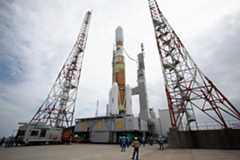
Japan has been developing its own launch vehicles, based upon various researches and experiments. Among launch vehicles,the H-IIA launch vehicle has been supporting satellite launch missions as a major large-scale launch vehicle with high reliability.
It is the H-IIB launch vehicle that is an upgraded version of the current H-IIA launch capacity and will be expected to open the door to a new possibility for future missions, including cargo transport tothe International Space Station (ISS) and to the Moon.
The H-IIB launch vehicle has two major purposes. One is to launchthe H-II Transfer Vehicle "KOUNOTORI" (HTV) to the ISS. HTV will carry not only necessary daily commodities for the crew astronauts, but also experimental devices, samples, spare parts and other necessary research items for the ISS. The other is to respond to broader launch needs by making combined use of both H-IIA and H-IIB launch vehicles. In addition, H-IIB's larger launch capacity will make it possible to perform a simultaneous launch of more than one satellite, and will reduce the cost. This will contribute to ensuring vitalization of the Japanese space industry.
Key Capacity Improvement: Clustering
The H-IIB launch vehicle is a two-stage rocket using liquid oxygen and liquid hydrogen as propellant and has four strap-on solid rocket boosters (SRB-A) powered by polibutadiene.
The H-IIB has two liquid rocket engines (LE-7A) in the first-stage, instead of one for the H-IIA. It has four SRB-As attached to the body, while the standard version of H-IIA had two SRB-As. In addition, the H-IIB's first-stage body has expanded to 5.2m in diameter from 4m of H-IIA's one. It has also extended the total length of the first stage by 1m from that of H-IIA. At the result of such enhancement, the H-IIB needs propellant 1.7 times more than the former.
Clustering several engines, whose performance is already fixed, has the advantage in shortening the period and reducing the cost for its development.
For Effective Development
At the time of launching HTV, the H-IIB will use a special fairing for HTV. However, in other parts, it will take over most of the specifications and structures of on-board equipments and ground systems already used for the H-IIA. These efforts are designed to reduce development risk and cost. Moreover, it will share the launch facility with the H-IIA and be launched from Yoshinobu Launch Pad of the Tanegashima Space Center.
Launch Schedule
Launch Records



 3.5MB)