Starting in 1996,Alexa Internet has been donating their crawl data to the Internet Archive. Flowing in every day, these data are added to theWayback Machine after an embargo period.
Starting in 1996,Alexa Internet has been donating their crawl data to the Internet Archive. Flowing in every day, these data are added to theWayback Machine after an embargo period.
TIMESTAMPS
The Wayback Machine - https://web.archive.org/web/20120516235330/http://web.gps.caltech.edu:80/~mbrown/sedna/
Sedna
The coldest most distant place known in the solar system; possiblythefirst object in the long-hypothesized Oort cloud
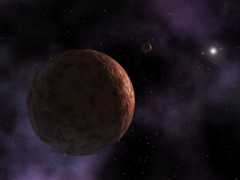
Artist's conception of the cold distant Sedna. The sun is a tinypoint of light 8 billion miles away from the red planetoid. Ahypothesizedtiny moon appears nearby.
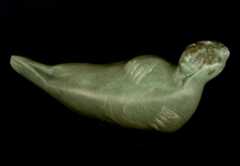
Artist's conception of the Inuit goddess Sedna, who rules over theseas(from the collection of M.E Brown).
On 15 March 2004, astronomers from Caltech, Gemini Observatory, andYaleUniversity announced the discovery of the coldest, most distant objectknown to orbit the sun. The object was found at a distance 90 timesgreaterthan that from the sun to the earth -- about 3 times further thanPluto, themost distant known planet.
Because of its frigid temperatures, the team hasnamed the object Sedna, after the Inuit goddess of thesea from whom all sea creatures were created.
How far away is Sedna?
Sedna is the most distant solar system object ever discovered. Itis twice as far from the sun as any other solar system object andthree times farther than Pluto or Neptune. Standing on the surface ofSedna, you could block the entire sun with the head of a pin held atarm'slength.
Even more interestingly, the orbit of Sedna is extreme elliptical,in contrast to all of the much closer planets, and it takes 10,500yearsto circle the sun.
Here is an image of the orbit and position compared to all theknown solar system objects (click for bigger version)
The sun is in the middle of the swarm of solar system objects.You can see that Sedna is at 90 AU (1 AU is an Astronomical Unit, thedistance between the earth and the Sun, about 150 million kilometers,or 93 million miles).
Don't miss the fabulous video, put together by Robert Hurt at theSpitzerScience Center, showing azoom out from the earth to Sedna to the Oort cloud (Robert isalso responsible for the artist's rendition of Sedna at the top).
What is the Oort cloud and what is its relationship to Sedna?
The Oort cloud is a hypotheticalshell of icy proto-comets in very loose orbits aroundthe sun that extends to a distance of almost halfway to the neareststar.Occasionaly, passing stars cause a slight change in the orbit of one ofthese proto-comets which causes them to come steaking in to the innersolarsystem where we see them as comets. A nice explanation can be found here.Though the Oort cloud has never been seen directly, the comets that wedo seeare very strong evidence of its existence.As can be seen in the graphic above, though, the Oort cloud is expectedto be much much further out than the orbit of Sedna. So why do we thinkSedna is a member of the Oort cloud? We believe that the existence ofSedna is evidence that the Oort cloud actually extends much further intowards the sun than previously thought. This "inner Oort cloud" wasformed in the same manner as the previously known "outer Oort cloud."Early in the history of the solar system many many small icy bodieswereorbiting the sun and getting sling-shot out by close encounters withplanets.As they were travelling further and further from the sun, the orbits ofthese bodies were affected by distant stars, causing them to slow downandstay attached to the sun. Sedna probably suffered a similar fate,except thestars which affected it must have been much much closer than previouslyexpected. We believe that this is evidence that the sun formed in atight-knitgroup along with many other stars.
How big is Sedna?
In our discovery images, we see only a point of light. We can'tdirectly measure the size of Sedna from this point.The light that we see has travelled from the sun, been reflectedoff the surface of Sedna, and come back to us where we can see it inthe images like the discovery images below. So a small icy objectand a large coal-covered object, for example, would both look about thesame brightness in the discovery images,because both objects could reflect about the same amount of sunlight.
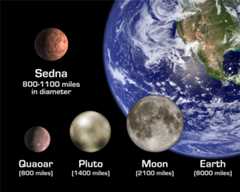
We can measure Sedna's size using a thermal telescope, whichmeasures the heat coming from the surface. We know how far away Sednais, so we know that the surface temperature is about 400 degrees belowzero Farenheit. A large object of that temperature will give off muchmore heat than a small object of that temperature (just light a matchand a bonfire are the same temperature, but a bonfire keeps youmuch warmer at night because it is so much bigger).In collaboration with Frank Bertoldi at the MPIfR Bonn, we used the 30meter diameterIRAM telscope, and incollaboration withJohn Stansberry at the University of Arizona and Bill Reach at theSpitzerScience Certer, we used theSpitzerSpace Telescope.Sedna was too small to be detected in either. This tells us thatSedna is at most about 1800 km in diameter: about halfway in sizebetweenPluto and the largest known Kuiper belt object Quaoar.Even though all we know for certain is that Sedna is smaller than 1800km,we have evidence which suggests that the size might be pretty close tothisnumber. We are virtually certain that the size is larger than the 1250km sizeof Quaoar, though this object has shown many unexpectedcharacteristics, sowe can't completely rule out a smaller size.
NO, at least not by our definition. Astronomers havebeen unableto agree on a precise definition of "planet", but we have a suggestionfor a definition below which is both historically and scientificallymotivated. By our definition, Sedna is not a planet. Nor is Pluto. Butthe other 8 are.
What is the definition of a planet?
Astoundingly, no precise scientific definition of the word "planet"currently exists. It is rare for scientists to have to define a wordthat is already in common usage and that everybody from school childrenon up already understand. How does one then go about constructing ascientific definition of such aword after the fact?
In such cases, we believe that it isimportant to be both true to the historical and popular perception ofthe meaning of the word while being scientifically descriptive,accurate, and meaningful.We will use these points -- historically valid and scientificallymeaningful --as the criteria on whichto judge potential definitions of the word "planet."We have identified 4 major ideas for the definition of the word"planet" (though the most common have never been written down to ourknowledge):
Purely historical.Mercury, Venus, Earth, Mars,Jupiter, Saturn, Uranus, Neptune, and Pluto are planets. Nothing elsein the solar system is a planet. This definition is definitelyhistorically valid, but fails miserably under scientific meaning. Whatif a new object larger than Pluto is found? What is it? Why is Pluto aplanet but an object 3/4 its size, like Sedna, is not? This definition,completelylacking in scientific motivation, makes the word "planet"meaningless as a scientific description.
Historical plus.Mercury through Pluto areplanets, as is any newly discovered object larger than Pluto. Thisdefinition is, we believe, the one in most common colloquial usethroughout the world, even if people don't realize that this is thedefinitionthey are using. Indeed, if Sedna had been larger than Pluto, most wouldhave hailed it as a 10th planet. This definition -- like theprevious -- is historically consistent, but -- like the previous --still fails the scientific test. Why is Pluto the cutoff size? Is therereally a big enough difference in size between Pluto and Sedna andQuaoar that one should be called a planet while the others are not? Thescientific answer remains a resounding no.
Gravitational rounding. Any object which isround due to its own gravitational pull and which directly orbits thesun is called a planet. This definition is very different! It isstrictly scientific, yet historically valid, as all objects that wecall planets by the historical definitions are indeed round due totheir own gravitational pull. More importantly (and by a completecoincidence) the dividing line between objects which are round andthose whichare not round is just a few times smaller than the size of Pluto. Sowhy not take advantage of this coincidence and simply define planets tobe objects which are round? To do so means that we must admit severalother bodies to the class of "planet." Sedna, Quaoar, the asteroidCeres, and perhaps a dozen Kuiper belt objects are also likely to beroundand thus, by this definition, planets.But these additions are perhaps a small price to pay for a definitionwhich rests on solid scientific principles.
Unfortunately, this definition completely fails the historicalsanity check. Historically,where does the criterion to be round come from,except for the near coincidence between the historical definition ofplanetand the transition size from round to not round? At no time in previoushistory has any discussion of whether or not an object isround been part of the discussion of whether or not it should be calleda planet. Ceres was initially considered to be a planet, butnotbecause it is round (which was unknown at the time), but because it wasthe only object known to exist between Mars and Jupiter. When otherasteroids of similar sizes were foundat nearly the same location it was decided to call them all members ofthe asteroidbelt, rather than planets.
Roundness is an important physical property, and gravity is thedominantforce in the solar system, so perhaps it is important tohave a special word which describes the class of objects in the solarsystem which are round. Butsimply because all historical planets are round does not at all meanthatit is good science to define all round objects to be planets. A muchbetter idea isto use a different word to descibe these objects. Spheroids?Gravispheres?Actually, we prefer the word "planetoid" as a new word to descibe roundobjects orbiting the sun. All planets are planetoids. Not allplanetoidsare planets.
Population classification. This definition requiresa little more explanation and a little more understanding of the solarsystem, but, in the end, leads to the most satisfactory definition of"planet". Just like the solar system very naturally divides itselfbetweenround objects and non-round objects, it also very naturally dividesitselfbetween solitary individuals and members of large populations. The bestknownexample of alarge population is the asteroid belt. We call it a population becauseone region of space contains objects with a continuous range of sizesfrom one moderately large object (Ceres) to a handful of slightlysmallerobjects (Vesta, Pallas, Hermione) to a huge number ofextremely small objects (rocks, dust particles). The solitaryindividuals are much different. In their region of space thereis only them (Earth, say) and then a collection of much much smallerobjects (the near-earth asteroids), with no continuous population inbetween.A single example helps to dramatize the difference between a continuouspopulation and a solitary individual. Ceres, the largestasteroid, has a diameter of 900 km. The next largest asteroid, Pallas,has a diameter of 520 km. After that is Vesta at 500 km, and Hygieaat 430 km, and the listcontinues on down. The jump in size between asteroids is never morethan a factor of two. In contrast, the earth has a diameter of about12,000 km,while the largest other object in the earth's vicinity, the asteroidGanymed,has a diameter of about 41 km, a factor of 300!
Mercury, Venus, Earth, Mars, Jupiter, Saturn, Uranus, andNeptuneall count as solitary individuals by this definition. Pluto and Quaoardo not. Pluto is clearly a member of the Kuiper belt population, as canbeseen from the fact that there are objects in the same vicinity slightlysmaller than Pluto (Quaoar, 2004 DW, Varuna), and then even a largernumber slightlysmaller than that, and then on down.
What about Sedna? Sedna is currently the only object known inits orbitalvicinity, but we strongly suspect that there will be many others foundout there with time. We thus feel it is more reasonable to classifySednaas a member of a large population (the inner Oort cloud of objects)ratherthan a solitary object. This classification saves us from having to gobackand reclassify Sedna in a decade when we find more objects!
Since there is a clear scientific distinction between solitaryindividuals and members of large populations it is instructive to comeup with words to describe these objects. The large populations can eachbe described by the particular population (asteroid belt, Kuiper belt,inner Oort cloud, Oort cloud). What about the solitary individuals?Isn't the best word to describe them "planet"?
Let's examine this definition in more details. First, it iscertainlyscientifically motivated and well-founded. But so was the "gravisphere"definition above. Is there any historical basis for saying that aplanetis a solitary individual that is not a member of a large population?Yes!As mentioned earlier, historically Ceres and the first few asteroidswereinitially classified as planets. Only when it became known that thereweremany many asteroids in similar orbits was it decided that they shouldno longer be classified as planets. Historically, there is a cleardistinction between planets and populations. Any definition which failsto make this distrinction is in strong trouble on historicalgrounds. This simple look at history shows that Pluto is completelyanalogous to Ceres. Pluto was initially thought to be a solitaryindividual. Over time we found more objects in the vicinity andrealizedinstead that it is a member of a large population. Historically, then,Pluto, too, should no longer be considered a planet.
We are thus left with a final concept of the word planet. Everyobjectin the solar system quite naturally can be classified as either asolitaryindividual or a member of a large population. The individuals areplanets.The populations are not. This definition fits the historical desire todistinguish between asteroids and planets, and this definition fits allofthe requirements of scientific motivation.
Even this definition is not perfect. People will always be ableto imagine(and perhaps even find) pathological scenarios in which the aboveclassification scheme fails. In contrast, the first three definitionsare much more rigorous and will never need refining. We don't find thisaspect of the first definitions an advantage, however. As we learn moreabout our solar systemour language -- both popular and scientific -- should change to fit ourknowledge. We think that our proposed classification scheme willsuffice for everything that is found in our solar system, butwe would like nothing better than to find some object which defieseverything that we currently think we know and forces us to completelyrethink fundamental questions like "what is a planet."
How well is the orbit known?
We know the orbit fairly well. After finding Sedna in November2003, we were able to trace it back in archival data to 2001. Withthis nearly 3 year arc, we know that the perihelion (closest approachdistance) is most likely to be within about 7 AU of our 76 AUperihelion estimate. With a perihelion of 76 AU, Sedna has a 60%farther closest approach than any other solar system object. Weexpect that the orbit will be improved in coming weeks as peoplesearch though archival data.
Is Sedna a Kuiper belt object?
NO. Sedna never enters the region of the Kuiper belt. TheKuiper belt is an icy asteroid belt just beyond Neptune. Extremelystrong evidence showsthat it has a rather sharp edge at 50 AU. Sedna never comes close than76 AU. Calling Sedna an inner Oort cloud object makes much more sense.
There are some KBOs that go very far from the sun like Sednadoes,but they all have closest approach at about 35-45 AU. Sedna is specialbecause it doesn't come any closer than 75 AU to the sun. We believethat this is because of the effects of passing stars, as describedabove.
A second speculative explanation for Sedna's orbit is that alargerbody, perhaps Mars-sized or larger could exist at around 70 AU in acircular orbit and could have caused Sedna to get thrown into itsstrange orbit. If such a planet existed, we would likely have alreadyfound it in our survey, though there are still a few places left tohide.
How was Sedna found?
We have been conducting an ongoing survey of the outer solarsystem using thePalomar QUESTcamera and theSamuel OschinTelescope atPalomarObservatory inSouthern California. This survey has been operating since the fall of2001, with the switch to the QUEST camera happening in the summer of2003. To date we have found around 40 bright Kuiper belt objects. To find objects, we take three pictures of a small region of the nightsky over three hoursand look for something that moves. The many billions of stars andgalaxies visible in the sky appear stationary, while satellites,planets, asteroids, and comets appear to move. Objects in the innerOort cloud are extremely distant and so move extremely slowly.
These are two slightly differently processed views of the same3 discovery images. The total area of sky shown in the bottom image isequivalent in size to the head of a pin held at arm's length.Incidentally, that is how big the Sun would appear from Sedna.
It is movingquite slowly and is faint, much slower and fainter than the recentlydiscovered2004DW, which we also found.
Vast areas of the sky have to be searched before something thisunusual isfound. Our search for new objects will continue for the next few years.
How bright is Sedna; can I see it?
Sedna is about 20.5 magnitudes in R, considerably fainter than2004 DW andQuaoar. It isbeyondthe reach of almost all amateurs astronomers (though, interestingly,the first confirmation of the existence of Sedna was made at Tenagra Observatory,anextremely high-end amateur telescope run by Michael Schwartz insouthernArizona).
In March 2004, the location of Sedna is easily found in theevening skyto the southwest just after sunset. It is almost directly below Mars,and forms a triangle with the very bright Venus. The following skychart was accurate for mid-March 2004 and is only left in place for anhistorical reference.
Where is Sedna (the detailed version)?
For orbital elements suitable for your telescope, planetarium, or skysoftware, please see the Minor PlanetCenter page
What is Sedna made of?
We don't know. Because it's surface is relatively bright, fromthe thermal observations (see above), we might expect it to have waterice or methane ice like Charon and Pluto have. But observations fromtheGemini Telescope and (incollaboration with Chris Koresko at JPL) the Keck telescope suggestthatthis is not true. Fromobservations at the 1.3-m SMARTS telescope in Chile,we do know that Sedna is one of the most red objects in the solarsystem --almost as red as Mars. Why? We're currently baffled.
When we first announced the discovery of Sedna, we noted thatcircumstantialevidence suggested that there is a moon around Sedna. Soon after, weacquired the images below with theHubble Space Telescope. Much toour suprise no moon is visible!
Why did we think we would see a moon?
The evidence for the existence of a moon is circumstantial, butnonetheless compelling. The story is a little complicated, though, andit goes like this:
We have found that Sedna systematicallygets a little brighter and a little fainter every 20 daysor so (more complete information can be found here).We think this is because there are bright and dark spots on the surfaceof Sedna and Sedna is rotating once every 20 days or so.
Most planets and asteroidsrotate much more quickly. The earth rotates in 24 hours, Jupiterand Saturn rotate in about 10 hours, many asteroids rotate in just ahandful of hours. Why is Sedna so different?
The answer perhaps can be found by thinking about Pluto. Pluto,too, has an unusuallyslow rotation: about 6 days. For many years this slow rotation was amysteryuntil it was realized that Pluto has a large moon, Charon, whichrevolvesaround Pluto once every six days. We now understand that Pluto oncerotated morequickly, but Charon's tugon Pluto has, over time, slowed the rotation of Pluto untilnow Pluto finally rotates as slowly as Charon revolves around it.
The same process could explain why Sedna rotates unusuallyslowly. If Sednahas a largemoon which revolves around it with a 20 day or so orbital period thatmoonwould have slowed Sedna's initially faster rotation and given theunusuallyslow rotation seen today.
(As an interesting aside, this also happens on the earth!The moon is gradually slowing theearth's rotation over time. Over a typical person's lifetime, the earthdaygets longer by about one one-thousandth of a second.)
Why is no moon visible?
We can think of 4 possibilities for why we do not see a moonaround Sedna.
(1) Perhaps we got extremely unlucky and the moon is hidingdirectly behind Sedna. This possibility is unlikely (about 1 in 100chance), but can't beruled out completely.
(2) Perhaps the moon is fainter than expected. We think thatthe moonhas to be quite large to explain the very slow rotation of Sedna,so we think that it should be bright. But it is possible that itis large but has a very dark surface and so is difficult to see.We believe that many objects (other than Sedna!) in the outer reachesof the solar system should be quite dark, so perhaps this suggestion isnot unreasonable.
(3) Perhaps the moon is gone! It is possible that there oncewas a moon which slowedthe rotation of Sedna but now the moon is gone. Moons can get destroyedbyimpacts with other large objects in space or they can be stripped awaybyclose encounters with other planetoids. While we can't rule out thispossibility, we do not think it is very likely.
(4) Perhaps our circumstantial evidence is misleading us.There are 2 ways that we can thinkof for this to have happened:
Perhaps the brightening and dimming that we think we seeare not real. Measurements in science are never perfect, and perhapssome of theseimperfections have, by bad luck, led us to believe that we aremeasuringSedna's rotation when we are really not. From our understanding of themeasurements, we can estimate that there is about a 1 in 20 chance ofthis type of bad luck. We thus think it is unlikely, but, again, wecan'trule it out.
Perhaps the measurement is real, but we are beingfooled. Imagine that youlook at a clock once every twenty-five hours. How fast would you thinkthehands were turning? The first day the clock would say noon. The secondday1pm. The third day 2pm. You might think the clock only moved 1 hour pertwenty-five hours. Perhapsthe same thing is happening with Sedna: Our measurements were madeapproximately every 24 hours, so if Sedna rotates every 25 hours, theneverytime we look it appears to have only rotated a little, and we think ittakes24 days to make a full rotation. This possibility cannot be ruled outwith the current data, though it would require the unusual coincidencethatSedna's rotation period would have to be unusually close to the earth'srotation period!
How will we learn more about the possibility of a moon?
Understanding which of the 2 above possibilities is correctwill bepossible from additional observations of Sedna. The two types ofobservationsthat we would most like to see are:
A careful look at the rotation of Sedna next year. Right nowSedna is too close to the sun to carefully observe, but next fall itwill again be well-placed for astronomical study. At that time we hopeto make a concerted effort too see if the rotation period is close to24 hours instead of 20 or so days. We will do that by watching Sednafor a full night to see if it varies. If it is really rotating onceevery 20 days or so, we will see no change in a night. If it isrotating more quickly we should see the change.
An optimized set of pictures from the Hubble SpaceTelescope. The pictures from HST were specifically designed to make itmost possible to measure the size of Sedna. Unfortunately, that doesn'tgive us the best view of a moon. We would like to try a very short HSTobservation optimized for a moon to either detect the moon or put themost stringent limits possible on how faint it must be.
Sedna, 2004 DW, Quaoar, 2002 AW197, why are all these new, bigobjectsbeing discovered NOW?
Technology is the reason. Clyde Tombaugh discovered Pluto in1930using photographic plates, which let you look at a very wide piece ofthe sky, but they are not nearly as sensitive as the CCD's that we usenow. (A CCD is what you will find inside most digital cameras.) Thenew, large objects listed above tend to be just faint enough that theywould be out of range of all the older surveys for moving objects doneafter Tombaugh's. Today, CCD's are getting large enough and computersare getting fast enough that it is significantly easier to find thesetypes of planetoids than it was even 5 years ago. We use a 172Megapixel camera mounted on a robotic telescope to find these things.Even about 5 years ago, such cameras were not available, and thecomputing power to analyze these cameras was not quite there either.
Are there more inner Oort cloud objects like Sedna that wehaven't seen?
It is very likely that there are more inner Oort cloud objectslike Sedna. We have looked at only 15% of the sky before findingSedna. As we continue to look at the sky, we may find a fewmore objects like Sedna. But this is only the beginning. Kepler'slaw states that an object on a very elliptical orbit like Sedna spendsmost of its time farthest from the Sun. Thus, for every Sedna we findnear closest approach, there should be many more very far from the Sunthat we can't see because they are so far away and faint. Also, Sednais rather large, about 1/2 to 3/4 the size of Pluto. Most solarsystem populations like the Kuiper belt objects and the asteroidsactually have many more smaller objects than large objects. So, forevery Sedna we find that is large, there should be many more that aresmall that we missed because they were faint. Although it is verydifficult to make predictions from one object, it seems very likelythat the inner Oort cloud will have thousands of times more objectsthan just Sedna. It is likely that there is more mass in the inner Oortcloud than in the Kuiper belt and the asteroid belt combined.
Why is it called Sedna?
2003 VB12 was the official temporary designation of theInternationalAstronomical Union (IAU) MinorPlanet Center, based on the year (2003) and date (14 Nov = the 22nd2-weekperiod of the year thus V=the 22nd letter of the alphabet. after thatit issequential based on the discovery announcement) of discovery. Once theorbit of 2003 VB12 is known well enough (probably 1 year), we willreccomend tothe IAU Committee on Small Body Nomenclature -- which is responsibleforsolar system names -- that it be permanently called Sedna(this has now happened, see above) .Our newly discovered object is the coldest most distant place known inthesolar system, so we feel it is appropriate to name it in honor ofSedna, the Inuitgoddess of the sea, who is thought to live at the bottom of the frigidarctic ocean. We will furthermore suggest to the IAU that newlydiscoverdobjects in this inner Oort cloud all be named after entities in arcticmythologies.
You can find out more about the legend of Sedna from manywebsites and books, including the ones listed here.