The Wayback Machine - https://web.archive.org/web/20120517130215/http://web.gps.caltech.edu/~mbrown/planetlila/
The dwarf planet is the most distant object ever seen in orbitaroundthe sun, even more distant thanSedna, theplanetoid discovered almost 2 years ago. It is almost 10 billion milesfrom the sun and more than 3 times more distant than the next closestplanet, Pluto and takes more than twice as long to orbit the sun asPluto.
Usually when we first discover distant objects in the outer solarsystem we don't know for sure how large they are. Why not? Because allwe see is a dot of light, like the picture at the top of the page. Thisdot of lightis sunlight reflected off the surface of the planet (interestingly thesunlight takes almost a day to get out to the planet, reflect off ofit, and get back to the earth!), but we don't know if the object isbright because it is large or if it is bright because it is highlyreflective or both.
When an object is too far away to directly see how big it is,astronomers use an indirect method instead where they measure the heatcoming from the object. If we wanted to measure the size of a fire, forexample, we could do it by measuring the total amount of heat comingfrom the fire. The temperature of the flames in a match and a bonfireare essentially the same, but a bonfire emits much more heat because itis much bigger. The same is true of distant planets. Because we knowhow far away the planet is we have a pretty good idea of the surfacetemperature (a frosty 405 degrees below zero!), thus when we measurethe total heat we can tell how big the object is. Unfortunately, thenew planet is so far away and so cold that our first attempt atmeasuring the heat, using the Spitzer Space Telescope, could not detectthe heat output. This fact tells us that the object must be smallerthan about 3300 km.We study the composition of distant objects by looking at sunlightreflected off of them. The sunlight reflected off the surface of theearth, for example, shows distinct signatures of the oxygen in earth'satmosphere, of photosynthetic plants, and of abundant water, amongotherthings. We have been using theGeminiObservatory on Mauna Kea, Hawaii to study the light reflected fromthe surface of Eris, and have found that the dwarf planetlooksremarkably similar to Pluto. A comparison of the two is shown below,where we show the amount of sunlight reflected in near infrared light.This type of light, just beyond what is visible to thehuman eye, is most sensitive to the types of ices expected on surfaces in the outer solar system.
The plot above compares the amount ofinfrared sunlight of different colors ("wavelength") reflected from thenew planet with the amount of sunlight reflected from Pluto. The dipsin the amount of sunlight at 1.15, 1.35, 1.7, and 2.3 um are acharacteristicsignature of a surfacecovered with solid frozen methane (natural gas). Both Pluto and Erisshowthese signatures. At the very low temperatures of Pluto and Eris,methane, which is in gaseous form on the earth, is frozensolid.The interior of Eris, like the interior of Pluto, is likelyamixture of rock and ice.

Pluto and thenew dwarf planet are not completely identical, however. WhilePluto's surface is moderately red, the new dwarf planet appears almostwhite,and while Pluto has a mottled-looking surface which reflects on average60% of the sunlight which hits it, the new planet appears essentiallyuniform and reflects 86% (+/- 7%) of the light that hits it. Thesecharacteristics were not at all expected. In fact, Eris reflectsmore sunlight from its surface than any body in the solar system otherthan Saturn's moon
Enceladus,which has active geysers continuously coating the surface infresh frost. We can't think of any source of heat for Eris thatwould cause similar geysers. So what is happening?
We think that the bright surface and uniform white coloring of theplanet both have the same cause. Right now the planet is as far awayfrom the sun as it ever gets, and thus as cold as it ever gets. At thisdistance from the sun even the planet's atmosphere is frozen solid. (Infact if the earth were brought that far away from the sun itsatmosphere would freeze solid, too!). In 280 years the planet will bethe closest it ever gets -- a factor of almost 2.6 times closer. Theabsolute temperature on the planet will rise over the next 280 years bya factor of 1.6 (which is the square root of 2.6). The currenttemperature of (a quite cold) 405 degrees below zero will be but adistant memory at this point when the temperatures will be a balmy 360degrees below zero. While both of these temperatures seem frigid beyondimagination, to methane and nitrogen (the likely components of theatmosphere of the planet), the difference between the two is thedifference between frozen solid and evaporating into the atmosphere.
In this hypothesis, then, Eris is bright and uniform because theatmosphere that it used to have (280 years ago at its peak) is nowfrozen solid to the ground, giving a bright shining coating to whatevertype of mottled surface used to be there. The whole atmosphere is nowprobably only a few inches thick.
This whole process repeats itself over and over and over with thedwarf planet's orbital period of 580 years.
For comparison, the relative temperature change on the new planet isequivalent to the earth's average temperature changing from about 60degrees F to about 360 degrees F ever 6 months. No other planet in thesolar system -- dwarf or otherwise -- goes through temperature swingsnearly as extreme as this!
What is Eris made out of?
While we can only see the surface of the dwarf planet, we have someeducatedguesses about the interior. Pluto, we know, has a density about midwaybetween ice and rock, thus we think that it is made of about half andhalf ice and rock on the inside. The new planet, being about the samesize and the same surface composition as Pluto, is probably close tothe same. We used to suspect that
allobjects out in the Kuiper belt are the same on the inside butrecent measurements suggest a very wide variety! For this reason, weare quite anxious to measure the actual density of the planet itself.Such a measurement is possible by measuring the mass of the planet bylooking at the way its
moon goes aroundit and then dividing this mass by the volume (which we know because weknow the size). We need more observations of the moon to accuratelydetermine its orbit, however, so we don't think we will know the answeruntil the end of the year.
How was Eris found?
The area of sky shown here isapproximately 0.015% of the amount of sky that we look at every night,but even though we survey vast regions of the sky per night, it isstill going to take us about 5 years to look at all of the sky visiblefrom Palomar Observatory.
Happily for us (and our families) much of the work is done bycomputers. The telescope is robotically controlled and sends its datato Pasadena every morning where it is searched by a bank of 10computers at Caltech. Each morning the computers find approximately 100potentially-moving objects that a human has to look at. The vastmajority are some flaw in the camera and are not real solar systemobjects, but, occasionally, as seen above, a real object makes itspresence known.
Because the new dwarf planet is so far away it is moving slower thanmost ofthe objects that we find. It is moving so slowly, in fact, that ourcomputers didn't notice it the first time around! We began a specialreanalysis a year later to specifically look for very distant objects.This reanalysis found the new planet at 11:20AM PST on January 5th2005, almost 1 1/2years after the initial data were obtained. Note that initial reportssuggested that the discovery date was January 8th. We apologize for themistake; it was caused because of the craziness surrounding the firstday of announcement. We didn't have time to check our notes andapparently our memories are not as good as they used to be.
What is the real name going to be?
this part is obviously out of date.the answer to the question? ErisWhen a new object is discovered the International Astronomical Union(IAU) gives it a temporary designation based on the date it was firstseen. Thus 2003 UB313 can be decoded to tell you that the data fromwhich the object was discovered was obtained in the second half ofOctober 2003. Next, depending on what the object is, the discovererspropose a certain type of permanent name.
Interestingly, there are no actual rules for how to name aplanet (presumably because no one expected there to be more). All ofthe other planets are named for Greek or Roman gods, so anobvious suggestion is to attempt to find such a name for the newplanet. Unfortunately, most of the Greek or Roman god names(particularly those associated with creation, which tend to be themajor gods) were used back when the first asteroids were beingdiscovered. If a name is already taken by an asteroid, the IAU wouldnot allow that name to be used again. One such particularly apt namewould have beenPersephone.In Greek mythology Persephone is the (forcibly abducted) wife of Hades(Roman Pluto) who spends six months each year underground close toHades. The new planet is on an orbit that could be described insimilar terms; half of the time it is in the vicinity of Pluto and halfof the time much further away. Sadly, the name Persephone was used in1895 as a name for the 399th known asteroid. The perhaps moreappropriate Roman version of the name, Proserpina, was used evenearlierfor the 26th known asteroid. The same story can be told for almost anyother Greek or Roman god of any consequence. One exception to this namedepletion is the Roman god Vulcan (Greek Haphaestus), the god of fire.Astronomers have long reserved that term, however, for a oncehypothetical (now known to be nonexistent) planet closer to thesun than Mercury (god of fire, near the sun, good name). We wouldnot want to use such a name to describe such a cold body as our newplanet!
Is this object really a planet or a dwarfplanet? Is Pluto aplanet? What makes a planet?
note that all of this is out of dateas of August 2006!Even after all of these years of debate on the subject of whether ornot Pluto should be considered a planet, astronomers appear no closerto agreement. I wrote extensively about this at the time of thediscovery of Sedna in March 2004. My thoughts have evolved since then,so it might be amusing to seewhatI said 1 1/2 years ago. I have been heavily influenced by writing ascientific review article this summer on the topic of "What is aplanet?" with my colleague Gibor Basri at U.C. Berkeley who I thank forhis insights. The main stumbling block in defining planets in our solarsystem is that, scientifically, it is quite clear that Pluto shouldcertainly not be put in the same category as the other planets. Someastronomers have rather desperately attempted to concoct solutionswhich keep Pluto a planet, but none of these are at all satisfactory,as they also require calling dozens of other objects planets. Whilepeople are perhaps prepared to go from 9 to 10 planets when somethingpreviously unknown is discovered, it seems unlikely that many peoplewould be happy if astronomers suddenly said "we just decided, in fact,that there are 23 planets, and we decided to let you know rightnow." There is no good scientific way to keep Pluto a planetwithout doing serious disservice to the remainder of the solar system.
Culturally, however, the idea that Pluto is a planet is enshrined ina million different ways, from plastic placemats depicting the solarsystem that include the nine planets, to official NASA web sites,to mnemonics that all school children learn to keep the nine planetsstraight, to U.S. postage stamps. Our culture has fully embraced theidea that Pluto is a planet and also fully embraced the idea thatthings like large asteroids and large Kuiper belt objects are notplanets.
In my view scientists should not be trying to legislate an entirelynew definition of the word "planet." They should be trying to determinewhat it means. To the vast majority of society, "planet" meansthose large objects we call Mercury through Pluto. We are then leftwith two cultural choices. (1) Draw the line atPluto and say there are no more planets; or (2) Draw the line at Plutoand say only things bigger are planets. Both would be culturallyacceptable, but to me only the second makes sense for what I think wemean when we say the word planet. In addition, thesecond continues to allow the possibility that exploration will find afew more planets, which is a much more exciting prospect than thatsuggested by the first possibility. We don't think the number ofplanets found by the current generation of researchers will be large.Maybe one or two more. But we think that letting future generationsstill have a shot at planet-finding is nice.
Astronomers tend to dislike this solution as it is clearlynon-scientific. The best analogy I can come up with, though, is withthe definition of the word "continent." The word sound like it shouldhave some scientific definition, but clearly there is no way toconstruct a definition that somehow gets the 7 things we callcontinents to be singled out. Why is Europe called a separatecontinent? Only because of culture. You will never hear geologistsengaged in a debate about the meaning of the word "continent" though.When geologists talk about the earth and its land masses they defineprecisely what they are talking about; they say "continental crust" or"continental drift" or "continental plates" but almost never"continent." Astronomers need to learn something from the geologistshere and realize that there are a few things -- like continents andplanets -- to which people have large emotional attachments, and theyshould not try to quash that attachment.
Thus, we declare that the new object, with a size larger than Pluto,is indeed a planet. A cultural planet, a historical planet. I will notargue that it is a scientific planet, because there is no goodscientific definition which fits our solar system and our culture, andI have decided to let culture win this one. We scientists will continueour debates, but I hope we are generally ignored.
How was the planetary status be decided?
The above gives my personal view on how to resolve the planetarystatus. The official decision will come from the InternationalAstronomical Union. We had hoped for a timely decision but we insteadappear to be stuck in committee limbo. Here is the story, as best I canreconstruct it from the hints and rumors that I hear:
Whew.
What else is out there?
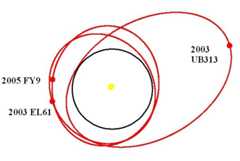
The last week of July 2005 was an exciting one for the outer solarsystem. In the course of two days the existence of three new objectswas announced, and each object was brighter than all of the previouslyknown objects in the Kuiper belt (with the exception of Pluto). With somany bright objects coming out at once it is hard to keep them allstraight. Here is the quick score card:
object
| Eris | 2003 EL61 | 2005 FY9 |
discoverers
| Brown, Trujillo, Rabinowitz
| Brown, Trujillo, Rabinowitz
| Brown, Trujillo, Rabinowitz
|
size
| 2400 +/- 100 km (105% Pluto)
| ~3/4 Pluto
| ~3/4 Pluto
|
brightness
| 4th brightest Kuiper belt object(KBO)
| 3rd brightest KBO
| 2nd brightest KBO
|
(note that though weconsider Pluto and Eris planets, they are also clearly members ofthe Kuiper belt, with Pluto the brightest member)
|
current distance
| 97 AU
| 52 AU
| 52 AU
|
(an AU is thedistance from the earth to the sun)
|
orbital period
| 560 years
| 285 years
| 307 years
|
closest approach to sun
| 38 AU
| 35 AU
| 39 AU
|
furthest from sun
| 97 AU
| 52 AU
| 52 AU
|
tilt of orbit compared to planets
| 44 degrees
| 28 degrees
| 29 degrees
|
satellite?
| yes!
| yes! (two of them!)
| no
|
surface composition
| Pluto-like
| water ice
| Pluto-like
|
when visible
| late summer, fall, earlywinter
| later winter,spring, early summer
|
Here is where these extremely bright Kuiper belt objects are in thesolar system these days:
What is the real story about the hastyannouncement and the reports of "hacking"?
In mid-July 2005 short abstracts of scientific talks to be given atameeting in September became available on the web (for example,here).We intended to talk about the object now known as 2003 EL61, which wehad discovered around Christmas of 2004, and the abstracts weredesigned to whet the appetite of the scientists who were attending themeeting. In theseabstracts we call the object a name that our softwareautomatically assigned, K40506A (the first Kuiper belt object wediscovered in data from 2004/05/06, May 6th). Using this name turns outto have been a very bad idea on our part! Unbeknownst to us, some ofthetelescopes that we had been using to study this object kept openrecordsof who has been observing, where they have been observing, and whatthey have been observing (these detailed records have since beenremoved from the web). A two-second Google search of "K40506A"immediately reveals one of these observing records. A little playingaround with web addresses then reveals even more records not initiallyGoogleable. Ouch. Bad news for us.Fromthe moment the abstracts became public anyone on the planet with a webconnection, and a little curiosity about this "K40506A" object, and aknowledge of orbital dynamics couldhave found out where it was. Anyone on the planet with even amodest-sized telescope could then go find the object and claim adiscovery as their own.
According to our web server logs, these observing logs were accessedon July 26, 2005 by a computer at the Instituto de Astrofisica inSpain. Less than two days after this computer accessed the observinglogs, the same computer was used to send email officially claiming thediscovery by P. Santos-Sanz and J.-L. Ortiz at the Instituto deAstrofisica (see detailed timelinehere). Atthe time of the announcementwe truly believed that they had no prior knowledge that we had beenobserving the object, and we truly believed that they had not used ourdata to make the announcement of the discovery, but other people foundthe coincidence suspicious.. Shortly after theirannouncement, however, we realized that all of our observingrecords -- including those about what is now known as 2003 UB313, thetenth planet -- were unexpectedly public, and madethe decision to prematurely announce the discovery of 2003 UB313 thatsame afternoon by a press conference. We were unhappy about having toforgo normal scientific protocol and announce the discovery with nocorresponding scientific paper, but under the circumstances we felt wehad no choice.
It is worth asking: if the observing records were on a publiclyaccessible web site, is it wrong to look at them? The obviousanswer is that there is nothing wrong with looking at information onany publicly accessible web site, just as there is nothing wrong withlooking at books in a library. But the standards of scientific ethicsare also clear: any information used from another source must beacknowledged and cited. One is not allowed to go to a library, find outabout a discovery in a book, and then claim that discovery as your ownwith no mention of having read it in a book. One is not evenallowed tofirst make a discovery and then go to the library and realize thatsomeone else independently made the same discovery and then notacknowledge what you learned in the library. Such actions would beconsidered scientifically dishonesty. It is not clear from the timelineprecisely what Ortiz and Santos-Sanz knew or how they used theweb-based records. They wererequired by the standards of science, however, to acknowledge their useofour web-based records if they accessed them. The director of the IAA,Dr. Jose Carlos del Toro Iniesta has promised to investigate whatprecisely happened. We have confidence in Dr. del Toro Iniesta toclarify the situation and determine the appropriate actions.
Some have commented that the real fault here was our own for keepingthe objects "secret." We are saddened by anti-scientific statementslike these, and have alreadywritten extensivelyon why this rather bizarreaccusation is spurious below. The community of scientists condemnsscientists who announce their results publicly before publishingscientific papers. Regardless of the number of times these bizarreaccusations are repeated, we will continue at all times to adhere toaccepted scientific protocol.
Why does it take so long to announce thesediscoveries?
Soon after the announcement of the discovery of the new planet thesuggestion slowly made its way around the internet that we, thediscoverers, were somehow violating long standing scientific standardsby keeping the existence of the planet "secret" for so long. Thissuggestion seemed so bizarre to us that we paid no attention at first,but, as with many things on the internet, it has been repeated enoughtimes even reasonable people are starting to believe it. We would liketo quickly dispell this odd misconception that no credible scientistwould hold.
One of the things that is so strange about this allegation is that itshould also be made of every single scientific result that is publishedin a reputable scientific journal. In all such cases, scientists makediscoveries, they verify their discoveries, they carefully documenttheir discoveries, and they submit papers to scientific journals. Whatthey
don'tdo is makediscoveries and immediately hold press conferences to announce them(one need only think back to the cold fusion days to remember howthoroughly the scientific community condemns such behavior). Goodscience is a careful and deliberate process. The time from discovery toannouncement in a scientific paper can be a couple of years. For all ofour past discoveries, we have described the objects in scientificpapers before publicly announcing the objects' existence, and we havemade that announcement in under nine months. These papers allow otherastronomers to verify, confirm, and critique the analysis we have done.Sadly, because we were forced to announce 2003 UB313 prematurely, wehave still yet to complete the scientific paper describing this object (
it is now finally complete!see below).We find this situation scientifically embarrassing and apologize to ourcolleagues who are reduced to learning about this new object fromreading reports in the press. We are hard at work on this scientificpaper, but, as we said above, good science is a careful and deliberateprocess and we are not yet through with our analysis. Our intent in allcases is to go from discovery to announcement in under nine months. Wethink that is a pretty fast pace.
One could object to the above by noting that the
existenceof these objects isnever in doubt, so why not just announce the
existenceimmediately upondiscovery and continue observing to learn more? This way otherastronomers could also study the new object. There are two reasons wedon't do this. First, we have dedicated a substantial part of ourcareers to this survey
preciselysothat we can discover and have the first crack at studying the largeobjects in the outer solar system. The discovery itself contains littleof scientific interest. Almost all of the science that we areinterested in doing comes from studying the object in detail
after discovery. Announcing theexistence of the objects and letting other astronomers get the firstdetailed observations of these objects would ruin the entire scientificpoint of spending so much effort on our survey. Some have argued thatdoing things this way "harms science" by not letting others makeobservations of the objects that we find. It is difficult to understandhow a nine month delay in studying an object that no one would evenknow existed otherwise is in any way harmful to science!
Many other types of astronomical surveys are done for precisely thesame reasons. Astronomers survey the skies looking for ever higherredshift galaxies. When they find them they study them and write ascientific paper. When the paper comes out other astronomers learn ofthe distant galaxy and they too study it. Other astronomers cull largedatabases such as the 2MASS infrared survey to find rare objects likebrown dwarves. When they find them they study them and write ascientific paper. When the paper comes out other astronomers learn ofthe brown dwarves and they study them in perhaps different ways. Stillother astronomers look around nearby stars for the elusive signs ofdirectly detectable extrasolar planets. When they find one they studyit and write a scientific paper..... You get the point. This is the waythat the entire field of astronomy -- and probably all of science --works. It's a very effective system; people who put in the tremendouseffort to find these rare objects are rewarded with getting to be thefirst to study them scientifically. Astronomers who are unwilling orunable to put in the effort to search for the objects still get tostudy them after a small delay.
There is a second reason that we don't announce objects immediately,and that is because we feel a responsibility not just to our scientificcolleagues but to the public. We know that these large objects thatkeep being found are likely to be the result of intensive interest bythe public, and we would like to have the story as complete as possiblebefore making an announcement. Consider, for example, the instantaneousOrtiz et al. announcement of the existence of 2003 EL61. Headlines inplaces like the BBC web site breathlessly exclaimed "new object may betwice the size of Pluto." But even at the time we knew that 2003 EL61had a satellite and was only 30% the mass of Pluto. We quickly got thetruth out, but just barely. Sadly, other interesting aspects of 2003EL61 also got lost in the shuffle. No one got to hear that it rotatesevery 4 hours, faster than anything else known in the Kuiper belt. Orhow that fast rotation causes it to be shaped like a cigar. Or how weuse the existence of the satellite to calculate the mass. All of theseare interesting things that would have let the public learn a bit moreabout the mysteries of physics and of the solar system. In the pressyou get one chance to tell the story. In the case of theinstantaneous announcement of 2003 EL61 the story was simply "there isa big object out there." We are saddened by the lost opportunity totell a richer scientific story and to have the public listen for justone day to a tale that included a bit of astronomy, a bit of physics,and a bit of detective story.
Given that we do precisely what other astronomers do and that we areactually very prompt about making announcements, where did the crazyideas that we should be announcing objects instantly come from?Interestingly, there is one area of astronomy in which instantaneousannouncement is both expected and beneficial to all. In the study ofrare, quickly changing objects, such as supernovae, gamma ray bursts,comets, and near earth asteroids, astronomers quickly disseminate theirresults so that as many people as possible can study the phenomenonbefore it disappears or changes completely. No one discovers a cometand keeps it to himself to study, because by the time the study wasdone the comet would be gone and no one else could study it ever again.The people initially suggesting that we were wrong to not announce ourobjects instantly are, for the most part, a small group of amateurastronomers who are familiar with comet and near earth asteroidobservation protocols. We can only assume that this familiarity ledthem to their misconceptions. Kuiper belt objects are not quicklychanging phenomena. Astronomers will be intensively studying Erisfor a long time to come.
We hope to discover a few more large objects in the outer solar system.When we do, we will do everything we can to learn as much as possibleabout them before we make their existence public, and we will try tomake the announcement as complete and scientifically and publiclyinteresting as possible. We will take the chance -- as all scientistsdo -- that by taking the time to do the scientific job correctlysomeone else may beat us to the announcement, and if they do we willcongratulate them heartily.
The scientific paper describing the discoveryis finally done!
As described in detail elsewhere, we were forced to announce theexistence of Eris before we had finished a scientific paperdescribing the discovery. While announcing discoveries via pressreleases with no scientific paper is generally frowned upon byscientists (including us) our colleagues have been understanding of theunusual circumstances under which this happened. The scientific paperdescribing the discovery has just been submitted to the AstrophysicalJournal. If you are curious what one of these papers looks like you can
readthe entire text. Now that the paper has been submitted to thejournal, the journal will send it out for peer-review, where anotherscientist will carefully and critically read what we have read andhelp decide if the paper meets accepted scientific standards. In almostall cases, the reviewer will suggest at least some changes to themanuscript before the paper is finally accepted. This process helpsensure that published scientific papers are as accurate and complete aspossible.
As of now the review process is complete and the revised paper ispublished in the December 10th 2005 issue of the Astrophysical JournalLetters.
You can read this page translated into Romanian
here.