Movatterモバイル変換
[0]ホーム
COLLECTED BY
Organization:
Internet Archive The Internet Archive discovers and captures web pages through many different web crawls.At any given time several distinct crawls are running, some for months, and some every day or longer.View the web archive through the
Wayback Machine.
Crawl of outlinks from wikipedia.org started May, 2011. These files are currently not publicly accessible.
The Wayback Machine - https://web.archive.org/web/20110604180947/http://www.gutenberg.org/files/30112/30112-h/30112-h.htm
The Project Gutenberg eBook, Development of the Phonograph at AlexanderGraham Bell's Volta Laboratory, by Leslie J. Newville
This eBook is for the use of anyone anywhere at no cost and withalmost no restrictions whatsoever. You may copy it, give it away orre-use it under the terms of the Project Gutenberg License includedwith this eBook or online atwww.gutenberg.org
Title: Development of the Phonograph at Alexander Graham Bell's Volta Laboratory
Contributions from the Museum of History and Technology, United States National Museum Bulletin 218, Paper 5, (pages 69-79)
Author: Leslie J. Newville
Release Date: September 27, 2009 [eBook #30112]
Language: English
Character set encoding: ISO-8859-1
***START OF THE PROJECT GUTENBERG EBOOK DEVELOPMENT OF THE PHONOGRAPH AT ALEXANDER GRAHAM BELL'S VOLTA LABORATORY***
E-text prepared by
Chris Curnow, Joseph Cooper, Stephanie Eason,
and the Project Gutenberg Online Distributed Proofreading Team
(http://www.pgdp.net)
[Pg 69]
Contributions from
The Museum of History and Technology:
Paper 5
Development of the Phonograph at
Alexander Graham Bell's Volta Laboratory
Leslie J. Newville
[Pg 70]
DEVELOPMENT OF THE PHONOGRAPH
AT ALEXANDER GRAHAM BELL'S
VOLTA LABORATORY
By Leslie J. Newville
The fame of Thomas A. Edison rests most securely on his genius formaking practical application of the ideas of others. However, itwas Alexander Graham Bell, long a Smithsonian Regent and friend ofits third Secretary S. P. Langley, who, with his Volta Laboratoryassociates made practical the phonograph, which has been calledEdison's most original invention.
The Author:Leslie J. Newville wrote this paper while he wasattached to the office of the curator of Science and Technology inthe Smithsonian Institution's United States National Museum.
The story of Alexander Graham Bell's invention of the telephone has beentold and retold. How he became involved in the difficult task of makingpractical phonograph records, and succeeded (in association with CharlesSumner Tainter and Chichester Bell), is not so well known.
But material collected through the years by the U. S. National Museum ofthe Smithsonian Institution now makes clear how Bell and two associatestook Edison's tinfoil machine and made it reproduce sound from waxinstead of tinfoil. They began their work in Washington, D. C., in 1879,and continued until granted basic patents in 1886 for recording in wax.
Preserved at the Smithsonian are some 20 pieces of experimentalapparatus, including a number of complete machines. Their firstexperimental machine was sealed in a box and deposited in theSmithsonian archives in 1881. The others were delivered by AlexanderGraham Bell to the National Museum in two lots in 1915 and 1922. Bellwas an old man by this time, busy with his aeronautical experiments inNova Scotia.
It was not until 1947, however, that the Museum received the key to theexperimental "Graphophones," as they were called to differentiate themfrom the Edison machine. In that year Mrs. Laura F. Tainter donated tothe Museum 10 bound notebooks, along with Tainter's unpublishedautobiography.[1] This material describes in detail the strange machinesand even stranger experiments which led in 1886 to a greatly improvedphonograph.
Thomas A. Edison had invented the phonograph in 1877. But the famebestowed on Edison for this startling invention (sometimes called hismost original) was not due to its efficiency. Recording with the tinfoilphonograph is too difficult to be practical. The tinfoil tears easily,and even when the stylus is properly adjusted, the reproduction isdistorted and squeaky, and good for only a few playbacks. Neverthelessyoung Edison, the "wizard" as he was called, had hit upon a secret of[Pg 71]which men had dreamed for centuries.[2] Immediately after thisdiscovery, however, he did not improve it, allegedly because of anagreement to spend the next five years developing the New York Cityelectric light and power system.
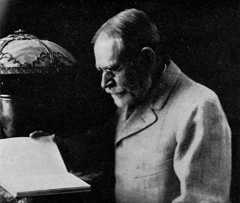
Figure 1.—Charles Sumner Tainter (1854-1940) from aphotograph taken in San Diego, California, 1919. (Smithsonian photo 42729-A.)
Meanwhile Bell, always a scientist and experimenter at heart, after hisinvention of the telephone in 1876 was looking for new worlds toconquer. If we accept Tainter's version of the story, it was throughGardiner Green Hubbard that Bell took up the phonograph challenge. Bellhad married Hubbard's daughter Mabel in 1879. Hubbard was then presidentof the Edison Speaking Phonograph Co., and his organization, which hadpurchased the Edison patent, was having trouble with its financesbecause people did not like to buy a machine which seldom worked welland proved difficult for an unskilled person to operate.
In 1879 Hubbard got Bell interested in improving the machine, and it wasagreed that a laboratory should be set up in Washington. Experimentswere also to be conducted on the transmission of sound by light, andthis resulted in the selenium-cell Photophone, patented in 1881. Boththe Hubbards and the Bells decided to move to the Capital. While Belltook his bride to Europe for an extended honeymoon, his associateCharles Sumner Tainter, a young instrument maker, was sent on toWashington from Cambridge, Massachusetts, to start the laboratory.[3]Bell's[Pg 72]cousin, Chichester Bell, who had been teaching college chemistryin London, agreed to come as the third associate. During his stay inEurope Bell received the 50,000-franc ($10,000) Volta prize, and it waswith this money that the Washington project, the Volta LaboratoryAssociation,[4] was financed.
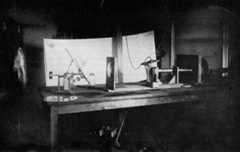
Figure 2.—Photographing Sound in 1884. A rare photographtaken at Volta Laboratory, Washington, D. C., by J. Harris Rogers, afriend of Bell and Tainter (Smithsonian photo 44312-E).
A description of the procedure used is found on page 67, of Tainter'sunpublished autobiography (seefootnote 1). There, Tainter quotesChichester Bell as follows:
"A jet of bichromate of potash solution, vibrated by the voice, wasdirected against a glass plate immediately in front of a slit, on whichlight was concentrated by means of a lens. The jet was so arranged thatthe light on its way to the slit had to pass through the nappe and asthe thickness of this was constantly changing, the illumination of theslit was also varied. By means of a lens ... an image of this slit wasthrown upon a rotating gelatine-bromide plate, on which accordingly arecord of the voice vibrations was obtained."
Tainter's story, in his autobiography, of the establishment of thelaboratory, shows its comparative simplicity:
I therefore wound up my business affairs in Cambridge, packed up all ofmy tools and machines, and ... went to Washington, and after muchsearch, rented a vacant house on L Street, between 13th and 14thStreets, and fitted it up for our purpose.[5]... The SmithsonianInstitution sent us over a mail sack of scientific books from thelibrary of the Institution, to consult, and primed with all we couldlearn ... we went to work.[6]... We were like the explorers in anentirely unknown land, where one has to select the path that seems to bemost likely to get you to your destination, with no knowledge of what isahead.
In conducting our work we had first to design an experimental apparatus,then hunt about, often in Philadelphia and New York, for the materialswith which to construct it, which were usually hard to find, and finallybuild the models we needed, ourselves.[7]
[Pg 73]
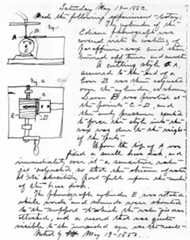
Figure 3.—Page from Notebook of Charles Sumner Tainter,describing an experiment in sound recording. The Tainter notebooks,preserved in the U. S. National Museum, describe experiments at theVolta Laboratory, in the 1880's. The Graphophone patents of 1886, werethe result of this research. (Smithsonian photo 44312.)
The experimental machines built at the Volta Laboratory include bothdisc and cylinder types, and an interesting "tape" recorder. The recordsused with the machines and now in the collections of the U. S. NationalMuseum, are believed to be the oldest reproducible records preservedanywhere in the world. While some are scratched and cracked, others arestill in good condition.
By 1881 the Volta associates had succeeded in improving an Edisontinfoil machine to some extent. Wax was put in the grooves of the heavyiron cylinder, and no tinfoil was used. Rather than apply for a patentat that time, however, they deposited the machine in a sealed box at theSmithsonian, and specified that it was not to be opened without theconsent of two of the three men. In 1937 Tainter (fig. 1) was the onlyone still living, so the box was opened with his permission.
For the occasion, the heirs of Alexander Graham Bell gathered inWashington, but Tainter was too old and too ill to come from San Diego.
The sound vibrations had been indented in the wax which had been appliedto the Edison phonograph. The following is the text of the recording:"There are more things in heaven and earth, Horatio, than are dreamed ofin your philosophy. I am a graphophone and my mother was a phonograph."Remarked Mrs. Gilbert Grosvenor,[8] Bell'sdaughter,[Pg 74]when the box wasopened in 1937, "That is just the sort of thing father would have said.He was always quoting from the classics."
Figure 4.—Patent Drawings from U. S. patent 341214, granted May 4,1886, to Chichester Bell and C. S. Tainter.
The method of reproduction used on the machine, however, is even moreinteresting than the quotation. Rather than a stylus and diaphragm, ajet of air under high pressure was used.
"This evening about 7 P. M.," Tainter noted on July 7, 1881, "Theapparatus being ready the valve upon the top of the air cylinder wasopened slightly until a pressure of about 100 lbs. was indicated by thegage. The phonograph cylinder was then rotated, and the sounds producedby the escaping air could be heard, and the words understood a distanceof at[Pg 75] least 8 feet from the phonograph." The point of the jet is glass,and could be directed at a single groove.
Figure 5.—Experimental Graphophone photographed in 1884at the Volta Laboratory. This is similar to one preserved at theSmithsonian Institution. (Smithsonian photo 44312-D.)
The other experimental Graphophones indicate an amazing range ofexperimentation. While the method of cutting a record on wax was the onelater exploited commercially, everything else seems to have been triedat least once.
The following was noted on Wednesday, March 20, 1881: "A fountain pen isattached to a diaphragm so as to be vibrated in a plane parallel to theaxis of a cylinder—The ink used in this pen to contain iron in a finelydivided state, and the pen caused to trace a spiral line around thecylinder as it turned. The cylinder to be covered with a sheet of paperupon which the record is made.... This ink ... can be rendered magneticby means of a permanent magnet. The sounds were to be reproduced bysimply substituting a magnet for the fountain pen...."
The result of these ideas for magnetic reproduction resulted in patent341287, granted on May 4, 1886; it deals solely with "the reproduction,through the action of magnetism, of sounds by means of records in solidsubstances."
Figure 6.—Another Experimental Graphophone, photographedat the Volta Laboratory in 1884. (Smithsonian photo 44312-F.)
The air jet used in reproducing has already been described. Other jets,of molten metal, wax, and water, were also tried. On Saturday, May 19,1883, Tainter wrote (seefig. 3):
Made the following experiment today:
The cylinder of the Edison phonograph was covered with the coatingof paraffine-wax and then turned off true and smooth.
A cutting style A., secured to the end of a lever B was thenadjusted over the cylinder, as shown. Lever B was pivoted at thepoints C-D, and the only pressure exerted to force the style intothe wax was due to the weight of the parts.
Upon the top of A was fixed a small brass disk, and immediatelyover it a sensitive water jet adjusted, so that the stream of waterat its sensitive part fell upon the center of the brass disk.
The Phonograph cylinder E, was rotated while words and sounds wereshouted to the support to which the water jet was attached, and arecord that was quite visible to the unaided eye was the result.
The tape recorder, an unusual instrument which recorded mechanically ona3⁄16-inch strip of wax-covered paper, is one of the machines describedand illustrated in U. S. patent 341214, dated May 4, 1886 (seefig. 4).The strip was coated by dipping it in a[Pg 76] solution of beeswax andparaffine (one part white beeswax, two parts paraffine, by weight), thenscraping one side clean and allowing the other side to harden.
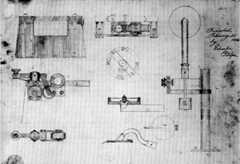
Figure 7.—Original Plans for a Disc Graphophone Patentedby Sumner Tainter in 1888, U. S. Patent 385886.
The machine of sturdy wood and metal construction, is hand powered bymeans of a knob fastened to the fly wheel. From the fly-wheel shaftpower is transferred by a small friction wheel to a vertical shaft. Atthe bottom of this shaft a V-pulley transfers motion by belts tocorresponding V-pulleys beneath the horizontal reels.
The wax strip passes from one 8-inch reel around the periphery of apulley (with guide flanges) mounted above the V-pulleys on the mainvertical shaft, where it comes in contact with the recording orreproducing stylus. It is then taken up on the other reel.
The sharp recording stylus, actuated by a vibrating mica diaphragm, cutsthe wax from the strip. In reproducing, a dull, loosely mounted stylus,attached to a rubber diaphragm, carried sounds through an ear tube tothe listener.
Both recording and reproducing heads, mounted alternately on the sametwo posts, could be adjusted vertically so that several records could becut on the same3⁄16-inch strip.
While this machine was never developed commercially, it is aninteresting ancestor of the modern tape recorder, which it resemblessomewhat in design. How practical it was or just why it was built we donot know. The tape is now brittle, the heavy paper reels warped, and thereproducing head missing. Otherwise, with some reconditioning, it couldbe put into working condition.
Most of the disc machines designed by the Volta associates had the discmounted vertically (seefigs. 5 and6). The explanation is that in theearly experiments, the turntable, with disc, was mounted on the shoplathe, along with the recording and reproducing[Pg 77] heads. Later, when thecomplete models were built, most of them featured vertical turntables.
Figure 8.—Another Page of the Plans Shown inFigure 7.The experimental Graphophone built from these plans is in the U. S.National Museum (cat. no. 287665).
An interesting exception has a horizontal 7-inch turntable (seefigs. 7 and8).This machine, although made in 1886, is a duplicate of one madeearlier but taken to Europe by Chichester Bell. Tainter was granted U.S. patent 385886 for it on July 10, 1888.
The playing arm is rigid, except for a pivoted vertical motion of 90degrees to allow removal of the record or a return to starting position.While recording or playing, the record not only rotated, but movedlaterally under the stylus, which thus described a spiral, recording 150grooves to the inch.
The Bell and Tainter records, preserved at the Smithsonian, are both ofthe lateral cut and "hill-and-dale" types. Edison for many years usedthe "hill-and-dale" method with both cylinder and disc records, andEmile Berliner is credited with the invention of the lateral cutGramophone record in 1887. The Volta associates, however, had beenexperimenting with both types, as early as 1881, as is shown by thefollowing quotation from Tainter:[9]
The record on the electro-type in the Smithsonian package is of theother form, where the vibrations are impressedparallel to thesurface of the recording material, as was done in the old ScottPhonautograph of 1857, thus forming a groove of uniform depth, butof wavy character, in which thesides of the groove act upon thetracing point instead of the bottom, as is the case in the verticaltype. This form we named the zig-zag form, and referred to it inthat way in our notes. Its important advantage in guiding thereproducing needle I first called attention to in the note on p.9-Vol 1-Home Notes on March 29-1881, and endeavored to use it in myearly work, but encountered so much difficulty in getting a form ofreproducer that would work with the soft wax records withouttearing the groove, we used the hill and valley type of record moreoften than the other.
[Pg 78]In 1885, when the Volta associates were sure that they had a number ofpractical inventions, they filed applications for patents. They alsobegan to look around for investors. After giving several demonstrationsin Washington, they gained the necessary support, and the AmericanGraphophone Co. was organized to manufacture and sell the machines. TheVolta Graphophone Co. was formed to control the patents.
The Howe sewing machine factory at Bridgeport, Connecticut, became theAmerican Graphophone plant; Tainter went there to supervise themanufacturing, and continued his inventive work for many years. ThisBridgeport plant is still in use today by a successor firm, theDictaphone Corporation.
The work of the Volta associates laid the foundation for the successfuluse of the dictating machine in business, for their wax recordingprocess was practical and their machines sturdy. But it was to takeseveral more years and the renewed work of Edison and furtherdevelopments by Berliner and many others, before the talking machineindustry really got under way and became a major factor in homeentertainment.[10]
PATENTS WHICH RESULTED FROM THE VOLTA LABORATORY ASSOCIATION
Patent
Number | Year | Patent | Inventors |
| 229495 | 1880 | Telephone call register | C. S. Tainter |
| 235496 | 1880 | Photophone transmitter | A. G. Bell, C. S. Tainter |
| 235497 | 1880 | Selenium cells | A. G. Bell, C. S. Tainter |
| 235590 | 1800 | Selenium cells | C. S. Tainter |
| 241909 | 1881 | Photophonic receiver | A. G. Bell, C. S. Tainter |
| 243657 | 1881 | Telephone transmitter | C. S. Tainter |
| 289725 | 1883 | Electric conductor | C. S. Tainter |
| 336081 | 1886 | Transmitter for electric telephone lines | C. A. Bell |
| 336082 | 1886 | Jet microphone for transmitting sounds by means of jets | C. A. Bell |
| 336083 | 1886 | Telephone transmitter | C. A. Bell |
| 336173 | 1886 | Telephone transmitter | C. S. Tainter |
| 341212 | 1886 | Reproducing sounds from phonograph records | A. G. Bell, C. A. Bell, C. S. Tainter |
| 341213 | 1886 | Reproducing and recording sounds by radiant energy | A. G. Bell, C. A. Bell, C. S. Tainter |
| 341214 | 1886 | Recording and reproducing speech and other sounds | C. A. Bell, C. S. Tainter |
| 341287 | 1886 | Recording and reproducing sounds | C. S. Tainter |
| 341288 | 1886 | Apparatus for recording and reproducing sounds | C. S. Tainter |
| 374133 | 1887 | Paper cylinder for graphophonic records | C. S. Tainter |
| 375579 | 1887 | Apparatus for recording and reproducing speech and other sounds | C. S. Tainter |
| 380535 | 1888 | Graphophone | C. S. Tainter |
| 385886 | 1888 | Graphophone | C. S. Tainter |
| 385887 | 1888 | Graphophonic tablet | C. S. Tainter |
| 388462 | 1888 | Machine for making paper tubes | C. S. Tainter |
| 392763 | 1888 | Mounting for diaphragms for acoustical instruments | C. S. Tainter |
| 393190 | 1888 | Tablet for use in graphophones | C. S. Tainter |
| 393191 | 1888 | Support for graphophonic tablets | C. S. Tainter |
| 416969 | 1889 | Speed regulator | C. S. Tainter |
| 421450 | 1890 | Graphophone tablet | C. S. Tainter |
| [Pg 79]428646 | 1890 | Machine for the manufacture of wax coated tablets for graphophones | C. S. Tainter |
| 506348 | 1893 | Coin controlled graphophone | C. S. Tainter |
| 510656 | 1893 | Reproducer for graphophones | C. S. Tainter |
| 670442 | 1901 | Graphophone record duplicating machine | C. S. Tainter |
| 730986 | 1903 | Graphophone | C. S. Tainter |
CONTENTS OF SMALL CHEST RECEIVED BY THE SMITHSONIAN INSTITUTION FROMMRS. LAURA F. TAINTER, 1947
Books (10) containing the home notes, volumes 1 to 8 and11 and 12, inclusive, March 1881-November 1883. (Vols, 9, 10, and13 were burned in a laboratory fire, September 1897.)
Binder containing drawings and notes for multiple recordduplicator, October 8, 1897-1908, and miscellaneous inquiries, log,telegraph recorder, diet, home plans.
Binder containing printed specifications of patents, S. Tainter, A.G. Bell, and C. A. Bell, June 29, 1880 to June 16, 1903.
Medal, Exposition Internationale d'Electricite, Paris, 1881, marked"Tainter."
Medal, Panama-Pacific Exposition, San Francisco, 1915, Medal ofAward.
Seven purple lapel rosettes (?), one with ribbon and palms, inboxes marked "1890." Notes in newspaper clipping.
Records of testimony of C. S. Tainter in various suits involvingthe phonograph: Volta Graphophone Co.vs. Columbia PhonographCo., no. 14533, Supreme Court of the District of Columbia, datedJanuary 13, 1894; American Graphophone Co.vs. U. S. PhonographCo., U. S. Circuit Court, New Jersey, dated May 14, 1895; AmericanGraphophone Co.vs. Edw. H. Amet, U. S. Circuit Court, NorthernDistrict, Illinois, in equity, dated February 14, 1896; AmericanGraphophone Co.vs. U. S. Phonograph Co.,et al., U. S. CircuitCourt, New Jersey, in equity, no date; American Graphophone Co.vs. Leedset al., U. S. Circuit Court, Two District, New York,N. Y., no date; testimony marked "Questions asked in Edison Co.suits" (duplicate copies) no date, no citation.
CONTENTS OF SMALL CHEST RECEIVED BY THE SMITHSONIAN INSTITUTION FROMMRS. LAURA F. TAINTER, 1950
Typed manuscript—"Memoirs of Charles Sumner Tainter" (plus manyphotostats of notes and articles) 4½ inches thick, pp. 1-71 toabout 1878, pp. 1 to 104 to factory at Bridgeport, some pagesmissing.
Box—containing handwritten notes for "memoirs" includes copies oftext of above (less photostats); copies of short biography;agreement creating American Graphophone Co.; letter of election tolife membership in the American Association for the Advancement ofScience.
Binder—exhibits of Tainter drawings in American Graphophone Co.vs. Edison Phonograph Works., vol. 1, U. S. Circuit Court, NewJersey.
Folder—clippings and photostats relating to the machines depositedin Smithsonian.
Certificate of appointment "Officer de l'Instruction publique,"France, October 31, 1889, for exhibition of Graphophone, ExpositionUniverselle, 1889.
Framed photo of Berliner & Tainter, 1919.
Photo of Tainter, 1919.
Separate package containing gold medal, certificate, Panama-PacificExposition, San Francisco, 1915; gold medal, certificate,Exposition Internationale Electricite, Paris, 1881.
Footnotes:
[1] Charles Sumner Tainter (1854-1940), "The talking machine and somelittle known facts in connection with its early development,"unpublished manuscript in the collections of the U. S. National Museum.
[2] One of the most interesting prophecies was written in 1656 by Cyranode Bergerac, in hisComic history of the states and empires of theMoon:
"'I began to study closely my books and their covers which impressed mefor their richness. One was decorated with a single diamond, morebrilliant by far than ours. The second seemed but a single pearl cleftin twain.
"'When I opened the covers, I found inside something made of metal, notunlike our clocks, full of mysterious little springs and almostinvisible mechanisms. 'Tis a book, 'tis true, but a miraculous book,which has no pages or letters. Indeed, 'tis a book which to enjoy theeyes are useless; only ears suffice. When a man desires to read, then,he surrounds this contrivance with many small tendons of every kind,then he places the needle on the chapter to be heard and, at the sametime, there come, as from the mouth of a man or from an instrument ofmusic, all those clear and separate sounds which make up the Lunarians'tongue.'" (See A. Coeuroy and G. Clarence,Le phonographe, Paris,1929, p. 9, 10.)
[3] Tainter retained a lifelong admiration for Alexander Graham Bell.This is Tainter's description of their first meeting in Cambridge: "...one day I received a visit from a very distinguished looking gentlemanwith jet black hair and beard, who announced himself as Mr. A. GrahamBell. His charm of manner and conversation attracted me greatly...."Tainter,op. cit. (footnote 1), p. 2.
[4] A. G. Bell apparently spent little time in the Volta Laboratory. TheDr. Bell referred to in Tainter's notebooks is Chichester A. Bell. Thebasic graphophone patent (U. S. patent 341214) was issued to C. A. Belland Tainter. The Tainter material reveals A. G. Bell as the man whosuggested the basic lines of research (and furnished the money), andthen allowed his associates to get the credit for many of the inventionsthat resulted.
[5] Tainter,op. cit. (footnote 1), p. 3.
[6]Ibid., p. 5.
[7]Ibid., p. 30.
[8] As quoted byThe Washington Herald, October 28, 1937.
[9] Tainter,op. cit. (footnote 1), pp. 28, 29.
[10] The basic distinction between the first Edison patent, and the Belland Tainter patent of 1886 was the method of recording. Edison's methodwas toindent the sound waves on a piece of tin-foil (wax was includedas a recording material in his English patent); the Bell and Tainterimprovement called forcutting or "engraving" the sound waves into awax record, with a sharp recording stylus.
The strength of Bell and Tainter patent is indicated by the followingexcerpt from a letter written by a Washington patent attorney, S. T.Cameron, who was a member of the law firm which carried on litigationfor the American Graphophone Co. The letter is dated December 8, 1914,and is addressed to George C. Maynard, Curator of Mechanical Technology,U. S. National Museum: "Subsequent to the issuance of the Bell andTainter patent No. 341214, Edison announced that he would shortlyproduce his 'new phonograph' which, when it appeared, was in factnothing but the Bell and Tainter record set forth in their patent341214, being a record cut or engraved in wax or wax-like material,although Edison always insisted on calling this record an 'indented'record, doubtless because his original tin-foil record was an 'indented'record. Edison was compelled to acknowledge that his 'new phonograph'was an infringement of the Bell and Tainter patent 341214, and took outa license under the Bell and Tainter patent and made his records underthat patent as the result of that license."
Transcriber's Note:
Additional spacing after some of the quotations is intentionalto indicate both the end of a quotation and the beginning of a new paragraph aspresented in the original text.
***END OF THE PROJECT GUTENBERG EBOOK DEVELOPMENT OF THE PHONOGRAPH AT ALEXANDER GRAHAM BELL'S VOLTA LABORATORY***
******* This file should be named 30112-h.txt or 30112-h.zip *******
This and all associated files of various formats will be found in:
http://www.gutenberg.org/3/0/1/1/30112
Updated editions will replace the previous one--the old editionswill be renamed.
Creating the works from public domain print editions means that noone owns a United States copyright in these works, so the Foundation(and you!) can copy and distribute it in the United States withoutpermission and without paying copyright royalties. Special rules,set forth in the General Terms of Use part of this license, apply tocopying and distributing Project Gutenberg-tm electronic works toprotect the PROJECT GUTENBERG-tm concept and trademark. ProjectGutenberg is a registered trademark, and may not be used if youcharge for the eBooks, unless you receive specific permission. If youdo not charge anything for copies of this eBook, complying with therules is very easy. You may use this eBook for nearly any purposesuch as creation of derivative works, reports, performances andresearch. They may be modified and printed and given away--you may dopractically ANYTHING with public domain eBooks. Redistribution issubject to the trademark license, especially commercialredistribution.
*** START: FULL LICENSE ***THE FULL PROJECT GUTENBERG LICENSEPLEASE READ THIS BEFORE YOU DISTRIBUTE OR USE THIS WORKTo protect the Project Gutenberg-tm mission of promoting the freedistribution of electronic works, by using or distributing this work(or any other work associated in any way with the phrase "ProjectGutenberg"), you agree to comply with all the terms of the Full ProjectGutenberg-tm License (available with this file or online athttp://www.gutenberg.org/license).Section 1. General Terms of Use and Redistributing Project Gutenberg-tmelectronic works1.A. By reading or using any part of this Project Gutenberg-tmelectronic work, you indicate that you have read, understand, agree toand accept all the terms of this license and intellectual property(trademark/copyright) agreement. If you do not agree to abide by allthe terms of this agreement, you must cease using and return or destroyall copies of Project Gutenberg-tm electronic works in your possession.If you paid a fee for obtaining a copy of or access to a ProjectGutenberg-tm electronic work and you do not agree to be bound by theterms of this agreement, you may obtain a refund from the person orentity to whom you paid the fee as set forth in paragraph 1.E.8.1.B. "Project Gutenberg" is a registered trademark. It may only beused on or associated in any way with an electronic work by people whoagree to be bound by the terms of this agreement. There are a fewthings that you can do with most Project Gutenberg-tm electronic workseven without complying with the full terms of this agreement. Seeparagraph 1.C below. There are a lot of things you can do with ProjectGutenberg-tm electronic works if you follow the terms of this agreementand help preserve free future access to Project Gutenberg-tm electronicworks. See paragraph 1.E below.1.C. The Project Gutenberg Literary Archive Foundation ("the Foundation"or PGLAF), owns a compilation copyright in the collection of ProjectGutenberg-tm electronic works. Nearly all the individual works in thecollection are in the public domain in the United States. If anindividual work is in the public domain in the United States and you arelocated in the United States, we do not claim a right to prevent you fromcopying, distributing, performing, displaying or creating derivativeworks based on the work as long as all references to Project Gutenbergare removed. Of course, we hope that you will support the ProjectGutenberg-tm mission of promoting free access to electronic works byfreely sharing Project Gutenberg-tm works in compliance with the terms ofthis agreement for keeping the Project Gutenberg-tm name associated withthe work. You can easily comply with the terms of this agreement bykeeping this work in the same format with its attached full ProjectGutenberg-tm License when you share it without charge with others.1.D. The copyright laws of the place where you are located also governwhat you can do with this work. Copyright laws in most countries are ina constant state of change. If you are outside the United States, checkthe laws of your country in addition to the terms of this agreementbefore downloading, copying, displaying, performing, distributing orcreating derivative works based on this work or any other ProjectGutenberg-tm work. The Foundation makes no representations concerningthe copyright status of any work in any country outside the UnitedStates.1.E. Unless you have removed all references to Project Gutenberg:1.E.1. The following sentence, with active links to, or other immediateaccess to, the full Project Gutenberg-tm License must appear prominentlywhenever any copy of a Project Gutenberg-tm work (any work on which thephrase "Project Gutenberg" appears, or with which the phrase "ProjectGutenberg" is associated) is accessed, displayed, performed, viewed,copied or distributed:This eBook is for the use of anyone anywhere at no cost and withalmost no restrictions whatsoever. You may copy it, give it away orre-use it under the terms of the Project Gutenberg License includedwith this eBook or online at www.gutenberg.org1.E.2. If an individual Project Gutenberg-tm electronic work is derivedfrom the public domain (does not contain a notice indicating that it isposted with permission of the copyright holder), the work can be copiedand distributed to anyone in the United States without paying any feesor charges. If you are redistributing or providing access to a workwith the phrase "Project Gutenberg" associated with or appearing on thework, you must comply either with the requirements of paragraphs 1.E.1through 1.E.7 or obtain permission for the use of the work and theProject Gutenberg-tm trademark as set forth in paragraphs 1.E.8 or1.E.9.1.E.3. If an individual Project Gutenberg-tm electronic work is postedwith the permission of the copyright holder, your use and distributionmust comply with both paragraphs 1.E.1 through 1.E.7 and any additionalterms imposed by the copyright holder. Additional terms will be linkedto the Project Gutenberg-tm License for all works posted with thepermission of the copyright holder found at the beginning of this work.1.E.4. Do not unlink or detach or remove the full Project Gutenberg-tmLicense terms from this work, or any files containing a part of thiswork or any other work associated with Project Gutenberg-tm.1.E.5. Do not copy, display, perform, distribute or redistribute thiselectronic work, or any part of this electronic work, withoutprominently displaying the sentence set forth in paragraph 1.E.1 withactive links or immediate access to the full terms of the ProjectGutenberg-tm License.1.E.6. You may convert to and distribute this work in any binary,compressed, marked up, nonproprietary or proprietary form, including anyword processing or hypertext form. However, if you provide access to ordistribute copies of a Project Gutenberg-tm work in a format other than"Plain Vanilla ASCII" or other format used in the official versionposted on the official Project Gutenberg-tm web site (www.gutenberg.org),you must, at no additional cost, fee or expense to the user, provide acopy, a means of exporting a copy, or a means of obtaining a copy uponrequest, of the work in its original "Plain Vanilla ASCII" or otherform. Any alternate format must include the full Project Gutenberg-tmLicense as specified in paragraph 1.E.1.1.E.7. Do not charge a fee for access to, viewing, displaying,performing, copying or distributing any Project Gutenberg-tm worksunless you comply with paragraph 1.E.8 or 1.E.9.1.E.8. You may charge a reasonable fee for copies of or providingaccess to or distributing Project Gutenberg-tm electronic works providedthat- You pay a royalty fee of 20% of the gross profits you derive from the use of Project Gutenberg-tm works calculated using the method you already use to calculate your applicable taxes. The fee is owed to the owner of the Project Gutenberg-tm trademark, but he has agreed to donate royalties under this paragraph to the Project Gutenberg Literary Archive Foundation. Royalty payments must be paid within 60 days following each date on which you prepare (or are legally required to prepare) your periodic tax returns. Royalty payments should be clearly marked as such and sent to the Project Gutenberg Literary Archive Foundation at the address specified in Section 4, "Information about donations to the Project Gutenberg Literary Archive Foundation."- You provide a full refund of any money paid by a user who notifies you in writing (or by e-mail) within 30 days of receipt that s/he does not agree to the terms of the full Project Gutenberg-tm License. You must require such a user to return or destroy all copies of the works possessed in a physical medium and discontinue all use of and all access to other copies of Project Gutenberg-tm works.- You provide, in accordance with paragraph 1.F.3, a full refund of any money paid for a work or a replacement copy, if a defect in the electronic work is discovered and reported to you within 90 days of receipt of the work.- You comply with all other terms of this agreement for free distribution of Project Gutenberg-tm works.1.E.9. If you wish to charge a fee or distribute a Project Gutenberg-tmelectronic work or group of works on different terms than are setforth in this agreement, you must obtain permission in writing fromboth the Project Gutenberg Literary Archive Foundation and MichaelHart, the owner of the Project Gutenberg-tm trademark. Contact theFoundation as set forth in Section 3 below.1.F.1.F.1. Project Gutenberg volunteers and employees expend considerableeffort to identify, do copyright research on, transcribe and proofreadpublic domain works in creating the Project Gutenberg-tmcollection. Despite these efforts, Project Gutenberg-tm electronicworks, and the medium on which they may be stored, may contain"Defects," such as, but not limited to, incomplete, inaccurate orcorrupt data, transcription errors, a copyright or other intellectualproperty infringement, a defective or damaged disk or other medium, acomputer virus, or computer codes that damage or cannot be read byyour equipment.1.F.2. LIMITED WARRANTY, DISCLAIMER OF DAMAGES - Except for the "Rightof Replacement or Refund" described in paragraph 1.F.3, the ProjectGutenberg Literary Archive Foundation, the owner of the ProjectGutenberg-tm trademark, and any other party distributing a ProjectGutenberg-tm electronic work under this agreement, disclaim allliability to you for damages, costs and expenses, including legalfees. YOU AGREE THAT YOU HAVE NO REMEDIES FOR NEGLIGENCE, STRICTLIABILITY, BREACH OF WARRANTY OR BREACH OF CONTRACT EXCEPT THOSEPROVIDED IN PARAGRAPH F3. YOU AGREE THAT THE FOUNDATION, THETRADEMARK OWNER, AND ANY DISTRIBUTOR UNDER THIS AGREEMENT WILL NOT BELIABLE TO YOU FOR ACTUAL, DIRECT, INDIRECT, CONSEQUENTIAL, PUNITIVE ORINCIDENTAL DAMAGES EVEN IF YOU GIVE NOTICE OF THE POSSIBILITY OF SUCHDAMAGE.1.F.3. LIMITED RIGHT OF REPLACEMENT OR REFUND - If you discover adefect in this electronic work within 90 days of receiving it, you canreceive a refund of the money (if any) you paid for it by sending awritten explanation to the person you received the work from. If youreceived the work on a physical medium, you must return the medium withyour written explanation. The person or entity that provided you withthe defective work may elect to provide a replacement copy in lieu of arefund. If you received the work electronically, the person or entityproviding it to you may choose to give you a second opportunity toreceive the work electronically in lieu of a refund. If the second copyis also defective, you may demand a refund in writing without furtheropportunities to fix the problem.1.F.4. Except for the limited right of replacement or refund set forthin paragraph 1.F.3, this work is provided to you 'AS-IS,' WITH NO OTHERWARRANTIES OF ANY KIND, EXPRESS OR IMPLIED, INCLUDING BUT NOT LIMITED TOWARRANTIES OF MERCHANTIBILITY OR FITNESS FOR ANY PURPOSE.1.F.5. Some states do not allow disclaimers of certain impliedwarranties or the exclusion or limitation of certain types of damages.If any disclaimer or limitation set forth in this agreement violates thelaw of the state applicable to this agreement, the agreement shall beinterpreted to make the maximum disclaimer or limitation permitted bythe applicable state law. The invalidity or unenforceability of anyprovision of this agreement shall not void the remaining provisions.1.F.6. INDEMNITY - You agree to indemnify and hold the Foundation, thetrademark owner, any agent or employee of the Foundation, anyoneproviding copies of Project Gutenberg-tm electronic works in accordancewith this agreement, and any volunteers associated with the production,promotion and distribution of Project Gutenberg-tm electronic works,harmless from all liability, costs and expenses, including legal fees,that arise directly or indirectly from any of the following which you door cause to occur: (a) distribution of this or any Project Gutenberg-tmwork, (b) alteration, modification, or additions or deletions to anyProject Gutenberg-tm work, and (c) any Defect you cause.Section 2. Information about the Mission of Project Gutenberg-tmProject Gutenberg-tm is synonymous with the free distribution ofelectronic works in formats readable by the widest variety of computersincluding obsolete, old, middle-aged and new computers. It existsbecause of the efforts of hundreds of volunteers and donations frompeople in all walks of life.Volunteers and financial support to provide volunteers with theassistance they need are critical to reaching Project Gutenberg-tm'sgoals and ensuring that the Project Gutenberg-tm collection willremain freely available for generations to come. In 2001, the ProjectGutenberg Literary Archive Foundation was created to provide a secureand permanent future for Project Gutenberg-tm and future generations.To learn more about the Project Gutenberg Literary Archive Foundationand how your efforts and donations can help, see Sections 3 and 4and the Foundation web page at http://www.gutenberg.org/fundraising/pglaf.Section 3. Information about the Project Gutenberg Literary ArchiveFoundationThe Project Gutenberg Literary Archive Foundation is a non profit501(c)(3) educational corporation organized under the laws of thestate of Mississippi and granted tax exempt status by the InternalRevenue Service. The Foundation's EIN or federal tax identificationnumber is 64-6221541. Contributions to the Project GutenbergLiterary Archive Foundation are tax deductible to the full extentpermitted by U.S. federal laws and your state's laws.The Foundation's principal office is located at 4557 Melan Dr. S.Fairbanks, AK, 99712., but its volunteers and employees are scatteredthroughout numerous locations. Its business office is located at809 North 1500 West, Salt Lake City, UT 84116, (801) 596-1887, emailbusiness@pglaf.org. Email contact links and up to date contactinformation can be found at the Foundation's web site and officialpage at http://www.gutenberg.org/about/contactFor additional contact information: Dr. Gregory B. Newby Chief Executive and Director gbnewby@pglaf.orgSection 4. Information about Donations to the Project GutenbergLiterary Archive FoundationProject Gutenberg-tm depends upon and cannot survive without widespread public support and donations to carry out its mission ofincreasing the number of public domain and licensed works that can befreely distributed in machine readable form accessible by the widestarray of equipment including outdated equipment. Many small donations($1 to $5,000) are particularly important to maintaining tax exemptstatus with the IRS.The Foundation is committed to complying with the laws regulatingcharities and charitable donations in all 50 states of the UnitedStates. Compliance requirements are not uniform and it takes aconsiderable effort, much paperwork and many fees to meet and keep upwith these requirements. We do not solicit donations in locationswhere we have not received written confirmation of compliance. ToSEND DONATIONS or determine the status of compliance for anyparticular state visit http://www.gutenberg.org/fundraising/pglafWhile we cannot and do not solicit contributions from states where wehave not met the solicitation requirements, we know of no prohibitionagainst accepting unsolicited donations from donors in such states whoapproach us with offers to donate.International donations are gratefully accepted, but we cannot makeany statements concerning tax treatment of donations received fromoutside the United States. U.S. laws alone swamp our small staff.Please check the Project Gutenberg Web pages for current donationmethods and addresses. Donations are accepted in a number of otherways including checks, online payments and credit card donations.To donate, please visit: http://www.gutenberg.org/fundraising/donateSection 5. General Information About Project Gutenberg-tm electronicworks.Professor Michael S. Hart is the originator of the Project Gutenberg-tmconcept of a library of electronic works that could be freely sharedwith anyone. For thirty years, he produced and distributed ProjectGutenberg-tm eBooks with only a loose network of volunteer support.Project Gutenberg-tm eBooks are often created from several printededitions, all of which are confirmed as Public Domain in the U.S.unless a copyright notice is included. Thus, we do not necessarilykeep eBooks in compliance with any particular paper edition.Each eBook is in a subdirectory of the same number as the eBook'seBook number, often in several formats including plain vanilla ASCII,compressed (zipped), HTML and others.Corrected EDITIONS of our eBooks replace the old file and take overthe old filename and etext number. The replaced older file is renamed.VERSIONS based on separate sources are treated as new eBooks receivingnew filenames and etext numbers.Most people start at our Web site which has the main PG search facility:http://www.gutenberg.orgThis Web site includes information about Project Gutenberg-tm,including how to make donations to the Project Gutenberg LiteraryArchive Foundation, how to help produce our new eBooks, and how tosubscribe to our email newsletter to hear about new eBooks.EBooks posted prior to November 2003, with eBook numbers BELOW #10000,are filed in directories based on their release date. If you want todownload any of these eBooks directly, rather than using the regularsearch system you may utilize the following addresses and justdownload by the etext year.http://www.gutenberg.org/dirs/etext06/ (Or /etext 05, 04, 03, 02, 01, 00, 99, 98, 97, 96, 95, 94, 93, 92, 92, 91 or 90)EBooks posted since November 2003, with etext numbers OVER #10000, arefiled in a different way. The year of a release date is no longer partof the directory path. The path is based on the etext number (which isidentical to the filename). The path to the file is made up of singledigits corresponding to all but the last digit in the filename. Forexample an eBook of filename 10234 would be found at:http://www.gutenberg.org/dirs/1/0/2/3/10234or filename 24689 would be found at:http://www.gutenberg.org/dirs/2/4/6/8/24689An alternative method of locating eBooks:http://www.gutenberg.org/dirs/GUTINDEX.ALL*** END: FULL LICENSE ***
[8]ページ先頭