Movatterモバイル変換
[0]ホーム
COLLECTED BY
Organization:
Alexa Crawls Starting in 1996,
Alexa Internet has been donating their crawl data to the Internet Archive. Flowing in every day, these data are added to the
Wayback Machine after an embargo period.
Starting in 1996,
Alexa Internet has been donating their crawl data to the Internet Archive. Flowing in every day, these data are added to the
Wayback Machine after an embargo period.
The Wayback Machine - https://web.archive.org/web/20101231042803/http://webvision.med.utah.edu:80/GABA-C.htm

-aminobutyric acid) is the main inhibitory neurotransmitter in the central nervoussystem. The inhibitory action of GABA is mediated by the receptorspresent on the cell membrane, and results in a reduction of neuronalexcitablity. At least three types of GABA receptors have beencharacterized. Table 1 summarizes some of the general propertiesof these three types of GABA receptors. GABAreceptors are ligand-gated chloride channels. They mediate fastinhibition and have a wide distribution throughout the centralnervous system. GABAreceptorshave a divese molecular composition. At least 16 subunits in 6groups have been identified. Pharmacologically, these receptorsare antagonized by bicuculline. GABA receptorsare also the targets of many therapeutic compounds (such as generalanaesthetics, sedative drugs, and alcohols). These compounds allostericallymodulate GABA receptor channel activities.GABA receptors belong to the G-proteincoupled receptor superfamily. The inhibition of GABAreceptors is mediated by indirect gating of either potassium orcalcium channels. GABA receptors are activatedby baclofen, and antagonized by phaclofen and saclofen. The subunitsof GABA receptors have recently been cloned.GABA receptors are the newly identifiedmember of the GABA receptor family. They are also linked to chloridechannels, with distinct physiological and pharmacological properties.In contrast to the fast and transient responses elicited fromGABA receptors, GABAreceptors mediate slow and sustained responses. Pharmacologically,GABA receptors are bicuculline- and baclofen-insensitive,and are not modulated by many GABA receptormodulators (such as benzodiazepines and barbiturates). GABA subunits are thought to participate informing GABA receptors on the neuronalmembrane, but the exact molecular composition of these receptorsis yet to be determined. GABAreceptors are expressed in many brain regions, with prominentdistributions on retinal neurons, suggesting these receptors playimportant roles in retinal signal processing.
| | | | |
| Ligand-gated Channel | G-protein coupled receptor | Ligand-gated Channel |
| | | GBR1, GBR2 | |
| | Muscimol, THIP | Baclofen | |
| | Bicuculline, Picrotoxin | Phaclofen | TPMPA, Picrotoxin |
| | Yes | No | No |
| | Benzodiazepines Barbiturates | | Zinc |
|

receptor" was first used by Johnston to describe a novel GABA binding site on neuronal membranes (Johnston, 1986, 1996). Although recent studies indicate a wide distribution of GABA receptorsin many parts of the central nervous system (Sivilotti and Nistri,1991; Albrecht et al., 1997; Boue-Grabot et al., 1998; Wegeliuset al., 1998; Enz and Cutting, 1999), these receptors are mostprominently expressed in the vertebrate retina. In the fish white perchretina, rod-driven (H4) horizontal cells were the firstretinal neurons where GABA receptorswere characterized (Qian and Dowling, 1993). Subsquently, GABA-receptor mediated responses have been detectedin many types of retinal neurons, including bipolar cells (Feigenspanet al., 1993; Qian and Dowling, 1995; Qian et al., 1997b; Lukasiewiczet al., 1994; Lukaisiewicz and Wong, 1997; Pan and Lipton, 1995;Nelson et al., 1999), cone-driven horizontal cells in catfish(Dong et al, 1994; Kaneda et al., 1997), cone photoreceptors (Picaudet al, 1998), and ganglion cells (Zhang and Slaughter, 1995).Among all these retinal neurons, the rod-driven horizontal cellsof white perch are the only cells where GABA responses are mediatedsolely by GABA receptors. The GABA responseselicited from other cells are usually a mixture of GABA receptorsand/or GABA transporters. The unique properties of the white perchrod-driven horizontal cell provided an excellent model to characterizethe physiological and pharmacological properties of GABA receptors on retinal neurons (Qian and Dowling,1993, 1994).
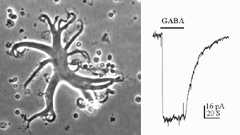
An example of a solitary rod-driven horizontal cell isolatedfrom white perch retina is shown in Fig. 1, together with a typicalGABA-elicited response from such a cell. These horizontal cellsreceive input from rod photoreceptors in the retina; and whenisolated, they keep their typical morphology in culture. Rod-drivenhorizontal cells have a flat cell body with diameter of 50-100um. There are several thick primary dendrites from whichmany fine processes extend. As shown in Fig. 1, GABA elicitsa slow and sustained response from these cells. The GABA-inducedmembrane currents are mediated by chloride ions, and therefore,exhibit inhibitory actions on these neurons. The responses showedno sign of desensitization, i.e. the responses are maintained ata steady level as long as GABA is present. Furthermore, the GABAresponses elicited from these horizontal cells exhibits slowkinetics, which could best be observed in the offset response.After the termination of GABA application, the membrane currentreturns to the baseline very slowly, with a time constant of ~15seconds. Such slow and sustained response properties are typicalof GABAc receptors.
It is interesting to note that the neurons in distal retina(i.e. photoreceptors, horizontal cells and bipolar cells) do notproduce action potentials at all. They only generate slow gradedresponses to light stimuli. It has always been thought that retinal neurons must have special ways to process and analyze such slow signals compared with fast transient neurons of the brain.The kinetics of GABAreceptor mediated responses are thus particularly suited for the generatation of signals in distal retinal neurons.
or GABA receptors. GABA receptorswere first described by Johnston for bicuculline- and baclofen-insensitiveGABA binding sites on neuronal membranes (Johnston, 1986, 1996).More detailed studies indicated that GABAreceptors on retinal neurons are not sensitive to the competitiveantagonists of either GABA receptors (suchas SR95531 and hydrastine), or GABA receptors(such as phaclofen and saclofen). Since the competitive antagonistsare thought to interact with the GABA binding sites on the receptors,these results indicate that a different conformation of GABA moleculeis preferred for binding to the GABAreceptor.In agreement with such a notion, the specific agonists of GABA and GABA receptorsexhibit quite different activity on GABA receptors.They either have no effect (isonipecotic acid, baclofen), or actas partial agonists (isoguvacine, muscimol), or as antagonists(THIP, P4S, 3-APA and 3-APMPA) (Woodward et al., 1993; Qian and Dowling, 1994). I4AA,a partial agonist of GABA receptors, behavesas a potent antagonist on GABA responsesof retinal neurons, and as a partial agonist on expressed GABA receptors in Xenopus oocytes (Qian and Dowling,1994; Qian et al., 1998).
GABA receptors also differ from classicalGABA receptors in terms of their responsesto various modulators. Two groups of compounds, benzodiazepineand barbiturates, are well-known to modulateGABA activity. On the other hand,none of these compounds have any significant influence on responsesmediated by GABA receptors (Polenzaniet al., 1991). For example, the GABA elicited response on whiteperch rod-driven horizontal cells are virtually identical in thepresence or absence of either diazepam or pentobarbital(Qian and Dowling, 1993). Another class of GABA receptor modulators, known as neuroactive steroids, have differenteffects on the expressed GABA receptorin Xenopus oocytes. Whereas some of them modulate GABA responseson these receptors, others do not (Woodward et al., 1992a; Morriset al., 1999). The effect of these neuroactive steroids on GABA receptors on neurons has yet to be determined.
Although both GABA and GABA receptors are linked to chloride channels, the channel properties of these two receptors are quite different. Unlike GABA receptors, picrotoxin inhibition on GABA receptors in white perch horizontal cells exhibits both competitive and non-competitivemechanisms (Qian and Dowling, 1994). In mammalian retina (rat), on the otherhand, GABA receptors are insensitiveto picrotoxin blockage (Feigenspan et al., 1993; Pan and Lipton,1995). The unusual features of GABA receptorsin rat retina are attributed to a single amino acid substitutionin the receptor subunit (Zhang et al., 1995). Furthermore, TBPS,like picrotoxin another chloride channel blocker on GABA receptors, does not block the responses mediatedby GABA receptors (Qian and Dowling, 1994;Woodward et al., 1992b). In addition, GABAreceptor-gated chloride channels exhibit a very small single channelconductance (Qian and Dowling, 1995; Chang and Weiss, 1999).
GABA receptor activities are modulatedby divalent cations (Calvo et al., 1994; Kaneda et al., 1997;Dong and Werblin, 1995; Chang et al., 1995). In particular, GABA receptor-mediated responses are inhibitedby low concentrations of zinc ions. The high sensitivity of GABA receptors to zinc inhibition is attributedto a histidine residue on the extracellular domain of the subunits(Wang et al., 1995).
Recently, a new GABA receptor antagonist,TPMPA, has become available commercially. This compound is thoughtto be a specific inhibitor of the GABA receptor(Ragozzino et al., 1996). The availability of such a drug willgreat facilitate further studies of this receptor.
receptors expressed onXenopus oocytes (Kusama et al., 1995). However, the mechanismsfor modulation by intracellular second messager systems are yet to be determined. Recently, Filippova and coauthors (1999) provided evidence for GABAreceptor internalization upon phosphorylation of the subunits.In addition, there is evidence that the large intracellularloop of GABA receptor subunits is involvedin the interaction of receptor protein with other intracellularproteins, which may play an important role in the clustering of thereceptors on neuronal membranes (Hanley et al., 1999).

subunits. These were first cloned from a human retinal cDNA library (Cuttinget al., 1991, 1992). When expressed in Xenopus oocytes, GABA subunits formed functional homo-oligomericreceptors with properties similar to those of GABA receptors in retinal neurons (Shimada 1992). Furthermore,the expression of GABA subunits hasbeen detected on retinal neurons where GABA receptor-mediatedresponses have been recorded (Qian et al., 1997a; Enz et al.,1995, 1996). In white perch retina, we have now cloned five forms of GABA subunits (Qian et al., 1997a, 1998). Fig. 4 showsa comparison of white perch GABA subunits and those cloned from mammalian retinas. The distancesbetween the various connecting elements represent the degree ofdivergence among subunits. Unlike the mammalian retina, whereonly one form of 1 and 2subunits has been identified, in white perch there are two forms of the subunit for each 1 and 2 family. In accordance with their deduced amino acid sequencesand the properties of the receptors they formed on Xenopus oocytes,each 1 and 2family was subdivided into an A and B forms. All white perch GABA1 and 2subunits are able to form functional homo-oligomeric receptors whenexpressed in Xenopus oocytes. GABA elicited responses in theseexpressed receptors are sustained, bicuculline-insensitive, andare not modulated by either benzodiazepines or barbiturates, featurestypical of GABA receptors. Like GABA receptors on retinal neurons, GABA receptors also gate chloride channels. However, the receptorsexpressed by each of the GABA subunitsdisplay unique response properties that distinguish one fromthe other. For example, the sensitivity of GABA activation and picrotoxininhibition varies among subunits. In addition, I4AA acts as anantagonist on A-type receptors, whereasit is a partial agonist on B-type receptors (Qian et al., 1998).

M GABA are illustrated in Fig.5. These recordings indicate that there are significant differencesin the kinetics of the GABA responses from Xenopus oocytesdepending on which white perch GABA subunitis expressed. To quantitate the kinetics of the GABA response,the offset GABA responses (current traces after GABA applicationis terminated) were replotted on a semi-logarithmic scale, withthe amplitudes normalized to their initial values (Fig. 6). Ineach case, the data were fit by a straight line, indicating thatoffset responses can be described by a single exponential function.The slope of the line represents the time constant of the decay andshows that the receptors formed by the various subunits exhibit significant differences in their response kinetics.The average time constants of offset responses elicited from receptorsformed by various white perch GABA subunits are shown in the bar graph in Fig. 6C. There are consistentdifferences between the response kinetics of the two receptorfamilies and between their subgroups. For example, the responsesfrom 1 receptors were significantlyslower than those of 2 receptors.Such difference in the response kinetics among 1and 2 receptors are determined, inlarge part, by a single residue at the second transmembrane domainof the subunits (Qian et al., 1999). This dichotomy among 1 and 2 subunitsis well conserved in all species where GABA subunits have been cloned. 1 subunits,which have a proline at the residue site, combine to make a receptor withslower kinetics; whereas 2 subunits,which contain a serine at the residue site, form receptors with fasterresponse rate. Thus, receptors made of human 1 subunits exhibit slower response kineticsthan receptors made of 2 subunits(Enz and Cutting, 1999). The kinetic differences among the receptorsformed by various GABA subunits couldprovide building blocks for the nevous system to construct differenttypes of signal filters, and different types of neuronal signalling in the nervous system.
and GABAc receptors are present as shown in Fig. 8. The transient component can be selectively blockedby the co-application of bicuculline, leaving a more sustainedresponse. Thus, the electrophysiological and pharmacological propertiesof GABAc receptors on bipolar cellsare very similar to those of GABAc receptors on rod-driven horizontal cells (Qian and Dowling1995; Lukasiewicz et al., 1994; Feigenspan and Bormann, 1994).
and GABAc receptors suggest that they play different roles in mediating inhibitionon bipolar cell terminals (Qian et al., 1997; Lukasiewiczand Shields, 1998). Furthermore, various subtypes of bipolar cellsexhibit different proportions of GABAandGABAc receptors. For example, in the rat retina, there is a clear difference in the contribution of GABAand GABAc receptors to rod and cone bipolar cells (Euler and Wassle, 1998). In white perch too, different morphological types of bipolar cells exhibit different proportions of GABAc receptor mediated components (Qian and Dowling, 1995). These results strongly suggest that different subtypes of bipolar cell utilize various mixtures of GABA and GABAc receptors to perform different activities and help create the variety of functional pathways through the retina.
Because of the presence of multiple GABA receptors on retinal neurons,it is sometimes difficult to isolate the contributions of eachreceptor. Recent studies on ganglion cell responses revealsome interesting features of GABAc receptorsin retinal information processing. For example, activation ofGABAc receptors leads to more transientlight responses in ganglion cells (Dong and Werblin, 1998) andthe delayed inhibition mediated by GABAcreceptors is thought to play a major role in shaping edge-enhancement of ganglion cell receptive fields (Jacobs and Werblin, 1998). The bipolar cell to ganglion cell synapse is probably heavily influenced by inhibitory amacrine feed forward or feedback synapses and these appear to be via primarily GABAc receptors.
| Dr. Haohua Qian was born in Jiangsu, China. He received his B.A. in Biology from Nanjing University (1982), M.S. in Neurobiology from Shanghai Institute of Physiology (1985), and Ph.D. in Anatomy and Cell Biology from University of Illinois at Chicago (1991). He is currently an Assistant Professor of Neurosciences in the Department of Ophthalmology and Visual Sciences at the University of Illinois at Chicago. During his postdoctoral studies with Dr. John E. Dowling at Harvard University, he characterized a new type of GABA receptor, the GABAc receptor, on retinal neurons. He is currently continuing these studies on the molecular structure and physiological functions of GABAc receptors in the vertebrate retina. |  |


February 2000
[8]ページ先頭