The Story of Kabul
The pages of history are studded with its name but the personal story of Kabul lies embedded by the inundations of dramatic events sweeping over it. Revealed, there emerges a highly individualstory in keeping with the character of its citizenry.
Aryans
Time and conjecture blur our view of the earliest known participants, the Aryans, who, c. 3000 B.C., traveled south from beyond the River Oxus, not as an army, but in family groups to cross theHindu Kush on their way to Northern India. They wrote no travelogues of their journey, but as they moved, they sang hymns about what impressed them. As part of their religious rites, thesehymns were passed on by word of mouth from one generation of priests to another until c. 1200 B.C. when they were written down in a collection known as the Rigveda. Here we may read of theKubha, or the Kabul River, and picture, if but hazily, the passage of this intrepid band.
Achaemenids
The mists of ignorance close in after their passing, lifting c. 520 B.C. to reveal conquering armies from Achaemenid Persia. The Achaemenid King, Darius, builder of the famous palaces of Susaand Persepolis, caused the following to be inscribed on his tombstone: "By favour of Ahuramazda these are the countries which I seized outside of Persia; I ruled over them; what was said tothem by me, that they did; my law that held them firm....." There follows a list of twenty-nine countries among which the Kabul Valley is listed.
The annexation of India by the Achaemenids was a highly profitable venture, if Herodotus is correct, for he reports that tribute from India (i.e. the Punjab and Sind) came to over a millionpounds sterling in gold dust. To facilitate trade, an imperial highway passed through the upper valley of Kabul where local officials ruled, with Persian counterparts, thus obviating revoltwithout eliminating provincial independence. Though traffic along this highway must have been brisk, a few coins found at the foot of Tepe Maranjan in the center of Kabul form our onlysurviving evidence of this prosperous trade and of the Achaemenid presence.
Alexander of Macedonia
Considerable time elapses before it is possible to resume this story in the summer of 329 B.C., in Qandahar, at the encampment of Alexander the Macedonian. His swift passage across Persia hadleft Achaemenid power crushed and he now stood poised, the fate of the eastern provinces at his command. It was early winter before the direction of his next march was made known. Defyingseemingly insurmountable obstacles, mysteriously provisioning man and beast in a barren land, undaunted by the incredible hardships of snow-blocked passes, he pushed his intrepid bandnorthward past Ghazni and descended upon the Kabul Valley. Here, at the southern base of the Hindu Kush, perhaps at Jebal Seraj, he encamped and ordered the building of the new city, to beknown as Alexandria-ad-Caucasum.
With Alexander were historians and diary-writers whose accounts, though unfortunately lost in the original, are preserved in the works of later Greek writers. Though these later writerslooked askance at the veracity of their predecessors, who they only grudgingly admit sometimes "stammer out a few words of truth," they did nonetheless condense much of the earlier worksinto their own accounts. Thus our knowledge of this period is remarkably detailed.
This being so, it is disappointing not to find details about a city of Kabul. It must be remembered, however, that Alexander was marching without benefit of maps. Under such circumstances, henecessarily looked upon mountain ranges and rivers as his guides. If we study these relative to Kabul, we quickly see that on arriving from Ghazni the army would have passed by the foot ofPaghman andIstalif on its way to the Charikar area. Kabul, being shielded behind twolow ranges, would not have been on the direct line of march.
Both Strabo and Pliny refer to a town called Ortospana, which Ptolomey, writing c. 150 A.D., is the first to identify with "Kabura on the Kophen River, the capital of the Kabolitae." Othercontemporary reports also verify the fact that at this time the region of the Kabul Valley were controlled by a number of totally independent tribes, each with its own autonomous chieftain.It seems reasonable that such a tribe was ruling at Kabul but that the small settlement was scarcely worth a detour by Alexander's army.
The decision to settle in Alexandria-ad-Caucasum was a natural one. There three important caravan routes met. From the west, caravans came via Balkh and the Ghorband Valley to meet those arrivingfrom China via Turkestan and thePanjshir Valley. From India, the caravan came via the Kabul River to Sarobi and thence via the PanjshirRiver, or, via Ghazni after leaving the major east-west route from Persia to India at Qandahar. Both Alexander and Darius before him, in their attempts to establish unified empires,including the territories of Persia, India, and Bactria, considered this spot of the most strategic significance.
Questions of strategy little concerned the ordinary Macedonian soldiers but we read that this mountain-ringed valley with its numerous vineyards appealed especially to them. Here they werereminded of their own homeland and identified it with that land which their ancient myths recorded as having been conquered by the god Dionysus. At the head of a wandering band of vine-garlandedrevellers, playing drums and cymbals, so says the myth, "Dionysus conquered, founded cities, and gave laws to these cities and introduced the use of wine...."
Alexander, though wine finally proved his nemesis, had more than wine on his mind that winter. As soon as the snows in the passes thawed, he set out via thePanjshir Valley, in pursuit of the last Achaemenid King, Darius III, who had taken refuge in Bactria with Bessus, its governor. Bessussubsequently killed Darius and proclaimed himself king. Exactly one year after leaving the Kabul Valley, having vanquished Bessus and conquered Bactria, Alexander returned toAlexandria-ad-Caucasum with 3,500 horses and 10,000 foot soldiers. Alexandria-ad-Caucasum and Kabul he formed into the separate satrapy of Parapamisidae, which he placed in the care of a Persiangovernor named Turiaspes. Affairs thus settled, Alexander and his army once again set forth, this time for the invasion of India.
Sturdy Greek peasant foot-soldiers wearing broad-brimmed hats, top boots, and cloaks thrown over shirts of mail, some carrying long heavy spears, others slings, javelins, or large bows, marchedside by side with contingents from the recently acquired territories of Egypt, Persia and Central Asia. Prancing with them were the much admired horses from the north of Hindu Kush, whose riders,we read, struck terror into the hearts of their enemies. They followed the Panshir River to its junction with the Kabul River, but before reaching Jalalabad they stopped to await the arrival ofthe King of Taxila and other lesser chieftains who had been summoned to the Kabul Valley by Alexander.
We can picture this encampment of oddly assorted soldiers, the royal tent in its center closely encircled by those of his "Companions," cavalrymen drawn from Macedonia's elite aristocracy.Somewhere among these elite were three men destined to be his successors: Ptolemy, future king of Egypt; Lysimachus, inheritor of the European conquests; Seleucus, prospective ruler of hisAsiatic conquests. One by one the summoned rajas came, riding on richly caparisoned elephants and followed by large retinues bearing presents of their countries' most prized products. In thismountain valley, one of history's greatest spectacles was thus staged. Alas, the chroniclers of the event did not see fit to identify the valley.
This colourful bustling picture is our last of Alexander in the vicinity of Kabul. Two years later, however, while at the mouth of the Indus preparing for the homeward journey, his attentionwas once again called to this valley when word reached him that Governor Turiaspes had been found guilty of extortion. His orders were quick and decisive; Turiaspes was executed and replacedby Oxyartes, father of his newly acquired Bactrian bride, Roxana, Bactria's most celebrated beauty. Forced by his own troops top abandon further conquest, Alexander faced west in October 325 B.C.,still dreaming of the glories he believed Greek leadership would stimulate in this fabulous new land. This was not to be: in 323 B.C., death cut short the dream which he alone had envisioned.
Seleucids
Murderous in-fighting now took place among Alexander's followers until the eventual emergence of the three successors mentioned above. In the eastern provinces, the news heralded an immediatereassertion of independence and by 322 B.C. Macedonian authority, established only six short years before, had vanished. These kingdoms had submitted in fear at the approach of a greatconqueror but his stay had been too short to instill loyalty. Now the garrisons were too weak to escape extermination. Herodotus tells us that the hill tribes of Kabul Valley were the mostwar-like, loyal only to their own and fiercely opposed to outside domination. True to their character, they now reverted to their accustomed system of tribal government. Politically, thepassage of Alexander had done little to alter life in the Kabul Valley. Eastward, India also reestablished local rule but in a form significantly different from pre-Alexandrian days. Wherebefore there had been a plethora of petty kingdoms, there now rose the strong, unified dynasty of the Maurya.
None of this was acceptable, of course, to Seleucus (323-280 B.C.), ruler of Babylonia and Persia, who regarded all of Alexander's eastern conquests as part of his inheritance. Marching fromhis capital on the Tigris to reclaim them he succeeded in winning back Bactria but after crossing the Hindu Kush in 305 B.C. he found a formidable Maurya army, composed of 60,000 infantry,30,000 cavalry, 9,000 elephants, and a multitude of chariots, opposing him on the other side of the Indus. What actually happened next is best reported by Strabo. In speaking of the areasbetween the Hindu Kush and the Indus, he tersely writes: "Alexander took these away from the Aryans and established settlements of his own, but Seleucus Nicator gave them to Sandrocottus(Chandragupta), upon terms of intermarriage and of receiving in exchange 500 elephants." So it would appear that for the price of one princess and 500 elephants, the Kabul Valley passed forthe first time under the suzerainty of India.
Mauryas
The Maurya period is one of immense cultural importance, especially under its most renowned ruler Ashoka (269-232 B.C.) whose empire extended from the Arabian Sea to the Bay of Bengal and fromthe Hindu Kush to Mysore in Central India. Details of its influence in the Kabul Valley, however, are lacking, chiefly from the fact that the new masters of the area held a completely differentattitude towards worldly affairs. Whereas the Greeks set down all that they saw in minutest detail with exuberant enthusiasm, the Indian writers recorded thought rather than action, ideas ratherthan events. Thus, momentous happenings are either ignored or, at most, cryptically referred to.
Ashoka was a great evangelist and issued many edicts regarding his Law of Piety which were inscribed on stone throughout his empire. From these we learn of his attitude toward the borderpeoples for whom he felt a benevolent responsibility although they did not come under his direct administration and remained as semi-independent satrapies under their own chieftains.Parapamisidae, or Kabul, formed one such satrapy, as did Arachosia, or Qandahar, where a bilingual Greek-Aramaic inscription was found some years ago and another, only in Greek, in February1964. A similar Greek inscription was also found in Laghman.
It was undoubtedly a time of prosperity for the people of the Kabul Valley situated mid-way between the strong empires of the Seleucids and the Mauryas. Laden with gold, jewels, spices, andcosmetics from India, caravans travelling to the west passed through the Kabul Valley on their way to meet others conveying furs from Central Asia and a novel new item, silk, from China.In their wake came diplomatic missions, for the courts of east and west curried the favour of the intermediate chieftains whose whims controlled their fortunes. This prosperity, however, wascontingent upon the maintenance of peace by their large and powerful neighbors. This in turn was dependent upon strong leadership.
By the end of the third century B.C. such leadership was lacking, and those in power were totally unable to command respect for their authority. This brought about chaos to the east andchaos to the west. The intermediate areas consequently fell prey to local, self-styled strongmen who grabbed whatever territory they could dominate. In the division of spoils, Kabul fell to theIndian King Subhagasena who ruled from Kapisa, a town east of modern Charikar, 36 miles north of Kabul.
 Bactrians
Up to this point, life in the Kabul Valley had been affected by currents sweeping in either from the west or from the east. The spotlight now shifts to centre to focus on Bactria. Reserved forroyal Achaemenid princes, favoured by Alexander, the wide fertile plains stretching between the northern slopes of the Hindu Kush and the Oxus River has long been a prize satrapy of Persia.The indigenous population included a high proportion of Greeks; descendants of prisoners captured at the time of Achaemenid wars with Greece, exiled Greek miscreants, a few veterans ofAlexander's armies, and the more recent colonists sent to strengthen the province against the approaching nomads. Together they formed a large, long established community which thoughthoroughly identified both socially and politically with the life of Bactria and essentially anti-Macedonian, were nevertheless, highly receptive to Hellenic influences. To history, they areknown as the Greco-Bactrians.
Taking advantage of the waning fortunes of the Macedonian Seleucids, the governor of Bactria, Diodotus, defected in 256 B.C. and when finally one last attempt at unification was made, by theSeleucid Antiochus III, the Bactrians were found to be both strong and fiercely determined to maintain their independence. Instead of conquering them, Antiochus III entered into an alliancewith his adversaries against their common foe, the nomads of Central Asia. Then, turning south, he crossed the Hindu Kush in 206 B.C. where King Subhagasena was easily persuaded to recognizehis suzerainty.
Before long, Bactria cast about for new lands to conquer. It could not move toward the west for here Parthia, a new kingdom lying southeast of the Caspian Sea, was waxing strong, and beyond Parthiawas Seleucia with which it had just allied itself. To the east, however, lay India still floundering in discord since the death of Ashoka. This rich prize was a powerful lure.
The move across the Hindu Kush was made c. 185 B.C. by Demetrius I who assumed the title of Aniketos (Victorious) directly upon taking possession of Kapisa. The traditional function of theHindu Kush as a barrier between the north and south was not yet, however, to be defied. Thus while Demetrius was in the south crushing the Mauryas, he lost Bactria to a rival, Eucratides.Heading north to retrieve it, he left his new conquests in the hands of his brother, Antimachus, who was shortly thereafter superseded in the Kabul Valley by two Bactrian brothers, joint kingsof Qandahar. To celebrate their victory they struck coins at Kapisa honoring the god Dionysus, the mythical conqueror of Kabul recalled by Alexander's soldiers. They were not long masters of thevalley before Eucratides wrested it from them, styling himself Megas (the Great) upon his victory. From this evidence, it would seem that the possession of Kapisa and the Kabul Valley wasconsidered a great moment by these Bactrian kings.
Indo-Greeks
Eucratides was a strong and able leader whose promising career was cut short by his son, who murdered him c. 160/155 B.C. plunging the Greco-Bactrian Dynasty into irreparable discord just at thetime when outside pressures from the north and from the west were building up against it. Though this spelled disaster for Bactria, time had not run out for the Greek kings south of the HinduKush. Nevertheless, the detailed story of these kings, known as Indo-Greeks, is one of utter confusion. Almost the only source of information is that derived from numismatic evidence and this initself is subject to many interpretations.
The information now available focuses our attention directly upon Kalasi, Kapisa, where the most illustrious of the Indo-Greek kings, Menander (130-110 B.C.) ruled with celebrated justice as farsouth as Ghazni and as far east as Taxila. Many thousands of Menander's coins have been found in Kabul itself so we may assume its existence as a prosperous center at this time. Upon Menander'sdeath, civil war resulted in the simultaneous rule of numerous petty kings with grandiose titles, each mutually antagonistic, once again plunged the area into turmoil. But before we canunderstand the final chapter of Greek rule in the east, it is necessary to examine happenings on the periphery of this seething center.
The restless hoard of nomadic tribes in Central Asia north of the Oxus has always been of concern to the rulers of Persia, who purposely kept Bactria strong as a buffer against their relentlessencroachment on the settled areas. During the period of Greco-Bactrians one such tribe, known as the Saka, inhabited the area in the neighborhood of the Jaxartes River while another tribe, theYueh-chih, were similarly settled on the Chinese border in the vicinity of Kansu. Just prior to the murder of Eucratides, c. 160 B.C., a rival tribe killed the Yueh-chih chief, made his skullinto a wine-cup and unceremoniously deprived his people of their grazing grounds. As a result, 100,000 families were compelled to wander westward with their horses, cattle and sheep. Theyappeared menacingly before the Saka, who finding Bactria then too strong to invade, moved by various routes into the Seistan area of southern Afghanistan.
The Yueh-chih were content in their new home until suddenly their old enemy the Hsiung Nu again appeared out of the steppe. Forced to seek new pastures, they looked across the Oxus. What theysaw is described by early Chinese sources thus: "They (the Bactrians) were sedentary, and had walled cities and houses. They had no great kings or chiefs, but some cities and towns had smallchiefs. Their soldiers were weak and feared fighting. They were skillful in trade." This brief but cogent statement pictures leaderless Bactria in decline. Opportunities for conquest, therefore,seemed bright and the Yueh-chih crossed the Oxus without opposition c. 128 B.C. and soon after incorporated Bactria into the Yueh-chih nation, then a loose confederation of five clans.
Turning next to the west, we must have a look at Parthia. Established about the same time as Greco-Bactria by a nomadic, non-Greek people, it had for some time functioned as a wedge between theGreek dynasties of Seleucia and Bactria, thus weakening the effectiveness of Greek alliances. Furthermore, at the same time that Bactria lost its strong leader, Eucratides, Parthia gained theleadership of its greatest ruler. Exploiting each sign of weakness on the part of the Seleucids, Parthian power grew until by 137 B.C. the empire stretched from Herat to the Tigris River. Whenthe wave of Saka invasion instigated by the Yueh-chih began to pour across its borders, Parthia, unlike tottering Bactria, was able to contain them, thus forcing the nomads to move eastward viaQandahar into the Punjab and Sind where they established kingdoms at the expense of the Indo-Greeks.
As the first century B.C. dawns we are thus presented with a picture of the Indo-Greeks confined to the Kabul - Gardez - Peshawar area and surrounded by restless nomadic kingdoms. In anattempt to withstand the threat of extermination, family feuds were set aside, marriages between contending houses were arranged, and gigantic efforts towards solidarity were made. Thoughsometimes successful in their wars against the Saka, these victories were only ephemeral and the ring gradually tightened. When at last Gardez was lost, Greek power was confined to one mountainvalley alone. This was Kabul.
 Kushans
In Bactria, the Yueh-chih were firmly established: the five clans now united under the banner of one, the Kushans, led by Kujula Kadphises. Unification meant strength, so Kujula Kadphisescrossed the Hindu Kush c. 48 A.D. and formed an alliance with the last Greek king in Kabul, Hermaeus, thus peacefully ending Greek rule. His son Vima Kadphises moved against the Saka innorthern India and established an empire which the famous Kushan king, Kanishka, continued to enlarge until his domain extended from Benares on the Ganges River to the Gobi Desert. Thus, theKushans were the first effectively to inspire the people of the Kabul Valley to become bestowers rather than receivers of authority. At Kapisa, the Kushan court rivalled that of the Caesars inRome and of the Han in China.
The great Kushan dynasty sitting astride the Hindu Kush rose at a fortuitous time in world history. Caravans in ever-increasing numbers passed between India and the sybaritic markets of Romeand China and the Kushans held strong control over this trade, gaining from it wealth and power, their rulers exploiting every circumstance to their fullest advantage. The years in Bactria hadwrought great changes on these nomads. Having no traditions on which to build a settled way of life, they adapted what they found in ways best suited to their own personality. What emerged wasa vibrant indigenous culture born of the fusion of western oriented Greco-Bactrian ideals with those of eastern oriented India and interpreted by the forceful character of Central Asia. Theresult was vital and dynamic.
The plains of Begram are desolate today. The silent desert effectively hides within its hillocks the glories of the mighty kings who once ruled ancient Kapisa. Happily, one day in 1939, thearchaeologists' spade came upon a Kushan treasure which by itself provides an illuminating capsule version of the Kushan story. Here in Kapisa, in two small rooms, were exquisite Indian ivorieswrought in the classic style of Maurya days, side by side, with fine Chinese lacquers and an infinite variety of Roman art objects from that far-flung empire. These included numerous bas-reliefsconsecrated to Dionysus and his cortege of satyrs and bacchants so long a favorite in the valley. Each piece of this treasure testifies to the existence of a rich trade with emporiumsthroughout the civilized world and to the existence of a highly refined and cultured citizenry in Kapisa.
The Kushans were patrons, not mere collectors of art. This patronage brought about the efflorescence of Ghandharan art in which Greco-Roman art forms enriched by Indian forms were employed inthe service of Buddhism. Buddhists texts are full of praise for the Kushan Kanishka, "King of Kings" (c. 100 A.D.), whose benevolent auspices vivified Buddhism. This patronage occasioned aflurry of renewed activity reminiscent of the days of Ashoka. Traveling with the caravans, Buddhist missionaries crossed the Hindu Kush and made their way into the Far East where their ideastook root so strongly in China and in Japan that they remain as a significant factor of the twentieth century culture.
The accounts of Kanishka's interest in Buddhism are verified by numerous archaeological finds. It would be a mistake to limit his philosophical interest to this religion alone, however.On his coinage, the Buddha represents only one of a wide pantheon of gods and goddesses, deities of Greek, Persian and Hindu origin. Furthermore, the presence of Persia and Greece, but not India,is evident among the ruins of Kanishka's temple at Surk Kotal just north of the Hindu Kush where excavations seem to disclose the existence of a purely indigenous eclectic religion, unaffectedby Buddhism, centered around the cult of fire. The cultural accomplishments of the Kushans were engendered by the liberal spirit fostered by their leaders. Kapisa, their capital situated at thecrossroads, was undoubtedly a prime source of inspiration.
Sassanians
This happy state continued until trouble beset the world at large. By the end of the second century A.D., China was showing signs of decadence and shortly thereafter the Roman Empire was in astate of disorganization. The trade upon which Kushan prosperity depended was gravely disrupted. At the same time, we see the rise of a new purely Iranian dynasty in Persia, the Sassanians.Their eastern expansion brought them into conflict with the Kushans who accepted Sassanian suzerainty sometime around the middle of the 3rd century. Attempts to throw off the foreign yoke weremade from time to time. There was a revival of Kushan power for six short years from 303 to 309 but then Shapur II (310-397) crushed them, reducing their territory to provincial status underSassanian viceroys ruling from Balkh.
Though numerous indications point to Kushan vassalage, political independence did not preclude cultural independence. The Sassanians had revived the ancient religion of Zoroaster and theirkings were supported, often controlled, by powerful Zoroastrian priesthood. In Kabul, the earliest surviving monuments date from the Kushano-Sassanian period but they are all Buddhist monuments.Furthermore, they reflect architectural and artistic styles inspired by Kushan and Gandharan examples. This applies equally to Tepe Maranjan, Shewaki, and Guldura which were important monasterieson the route from Kapisa, still the major city in the valley, to Gardez.
Hephthalites
As we have seen before, signs of weakness signaled nomadic invasions from the steppes of Central Asia and the return of the Hindu Kush to its function as a barrier between north and south. Thiswas again the case at this time when Hephthalites or White Huns took over Kushan territory in Bactria. About 400 A.D. they swept over the Hindu Kush and occupied Kapisa. Their rule here and inIndia is known principally for its furious destruction of Buddhist centers and ruthless oppression of the people. They ruled in Bactria for 100 years and held sway for another 100 years afterthey conquered the areas south of the Hindu Kush. And yet, outside of Chinese Buddhist sources, admittedly prejudiced against them, we know next to nothing about their presence in Afghanistan.Excavations by the French Archaeological Mission (DAFA) of Hephthalite graves near Kapisa attest to little more than their presence here which is also true of the Hephthalite pottery found atGhazni and of their rock inscriptions at Uruzgan northwest of Qandahar. New excavations reopened by DAFA in 1963 outside of Kunduz on what may in fact be the site of a royal Hephthalite cemeteryare, therefore, being watched with considerable excitement.
For the moment all that remains to be recounted is the end of their power in 531 A.D. which was brought about by a coalition of the Western Turks and the Sassanians. During the subsequentpartitioning of Hephthalite territory, Kabul was returned to the Sassanians who were, however, no longer strong enough to prevent a century of anarchy. During this time, almost every valley flewthe flag of its own independent petty Kushan or Hephthalite prince, many of whom had by this time adopted the religion of their subjects. We have priceless account of this period by the Chinesepilgrim Hsuen-tsang, whose precise observations during his long journey from 630 to 644, give us the clearest picture of the valley since the days of the Greek writers. He stayed at Kapisa fromMay to August in 630 and again for a week on his return journey in 644, when he also visited Kabul.
Hsuen-tsang says of Kabul: "The climate is icy cold; the men are naturally fierce and impetuous. The king is a Turk. They have profound faith for the three precious objects of worship (Buddhism);he esteems learning and honors virtue." The chapter on Kapisa is a long one. From it we ascertain that it was still the paramount city of the valley and continued to be an important emporium oftrade and a thriving religious centre even though its political authroity was limited to Kabul, Laghman, Jalalabad and Gandhara.
Arabs
At the very moment when Hsuen-tsang was thus recording his impressions of the Kabul Valley, a dynamic new force swept out of the deserts far to the west. With striking rapidity, the banner ofIslam was carried out of Arabia across Syria into Persia where a crushing defeat was inflicted upon the Sassanians in 642. Seemingly invincible, the Arabs pressed on to come face to face with arugged terrain new to these desert men. And the mountains were defended by equally rugged tribesmen. These were to prove obstinate obstacles. Approaching the heart of Afghanistan via Qandaharand Ghazni, Islam's cyclonic forward changed to a slow and difficult advance in which every mile was hotly disputed, attack after attack was repulsed, and conquered cities rested only torevolt.
Leading the defense at Kabul was a Turkish, possibly Hinduized, king of a dynasty variously referred to as Kabul Shahi, the Turki Shahi, or the Ratbil Shahan, the latter referring to one of thedynasty's most celebrated figures. They had raised Kabul to paramountcy over Kapisa and now these kings of Kabul resisted the Arabs with such bravery that their exploits form the substance ofmany heroic tales in early Islamic literature.
Kabul was captured by the invaders in 664 but only after a siege which lasted a full year. Persistent contumacy necessitated subsequent action and the city was actually fought for on severaloccasions. It succumbed only after long sieges or as a result of misadventure such as the time a wounded elephant fell in the gateway thus preventing the closing of the city's doors to theenemy. Finally, thoroughly exasperated, the Arabs sent in a special force called the Army of Peacocks. Somewhere, in a gorge between Ghazni and Kabul, 40,000 Arab soldiers met their destiny.
Despite such incidents the resistance of the Kabul Shahi was viewed with great respect by their adversaries as this tribute to the passing, by the Ghaznavid historian, Al-Birumi, reflects: "TheHindu Shahiya are now extinct, and of the whole house there is no longer the slightest remnant in existence. We must say that, in all their grandeur, they never slackened in the ardent desireof doing that which is good and right, that they were men of noble sentiment and noble bearing."
Two hundred years were to elapse before these princes could be forced to abandon their mountain fortress. During this time, Islam and its protagonists triumphed in nearby states: Herat, Samarkand,and Kashgar in the north, and the Seistan in the southwest, were all ruled by Arab governors by the close of the eighth century. Kabul itself lost some of its extensive territories to Herat, andan Arab agent resided in Kabul to make sure tribute was appropriately forwarded to the Caliphs of Baghdad. Nevertheless, it retained its own princes and its submission was lax, its fealtyloose. There was as yet no permanent occupation of Kabul by Islam.
Saffarids
Elsewhere, enthusiasm for the new religion was great and gave rise to the formation of volunteer troops known as Warriors of the Faith who hired out their services to anyone conducting a holywar against the infidel. Although often described, even by early Islamic sources, as robbers and scoundrels, individuals of this group did sometimes achieve great fame and power. One such wasYaqub ibn Layth Saffari, a coppersmith from Seistan, who marched on Kabul in 871. Here he routed Kallar, an Indian Brahmin, who as prime minister had usurped the throne of Kabul in 850 andfounded the Hindu Shahi Dynasty. Kallar fled to Gardez where he established a new capital from which he ruled for another few years until chased from the vicinity of Kabul by Amro ibn Laith.During this campaign, the famous Hindu temple to Suriya in the Logar was destroyed, and the Hindu power at Kabul was finally broken.
The rise of the Saffarids was indicative of the troubles besetting the weakening Caliphate at Baghdad. Indigenous populations rose against their Arab conquerors in the eastern provinces; localchiefs replaced Arabs as governors and assumed virtual independence. During the last years of the ninth century, the most powerful of these dynasties, the Samanid princes of Bokhara, extendedtheir influence southward to acquire possession of Kabul c. 900. Being so far from Bokhara, Kabul reverted to the rule of the local chiefs who were most probably invested by the Amirs ofBokhara to whom they paid a yearly tribute.
Ghaznavids
At the Samanid court a Turkish slave, Alptigin by name, rose to great power as Commander-in-Chief of the Samanid forces in Khorasan. When in 962 he was caught in an unsavory bit of courtintrigue, he deemed immediate departure to be most prudent and set out to find a kingdom of his own. Heading south through Bamiyan, he took Ghazni in January 963 after a siege of four months.A successful future seemed assured him but fate decreed otherwise; he died the following September. The city, suffering under a series of inept successors, finally sent to Kabul where theirformer ruler, Abu Bakr Lawik, had sought refuge. Accepting with alacrity, their former king set forth immediately with his brother-in-law, the son of Kabul's chieftain, by his side. FromGhazni, Alptigin's slave and son in-law, Sebuktigin, went out to the Logar Valley and joined in battle with the army from Kabul.
Victorious, Sebuktigin "came out of the fort of Ghazni with the umbrella, jewels, and banners and proceeded to the Jami Masjid where he was confirmed King" in April 977. Thus, the gloriousperiod of the Ghaznavids began. Sebuktigin extended his domination by annexing the neighboring petty states including Kabul, conquering in the name of Islam which became at last the faith of thevalley. His son, the great Sultan Mahmud (i.998-1030), extended his sovereignty and gained special renown for his numerous iconoclastic forays into India from which he returned with vast storesof treasure: "jewels and unbored pearls and rubies, shining like sparks in iced wine, emeralds as it were sprigs of young myrtle, diamonds as big as pomegranates." At Ghazni historians chronicledits story, poets sang of its glory and architects built a city worth of its wealth and culture.
The Sultans of Ghazni reveled in splendour and opulence. They built palaces and gardens in every important city of the realm: Herat, Balkh, and Lashkar-i-Bazar. Kabul, a dependency of Ghaznithroughout the Ghaznavid period, does not seem to have been thus favoured and we have only occasional references to the fact that the Sultans pitched their tents outside its gates. Tersethough these references may be, they allow one to picture lively and colourful happenings at Kabul. Imagine, for instance, the arrival of Sultan Mahmud in 1023 after a victorious campaign in India.He stopped in Kabul to review his troops: "54,000 well-equipped cavalry, 1,300 elephants in defensive armour, horses, and camels beyond computation." Eight years later, Sultan Mas'ud also stoppedhere to review his troops and we are told he was pleased to find his "1,670 elephants all plump and ready for action."
 Mongols
After the death of Sultan Mahmud in 1030, we enter once more into a long period of turmoil where the gradually weakening Ghaznavids bowed before new powers rising in the north. These were fiercebold men from the hills southeast of Herat, masters of the newly established House of Ghor which was destined to rule Delhi. The Ghorids dominated the 12th century only to be swept away in theKabul area by the start of the 13th by the Khwarizm from the eastern shores of the Caspian Sea. Kabul was included in the kingdom of Bamiyan during much of this time but central authority wasbut reluctantly endured and the city did obeisance first to its local chieftains. It was a relatively peaceful prelude, however, to the devastating storm soon to erupt from the heart of CentralAsia. Genghis Khan was on his way.
The Khwarizm Empire stretched from north of Samarkand to the Arabian Sea and from the eastern borders of Afghanistan through Central Persia. Its ruler, Sultan Muhammad, glorified in his power.When, therefore, Genghis Khan sent a mission demanding that a border governor be handed over for punishment, the Sultan singed off the beards of the envoys and returned them without comment.Who was this upstart Mongol who dared to make demands?
He soon learned, for it was his effrontery that raised the curtain on one of history's grimmest periods of destruction. By the beginning of 1220, Genghis Khan was in Balkh with 100,000 mountedmen and the appalling scenes of devastation marking his path attested to the magnitude of his fury. Sultan Muhammad turned his back and fled, leaving the impossible situation in the hands of hisson Jalal-ad-Din, a man of great courage and determination. Refusing to despair, he retired to Ghazni where his personality alone succeeded in uniting the independent tribes. In pursuit, GenghisKhan sent 30,000 savage riders, each with three reserve horses. Quickly assembling his newly formed army, Jalal-ad-Din advanced to meet his enemy at the confluence of the Panjshir and GhorbandRivers, northeast of modern Charikar, close to the ancient Kapisa.
As the two armies faced each other across the Panjshir River that evening in the fall of 1221, the hearts of the Afghans were filled with dire misgivings for the figures of a huge host loomedin the darkness. Their leader was not to be intimidated. He rallied them to attack at dawn. With astonishment, they watched their opponents flee, with amazement, they examined the portion of thegreat host behind; they found them to be mere scarecrows of straw covered with felt, bound to the backs of the reserve horses. A propitious beginning this, but unity was alien to these tribesmenand they fell victim the very next day to a petty dispute over a horse. The strongest of the leaders rode off, leaving the alliance shattered behind him.
Genghis Khan did not take kindly to defeat. He advanced to the south like "flash lightning" vanquishing every stronghold on his way. The barbarity inflicted upon those who resisted his advanceis difficult to contemplate, much less describe. He stopped briefly on the Kabul battlefield and we may picture him here at age 59 astride a horse, his long-sleeved black sable coat set off bya high white felt hat from which long red streamers hung to frame his hardened face.
As this horde moved out of the valley on its way to the final battle with Jalal-ad-Din on the banks of the Indus, "the countryside was choked with horsemen, the air black with the dust ofcavalry." Jalal-ad-Din succeeded in escaping across the Indus but his cause was utterly crushed and Genghis Khan pursued him no further. Retracing his steps, the conqueror passed again throughKabul in March 1222. Toward the end, Genghis Khan seems to have suffered some uneasiness about his policy of total annihilation. It is said that upon asking an Afghan prince if the blood he hadshed would remain forever in the memory of men, he was assured, with considerable temerity, that the present rate of bloodletting would certainly preclude the existence of man to harbour anysuch memories. So it must have seemed to the peoples of this time.
Genghis Khan died in 1227 and the old territory of Khwarizm was left in the hands of his son Chagatai who completed the subjugation of the mountain tribes of Afghanistan. For 100 years, theyremained in the grip of the Mongols. By the end of this period, the far-flung empire of the Khans had begun to crumble and once more Kabul was caught in the ensuing scramble for power.
These struggles were fought for personal gain unmindful of the ruin and desolation of the indigenous people and their countries, hence recovery from the holocaust was painfully slow. Local Turkishchiefs administering the provinces for their Mongol lords were sometimes successful in relegating their lords to a new Mongol figure to restart the cycle. The most powerful jockeying for powertook place in the north around Bokhara and Samarkand for the Mongols did not settle in great numbers south of the Hindu Kush, but the effects of the chaotic struggles in the north nonethelesssubmerged the southern provinces in poverty and widespread lawlessness. It was an era of petty autocrats whose authority scarcely extended beyond their own villages.
That Kabul was victim to these machinations is all too evident from the poignant account of the Moroccan traveller, Ibn Battuta. In visiting Kabul in 1333, he writes: "We travelled on to Kabul,formerly a vast town, the site of which is now occupied by a village inhabited by a tribe of Persians called Afghans. They hold mountains and defiles and possess considerable strength, and aremostly highwaymen."
Timurids
Three years later, in 1136, a boy was born in a small valley fifty miles south of Samarkand. His early life, from 1360 on, mirrors the chaos of these times, but he was destined to become itsmaster. This was Timur, known to European histories as Tamerlane, son of an impoverished Turkish chieftain. Timur journeyed to Samarkand where his services on behalf of the Turkish governor wasso appreciated that he won the hand of the governor's grand-daughter whose brother was then Prince Husain of Kabul. Not long after, however, a Mongol lord of the Chagatais appeared from the eastto reclaim his heritage both in Smarkand and in Kabul. Timur, in a series of wily maneuvers, emerged as a regent for the Mongol in Tansoxiana but his position was precarious and before long, heand his bride were forced to seek refuge in the mountains of the Hindu Kush.
Searching for the deposed Husain, they entered the valley of Kabul where they furtively bartered outside the city for fresh horses before continuing south to a rendezvous with Husain in thevicinity of Qandahar. Here with nothing but boundless ambition, they engaged in the life of soldiers of fortune. They fought well for the local chieftain and it was during one of these battlesthat Timur received a foot wound from which he never fully recovered, which is why some of his chroniclers, in vituperation, call him Timur-i-Lang, Timur the Lame. Little by little, thereputation of their prowness grew until, from Kabul to the Aral Sea, the tribes rallied to their cause. By the close of 1369, Timur divested himself of his avaricious companion Husain, and wasproclaimed sovereign at Balkh.
The next few years were occupied with campaigns in the north but his strength and leadership brought about stability throughout the realm and led to a gradual recovery of the south. By 1397, hewas eyeing India. Though somewhat hesitant at first, he received much encouragement from his sons. One argued that "whichever Sultan conquers India becomes supreme over the four quarters of theglobe," while another pointed out that "India is full of gold and silver, diamonds and ruby and emerald...," and his grandson, Pir Muhammad, Governor of Kabul, sent urgent petitions advising himthat the "time for conquest is propitious." Timur himself says, "My object in the invasion of Hindustan is to lead a campaign against infidels, to convert them...." A campaign that offeredpower, wealth, opportunity, and the glory to God, was hardly to be resisted. Accordingly, with an army "as numerous as the leaves of tree," Timur set out from Samarkand in March 1398 to conquerDelhi. In August, he came to Kabul where he pitched his tent on a nearby meadow.
Kabul under Pir Muhammad was now the prosperous capital of a province which included Kunduz, Badakhshan, Ghazni, Qandahar, and the territory to the east, as far as the Indus. Timur visited thisimportant capital with all the pomp and ceremony befitting a powerful potentate. He had two royal pavilions for use while travelling so that one could be sent ahead, to be readied for his arrival.We are indebted to a European traveller, Clavijo, Ambassador to Castile, who on visiting Timur in 1403 wrote this colourful description of Timur's travelling accommodations: "The pavilion was ahundred paces broad, and had four corners and the ceiling was round like a vault. It was pitched upon twelve poles, each as large around as a man's chest, and each painted gold and blue andother colours. From the vault of the ceiling of the pavilion silken cloths descended, making an arch from side to side. There was a crimson carpet embroidered with gold threads. In the fourcorners were the figures of four eagles with their wings closed. The outside of the pavilion was covered with silk stripes, black, white, and yellow. At each corner was a high pole with a copperball and the figure of a crescent, and on the top of the pavilion there was a tower of silken cloths, with turrets and an entrance door. This pavilion was so large and high that from adistance it looked like a castle, and it was a very wonderful thing to see and possessed more beauty than it is possible to describe."
Timur held all state ceremonies in these pavilions, preferring them to any palace. While at Kabul, he received an ambassador from Persia who came with a tribute so large that the court recordersworked unceasingly for three days and nights in listing it. The presentation ceremony was one of the most spectacular events recorded in the historical narratives of this period. For a full day,the treasure passed in review: leopards, birds of prey, robes of gold and brocade of every hue, camels, mules, Arab horses with gold saddles, pavilions, tents, couches, hangings, vessels, and gemsof every variety.
So we can picture Timur at Kabul and wonder if the monarch so ensconced amidst such splendor turned memory back to his earliest visit to the valley.
Timur the warrior had spread his conquests far and wide during which he had acquired a reputation for being cruel and savage. At his capital in Samarkand and in such northern cities as Herat,a different side of his character unfolded. Here he began a renaissance of culture by his avid patronage of artists and all men of learning and by his passionate beautification of his cities.This trait was strongly inherited by his son and successor Shah Rukh under whose wise and just rule from 1404 to 1447, the Timurid dynasty enjoyed its greatest glory. However, the new life whichreturned to the lands of the Hindu Kush during these years was stunted in later years by ceaseless internal strife in which every descendant of Timur aspired to supreme authority, be it in thecapital, a province, a town, or a valley. A hundred years after the death of Timur it was his descendant Ulugh Beg who ruled at Kabul.
Moghuls
Far to the north, just east of Samarkand, was another small valley kingdom, where a young crown prince boasted direct descent from both Genghis Khan and Timur. Such an elite heritage was notenough, however, to spare him from internal intrigue when his father's death placed him on the throne in 1495 at the age of twelve. In addition, the powerful Uzbegs from Transoxiana tookadvantage of the young king's troubles to sweep down upon him, forcing him at length to flee with a few impoverished followers. He turned at first to powerful relatives ruling rich cities of thenorth but they, having noted the determination with which he defended his valley and being jealous in the protection of their own thrones, deemed it wise to spurn him.
So, Zahir-ad-Din Muhammad, later known as Babur, the Tiger, wandered over the Hindu Kush until, in October 1504, he looked upon Kabul, a city but recently usurped from Ulugh, Beg's successor.From the heights of Bemaru he saw a valley beautiful in its fall colours and from informants he learned that the city was seething with discontent. Babur attacked, unseated the usurper, and won athrone. He was passionately entranced with the beauty of his new home and immediately set about to embellish his capital. Numerous gardens, for which he brought in saplings and seeds from landsto the north, were laid out under his personal supervision. In the midst of these gardens, new buildings rose.
The court indulged in simple pleasures. Of his early days in Kabul, Babur recounts with appreciation the remembrance of a well-turned phrase and of those hours spent in sharing a cup of winewith friends in one or the other of his new gardens. The simplicity was in marked contrast to the opulent court of his relatives in Herat, as he himself notes.
It was not, however, a completely easy throne upon which to sit. Though the tribes of Kabul readily acquiesced to his leadership, he says those of other valleys were fierce and difficult tosubdue. Persistently he moved on to Peshawar, to Ghazni, into the Hazarajat to Ghor, over the Hindu Kush to Badakhshan, and later south to Qandahar. While away on these campaigns, he had constantlyto keep in touch with affairs at home, for his family, now comfortably ensconced on large estates surrounding the city, easily forgot their debt to his leadership, and plotted against him for histhrone.
He persevered, however, and twenty years after his arrival, with affairs at home under control and with expansion to the north and west pushed as far as possible, the lure of India caught Baburas it had caught so many empire builders before him. Ambition drove him to leave the rugged mountain for the fertile plain but he left Kabul in 1525 with considerable reluctance. From this timeonward, he ruled from a new capital in Agra but he never abandoned Kabul in his heart. At Panipat, scene of his decisive victory over Delhi in 1526, he built a mosque in commemoration of thisbattle. He named it the Kabul Shah Mosque in honour of the land he loved. Later, repeated instructions concerning the repair and upkeep of buildings and gardens in Kabul were sent to his sonKamran, now instated as Governor of Kabul, for, as he says: "I have a longing beyond expression to return to Kabul. How can its delights ever be erased from my heart."
 Babur was a brilliant military strategist whose resoluteness founded the great Moghul Empire, and yet, in the story of Kabul, the image of the warrior is tempered by his love of poetry and beauty,his delight in nature, and his generosity toward those around him. It was upon the pleasures of this life that the dying monarch's thoughts dwelt a few short years later when he willed that heshould be laid to rest in afavourite garden at Kabul. Unrest following his demise in 1530 prevented the immediate fulfillment of his wishand for nine years, he remained buried at Agra, not farfrom where the Taj Mahal now stands. When at length his last journey was made, it was his faithful Afghan wife, Bibi Mubarika Yusufzai, who brought him to his beloved Kabul.
Humayun, Akbar, Jahangir, and Shah Jahan, protagonists of the quintessence in oriental magnificence, now enter this story. Ruling from Agra and Delhi, the Moghul princes found their westernprovinces to be uneasy possessions. Important cities like Herat and Qandahar were wrested from them in time and the recalcitrant tribes between Kabul and India has often to be assuaged withhealthy allowances. In spite of this, they zealously retained the hold on Kabul for its position was strategic, and these sons of Babur had inherited much of their ancestor's fondness for thevalley.
Each of these kings had occasion to visit Kabul, either on pleasure or in the course of protecting their outlying territories; Akbar in 1581, Jahangir in 1607, and Shah Jahah in 1640. Suchvisits gave an impetus to the cultural life of the city which was during this time further embellished by buildings and gardens wrought in the elegant style developed by the Moghuls. Gracefulpavilions similar to those at Lahore and Delhi rose upon the outer walls ofBala Hissar and along the riverside. In the heart of thecity, Kabul's governor, the celebrated Ali Mardan Khan (d. 1657), built a covered bazaar, the Char Chatta, which was to remain famous throughout the next two centuries for its fountains, muralsand exotic merchandise. A few years later, in 1640, Shah Jahan built a graceful marble mosque inBabur's Garden, close to the simple tombof his forefather.
Ghilzais
The 16th and 17th centuries were, therefore, comparatively peaceful times for Kabul due in part to the fact that power in India under the Moghuls had been paralleled by equal power in Persiaunder the Safavid Dynasty. By the beginning of 18th century, however, both houses had succumbed to a surfeit of luxury and local rulers began to stir. At Qandahar, then under the Persians,Ghilzai chieftains declared their independence, defeated the Persian armies come to contest their claim, and pushed on to take possession of the Safavid throne at Isfahan. Theirs was but ashort lived occupancy lasting only from 1722 to 1730, when they were defeated by the Persian general Nadir Shah Afshar who, after seating himself upon the Persian throne, went on to captureQandahar in March 1738.
Nadir Shah Afshar
His next objective was the throne of Delhi which he approached via Kabul in May. Though the Moghul garrison's weak resistance was overcome by June, Nadir Shah remained in the city untilSeptember before descending into India. Strongly supported by his trusted Afghan general Ahmad Khan Abdali leading his tribal followers, Nadir Shah defeated the Moghuls, gathered a rich booty,and returned to Kabul in 1740, leaving the Moghul king to rule India under Persian suzerainty. The territory west of the Indus, however, was transferred to direct Persian rule and a rearguardof several thousand Qizilbash troops, for whom four large garrisons were built, were left behind in Kabul. The Qizilbash formed the center of Nadir Shah's army, always fighting close to theirleader; his most trusted servants and fanatical Shias. However, Nadir Shah lacked the genius to forge an empire out of his conquests and the interim of his tenure is therefore significant tothis story only because it set the stage for the emergence of Afghanistan.
Ahmad Shah Durrani
The new epoch opens in violence with the assassination of Nadir Shah in 1747. At Qandahar, the seat of local independence prior to the rise of Nadir Shah, powerful tribal chieftains reviewedthe signs and concluded that recent events had been but a temporary interruption of their goals: India, under waning Moghul power, lay inert; Persia, rent with internal dissensions, layimpotent. The time was without question theirs, but who was to lead them? Day after day at the tribal council powerful chiefs proudly proclaimed their individual merits with ever-increasingvehemence. At length, when all seemed lost, a seer came forward to point to a quiet young man, that same Ahmad Khan Abdali, 25, so recently the trusted general of Nadir Shah. Miraculously, thehaughty chiefs acquiesced and proclaimed him Ahmad Shah, King of the Afghans.
Knowing that he must give proof of his abilities, Ahmad Shah's first move was toward Kabul where he easily overcame the resistance of the disheartened Qizilbash garrisons. He then advanced uponthe tottering Moghuls in Delhi where he was actually invited to accept the throne of India. Declining, he took only lands west of the Indua. "I will conquer countless lands; And revive the memoryof Sher Shah; But I cannot forget the fascinating orchards of my motherland; When I think of the mountain peaks of my country; I forget the throne of Delhi."
This Pashtu poem from his own pen is indicative of the man and his objectives.
Ahmad Shah's military campaigns were many but they are incidental to his real contribution to this story already sprinkled with brilliant military figures. His genius lay instead in his abilityto imbue his intractable, volatile countrymen with a national conscience. While travelling from his capital in Qandahar to visit with tribal chieftains throughout his realm, he often had occasionto visit Kabul, where he stayed, not in the marble palaces of the lofty Bala Hissar, but in a garden in the city, accessible to those who wished to see him. It was through simple gestures suchas this that Ahmad Shah Baba, Father of the Afghans, achieved his remarkable goal: Afghanistan, Land of the Afghan.
Ahmad Shah brought about this national cohesiveness in the incredibly short time of twenty-six years but on his death in 1772, the age-old plague of fraternal jealousies returned to place it injeopardy. In retaliation for the disloyalty exhibited by the people of Qandahar over the accession, Timur Shah, the second son whom Ahmad Shah had chosen, transferred the capital to Kabul.
The political history from this point presents a fast moving kaleidoscopic story filled with grim internecine struggles boding a hasty end for the new Afghanistan. Timur Shah's unfinishedmausoleum in the center of Kabul stands today as a monument to these unsettled times. For the reader who enjoys exciting adventure stories packed with a wealth of glamorous figures andingenious plots, this period offers fascinating reading. The details are beyond the scope of this simple survey and are furthermore available in a number of works in English. Here we must contentourselves with a few salient events and personalities specifically involving the life of the city.
Amir Dost Mohammad Khan
The struggles for paramountcy were played out in the palaces and dungeons of Bala Hissar where oriental splendor replaced the simplicity of Ahmad Shah. Splendor did not, however, commandobedience and by the time Dost Muhammad Khan, the first of the Muhammadzai Dynasty, secured the throne of Kabul in 1826, his authority was respected scarcely more than a hundred miles from thecity. Even within this radius, each valley fort did obeisance first to its own chief. Beyond this radius, the country was divided between Herat and Qandahar ruled by bitterly opposed members ofthe same family. Of the contenders, Amir Dost Muhammad was the most outstanding.
 During his reign, Kabul played a cordial host to an ever-increasing parade of western visitors, acute observers who wrote voluminously and vividly for an excited public eager to devour theminutest of details concerning this all but unknown land. We can walk with them and in so doing find ourselves very much at home. The city was smaller than it is today. About three miles incircumference, it covered the approximate area now bounded byBala Hissar,theSpinzar Hotel and the defile between the hills of Asmai and Sher Darwaza. In the center,nearPul-i-Khisti, several large serais catered to caravans arriving from far-off lands as they had been doing from time immemorial.The goods they brought "from most every part of the world" were offered for sale in covered bazaars of the Chahr Chatta and in theShor and Darwaza Lahori bazaars, two main streets which ran fromPul-i-Khisti to the foot ofBala Hissar through the densely packedresidential section of the city. Other specialty markets such as the grain and cattle markets, were located on the left bank of the river and large garden estates took up the remaining space.
The villages of Deh Afghanan and Deh Mazang clung to the sides of Asmai as they today but present day Shahr-i-Nau was laid out in small farms which produced fruits and vegetables for the city.The Amir and his retinue continued to live in the palaces ofBala Hissar where there was also a separate city unit of about 1,000houses. All together, the city's population during these early years of the 19th century was estimated to be between 50-60,000, which represented an increase of 40,000 from the day Timur Shahfirst brought his court to Kabul.
This was the prize for which the rival claimants gambled. Amir Dost Muhammad's efforts to maintain his position were further complicated by the entrance of foreign powers into the desperate game.Napoleon's intrigues in Persia first directed the British in India to open official relations with the Court of Kabul as early as 1809. Russia's steady advance southward toward the Oxus Riverdeepened their concern. Acutely aware of Afghanistan's age-old position as a highway from Persia and Central Asia to India, they took an active interest in the seating and unseating of princeson the throne of Kabul during the remainder of the 19th century. They had rich investments to protect. Twice this interest involved the actual participation of British troops: first in 1838-1842during the First Anglo-Afghan War and again in 1878-1880 during the Second Anglo-Afghan War.
 First Anglo-Afghan War
During the first of these episodes, the British escorted Shah Shujah, an exile in India for thirty years, back to the throne in Kabul. To do this, they deposed Amir Dost Muhammad who wasaccused of negotiating favourably with Persia, where Russian influence was strong, and with Russia in a manner considered to be hostile to British interests.
Since feelings ran high against the puppet Shah Shujah, British troops stayed in Kabul to support him. They built a large walled-in cantonment to the northeast on the right side of Ansari Wat(airport road). Here officers' wives carefully tended their gardens, hemmed dainty handkerchiefs, and dined off imported mahogany tables. The men passed their leisure time in enjoyingvarious equestrian sports with their Afghan friends. As winter came on, British officers fashioned skates out of locally procured wood and iron and joined the Afghans in their graceful sportof sliding on the frozen waters of Wazirabad Lake. As the spring thaws arrived, one Englishman launched a sailboat on this lake which proved to be an object of considerable fascination for bothAfghan and Englishman. During the summer, hockey, cricket, football, and quoits were played on these meadows which also provided an exciting course for the steeplechase. At the cantonment,Afghans dined with the British officers in their mess hall and sat as enthusiastic audience in the specially constructed theatre where Sir Alexander Burnes is said to have translated Englishcomedies into Persian with remarkable skill. In return, the Englishman were invited to Afghan homes in the city to "share in the field sport in their country castles."
The pleasant living and the camaraderie thus reported by the participants was but a false facade. Only a very small proportion of Kabul's citizens welcomed the foreigners. The rest of the cityand of Afghanistan was seething in opposition to the policies dictating the British presence; resentment ran deep in the hearts of the tribesmen who valued their independence so highly theychafed at the outside interference in their midst. This resentment culminated in the massacre of the retreating British forces on the road to Jalalabad in January, 1842. At Kabul, Shah Shujahwas ambushed and killed by his own people not far from the citadel ofBala Hissar on the 5th of April.
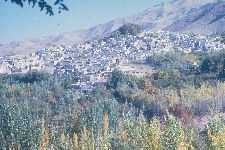 British troops under General Pollock, later entitled "The Avenger," returned the following September from Jalalabad followed closely by General Nott from Qandahar. They found the gates of thecitadel standing open, the city deserted, its people fled with their valuables toIstalif. A few days later, they were joined by the 120-oddBritish prisoners who had been taken as hostages by Dost Muhammad's son, Akbar Khan as security for his father's well-being. Except for one officer who reached Jalalabad, these hostages werethe only British to survive.
On October 10th, searching for a "mark" to leave on the city to remind it of British power for revenge, General Pollock issued orders for the destruction of the Chahr Chatta, the great bazaarwhich was the city's famed adornment. While this was being carried out soldiers and camp followers broke through authority to set most every quarter of the city, except theBala Hissar and the Qizilbash section of Chandawl, to the torch. The glow from these fires still filled the sky as the troops leftthe city two days later.
The disastrous failure of the British policy in unseating Amir Dost Muhammad led authorities in India to view their erstwhile prisoner with new favour. Amir Dost Muhammad quietly returned toKabul in January, 1843 and reoccupied his throne without fanfare. He ruled successfully for the next twenty years during which time he annexed to the Kingdom of Kabul the territories of thenorth and Qandahar by 1853 and of Herat in 1863, a few months before his death.
Amir Sher Ali Khan
The Amir's death heralded bitter controversies between his sons over the succession. At the same time Russia renewed its steady drive toward the Oxus River. This reinforced British interest inAfghanistan and in 1869, a cordial meeting between the incumbent at Kabul, Amir Sher Ali Khan, and the Viceroy took place in India. But Russia continued to advance and further initiated asteady correspondence with Kabul. When they finally dispatched a Mission to Kabul in 1878, the Viceroy of India countered by sending a British Mission to Kabul, a move they had desired for yearsbut which the Amir had consistently refused.
Second Anglo-Afghan War
 The Amir earnestly desired the absence of both Missions from his capital, but his advice went unheeded. On the 21st of September, 1878, the British Mission advanced to theKhyber Pass where the commandant of the fort at Ali Masjid refused them entry. A month later, no answer to their ultimatum having beenreceived, British troops forcibly crossed Afghanistan's southeastern border, thus initiating the Second Anglo-Afghan War. Amir Sher Ali Khan then quitted Kabul for Russia with the intention oflaying his grievances before the court which had professed such staunch friendship. In Kabul, the Amir left his son Yakub Khan as Regent.
In order to prevent the further advance of British troops into Afghanistan, Yakub Khan met with the British at Gandamak in May and there concluded a treaty ending, so it was thought, theSecond Anglo-Afghan War. One of the principal provisions of this Treaty of Gandamak called for the Amirs of Afghanistan to "henceforth conduct all relations with foreign states in accordancewith the advice and wishes of the British Government."
Amir Sher Ali Khan died in Mazar-i-Sharif in February, 1879, having been refused admittance to Russia, and Yakub Khan became Amir at Kabul. The following July, Sir Louis Cavagnari arrived inKabul to establish a permanent British Resident Mission, another provision of the Treaty of Gandamak. In September, mutinous troops attacked the Mission, killing all but three or four of itsmembers and burning their quarters inBala Hissar to the ground. This news put the still mobilized British troops again on the marchunder General Roberts and the second phase of the Second Anglo-Afghan War opened.
General Roberts occupied Kabul via the Logar Valley in October. Once settled in their cantonments at Sherpur, the troops set about enjoying the valley; bamboo punts, flat-bottomed canoes, androwboats skimmed along on Wazirabad Lake, cricket and polo teams met in contest, and there were many competitions at horseracing. The city, returned to its former prosperity, continued tofascinate: "Towards the afternoons the main bazaars present a most lively and animated appearance, and are densely and incongruously crowded: camels, elephants, mules, horsemen, Afghans andEnglishmen all jostling along in a busy stream."
The question of how to proceed was a vexing one. Amir Yakub Khan had resigned and the chiefs have raised his son as Amir, who, however, was too young to serve as more than a figurehead. Moreover,despite the pleasurable pursuits recorded by the participants, there was no lack of the old resentment and by the middle of December forces from north, south, and west were converging on Kabul.Thinking to head off a meeting of these forces, General Roberts sent out troops against them only to be driven back behind the walls of the Cantonment where he was besieged for nine days whilethe leader of the Afghan forces, Muhammad Jan Khan, held control of the city.
The assault was then suddenly abandoned. The British emerged from behind the walls of Sherpur to find the mountains and the plains which had bristled with thousands of hostile tribesmen nowquiet and serene. The city lay before them undefended; contentions between the chieftains had dissolved their alliance and the tribesmen had returned to their villages. Roberts assumed controlof the city but the British Government was not interested in actual annexation. The desperate search for a leader capable of conciliating the varied interests eventually turned toward oneAbdur Rahman who had recently crossed the Oxus with a small following. During the struggles for succession following Amir Dost Muhammad's death in 1863, Abdur Rahman had fought vigorously onhis father's behalf thereby establishing his reputation as a man of strength. His father, however, died in 1867 after a short and tenuous reign of one year whereupon Abdur Rahman retired inexile to Russia. His appearance was now welcomed with great optimism.
Amir Abdur Rahman
The new Amir of Kabul was officially recognized at a durbar on the 22nd of July, 1880. On the 11th of August the British troops marched out of Kabul: 23,000 troops and 40,000 followersaccompanied by large droves of cattle and every description of transport, "carts, hackeries, ekkas, elephants, camels, mules, ponies, donkeys, and pack bullocks." They left a country dividedwithin and beset from without. As Amir Abdur Rahman himself says in his autobiography, "when I first succeeded to the throne of Kabul my life was not a bed of roses. Here began my first severefight against my own relatives, my own subjects, and my own people."
Amir Abdur Rahman, however, was admirably equal to the task set before him. Strong and ruthless in his dealings with internal insurrection, knowledgeable in his relationships with neighbouringcountries, able as an administrator, he quickly exchanged chaos for stability; Qandahar and Herat bowed to the authority of Kabul, neighbouring countries settled long-standing border disputesand Afghanistan as we know it today emerged.
 At Kabul, there was much to be done. A new palace and citadel, known as theArg, was begun near Deh Afghanan and around it farms gave wayto a fashionable residential area. Here the Arg Bazaar was built and princes and courtiers built homes surrounded by lovely gardens. Accounts of the gracious living enjoyed at the palaces atBabur's Gardens, Chilsitoon,Bagh-i-Bala, Shahrara, andPaghman bespeak a return to tranquility. Foreign conquest, in the past a favoured means of maintaining the allegiance of tribes, was nolonger feasible but Amir Abdur Rahman had learned much from his days beyond the frontier and turned his energies instead to an avid championship of new workshops, schools, and hospitals. By 1901,Kabul's population had risen to an estimated 140-160,000.
Amir Habibullah
Late in September of 1901 Amir Abdur Rahman passed away at his favorite new palace ofBagh-i-Bala. Due to the fear of possible palaceintrigue, his body was secretly carried into the city and buried in the east wing of theBustan Seraj,his private city palace, which remains today as his mausoleum. His son, Prince Habibullah, ascended the throne without incident on the 3rd of October, to begin a reign which followed thegeneral principles of development laid down by his father. The city continued to grow: the new bazaar near theArg expanded;Dilkhusha Palace and other palaces in theArg were built; various public buildings such as theId Mosque and the shrine at Khwaja Safa were enlarged. Perhaps the greatest single innovation in the city during his reign was theintroduction of electricity.
King Amanullah
Amir Habibullah was cut down by the hand of an assassin nearJalalabad in February, 1919 upon which his son Amanullah succeeded to thethrone. A quickening of modern innovations was immediately evident. Chafing under the remnants of British suzerainty, the continued control of external affairs, Amir Amanullah instigated theThird Anglo-Afghan War or War of Independence. Hostilities commenced at Torkham in theKhyber Pass on the 3rd of May. On the 24th,Kabul experienced its first aerial bombing. General Nadir Khan and his brother Shah Wali Khan, directing matters with great flourish and causing the British considerable discomfort on theCentral and Southern fronts, advanced some distance into British India. By the 3rd of June, there was talk of an armistice, on the 20th of July, Afghan and British diplomats met, and on the 8thof August, the Treaty of Rawalpindi was signed. This was a provisional treaty which prepared the way for a final treaty granting full independence to Afghanistan which was fully ratified inKabul on November 22, 1921.
 To celebrate Afghanistan's entrance into the community of sovereign nations, a new capital for the new nation was begun in Chahrdeh atDarulaman, where elaborate, European styled buildings sprang into being. Trolley lines were laid to connect the old city with thenew, streets were widened to accommodate an increase in motor traffic, new highways were begun, and the old cantonment at Sherpur gave way to become Kabul's first airfield.
As diplomatic relations were established with other countries, Kabul played host for the first time to foreign embassies and legations: Russia, Turkey, Germany,Britain, Iran, Italy, and France. In 1926, Amir Amanullah assumed the title of King and in December of the following year, he embarked upon atour of Europe where he was welcomed with enthusiasm while the press exclaimed ecstatically over the beauty and charm of the gracious Queen Soraya. On their return the palaces of Kabul andJalalabad were redecorated with the choicest of their purchases and the building boom spread toPaghman where triumphal arches, ornate theaters, cafes, hotels, racecourses, bandstands, and villas rose with amazing speed. Comprehensivepolitical and social reforms were promulgated at the same time and here the people balked. Incited by conservative leaders from theShor Bazaar of Kabul, the country was set aflame.
By the end of 1928, universal rebellion had crystallized under the banner of Bacha Saqao, son of a water-carrier, who came with his band from the Koh Daman to take possession of the city inmid-January, 1929. King Amanullah left Kabul by Rolls Royce for Qandahar, leaving the throne to his brother King Inayatullah who followed three days later in a British plane. Bacha Saqao thenassumed the title of Amir Habibullah Ghazi, but it was the mob which ruled the streets of Kabul, burning and looting its palaces already broken by the shells of heavy bombardment. Outsidethe city, the country once more writhed in anarchy, unable to offer its trust to anyone. In Europe, General Nadir Khan, once Commander-in-Chief and the hero of the War of Independence but morerecently estranged and sent as Ambassador to France, heard of the distress of his country and hurried to India with his brothers.
For a tortured interval, he could do no more than pace the floor of his room at Dean's Hotel in Peshawar for he had only moderate following, scanty equipment and scantier funds. Undaunted, hecrossed the border in March, 1929 and despite initial setbacks, pushed on through Pakhtia province toward the capital, securing the confidence of the hesitant as he went. By the beginning ofOctober, the advance led by Sardar Shah Wali Khan, the General's brother, reached Kabul. Bacha Saqao fled, was captured and hung.
King Nadir Shah
Six days later an all-Afghan Jirgah proclaimed Nadir Khan King of Afghanistan. The task before him was monumental: to establish order out of internal chaos meant inevitable dissatisfactionamong those curtailed; to maintain profitable international relations gave rise to grave criticism from those traditionally suspicious of outside interference. In the end, these factors ledto the regrettable assassination of King Nadir Shah on the grounds of the Dilkhusha Palace on the 8th of November, 1933. The patriotism of the royal family, however, permitted an untroubledresolution of the potentially dangerous situation thus created; at 6:00 the same evening the King's 19 year old son, Prince Muhammad Zahir Shah, was proclaimed King of Afghanistan.
 King Muhammad Zahir Shah
At first under the loyal guidance of his wise and capable uncles and subsequently by virtue of his own able leadership, His Majesty King Zahir Shah has continued to lead Afghanistan towardincreased prosperity and a respected place among the world's nations. The city of Kabul reflects this. Busy traffic hums along in a steady stream past new multi-story buildings in which menand women labour together in the interest of their country's development. The demand for more personnel requires the constant expansion of educational facilities of which the new buildings of theKabul University are striking examples.
Hotels, restaurants, movie houses and theatres are also a part of the scene. Sophisticated imports may be purchased along the main thoroughfares and yet, by the river and on meandering sidestreets, one may find the colourful sights associated with exotic oriental bazaars filled with goods of every description. The city is changing and growing with such rapidity that it is hard tokeep track of it; every day, old landmarks fall to be replaced with the new. Future development calls for expansion on every side which the Municipality of Kabul presented to the Government ofAfghanistan in November, 1964. With all this, the people of Kabul are devoted to the natural beauties of their valley and tucked away on the mountain slopes there are picturesque retreats forpicnic and gay outings, and for contemplation.
Today one may travel to Kabul via any of several airlines which service its most modernairport. Or, one may arrive via broad highwaysrecently completed. Whichever the means of approach, upon arriving at this city of 500,000, the visitor will find that its citizens stand tall, handsome, happy, and proud.
This is their heritage from Kabul.