The Day the Earth Stood Still is a re-invention of the1951 science-fictionfilm classic. Keanu Reeves stars as the benevolent visiting alien Klaatu,come to Earth to warn us to change our barbaric ways or face destruction.

The arrival in New York's Central Park of a giant sphere fromanother world may have dire consequences for our planet. Photo credit:WETA.
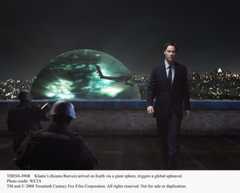
Klaatu's (Keanu Reeves) arrival on Earth via a giant spheretriggers a global upheaval. Photo credit: WETA.

A massive and seemingly unstoppable alien force destroys astadium in seconds. Photo credit: WETA.
Ten years ago,Titanic was the first film to use Linuxin a big way. Today,Linux dominates big-budget visual effects and 3-D animation. Ever sinceTheMatrix, it's become routine to have several visual-effects companiesworking on the same film. A visual effects supervisor at the studio, inthis case Fox, selects which companies will create the visual effects.
“I came in and met with the director Scott Derrickson”, saysTheDay the Earth Stood Still Visual Effects Supervisor Jeffrey A. Okun.“In Scott's opinion, and one I agree with, the day of visual effect asstar of the movie is gone. He wanted to focus on story. Hewanted spectacular effects that were invisible. When dealing withspaceships, aliens and giant robots, that's a bit of a challenge.”
“Weta was our primary group on the film that did 220 shots on thefilm”, says Okun. “Then Cinesite. We had Flash Filmworks and CosFX.Later on we added Hammerhead and Hydraulx, a company called At the Post,and a couple other little companies. Weta handled the Sphere, the alien,the robot and the Swarm. It's all particle systems based on chaostheory. That means it's render-intensive.”
“There's a shot of the Sphere that we call the super-sphereshot”, says Okun. “That starts in the swamp and takes you tovarious Spheres activating around the world. That took 30 days torender. That's pretty crazy. It's around 1,100 frames. It's anamazing shot. You don't want to show it to the director at the end of theday and have him say, 'That's not really our sphere'...which iswhat happened. We came up with a patch system at Weta Digital where wecould render a section and patch it over the offending thing. Thisparticular patch took three days to render.”
“Linux is an integral part of what we do here at Weta”, saysProduction Engineering Lead Peter Capelluto. “It's very well suitedfor the dynamic needs of the visual-effects industry. Our department wouldhave a much more difficult time accomplishing our goals with any otheroperating system.”
“Weta predominantly uses Linux for our workstations and also for ourrenderfarm and servers”, says Capelluto. “There are a fewapplications that require the use of Mac OS X, Windows and Irix. Wheneverpossible, we use Linux. The open-source nature of Linux and the many Linuxapplications are a major advantage. We also prefer it for stability, lowcost, access control, multiuser capabilities, control andflexibility.” Capelluto's department develops pipeline software,such as the digital asset management system and the distributed resourcemanagement system for their renderfarm.
“We have 500 IBM Blade Servers, 2,560 HP BL2x220C Blade Servers and 1,000 workstations”, says Weta Digital Systems Department Lead AdamShand. “Ubuntu is our primary render and desktop distro. We also useCentOS, RHEL and Debian.” The workstations are IBM and HP. Weta usesNetApp DataOnTap, NetApp GX, BluArc, Panasas and SGI file servers. Storageis mostly NAS, not SAN. For open-source apps, they use Apache, Perl, Python,MySQL, PostgresSQL, Bind, OpenOffice.org, CUPS, OpenLDAP, Samba, Firefox,Thunderbird, Django, Cacti, Cricket, MRTG and Sun Gridware.
“We're big fans of open-source code here at Weta”, saysCapelluto. “We're utilizing Sun's Grid Engine for distributedresource management and have helped them fix a number of bugs. It's verypowerful to be able to improve upon open-source software and to fix anyproblems you encounter.”



