 | Mercenary Air
This morningMilitary.com has a story on America's most famous (or infamous) private security contractor, Blackwater USA, purchasing a light attack aircraft. Report Says Blackwater Bought Fighter (AP) A subsidiary of U.S. military security contractor Blackwater Worldwide has purchased a fighter plane from the Brazilian aviation company Embraer, a Brazilian newspaper reported June 1. The 314-B1 Super Tucano propeller-driven fighter - the same used by the Brazilian military - was bought for $4.5 million and delivered to EP Aviation at the end of February, according to the Estado de S. Paulo newspaper.
First of all the headline is misleading. The Tucano isn't a "fighter" unless you're a seriously third world air force. But it has been bandied around as a good answer for a "counter-insurgency" aircraft. So Blackwater has clearly done some research (and been reading DT, I have to assume) on the best plane to fight a dirty war. It's interesting, too, that the company is buying new. Seems to me there'd be a lot more surplus gear on the market for them to snap up -- and keep it low profile as well. It was not clear if it was Embraer's first sale of a military-style aircraft to a private company. EP Aviation has 33 planes and helicopters registered with the FAA, according to the agency's Web site, only one of which is from Embraer. Officials with Brazil's government and Embraer declined to comment on the Estado report. Phone calls to Blackwater were not returned. The sale was apparently approved, the Estado report noted, by Brazil's president in a deal negotiated with the U.S. government. Brazilian law prohibits the sale of arms to companies or for use in existing conflicts. It does worry be a bit each time a company like Blackwater continues this arms build up. Sources tell me they've got a "Spectre'-like" gunship already, and they've been buzzing around Baghdad in spec-ops-style armed Little Birds. So what happens when a contract with the US Gov goes bad -- say Congress pulls funding from a contract midway through the agreement. Will Blackwater use this kind of equipment to come collect what it's owed? Seems far fetched, I know, but Blackwater officials are downplaying the Tucano buy to curb fears. The newspaper reported that Blackwater president Gary Jackson said the plane would be used for training. The plane sold to EP Aviation did not include the two .50-caliber machine guns normally attached to the wings.
Oh, I'm sleeping better already... -- Christian Merc Chopper Shot Down (Updated)The tens of thousands offoreign mercenaries fighting alongside coalition soldiers in Iraq aren't just tooling around in up-armored SUVs sporting submachine guns. These guys have got helicopters too that they use to escort convoys -- and one of them has just been shot down over Baghdad, according to theAssociated Press: 
Five civilians died in the Baghdad crash of a helicopter owned by the private security companyBlackwater USA, according to a U.S. military official. The helicopter was shot down Tuesday over a predominantly Sunni neighborhood, a senior Iraqi defense official said. The crash came three days after a U.S. Black Hawk helicopter crashed northeast of Baghdad, killing all 12 soldiers aboard.
Blackwater should haveseen this coming. Unlike U.S. military helicopters, which are armored and equipped withcountermeasures to defeat shoulder-fired missiles, Blackwater'sMcDonnell Douglas MD-369FF Loaches are essentially defenseless, unless you count the two mercs hanging out the cabin doors with their rifles. Note that Blackwater's choppers -- which fly from the same Green Zone helipad used by the U.S. Army and Marines -- are just civil versions of theHughes OH-6 Cayuse that the Army began phasing out after the Vietnam War due to their vulnerability. U.S. Special Forces flyupdated H-6s, but only at night, when it's safer. It's not clear what time of the day the Blackwater bird was shot down, but I've witnessed these choppers buzzing around in broad daylight. It's too early to tell what this shoot-down means for Blackwater and for merc ops in Iraq. But one thing's for sure: with the militarystruggling to scare up another 20,000 troops for its so-called"surge," the demand for private soldiers isn't going away. UPDATE 1/24/07: Four of the dead Blackwater men were apparently killed execution-style, perhaps after surviving the chopper crash, while the fifth was a member of a second chopper crew also at the site of the crash. All this according to theAssociated Press:
In Washington, a U.S. defense official said four of the five killed were shot in the back of the head but did not know whether they were still alive when they were shot. The U.S. official spoke on condition of anonymity because he was not authorized to speak on the record. ... Another American official in Baghdad, who spoke on condition of anonymity, said three Blackwater helicopters were involved. One had landed for an unknown reason and one of the Blackwater employees was shot at that point, he said. That helicopter apparently was able to take off but a second one then crashed in the same area, he added without explaining the involvement of the third helicopter. The New York Times, citing unnamed American officials, reported that the helicopter's four-man crew was killed along with a gunner on a second Blackwater helicopter.
--David Axe, crossposted atWar Is Boring UPDATE 01/24/07 11:01 AM: Who do ya trust? Doug Brooks, president of the International Peace Operations Association, an industry group that includes security contractors, said the type of helicopter downed, known as a "little bird," isamong the safest modes of transportation in war zones. "Their crews are the best -- they really know their stuff," he said in an e-mail. "They are very good at avoiding fire, flying low and fast -- and the tiny helicopters are very hard to hit."
Doug is a nice guy. But I'll put my money on Axe as the more objective observer. UPDATE 01/24/07 11:07 AM: Robert Young Pelton hasdetails on the incident -- and recent footage of Blackwater choppers in action. Washington Post Meets Soldiers' Justice Twelve days ago, Peter Singerbroke the story here, that private military contractors were going to be subject to the same laws as soldiers. Since then, big media outlets from theBoston Globe to theFinancial Times have picked up on Singer's scoop. Today, it's theWashington Post'sturn. The paper puts the story on thefront page. Twelve days ago, Peter Singerbroke the story here, that private military contractors were going to be subject to the same laws as soldiers. Since then, big media outlets from theBoston Globe to theFinancial Times have picked up on Singer's scoop. Today, it's theWashington Post'sturn. The paper puts the story on thefront page.
"Right now, you have two different standards for people doing the same job," said Sen. Lindsey O. Graham (R-S.C.), who pushed the provision. "This will bring uniformity to the commander's ability to control the behavior of people representing our country." Graham, an Air Force Reserve lawyer, said the change will help morale in the field. "If the troops see someone getting away with something that hurts the overall mission, that is a morale buster," he said. Under military law, known as theUniform Code of Military Justice, commanders have wide latitude in deciding who should be prosecuted. Crimes include many that have parallels in civilian courts -- murder and rape, for instance -- as well as many that don't, such as disobeying an order, fraternization and adultery. Legal experts say that latitude is one reason why attempting to hold civilians to the same standards as U.S. troops could be a messy process. It is also likely to raise constitutional challenges: Civilians prosecuted in military court don't receive a grand jury hearing and are ultimately tried by members of the military, rather than by a jury of their peers... To try to solve the problem, Rep. David E. Price (D-N.C.) introducedlegislation last week that he said would strengthenMEJA [the Military Extraterritorial Jurisdiction Act, which supposedly expand federal prosecutors' authority to foreign battlefields], an option he considers superior to using military law. "Military law is not appropriate for civilians," Price said. "The constitutional questions just confuse the issue."
TheNew York Times also gives our lil' site ashout-out over the scoop, in the "What's Online" column. Soldiers' Justice Spreads More big media outlets are picking up on -- and adding to -- Peter Singer's Defense Tech scoop, thatprivate military members with now be subject to the same laws as American soldiers. There may even be a test case coming up, sooner than we all thought. More big media outlets are picking up on -- and adding to -- Peter Singer's Defense Tech scoop, thatprivate military members with now be subject to the same laws as American soldiers. There may even be a test case coming up, sooner than we all thought.
Virginian-Pilot: As pressure grows in Congress to hold private military companies such as Blackwater USA more accountable for their conduct, reports have surfaced of a Dec. 24 shooting in Baghdad that could serve as a textbook case.
Austin American-Statesman: the contractors subject to the military's laws and penalties serves as a deterrent, defense analyst Larry Korb said. "It gives the commanders there the ability to say, 'Look, you are in my zone of responsibility. Here's the ground rules, and if you violate them, here's what happens.'"
GovExec: Doug Brooks... president of the International Peace Operations Association, [which] represents private security firmsgroup's president... said the military justice code is not well equipped to handle crimes committed by civilians. "We're all for accountability, and frankly the UCMJ will be great if it can work," Brooks said of the rule change. "But UCMJ isn't the right thing to do this." He cited concerns about the constitutionality of subjecting civilians to military legal processes, thereby depriving them of certain aspects of the regular judicial process. Brooks said it also was unclear whether the military justice code could be applied to non-Americans. If the law applies only to Americans working on Defense contracts, he said, it would ultimately cover less than 10 percent of the contracting force in Iraq, which includes people from around the world.
Financial Times: Christopher Beese, chief administration officer for ArmorGroup, a security company that operates in Iraq, said he doubted whether the new law would have any impact until the US, UK and Iraqi authorities "demonstrate there is resolve to take action where action is necessary". Mr Beese added that even in situations where ArmorGroup had itself raised concerns about the actions of some of its employees, it had found great difficulty getting the authorities to act.
Jane's: US Army Colonel Peter Mansoor, an influential military thinker on counter-insurgency and a veteran of the Iraq war, told Jane's in a recent interview that the US military needs to take "a real hard look at security contractors on future battlefields and figure out a way to get a handle on them so that they can be better integrated - if we're going to allow them to be used in the first place".
Contractors Squirm Under Soldiers' Justice? TheBoston Globe andDefense News have picked up on Peter Singer's scoop -- thatmilitary contractors are now going to be subject to soldiers' justice. TheBoston Globe andDefense News have picked up on Peter Singer's scoop -- thatmilitary contractors are now going to be subject to soldiers' justice.
Neither theGlobe norDefense News could find any big defense contractor to comment on the five-word change to the law, spearheaded by Senator Lindsey Graham, a South Carolina Republican and former JAG. But they've caught the legal and private military interest groups squirming. Stan Soloway, president of the Professional Services Council, an organization that represents government contractors, tellsDefense News that "one result [of the rule change] may be that contractors now can be punished for actions not ordinarily prosecutable under U.S. law." The UCMJ’s "behavioral requirements are very different and potentially in conflict with contract law and criminal law," Soloway said... Civilian contractors now might be punished for disrespecting an officer, disregarding an order or committing adultery — actions that are not prosecutable under U.S. law, Soloway said. "If a general or colonel directs a contractor or government civilian to do something that is outside terms of contract, under U.S. procurement law, the contractor does not do it without authority from the contracting officer," Soloway said. But under the UCMJ, "that might be failure to follow an order."
"I think there should have been some kind of hearing before Congress passed this measure," Eugene R. Fidell, president of the National Institute of Military Justice, tells theGlobe. "Ultimately, if this power is used, it will create a substantial issue that would likely reach the Supreme Court, and it will put us at odds with contemporary international standards." Fidell said that US courts have a history of throwing out convictions of civilians who were tried in military courts, including the 1957 case of a wife who killed her husband on a military base. "There was a period of decades that you could have crimes by US persons overseas that could never be punished," he said.
Hopefully, that will start to change. Soldiers' Justice; Readers React (Updated) If you haven't had a chance yet, go check out thecomments to Peter Singer's story on theprivate military contractors who will now have to face soldiers' justice. A few samples: If you haven't had a chance yet, go check out thecomments to Peter Singer's story on theprivate military contractors who will now have to face soldiers' justice. A few samples:
My CO had a very interesting way of making sure the civilian contractors in his area to behave. Before he came the civilian contractors were acting like thugs. My CO in the civilian world is a cop. So he got his friends to pull up personal data on the civilian contractors. He had a meeting with them and basically told them if they keep on acting the way they did he will make sure their personal information makes it's way to the insurgents and he will personally hand them over to members of the Iraqi police that he is fairly certain are members of the insurgency. Funny thing was after that meeting the civilian contractors stopped being thugs to the Iraqis.
Posted by: Billy at January 4, 2007 03:21 PM
Good. Exposure to the UCMJ means additional risk, which means more money. I need a raise. Being subject to the UCMJ will make us immune from Iraqi law under the Status of Forces Agreement (SOFA), just like soldiers. Also, the US government will not turn us over to the International Criminal court (ICC) to be tried for war crimes; real, imagined, or concocted. I lived under UCMJ for 22 years. A few more will not make any difference.
Posted by: Thorn... at January 4, 2007 01:39 PM
The British Investigation into the "Elvis" video event released its report before Christmas concluding that all the footage in the video came from legitimate operations. Strange you mention the case to support your argument but don't mention the (previous) resolution. Raised major red flags with me about the enitire article.
Posted by: Michael Stora at January 4, 2007 02:48 PM
I am on my 3rd tour, I have seen a contractor shoot a civilian in the head because he protested when the contractor grabbed his daughters breasts. There was nothing that anyone could do about it when re radioed it in we were told to lethim go. This isjust one of dozens of stories and one that I saw myself.
Posted by: WKean at January 4, 2007 01:49 PM
Kevin Drum,ROFASIX,Hilzoy,MountainRunner, theColumbia Journalism Review, andmy man Blackfive all have interesting takes, too. Give 'em a read. UPDATE 01/05/06 6:15 PM: P.W. Singer "refute[s] a few of the most insane/stupid posts" responding to his story. UPDATE 01/05/06 11:30 AM:Pat Dollard sends as an interesting take on the rule changes from one military officer. Check it outafter the jump. 1. There are a few Articles [in the UCMJ] that apply [to reporters]… Article 82 - SOLICITATION (this would apply to the guy who pimped the soldier to challenge Rumsfeld about the vehicle armor); Article 88 – Contempt; Articles 89 - Disrespect, Article 107 - MAKING A FALSE OFFICIAL STATEMENT (I would like to pay some people back); Article 117 – provoking speeches or gestures, Article 132 - FRAUDS AGAINST THE UNITED STATES… 2. For contractors (we are actually referring ONLY to security contractors like BlackWater, Triple Canopy)… This amendment to the already existing law will help area/unit commanders control their actions and their movement. Since they are mercenaries, and many prior military, every single article applies to them… 3. You can see how this tool will effect BOTH "contractors" and media personnel. The way I see it is this: A- [Applied to reporters, it is] a tool for the government to allow/use the military to control media content and output. This could be a VERY controversial issue. B- [Applied to contractors,] it allows for unit and area commanders to CONTROL the conduct and accountability of civilians/contractors/reporters that are operating in their Area of Operation. As a military commander, who personally, and intimately dealt with both agencies outlined above, I feel that this is the greatest merit of the "amendment" to the law. 4. What is missing is an appendix, that deals with the specific application of all the articles of the UCMJ as it applies to contractors, reporters, etc. It already exists, but there are a few grey areas that immediately pop out. Realize there are many, but here are few to get your mouth wet: Is there a specific authority that can adjudicate the law? Right now, as a Captain, I can punish/adjudicate the law to all those who the law applies to. My authority, as well as at the battalion level - uses Non- Judicial Punishment to adjudicate the law. We take away rank, money, assign "extra duties", and restrict or "ground" them. So, it would make sense to me that all of these cases will be referred to a higher authority in order to adjudicate the law by Court Martial. All the money, rank, etc applies, but there is imprisonment factors and felony/criminal charges that carry the same implications as in the "real world". There is no "double-jeopardy". We cannot charge, and punish you against the UCMJ, and then punish you for the same offense in the civilian court system. So, I cannot use MEJA and the UCMJ together, it has to be one or the other. These laws need to be explained to everyone that it applies to. And in my opinion, there needs to be some sort of signature/contract that binds them to these laws. 5. While I like the whole concept, it leaves too much to interpretation and needs to be strictly defined, so that when it comes time to hold the "target audience" accountable for their actions - there can be no way they can get out of it. We can do MUCH better, and I am surprised that no one has taken the initiative on this. Since the DOJ, MEJA, and all the other bullshit cannot take care of this issue on their own, they will continue the trend of piling this responsibility upon the shoulders of the US service members. Since we are already carrying the State Department on our backs, in addition to battling a raging insurgency, and rebuilding a nation - I guess we can make room for the DOJ. I guess it really makes sense. Do you really think they will send Department of Justice personnel to Iraq to help enforce MEJA and all applicable laws? As it applies to most of our public officials, they are not willing to shoulder the same burden and make the same sacrifices as the American, and now Iraqi, service members. But, like I said, this would be a much appreciated tool for military commanders to control their battle-space. So, all bitching aside, I like it. And it makes me want to go back even more.
Guns-for-Hire Accused of Gitmo Abuse WaPo: "New allegations of detainee abuse at Guantanamo Bay released by the FBI on Tuesday putprivate contractors at the center of interrogation operations, raising questions once again aboutwhere they fit in the military's chain of command." WaPo: "New allegations of detainee abuse at Guantanamo Bay released by the FBI on Tuesday putprivate contractors at the center of interrogation operations, raising questions once again aboutwhere they fit in the military's chain of command."
Contractors have traditionally not been subject to the Uniform Code of Military Justice, the body of laws that governs the behavior of soldiers. Other laws apply to contractors, but many remain untested. "You have two different types of people operating under different sets of rules," said Scott L. Silliman, executive director of the center on law, ethics and national security at Duke University.
The Law Catches Up To Private Militaries, EmbedsSince the start of the Iraq war, tens of thousands of heavily-armed military contractors have been roaming the country -- without any law, or any court to control them. That may be about to change, Brookings Institution Senior FellowP.W. Singer notes in a Defense Tech exclusive. Five words, slipped into a Pentagon budget bill, could make all the difference. With them, "contractors 'get out of jail free' cards may have been torn to shreds," he writes. They're now subject to the Uniform Code of Military Justice, the same set of laws that governs soldiers. But here's the catch: embedded reporters are now under those regulations, too. 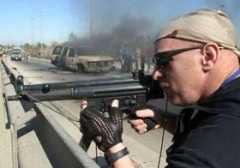 Over the last few years, tales of private military contractors run amuck in Iraq -- from theCACI interrogators at Abu Ghraib to the Aegis company's Elvis-themed internet "trophy video" —- have continually popped up in the headlines. Unfortunately, when it came to actually doing something about these episodes ofOutsourcing Gone Wild, Hollywood took more action than Washington. The TV seriesLaw and Order punished fictional contractor crimes, while our courts ignored the actual ones. Leonardo Dicaprio acted in amovie featuring the private military industry, while our government enacted no actual policy on it. But those carefree days of military contractors romping across the hills and dales of the Iraqi countryside, without legal status or accountability, may be over. The Congress has struck back. Over the last few years, tales of private military contractors run amuck in Iraq -- from theCACI interrogators at Abu Ghraib to the Aegis company's Elvis-themed internet "trophy video" —- have continually popped up in the headlines. Unfortunately, when it came to actually doing something about these episodes ofOutsourcing Gone Wild, Hollywood took more action than Washington. The TV seriesLaw and Order punished fictional contractor crimes, while our courts ignored the actual ones. Leonardo Dicaprio acted in amovie featuring the private military industry, while our government enacted no actual policy on it. But those carefree days of military contractors romping across the hills and dales of the Iraqi countryside, without legal status or accountability, may be over. The Congress has struck back.
Amidst all the add-ins, pork spending, and excitement of the budget process, it has now come out that a tiny clause was slipped into the Pentagon's fiscal year 2007 budget legislation. The one sentence section (number 552 of a total 3510 sections) states that "Paragraph (10) of section 802(a) of title 10, United States Code (article 2(a) of the Uniform Code of Military Justice), is amended by striking `war' and inserting `declared war or a contingency operation'." The measure passed without much notice or any debate. And then, as they might sing onSchool House Rock, that bill became a law (P.L.109-364). The addition of five little words to a massive US legal code that fills entire shelves at law libraries wouldn't normally matter for much. But with this change, contractors' 'get out of jail free' card may have been torn to shreds. Previously, contractors would only fall under theUniform Code of Military Justice, better known as the court martial system, if Congress declared war. This is something that has not happened in over 65 years and out of sorts with the most likely operations in the 21st century. The result is that whenever our military officers came across episodes of suspected contractor crimes in missions like Bosnia, Kosovo, Iraq, or Afghanistan, they had no tools to resolve them. As long as Congress had not formally declared war, civilians -- even those working for the US armed forces, carrying out military missions in a conflict zone -- fell outside their jurisdiction. The military's relationship with the contractor was, well, merely contractual. At most, the local officer in charge could request to the employing firm that the individual be demoted or fired. If he thought a felony occurred, the officer might be able to report them on to civilian authorities. Getting tattled on to the boss is certainly fine for some incidents. But, clearly, it's not how one deals with suspected crimes. And it's nowhere near the proper response to the amazing, awful stories that have made the headlines (the most recent being the contractors whosprung a former Iraqi government minister, imprisoned on corruption charges, from a Green Zone jail). And for every story that has been deemed newsworthy, there are dozens that never see the spotlight. One US army officer recently told me of an incident he witnessed, where a contractor shot a young Iraqi who got too close to his vehicle while in line at the Green Zone entrance. The boy was waiting there to apply for a job. Not merely a tragedy, but one more nail in the coffin for any US effort at winning hearts and minds. But when such incidents happen, officers like him have had no recourse other than to file reports that are supposed to be sent on either to the local government or the US Department of Justice, neither of which had traditionally done much. The local government is often failed or too weak to act - the very reason we are still in Iraq. And our Department of Justice has treated contractor crimes in a more Shakespearean than Hollywood way, as inMuch Ado About Nothing. Last month, DOJ reported to Congress that it has sat on over 20 investigations of suspected contractor crimes without action in the last year. The problem is not merely one of a lack of political will on the part of the Administration to deal with such crimes. Contractors have also fallen through a gap in the law. The roles and numbers of military contractors are far greater than in the past, but the legal system hasn't caught up. Even in situations when US civilian law could potentially have been applied to contractor crimes (through theMilitary Extraterritorial Jurisdiction Act), it wasn't. Underlying the previous laws like MEJA was the assumption that civilian prosecutors back in the US would be able to make determinations of what is proper and improper behavior in conflicts, go gather evidence, carry out depositions in the middle of warzones, and then be willing and able to prosecute them to juries back home. The reality is that no US Attorney likes to waste limited budgets on such messy, complex cases 9,000 miles outside their district, even if they were fortunate enough to have the evidence at hand. The only time MEJA has been successfully applied was against the wife of a soldier, who stabbed him during a domestic dispute at a US base in Turkey. Not one contractor of the entire military industry in Iraq has been charged with any crime over the last 3 and a half years, let alone prosecuted or punished. Given the raw numbers of contractors, let alone the incidents we know about, it boggles the mind. The situation perhaps hit its low-point this fall, when the Under Secretary of the Armytestified to Congress that the Army had never authorized Halliburton or any of its subcontractors (essentially the entire industry) to carry weapons or guard convoys. He even denied the US had firms handling these jobs. Never mind the thousands of newspaper, magazine, and TV news stories about the industry. Never mind Google's 1,350,000 web mentions. Never mind the official report from U.S. Central Command that there were over 100,000 contractors in Iraq carrying out these and other military roles. In a sense, the Bush Administration was using a cop-out that all but the worst Hollywood script writers avoid. Just like the end of the TV seriesDallas, Congress was somehow supposed to accept that the private military industry in Iraq and all that had happened with it was somehow 'just a dream.' But Congress didn't bite, it now seems. With the addition of just five words in the law, contractors now can fall under the purview of the military justice system. This means that if contractors violate the rules of engagement in a warzone or commit crimes during a contingency operation like Iraq, they can now be court-martialed (as in,Corporate Warriors, meetA Few Good Men). On face value, this appears to be a step forward for realistic accountability. Military contractor conduct can now be checked by the military investigation and court system, which unlike civilian courts, is actually ready and able both to understand the peculiarities of life and work in a warzone and kick into action when things go wrong. The amazing thing is that the change in the legal code is so succinct and easy to miss (one sentence in a 439-page bill, sandwiched between a discussion on timely notice of deployments and a section ordering that the next of kin of medal of honor winners get flags) that it has so far gone completely unnoticed in the few weeks since it became the law of the land. Not only has the media not yet reported on it. Neither have military officers or even the lobbyists paid by the military industry to stay on top of these things. So what happens next? In all likelihood, many firms, who have so far thrived in the unregulated marketplace, will now lobby hard to try to strike down the change. We will perhaps even soon enjoy the sight of CEOs of military firms, preening about their loss of rights and how the new definition of warzone will keep them from rescuing kittens caught in trees. But, ironically, the contractual nature of the military industry serves as an effective mechanism to prevent loss of rights. The legal change only applies to the section in the existing law dealing with those civilians "serving with or accompanying an armed force in the field," i.e. only those contractors on operations in conflict zones like Iraq or Afghanistan. It would apply not to the broader public in the US, not to local civilians, and not even to military contractors working in places where civilian law is stood up. Indeed, it even wouldn't apply to our foes, upholding recent rulings on the scope of military law and the detainees at Gitmo. In many ways, the new law is the 21st century business version of the rights contract: If a private individual wants to travel to a warzone and do military jobs for profit, on behalf of the US government, then that individual agrees to fall under the same codes of law and consequence that American soldiers, in the same zones, doing the same sorts of jobs, have to live and work by. If a contractor doesn't agree to these regulations, that's fine, don't contract. Unlike soldiers, they are still civilians with no obligation to serve. The new regulation also seems to pass the fairness test. That is, a lance corporal or a specialist earns less than $20,000 a year for service in Iraq, while a contractor can earn upwards of $100,000-200,000 a year (tax free) for doing the same job and can quit whenever they want. It doesn't seem that unreasonable then to expect the contractor to abide by the same laws as their military counterpart while in the combat theatre. Given that the vast majority of private military employees are upstanding men and women -- and mostly former soldiers, to boot -- living under the new system will not mean much change at all. All it does is now give military investigators a way finally to stop the bad apples from filling the headlines and getting away free. The change in the law is long overdue. But in being so brief, it needs clarity on exactly how it will be realized. For example, how will it be applied to ongoing contracts and operations? Given that the firm executives and their lobbyists back in DC have completely dropped the ball, someone ought to tell the contractors in Iraq that they can now be court martialed. Likewise, the scope of the new law could made more clear; it could be either too limited or too wide, depending on the interpretation. While it is apparent that any military contractor working directly or indirectly for the US military falls under the change, it is unclear whether those doing similar jobs for other US government agencies in the same warzone would fall under it as well (recalling that the contractors at Abu Ghraib were technically employed by the US Department of Interior, sublet out to DOD). On the opposite side, what about civilians who have agreed to be embedded, but not contracted? The Iraq war is the first that journalists could formally embed in units, so there is not much experience with its legal side in contingency operations. The lack of any legal precedent, combined with the new law, could mean that an overly aggressive
interpretation might now also include journalists who have embedded. Given that journalists are not armed, not contracted (so not paid directly or indirectly from public monies) and most important, not there to serve the mission objectives, this would probably be too extensive an interpretation. It would also likely mean less embeds. But given the current lack of satisfaction with the embed program in the media, any effect here may be a tempest in a tea pot. As of Fall 2006, there were only nine embedded reporters in all of Iraq. Of the nine, four were from military media (three fromStars and Stripes, one fromArmed Forces Network), two not even with US units (one Polish radio reporter with Polish troops, one Italian reporter with Italian troops), and one was an American writing a book. Moreover, we should remember that embeds already make a rights tradeoff when they agree to the military's reporting rules. That is, they have already given up some of their 1st Amendment protections (something at the heart of their professional ethic) in exchange for access, so agreeing to potentially fall under UCMJ when deployed may not be a deal breaker. The ultimate point is that the change gives the military and the civilians courts a new tool to use in better managing and overseeing contractors, but leaves it to the Pentagon and DOJ to decide when and where to use it. Given their recent track record on legal issues in the context of Iraq and the war on terror, many won't be that reassured. Congress is to be applauded for finally taking action to reign in the industry and aid military officers in their duties, but the job is not done. While there may be an inclination to let such questions of scope and implementation be figured out through test cases in the courts, our elected public representatives should request DoD to answer the questions above in a report to Congress. Moreover, while the change may help close one accountability loophole, in no way should it be read as a panacea for the rest of the private military industry's ills. The new Congress still has much to deal with when it comes to the still unregulated industry, including getting enough eyes and ears to actually oversee and manage our contracts effectively, create reporting structures, and forcing the Pentagon to develop better fiscal controls and market sanctions, to actually save money than spend it out. A change of a few words in a legislative bill certainly isn't the stuff of a blockbuster movie. So don't expect to see Angelina Jolie starring in "Paragraph (10) of Section 802(a)" in a theatre near you anytime soon. But the legal changes in it are a sign that Congress is finally catching up to Hollywood on the private military industry. And that is the stuff of good governance. --P.W. Singer is Senior Fellow and Director of the21st Century Defense Initiative at The Brookings Institution. He is the author ofCorporate Warriors: The Rise of the Privatized Military Industry (Cornell University Press) and the upcoming bookWired for War (Houghton Mifflin). |
| |




