 |  |  |  | |  Start Start | DAI | Research | Research Databases | Contact | Infos | News | Annual Report | | | | Objectives | | Organization | | History | | Departments | | Auswärtige Kulturarbeit | | Members | | Sponsors | Partnerschaften
Vereinbarungen | |
| | Projects | | Publications | Guidelines for Contributors
to Publications | Research Cluster/
Research Plan | |
| | Libraries | | ZENON Verbundkatalog | | Archives | Picture Libraries/
Photograph Collections | |
| | | Scholarships | | Scholarship Holders | | Positions Offered | | Participation in Excavations | |
| | Press Releases | | Events | | Reports | |
| |
| Deutsch | | |
Georgia: Aruchlo |  | An Early Neolithic Tell Settlement of the 6th Millennium BC Excavations at an Early Neolithic Settlement Mound Location| |  | | | | Fig. 1. Aerial view of the tell | |
|
The Neolithic settlement of Aruchlo I is located about 50 km southwest of Tbilisi at the western access to the village Nachiduri on the main route to Bolnisi. Only a few hundred meters from the site the Chrami and Masavera rivers, exiting from the mountains, join to flow eastwards and into the Kura river approximately on the Georgian-Azerbaijan border. The Kura continues southeastwards, draining into the Caspian Sea.
This situation is indicative of the basic direction of communication between early agriculturalists. A number of tell settlements from about the same period of time are located along the Chrami river, for example, Sulaveris-Gora, Imiris-Gora and Chramis Didi-Gora in Georgia and farther to the southeast in the area of the Kura river Somutepe and Toiretepe in Azerbaijan. In view of their comparable architecture, pottery and other archaeological material, these tell settlements can be ascribed to the "Sulaveri-Somutepe-Group". | | | Objectives| |  | | | | Fig. 3. View of the excavation in 2005 | | | |  | | | | Fig. 2. View of the excavation during the 1960s | |
As early as the 10th millennium BC human subsistence and way-of-life that were based upon agriculture developed in the so-called "Fertile Crescent", an area extending in a curve from the Levant in the west through the Taurus mountains in the north to the Zagros mountains in the east. This subsistence replaced mankind's earlier form of existence by hunting and gathering, which had endured for millions of years. The cultivation of cereals and the domestication of animals developed over the course of several millennia. The most influential archaeologist of the 20th century, V. Gordon Childe, termed the transition from the hunter-gatherer to the agrarian way-of-life appropriately as the "Neolithic Revolution", not only in view of the rapidity of change, but also the far-reaching effects of this change in all aspects of life.
Since the 7th millennium BC the farming and stock-raising spread successively from the Near East towards the West, to Anatolia and Greece and farther into the Balkan peninsula. Whereas the expansion of the Neolithic to the west can be followed relatively well, it is difficult to trace to the north and east of the Fertile Crescent due to the lack of modern excavations and research.
And it is precisely this problem that recent excavations at Aruchlo approach. Over a longer time they could represent the first in a number of excavations in Azerbaijan, Iran and Turkmenistan that would fill in this deficit in information. Comparable perspectives could be gained concerning the varied strategies used by early farmers in adapting to their new environment.
Thus, one of the main objectives of the new excavations in Aruchlo is to gather as much data as possible that is relevant for reconstructing the environment in prehistoric times. This would include botanical and zoological remains, examinations of sediments etc., which would be integrated into a network of secure radiocarbon dates.
A further endeavour of the project is to provide students of archaeology in Georgia with the opportunity of gathering experience on excavations. | | History of Research| |  | | | | Fig. 4. Axe made of antler | |
A number of excavations in tell settlements of the "Sulaveri-Somutepe-Group" have been conducted since the 1960s. The settlements are characterised by relatively small circular structures made of mud (Fig. 2) as well as pottery typically decorated with knobs (Fig. 10), rarely red-polished or - even less - painted clay vessels. Bone artefacts include awls above all, and there are also axes (Fig. 4) and hammers made of antler. There was abundant use of tools made of obsidian (Fig. 5). Clay figurines, prolific in settlements in the area of the Zagros mountains in Mesopotamia, are rare in Aruchlo. Botanical and zoological investigations could not be correlated with settlement layers, functional contexts nor with a sufficiently fine network of 14C dates. The few 14C dates that are available for Aruchlo range from the 60th to the 54th centuries BC. | | Previous Activities| |  | | | | Fig. 5. Obsidian tools | |
Excavations took place in Aruchlo under the direction of T.N. Čubinisvili between 1966 and 1976 and under D. Gogelia between 1978 and 1985. The older excavations comprised one central area and several long sondages that served to investigate a ditch complex. A total of 936 square meters of the tell settlement was uncovered (Fig. 1). However, the documentation recorded as well as the finds made during this time were largely destroyed by a fire in the excavation house.
The excavators were able to distinguish six settlement horizons in the excavated area, of which the two uppermost were severely disturbed by later Bronze Age intrusions. The undisturbed lower layers contained circular structures of various sizes (Fig. 2) and presumably different functions. They were densely built without any recognisable predominance. | | Current Work| |  | | | | Fig. 10. Rim fragment of a vessel | | | |  | | | | Fig. 9. Base of vessel | | | |  | | | | Fig. 7. Circular structure | | | |  | | | | Fig. 6. Circular structure | | | |  | | | | Fig. 8. Statuette | |
The aim of the new excavation in the summer of 2005 was to gain information about the preservation of the architecture. A further endeavour was to gather sufficient samples for zoological and botanical analyses as well as for 14C-dating through the longest possible stratigraphic sequence of settlement. Yet, to achieve this further untouched areas of the settlement mound were not opened. Instead, in order to spare the original substance of this prehistoric monument, a profile baulk from one of the previous excavations was excavated (Fig. 3).
Geomagnetic prospection has not brought forth any clear results thus far, due to the abundance of scrap metal from recent times that is scattered over the entire area of the tell.
Contrary to expectations an entire structure, slightly oval in outline with a maximal diameter of 2.30 m, was distinguished within the confines of the excavated area (Fig. 6). Its walls were about 20 cm thick and preserved up to 0.8 m in height. In order to understand the process of the structure's abandonment, the accumulated debris was carefully removed from the interior until mudbrick rubble from the actual collapsed structure was reached. This fill consisted of several compact layers of ash containing pottery and artefacts of obsidian and bone. The original floor level lay below the mudbrick rubble. Only a few finds lay directly upon the floor, including a bone hammer found close to the wall.
In order to gain samples from a stratigraphic sequence, a trench of 2 x 1.5 m was laid farther to the east on the edge of the profile. At a depth of 1.30 m a section of another circular structure came to view (Fig. 7). There a clay figurine, the first known in Aruchlo (Fig. 8), was found in the uppermost preserved layer of fill. Directly below were two layers of river gravel that displayed traces of fire.
As far as recognisable, both circular structures were built of unbaked mudbricks in alternation with thin layers of a cohesive material. However, the possible use of rammed earth cannot be dismissed, as it was difficult to distinguish individual mudbricks. Traces of hearths and fireplaces or signs of fire on the walls have not been attested thus far. This is indeed noteworthy, for layers of ashes were found both inside and outside of the circular structures within the excavated area. In the profile (Fig. 7) these ash layers are massive in appearance, for which there is no plausible explanation as yet.
Evaluation of the samples still requires a considerable amount of time. Due to the limited size of the excavated area, a functional and/or stratigraphic differentiation of the archaeological material has not been possible thus far.
During the excavation of 2005 in Aruchlo over 2400 pottery sherds were recorded. More than 90 % thereof belongs to the Neolithic period. The sherds are all hand-formed and clearly display finishing touches such as finger imprints on the outer surface. The clay was tempered with minerals; the sherds are often poorly fired and can show traces of fire. The wall thickness of the vessels ranges between 0.5 and 1.2 cm. Most of these fragments have a rough, barely smoothed surface ranging from yellow-orange-red to grey-brown in colour or a greyish to olive-green slip. Almost one-third of the corresponding vessel rims is decorated with longish or oval knobs (Fig. 10). In general, the knobs were set upon the rim before firing, while the clay was still moist; only in a few cases were they pressed into the clay. Most of the knobs are arranged in a simple row, seldom in groups or with alternating spaces. Unusual sherds are decorated in relief with semi-circular or small rectangular applications. There are also combinations of different kinds of decoration. Moreover, in some cases undecorated, relatively thin-walled sherds with a uniformly finished and smoothed surface account for a well-polished, reddish ware that is quite distinctive among the other sherds described above. They represent less than 10 % of the total assemblage of Neolithic sherds.
The few vessel forms that could be distinguished thus far include simple small dishes and slightly globular pots, some with a horizontal grip. Further, there are small bowls, pot covers with a knob as grip and flat bases. The last display clear mat impressions, woven in a spiral (Fig. 9).
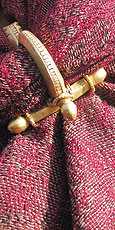
Among the small finds of note are a carneol pendant (Fig. 11) and a clay cone ("token"). The spectrum of bone artefacts is presented foremost by awls as well as hammers and axes of antler. | | Cooperation| |  | | | | Fig. 11. Carneol pendant | |
The recent excavation in Aruchlo were carried out in cooperation with the Archaeological Center "Otar Lordkipanize" of the Georgian Academy of Sciences, represented by Dr. Guram Mirzchulava.
Further investigations were conducted by: Prof. Dr. Ivan Gatsov (stone tools), Katrin Bastert, M.A. (pottery), Dr. Baoquan Song (geomagnetics), Prof. Dr. Norbert Benecke (archaeozoology), Dr. Reinder Neef (archaeobotany) and Dr. Jochen Görsdorf (14C-dating). Participants of the excavations included Michael Ullrich (Eurasia Department of the DAI), Katharina Malek, M.A., Andrzej Kuczminski (Ruhr-University in Bochum), Lewan Tshabashvili, Eliso Bagaturia, Irma Berzenishvili, Joni Abuladze and Dimitri Jovania (all from the University Tbilisi), and Bogdan Tanasescu (Archaeological Intitute, Bucharest), Anika Hotzan-Tshabashvili (Free University Berlin) and Vladimir Josseliani (Erlangen University).
Results of the excavation in 2005 will be published in the journalZeitschrift Archäologische Mitteilungen aus Iran und Turan.
In addition, other cooperative projects are being conducted in Georgia: an excavation by the Eurasia Department of the DAI in Tachti-Perda in Georgia, an excavation organised by the Tübingen University in Udabno, and the excavation at the Bronze Age gold mine at Saktrissi, in which the Deutsches Bergbaumuseum in Bochum is involved. | | ContactProf. Dr. Svend HansenUr- und Frühgeschichte
Telefon: 030-83008-310
Telefax: 030-83008-313
Email:eurasien@dainst.de
| |
|