
 Negotiations between France, Britain and Russia, during the early months of 1806, broke down. Prussia had been lashed to fury by the discovery that Napoleon had attempted to bribe Britain with Hanover, which he had so recently ceded to Prussia. Wishing to strike her before succour reach her from Russia, Napoleon anticipated her ultimatum by marching against her towards the Elbe River.
The ultimatum reached Napoleon on the 7th October 1806, seven days later the mighty Prussian army had been destroyed at Jena and Auerstadt. The survivors were pursued to the Baltic Sea. Hanover was occupied by the French troops; Saxony, detached from Prussian alliance, was eventually attached to that of France. It was cemented with the Saxon ruler being promoted to king. Napoleon ruled most of the continent. Central and northern Europe were under French occupation, Spain was in alliance with Napoleon, and Prussia was destroyed.
 The defeat of Prussia in 1806 did not end the war. Some Prussian troops survived. In winter he marched into Poland. Marshal Murat entered Warsaw (see picture) to a rapturous welcome.He was feted by the Poles igniting vain hopes of future kingship.
The Russian army was east and north of the Vistula River.Napoleon resolved not to irritate them by inciting the Poles subject to her to insurrection, and he, throughout the war, restricted his operations in this sense to the Prussian share of Poland."In the 16th century Poland had been one of the most powerful countries in Europe ...within the space of 200 years, however, Poland had been eclipsed by its neighbours ... Soon the country's historyculture and language were extinguished and its very name abolished. In this way was the white eagle of Poland devouredby the three black eagles of Prussia, Russia, and Austria. ... Meanwhile the Poles looked for France, with its revolutionary ideas of Liberty,Equality and Fraternity, as a beacon of hope. The fact France's enemies happened to be Poland'soppressors was an obvious attraction, and many Polish soldiers volunteered for service in theFrench army." (Summerville - "Napoleon's Polish Gamble" p 15)
To the Polish deputations which approached him in Berlin and at Warsaw, he replied vaguely, "France has never recognised the different partitions of Poland; nevertheless, I cannot proclaim your independence until you have decided to defend your rights as a nation with arms in your hands by every sort of sacrifice, even that of life. You have been reproached with having, in your continued civil dissensions, lost sight of the interests of your country. Instructed by your misfortunes, reunite yourselves and prove to the world that one spirit animates the whole Polish nation."
Napoleon was furious with Marshal Murat, for forwarding one petition from Warsaw, in which it was prayed that the Polish kingdom might be reconstituted under a French commander.Napoleon's replies to Poles were sufficiently encouraging to assure to him the moral and material support of the Poles in the ensuing campaign, and to deprive Prussia and Russia of all hope of recruiting their armies by voluntary enlistment in Poland. Napoleon entered Warsaw in 1807 and French eagles soared over the Vistula. The Emperorwas hesitant about reenacting the Kingdom of Poland. In spite of the ovations given him by the Poles, he wrote: "Only God can arbitrate this vast political problem ... It would mean blood, more blood, and srtill more blood ..." But it was not long before the Duchy of Warsaw became a bastion of France in central and Eastern Europe, and Polish troops stood ready to fight for Napoleon and independence. The war in 1807 was called by Napoleon the "First Polish War" and resulted in the formation of the Polish state. The country was divided into departments. The branches of justice, war, finance and police, were assigned to Polish government.
"The topography of Poland was little known [to the French]. A survey detachment directly under imperial headquarters was accordingly organized to which was entrusted the task of mapping the country as the army advanced.The instructions issued to these 'surveyors' are not without interest.They were to move with the advanced guard of each corps and to send their work daily to imperial headquarters.Attention was especially called to the necessity for recording the name of each village - this, one would think, was a somewhat superfluous instruction -with its population and nature of soil. Each sketch was to be signed so that, if more precise information was subsequently required by Napoleon, the officer concernedcould be readily summoned. The emperor complained later that it was to find on his maps a place mentioned in a dispatch, and gave ordersthat places named must have their locality plainly described." (- F.D. Logan) Napoleon's army crossed the Vistula River in several points.Loraine Petre described the theatre of war: "... a country for the most part flat, marshy, and thickly wooded- a country resembling, except in the last respect, the broads of Suffolk and Norfolk.There are no heights of any importance, and it is only in the north-western corner ... that it is possoble to describe the country as anything by an undulating plain. Here the underying rock of the Polish plain crops out, and gives rise to hills which, in places,reach the elevation of 500 to 700 feet above the sea, amongst which are imbedded the lakes ... "Many of the lakes are long and narrow, others of fantastic trace with long, finger-like bays.The theater of war was wooded and it was impossible to find an area sufficiently clear of continuous forest to allow of the deployment of larger force. It was a difficult terrain for speedy maneuvers. There were only few roads and even fewer cities. It was a good place to put 'population explosion' in focus.
The Russians had been located and beaten at Eylau and Hoff. The rest of the winter and spring passed in quietness. Napoleon had begun to contemplate a renewal of the campaign so early as the end of April,when he wrote Marshal Soult to send his sick to the rear, preparatory to a general advance.All he needed was only the capture of Danzig (see map), an important sea port and fortress by the Baltic Sea. When Danzig fell to French hands the Emperor wrote: "Everything leads to the belief that the enemy is on the move,though it is ridiculous on his part to engage in a general action now that Danzig is taken ..." In early June, Bennigsen decided to attack the advanced corps of Marshal Ney.His plan for the destruction of Ney was very complicated. The scheme had in its favor the fact that Neymhis front being surrounded by woods, could not see what was going on at any considerable distance.Nevertheless, Ney obtained sufficient information from his cavalry to convince him thatsome serious movements were in progress before fim. He requested Soult to support his leftand Davout to strengthen his position at Bergfried on the right.Bennigsen postponed the movement till the 5th. Then he took on the offensive and after several smallengagements had expanded its force and came to a standstill.The Emperor had not been idle, he ordfered the Guard cavalry to assemble at Finkenstein,and sent orders to his marshals. His design now was, to cut the Russian army from the Baltic Sea and Koenigsberg (see map) and its resources. On the 9th, the French troops occupied these positions:
- Marshal Soult's corps was at Altkirch
- Marshal Davout held the left bank of the Alle River above Guttstadt
- Marshal Ney's corps was at Guttstadt
- Marshal Murat's Reserve Cavalry was at Guttstadt
- the Guard was at Guttstadt
- Marshal Mortier was approaching Guttstadt Bennigsen was furious at Ney's miraculous getaway: outnumbered by 3 : 1, it was an easy victory for theRussians. Fuming Bennigsen blamed Sacken for allowing Ney to escape. Next, Bennigsen fell victim to a French ploy that stopped his advance in its tracks.The Russian general received a captured dispatch, addressed to Ney, stating that Davout's corps is aboutto fall on Bennigsen's rear. Thrown into a panic, Bennigsen shifts into reverse, ordering a retreat.First he marched to Guttstadt, and then to Heilsberg. But the dispatch is bogus, planted on the Russiansin an effort to save Ney.
"Bennigsen, having failed in this attempt at a surprise stroke, had nothing to do but fall back alongthe main road which leads to Konigsberg, for his numbers were inferior to those which theEmperor could bring now against him ... On the other hand he felt fairly sure ... of being able to maintainthe defensive indefinitely as he so fell back ... first of all he had heavilyfortified Heilsberg, a place on the main road ... and next because he had proved duringall the winter fighting the stubbornness of the Russian line." (- Hilaire Belloc)
On the north side, an undulating plain stretched in all directions.It was intersected by the course of the Spuibach Stream. On the left side of the stream was the Lawden Wood.Half a mile south-west of the wood was the village of the same name.This whole area was familiar to the Russians.Between February and May the Russians had made use of every fold of the terrain around Heilsberg. Majority of the earthworks stood on the southern bank of Alle River as Bennigsen anticipated the French to come from that direction. On the northern bank stood 3 redoubts, probably 3 or 4 smaller earthworks were there as well. Mjr Karl-Friedrich von Both wrote shortly after the war and mentioned six redoubts on northernbank of Alle. Another author, Petre, wrote about 3 redoubts, 1 earthwork by the river to defend the bridges and further 2 earthworks interspersed. He also stated that the Redoubt #1 stood approx. 500 paces from the river, and Redoubt #2 stood approx. 900 paces north of the Redoubt #1. On Hoepfner's map are at least 7 redoubts and earthworks (fleches ?). The Redoubt #1 and #2 had walls 10 feet high and 12 feet thick. Wooden logs supported the inner and outer walls.
(Each battalion had 4 companies.) .   The regular cavalry was numerous and of quite good quality, especially the cuirassiers and hussars were excellent. The cuirassiers in that time wore no body armor except helmets. The hussars were very bold. The Russians had no great cavalry leader, no one who knew when to use them to the greatest advantage. Historian Lorain Petre writes: "As a horseman, the Russian regular cavalryman had no experience, except in the schools. he was not born to the use of horses and he had to learn both how to ride and how to care for them. Yet the Russian cavalry distinguished itself throughout the campaign and was often victorious over the French with all its training." (- Petre "Napoleon's Campaign in Poland 1806-7", p 33) The regular cavalry was numerous and of quite good quality, especially the cuirassiers and hussars were excellent. The cuirassiers in that time wore no body armor except helmets. The hussars were very bold. The Russians had no great cavalry leader, no one who knew when to use them to the greatest advantage. Historian Lorain Petre writes: "As a horseman, the Russian regular cavalryman had no experience, except in the schools. he was not born to the use of horses and he had to learn both how to ride and how to care for them. Yet the Russian cavalry distinguished itself throughout the campaign and was often victorious over the French with all its training." (- Petre "Napoleon's Campaign in Poland 1806-7", p 33)
|

Approx. 6 km away and in front of the Russian battleline at Heilsberg, stood Borosdin's force:
|
The French fled with the Russians and Prussians hot on their heels.The victors however got under cannonade from the French artillery and were forced to fall back. The situation stabilized for a very short while.It was however a proverbial silence before the storm.
Napoleon kept looking in the direction where French cavalry have been fighting. The Emperor anxiously asked Murat 'what's going on over there ?' Unable to relax the Emperor, Murat mounted his horse and rode to the front of 5th Hussars. In the past this regiment was part of the legendary Hellish Brigage led by GdB Lasalle. At Heilsberg the 5th and 7th Hussars and 3rd Chasseurs formed GdB Pajol's brigade. Murat charged with a headlong rashness but his horse was struck by canister. Horse and rider were knocked over together like a stand of muskets. Murat - now without one boot, it was stuck in the strirup of killed horse - quickly mounted another horse.He took the entire brigade led by Pajol and advanced against the enemy.Uvarov's cavalry was of high quality and the fresh reinforcements brought by Murat changed little. The French continued to suffer heavy casualties and the battle continued. Colonel Dery and several other officers were wounded. If the cavalry fight between Uvarov and Murat was so impressive, why does it receive such little attention? The author of this article is unable to answer the question. Quite possibly, most historians and scholars haveconcluded that the cavalry engagement was minor in comparison with the infantry and artillery actionsand has been treated accordingly.  |
Encouraged by this success, Murat rallied his cavalry and made a dash at the Russians. There was no more show of resistance and the Russians disappeared to whence they came. It is due, however, to say that this attack of the Russian cavalry was of a most daring character, when the extent of their advance from all support is considered, and that they thus attacked the French positively in their own lines. Pity for their character that so dashing an advance should have been followed by so poor ending. |
Meanwhile the 18th Line Infantry (nicknamed "The Brave") marched north to outflank the Russian lines. It was attacked by Cossacks near the village of Grossendorf. The 18th found itself isolated and in a difficult situation. Two more battalions and one battery were sent and only then the 18th was able to withdraw.
While Bagration and exchanged blows, Legrand's division and Savary's Fusiliersmoved to attack the Lawden Wood. The wood was defended by three weak jager regiments left there by Uvarov. After a long and fierce battle and several bayonet charges made by both sidesthe French captured the wood. Tactically it was very important as the wood gave support to the northern flank of the French line. |
The columns of French infantry rushed forward as it was intolerable to stay under such cannonade. On the band of brothers pushed, closing the gaps, dressing the line, their pace breaking into a run as they neared the earthworks. Colonel of the 105th Line Infantry was wounded twice. Savary's Fusiliers left the safety of the Lawden Wood and marched on Legrand's flank.The 26th Light Infantry stormed the Redoubt #2. With muzzles of their cannons projecting through the embrasueres and ammunition closeat hand, the Russian gunners awaited the French. Terrible grape fire decimated the 26th, it was followedby musket volleys fired by two battalions at the redoubt. Nothing could stop the 26th, they carried the earthwork about 7 PM. According to Military Journal of the IV Army Corps it was the 26th Light, but according to Russians the 26th was repulsed and the redoubt was taken by the Fusiliers. Shikanov thinks that the 26th could indeed take the redoubt but the Fusiliers held it while the 26th continuedits advance. The Russians claimed that they saw the Fusiliers very near to the redoubt. GM Warneck's troops (Pernov, Kalouga and Sievsk Musketeers) were near the Prussians and could see in the fading daylight the outline of enemy formations. Then came the yellow flashes, followed by loud explosions, and the field was blanketed in smoke and blood. Although the Russians suffered badly they were moving at the double quick as steadily as if at drill. The men of the 26th turned the captured guns against the musketeersand opened fire. General Warneck and numerous officers and men fell to the ground.
|
In the morning all the horrors of battlefield were clearly visible. There were thousands upon thousands of wounded and killed soldiers who had been already stripped of all clothes. Large patches of grass were covered with blood. The level of suffering for the soldiers was beyond compare. There were bodies without heads, without legs, shot through the belly, with blown away foreheads, with holes in their chests, wounded, kicking horses.
"Of the tactics of the French in this terrible combat, there is not much that is favourable to be said. Napoleon attacked a very strong position with very inferior forces, for it was not till too late in the day to save the situation that Lannes' corps, Ney, and the Guard could reach the battlefield. The two latter took no part in the fighting, and merely served as a support on which the beatencorps in front could fall back. With Soult's endeavours, in face of an overwhelming enemy,no fault could be found. But for Napoleon's presence on the field, it is not impossiblethat that cautious marshal would have refrained from pressing his attack much beyond Bewernick,until the turning movement on the Russian right should take effect.Murat, on this day, appeared to no advantage. ... Napoleon was disgusted with behaviour of his cavalry;'they did nothing I ordered' he said.Lannes' final attack, at 10 PM, was mere waste of life; it could not reasonably be expected to succeed with a single division." (Petre - "napoleon's campaign in Poland, 1806-1807" pp 303-304)
|
Shikanov - 'Piervaia Polskaia Kampaniia 1806-7"
von Höpfner - "Der Krieg von 1806 und 1807" Vol. III and IV
Petre - "Napoleon's Campaign in Poland, 1806-1807"
The Department of History at the US Military Academy - series of campaign atlases
Sir Wilson - "Brief remarks on the Character and Composition of the Russian Army, and a Sketch of the Campaigns in Poland in the Years 1806 and 1807"
Summerville - "Napoleon's Polish Gamble"
Napoleon, His Army and Enemies
 "The Russians retired into a strong prepared position at Heilsberg with 90,000 men." (Chandler - "Dictionary of the Napoleonic Wars" p 195)Heilsberg was a small town, situated on the left bank of the Alle River.In Heilsberg stood an old Teutonic castle (see picture). For many years it was a residence of the bishops of Warmia and a stronghold protecting the eastern border of their domain. By the power of the Second Peace Treaty of Torun signed in 1466, Warmia was incorporated into Poland. The year of 1772 brought the incorporation of Warmia into Prussia.
 The Commander of the Russian army was 62 years old Baron Levin-August-Gottlieb (Leontii Leontievich) von Bennigsen. Bennigsen played a prominent role in the Russian army. He was often involved in court intrigues and disliked by some generals. According to Nikolai Mozhak of Russia "Bennigsen came of a very old German noble family ... he showed himself as a brave, composed and enterprising officer... " Bennigsen was highly praised for the Battle of Eylau. According to Shikanov, at Heilsberg Bennigsen didn't feel good during the day. This old commander was either sick or in pain. He dismounted his horse several times during the battle and laid on the grass.
 The Russian infantry were excellent in bayonet charges and able to withstabd heavy artillery bombardement as nobody else in Europe. But in the same time they were very poorly trained in musketry, skirmishing and maneuvering. The Russian infantrymen were known in Europe as inured to hardships of all sorts. Generally the infantryman was of smaller stature than his western counterpart. The exceptions were only the grenadiers and guardsmen. The officers who led the Russian infantry were not worthy, as a rule, of the magnificient raw material which they should have been able to mould into shape. Many officers were ill qualified. They spent time gambling and drinking. The infantry consisted of light infantry (jagers), line (musketeers), and heavy (grenadiers).
 The Russians were fond of their artillery, convinced that theirs was one of the best in Europe. They had the most numerous artillery on the continent and many pieces were of heavy caliber. It gave advantage in battle but delayed the movements of the troops during campaigns. ("Some 70 or 80 guns had to be abandoned in deep mud, during the retirement to Pultusk and Golymin" - Loraine Petre)The possibility of their capture caused a serious anxiety to the generals. The artillery officers were better educated than infantry and cavalry officers. The gunners were strong and used to heavy labor. The NCOs were superb in every aspect.The foot gunners wore uniforms similar to infantrymen's, while the horse gunners to dragoons' outfits. (see pictures)The artillery horses were smaller than in the French artillery, but well-bread and known for hardiness. In contrast to the French, the Russian rarely suffered shortage of horses.
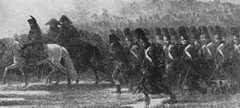 Loraine Petre described the French troops during the campaign in Eastern Prussia and Poland.He wrote: "The rank and file of the army was but little, if at all, past its best. In the earlier part of thecampaign, its youngest men were the conscripts of 1806 who had, owing to their premature enrolment,already undergone a years' training. Many of the troops had been with Napoleon in hisearlier campaigns and in Egypt, very many had been at Ulm and Austerlitz, the majority had just emerged from thebriliant campaign of Jena. They were now preparing for a renewed war against fresh enemies; the hardest taskthat an army can undertake. Even these hardened and enthusiastic warriors contemplated witg dreadthe prospect of a fresh winter campaign in an inhospitable and difficult country, and Napoleon was often remonstratedwith, as he rode alongside of his men, for insisting on their advance to Poland. To such complaints he would reply with the rough jestswhich his veterans loved to hear from him ... In action, the infantry was still splendid, and did not as yet require to be formed in deep columns of many battalions,such as was macdonald's at Wagram, three years later. The cavalry was excellent and well mounted, though, in the latter respect, they fell short of many Russian cavalry regiments.The artillery was highly trained and invariably made good practice."(Petre - "Napoleon's Campaign in Poland, 1806-1807" pp 27-28)
 "The emperor, with the whole Grand Army in his wake, is riding towards the final showdown withBennigsen. It is time to make the Polish gamble pay off. ...
 Before 10 AM (according to Shikanov it was earlier) Bennigsen received information from Borosdinthat the French were advancing in the direction of Launau.Bennigsen sent GM Lvov with the task of supporting Borosdin. Lvov's force consisted of: Kiev Dragoons, Kexholm Musketeers, two jager regiments, battalion of militia, and 2 horse guns. While the French artillery kept firing on Borosdin and Lvov's troops,GdD Latour-Maubourg led his dragoons in an all-out charge. Yermolov wrote that the French dragoons attacked Russian infantry not only from the front but also from the rear. Yermolov was able to escape only because he had a fast horse.About 2 PM Murat drove back Borosdin and Lvov.
 Meanwhile Bennigsen sent orders to Bagration (see picture) who was retiring on the opposite side of the river, to cross by the pontoon bridges and to move again up the north bank and fend off the French. Bagration met Borosdin's and Lvov's forces at Bewernick (Bobrownik today) retiring before the French.Bagration deployed his forces behind Bewernick and Dlugoleka. Jagers (in skirmish) order and some Cossacks were posted along and behind the Bewernick brook. Cavalry and horse battery towards Langwiese (today Dlugoleka), two batteries and three columns of infantry stood behind Bewernick.The Russian artillery poured cannonballs and shells into the enemy's cavalry. The attackers haltedand at 2 pm MdE Murat - already in a filthy temper - decided to wait for Soult's corps as his cavalry alone was not enough to take on Bagration's force. Once Soult's infantry and artillery arrived they unlimbered 36 cannons on a heightened ground 500 m from Bobrownik, and opened fire. The French soon got the upper hand over the two Russian batteries (24 guns) and the green-clad gunners limbered up and withdrew. The Russian jagers and Cossacks covered the retreat ofBagration's force.
 Murat's cavalry, with dragoons in the lead, advanced towards Langwiese.Bagration's cavalry attacked Murat before he reached his destination. Murat rallied his troops but then was again attacked, this time by a larger force of cavalry (25-35 squadrons)led by Uvarov. Uvarov placed three jager regiments in the wood near Lawden, and sent the cavalry under Kozhin and Fock across the Spuibach just as Bagration's troops were slowly faling back.
 Kozhin and Fock threw threw their squadrons, mostly cuirassiers (they wore no armor except helmets) against the flank of Latour-Maubourg's 1st Dragoon Division. General-Major Sergei-Alexeievich Kozhin was not only commanding the cavalry brigade, he was also thechef of His Majesty's Cuirassier Regiment, the best heavy cavalry outfit in the Russian cavalry right after theGuard. The timing of the attack was perfect as the French cavaliers were in a vulnerable situation. They were endeavoring to sort themselves out after their fight with Bagration's hussars and dragoons. The French dragoons were routed with easy. Especially the 15 squadrons of Russian cuirassiershit them hard.
 Murat rode to the front of the 3rd Heavy Cavalry Division and cried "Forward !" The cuirassiers drew their sabers and moved forward. De Gonneville of the 6th Cuirassiers writes: "At this moment the grand duke of Berg (Murat) came up to us;he came from our right rear, followed by his staff, passed at a gallop across our front, bending forwardson his horse's neck, and as he passed at full speed by General Espagne, he flung at him one word alone which I heard,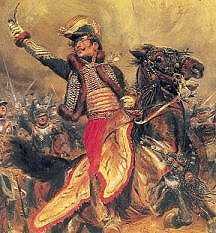
 Napoleon's ADC Jean-Marie René Savary received order to take GdD Roussel's 4 battalions of Fusiliers of the Imperial Guard and 12 guns and support Murat. Savary marched in the direction where was fought the great cavalry battle and was almost swept away by the fleeing French cuirassiers and dragoons.
 Marshal Murat met Savary and insisted that the guardsmen attack with bayonet. Savary was annoyed with Murat's actions: "It would be better for us if he (Murat) was less brave and had a little more common sense." Savary's guardsmen loaded their muskets and cannons and opened fire at close range. The enemy was checked by crisp volleys of the Guard fusiliers and many Russians and Prussians were unsaddled. The gallant commander of the Russian cuirassiers, GM Kozhin, was killed.One of the cuirassiers picked up his body, threw over saddle and rode away to the Russian lines.
 With the repulse of Russian cuirassiers by French artillery and the Fusiliers of the Imperial Guardthe flank of Bagration was exposed. This warhorse was still on the 'French' side of the Spuibach.St.Cyr's infantry division attacked him frontally. Being pressed from the front and having his right flank exposed Bagration rapidly fell back.Until now the hard fighting troops of Bagration lost approx. 50 % killed and wounded. During crossing the Spuibach Stream Bagration's horse was killed. Bagration was the master of rear-guard or advance-guard fighting, and was a tactically aggressive commander. In April 1799 Bagration captured Brescia in Italy, then he defeated French General Serurier and forced another commander, Moreau, to retreat to Marengo. At Trebia he led the advance guard. In 1805 Bagration again commanded advance guard of Kutuzov's army and then during retreattook command over the rear guard. Prince Bagration was placed in the most dangerous situations, where it would be necessaryto fight against overwhelming odds. His heroics in 1806-1807 as rear-guard commander are well-knownin Russia.
 Meanwhile Grand Duke Constantine established a mighty battery on the right bank of the Alle Riverand pounded St.Cyr's and St.Hilaire's troops. This magnificient battery was commanded by Diebich or Diebitzsch (see picture) - in 1830s commander of the entire Russian army.
 With Bagration's troops out of the way, the numerous Russian artillery (approx. 100 cannons !)deployed along the entire battle line opened fire. Up and down the line, men were reeling and falling, horses plunging and mad with wounds, the men yelling, shells bursting, it was as if the last day of Pompei. The cannonballs were throwing up chunks of soil where they struck. Smoke, splinters, blood, wreck and carnage were indescribable.The galling fire of so many cannons made a tremendous moral effect on the infantry and cavalry. If the cannonball struck column of infantry, the first man would have his head taken off, the next was shot through the breast, the next through the stomach, and the fourth and fifth had all their bowels torn out. Many wounded horses were limping over the field and suffering. Colonel of the French 4th Line Regiment and commanders of both battalions were wounded.
 Meanwhile Bennigsen brought over the Alle River (Lyna River today) the 7th, 3rd, and 14th Division.The 1st and 2nd Division formed the reserve.
 The musketeers however pressed forward. Some French and Russian subunits crashed together with a force that caused a murderous rebound, and rippling aftershocks sent men tripping and sprawling in the pack ranks that followed. All order disintegrated in a wild, frenzied fight of point-blank shots and clubbed muskets, and the wounded and dying were trampled underfoot.The Kalouga Musketeers having its grenadier battalion in the front took the Redoubt #2 atbayonet point.
 The musketeers and Prussian cavalry (Ziethen's dragoons and the Towarzysze Regiment)rushed after the fleeing French.The fleeing French infantry run in the direction of Lawden Wood where stood GdD d'Espagne's 3rd Cuirassier Division. The cuirassiers became disordered and fled too.The Prussians then pursued the heavies into the midst of the French artillery where they cut down number of gunners.French infantry formed squares and delivered well-aimed volleys, the Prussians were forced to retire to their original position. GdD Oudinot suggested the Emperor go to the safety. Oudinot added jokingly that if the Emperor refuses then Oudinot's grenadiers will take him by force.
 Meanwhile arrived Marshal Lannes with his divisions. At about 10 PM he sent Verdier's division from the Lawden Woodforward against the Redoubt #2. Warned by a French deserter of the impending attack,Bennigsen was prepared to meet it. Bennigsen sent 14th Division on the right flank. The commander of this division, Olsufiev was wounded and replaced by GM Alexeiev.Verdier's division, supported by the 75th Line (of Legrand's division), advanced across the plain separating the two armies.
 But there was no rest for Bagration's troops. Bagration was sick with fever and fellunconscious from his horse several times during the battle."Bagration (see picture) once more, with Platov's Cossacks, took the post in which he had already shown suchmarked capacity, the command of the rear guard. It was not tll the morning of the 12th was well advanced that the last troops had passed the river, burning the bridges behind them, as well as the camp on the right bank." (- Petre)
 Napoleon entered the town of Heilsberg (see picture), and wrote a short letter to Marie Countess Walewska and left.
 "... Bagration's conduct of his rear guard action against Soult was admirable as his fight on the previousevening before Guttstadt. His steadfast resistance wore out the enemy, before they even arrived within striking distance of Bennigsen's line of battle.