Movatterモバイル変換
[0]ホーム
COLLECTED BY
Organization:
Alexa Crawls Starting in 1996,
Alexa Internet has been donating their crawl data to the Internet Archive. Flowing in every day, these data are added to the
Wayback Machine after an embargo period.
Crawl data donated by Alexa Internet. This data is currently not publicly accessible
The Wayback Machine - https://web.archive.org/web/20041225082206/http://www.ifa.hawaii.edu:80/~jewitt/quaoar.html
TheKuiper belt is the repository of the Solar System's most primitive ices and organic molecules and is widely thought to be the source of the short-period (specifically "Jupiter Family") comets. For these reasons, there is great interest in determining the compositions of the Kuiper Belt Objects (KBOs) but, owing to the faintness of objects beyond Neptune, this has proved fantastically challenging even with the world's largesttelescopes.
In the Nature paper, we present the first high quality spectrum of bright KBO (50000)Quaoar taken with the CISCO spectrometer at theSubaru 8-mtelescope on Mauna Kea.
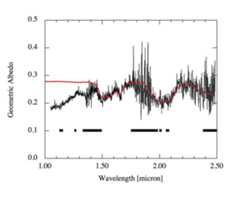
Thecrystallinity of the ice indicates something about the temperaturehistory of the ice.
The surface temperature of Quaoar is only 50 K(-220 C) and, at these low temperatures, the thermodynamicallypreferred form of ice is amorphous (meaning "structureless": the watermolecules freeze where they stick in a jumbled pattern). Our Subaru spectrumshows instead that the ice is crystalline (from the 1.65 micron absorptionband, which is weak or absent in amorphous ice). Crystalline ice, in which the water molecules are arranged in a regularlattice-like pattern, indicates formation at temperatures in excess of110 K (about -160 C). Our datashow that the ice on Quaoar has at some time been raised intemperature above 110 K, the critical temperature for transformationfrom amorphous to crystalline.
Two ways to heat the ice are 1) toform it at temperatures above 110 K, presumably beneath the frigidsurface, and then somehow expose it to view from Earth. Warm ice couldbe excavated by impact from deeper layers, or blown onto the surface bylow-level cryovolcanic outgassing through vents. 2) Ice on the surfacecould be heated above 110 K by micrometeorite impact.
The extra wrinkle is that crystalline ice, however it came to beemplaced on the surface of Quaoar, is itself unstable. Bombardment byenergetic particles from the solar wind and by cosmic rays breaks thebonds between molecules in the crystalline lattice producing amorphousice. The timescale for this "back-conversion" of crystalline toamorphous ice is uncertain but probably on the order of 10 Myr for thesurface ice. 10 Myr is effectively "yesterday" compared to the 4500Myr age of the solar system. This means that whatever process emplacesthe crystalline ice (basically either impact gardening or cryovolcanicoutgassing) has been active in the immediate past and, indeed, isprobably still active.
A two-step scenario seems plausible. First, buried ice is heated byradiogenic decay in the interior of Quaoar. Ammonia in the icesdepresses the melting temperature and crystalline water exudes onto thesurface, much as we have seen in Voyager images of the icy (andcrystalline) satellites of Uranus (e.g. 480 km diameterMiranda). This probably happened billions ofyears ago when radioactivity was a little stronger than it is now.Second, some resurfacing process (impact gardening or burps of gas withentrained ice crystals percolating to the surface) replenishes theoptical surface on a much shorter (<10 Myr) timescale, erasingthe destructive effects of energetic particle bombardment.
While the interpretation remains speculative, the good news is thatwe are, for the first time, able to take useful spectra that reveal unexpected and intriguing properties of the surface of distant Quaoar.
TheNature paper islinked here as a pdf file.
An associated"News and Views" riff on this paper by Dave Stevenson.
Some notes about how to pronounce Quaoar arehere.
[8]ページ先頭