#include <selfmt.h>
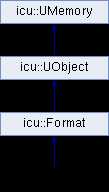
Public Member Functions | |
| SelectFormat (constUnicodeString &pattern,UErrorCode &status) | |
Creates a newSelectFormat for a given pattern string.More... | |
| SelectFormat (constSelectFormat &other) | |
| copy constructor.More... | |
| virtual | ~SelectFormat () |
| Destructor.More... | |
| void | applyPattern (constUnicodeString &pattern,UErrorCode &status) |
| Sets the pattern used by this select format.More... | |
| UnicodeString & | format (constUnicodeString &keyword,UnicodeString &appendTo,FieldPosition &pos,UErrorCode &status) const |
| Selects the phrase for the given keyword.More... | |
| SelectFormat & | operator= (constSelectFormat &other) |
| Assignment operator.More... | |
| virtual bool | operator== (constFormat &other) const override |
| Return true if another object is semantically equal to this one.More... | |
| virtual bool | operator!= (constFormat &other) const |
| Return true if another object is semantically unequal to this one.More... | |
| virtualSelectFormat * | clone () const override |
| Clones thisFormat object polymorphically.More... | |
| UnicodeString & | format (constFormattable &obj,UnicodeString &appendTo,FieldPosition &pos,UErrorCode &status) const override |
| Format an object to produce a string.More... | |
| UnicodeString & | toPattern (UnicodeString &appendTo) |
| Returns the pattern fromapplyPattern() or constructor.More... | |
| virtual void | parseObject (constUnicodeString &source,Formattable &result,ParsePosition &parse_pos) const override |
This method is not yet supported bySelectFormat.More... | |
| virtualUClassID | getDynamicClassID () const override |
| ICU "poor man's RTTI", returns a UClassID for the actual class.More... | |
| U_I18N_APIUnicodeString & | format (constFormattable &obj,UnicodeString &appendTo,UErrorCode &status) const |
| Formats an object to produce a string.More... | |
| virtualU_I18N_APIUnicodeString & | format (constFormattable &obj,UnicodeString &appendTo,FieldPosition &pos,UErrorCode &status) const=0 |
| Format an object to produce a string.More... | |
| virtualU_I18N_APIUnicodeString & | format (constFormattable &obj,UnicodeString &appendTo,FieldPositionIterator *posIter,UErrorCode &status) const |
| Format an object to produce a string.More... | |
 Public Member Functions inherited fromicu::Format Public Member Functions inherited fromicu::Format | |
| virtualU_I18N_API | ~Format () |
| Destructor.More... | |
| U_I18N_API bool | operator!= (constFormat &other) const |
| Return true if the givenFormat objects are not semantically equal.More... | |
| U_I18N_APIUnicodeString & | format (constFormattable &obj,UnicodeString &appendTo,UErrorCode &status) const |
| Formats an object to produce a string.More... | |
| virtualU_I18N_APIUnicodeString & | format (constFormattable &obj,UnicodeString &appendTo,FieldPositionIterator *posIter,UErrorCode &status) const |
| Format an object to produce a string.More... | |
| U_I18N_API void | parseObject (constUnicodeString &source,Formattable &result,UErrorCode &status) const |
| Parses a string to produce an object.More... | |
| U_I18N_APILocale | getLocale (ULocDataLocaleType type,UErrorCode &status) const |
| Get the locale for this format object.More... | |
| U_I18N_API const char * | getLocaleID (ULocDataLocaleType type,UErrorCode &status) const |
| Get the locale for this format object.More... | |
| Public Member Functions inherited fromicu::UObject | |
| virtual | ~UObject () |
| Destructor.More... | |
Static Public Member Functions | |
| staticUClassID | getStaticClassID () |
| ICU "poor man's RTTI", returns a UClassID for this class.More... | |
Friends | |
| class | MessageFormat |
Additional Inherited Members | |
| Protected Member Functions inherited fromicu::Format | |
| U_I18N_API void | setLocaleIDs (const char *valid, const char *actual) |
| U_I18N_API | Format () |
| Default constructor for subclass use only.More... | |
| U_I18N_API | Format (constFormat &) |
| U_I18N_APIFormat & | operator= (constFormat &) |
| Static Protected Member Functions inherited fromicu::Format | |
| staticU_I18N_API void | syntaxError (constUnicodeString &pattern, int32_t pos,UParseError &parseError) |
| Simple function for initializing aUParseError from aUnicodeString.More... | |
Detailed Description
SelectFormat supports the creation of internationalized messages by selecting phrases based on keywords. The pattern specifies how to map keywords to phrases and provides a default phrase. The object provided to the format method is a string that's matched against the keywords. If there is a match, the corresponding phrase is selected; otherwise, the default phrase is used.
UsingSelectFormat for Gender Agreement
Note: Typically, select formatting is done viaMessageFormat with aselect argument type, rather than using a stand-aloneSelectFormat.
The main use case for the select format is gender based inflection. When names or nouns are inserted into sentences, their gender can affect pronouns, verb forms, articles, and adjectives. Special care needs to be taken for the case where the gender cannot be determined. The impact varies between languages:
- English has three genders, and unknown gender is handled as a specialcase. Names use the gender of the named person (if known), nouns referringto people use natural gender, and inanimate objects are usually neutral.The gender only affects pronouns: "he", "she", "it", "they".
- German differs from English in that the gender of nouns is ratherarbitrary, even for nouns referring to people ("Mädchen", girl, is neutral).The gender affects pronouns ("er", "sie", "es"), articles ("der", "die","das"), and adjective forms ("guter Mann", "gute Frau", "gutes Mädchen").
- French has only two genders; as in German the gender of nounsis rather arbitrary - for sun and moon, the gendersare the opposite of those in German. The gender affectspronouns ("il", "elle"), articles ("le", "la"),adjective forms ("bon", "bonne"), and sometimesverb forms ("allé", "allée").
- Polish distinguishes five genders (or noun classes),human masculine, animate non-human masculine, inanimate masculine,feminine, and neuter.
Some other languages have noun classes that are not related to gender, but similar in grammatical use. Some African languages have around 20 noun classes.
Note:For the gender of aperson in a given sentence, we usually need to distinguish only between female, male and other/unknown.
To enable localizers to create sentence patterns that take their language's gender dependencies into consideration, software has to provide information about the gender associated with a noun or name toMessageFormat. Two main cases can be distinguished:
For people, natural gender information should be maintained for each person. Keywords like "male", "female", "mixed" (for groups of people) and "unknown" could be used.
- For nouns, grammatical gender information should be maintained for each noun and per language, e.g., in resource bundles. The keywords "masculine", "feminine", and "neuter" are commonly used, but some languages may require other keywords.
The resulting keyword is provided toMessageFormat as a parameter separate from the name or noun it's associated with. For example, to generate a message such as "Jean went to Paris", three separate arguments would be provided: The name of the person as argument 0, the gender of the person as argument 1, and the name of the city as argument 2. The sentence pattern for English, where the gender of the person has no impact on this simple sentence, would not refer to argument 1 at all:
{0} went to {2}.Note: The entire sentence should be included (and partially repeated) inside each phrase. Otherwise translators would have to be trained on how to move bits of the sentence in and out of the select argument of a message. (The examples below do not follow this recommendation!)
The sentence pattern for French, where the gender of the person affects the form of the participle, uses a select format based on argument 1:
{0} est {1, select, female {allée} other {allé}} à {2}.Patterns can be nested, so that it's possible to handle interactions of number and gender where necessary. For example, if the above sentence should allow for the names of several people to be inserted, the following sentence pattern can be used (with argument 0 the list of people's names, argument 1 the number of people, argument 2 their combined gender, and argument 3 the city name):
{0} {1, plural, one {est {2, select, female {allée} other {allé}}} other {sont {2, select, female {allées} other {allés}}} }à {3}.Patterns and Their Interpretation
TheSelectFormat pattern string defines the phrase output for each user-defined keyword. The pattern is a sequence of (keyword, message) pairs. A keyword is a "pattern identifier": [^[[:Pattern_Syntax:][:Pattern_White_Space:]]]+
Each message is aMessageFormat pattern string enclosed in {curly braces}.
You always have to define a phrase for the default keywordother; this phrase is returned when the keyword provided to theformat method matches no other keyword. If a pattern does not provide a phrase forother, the method it's provided to returns the errorU_DEFAULT_KEYWORD_MISSING.
Pattern_White_Space between keywords and messages is ignored. Pattern_White_Space within a message is preserved and output.
Example: UErrorCode status = U_ZERO_ERROR;MessageFormat *msgFmt = new MessageFormat(UnicodeString("{0} est {1, select, female {allée} other {allé}} à Paris."), Locale("fr"), status);if (U_FAILURE(status)) { return;}FieldPosition ignore(FieldPosition::DONT_CARE);UnicodeString result;char* str1= "Kirti,female";Formattable args1[] = {"Kirti","female"};msgFmt->format(args1, 2, result, ignore, status);cout<< "Input is "<< str1<< " and result is: "<< result<< endl;delete msgFmt;Produces the output:Kirti est allée à Paris.
- Stable:
- ICU 4.4
Constructor & Destructor Documentation
◆ SelectFormat()[1/2]
| icu::SelectFormat::SelectFormat | ( | constUnicodeString & | pattern, |
| UErrorCode & | status | ||
| ) |
Creates a newSelectFormat for a given pattern string.
- Parameters
pattern the pattern for this SelectFormat. errors are returned to status if the pattern is invalid.status output param set to success/failure code on exit, which must not indicate a failure before the function call.
- Stable:
- ICU 4.4
◆ SelectFormat()[2/2]
| icu::SelectFormat::SelectFormat | ( | constSelectFormat & | other | ) |
copy constructor.
- Stable:
- ICU 4.4
◆ ~SelectFormat()
| virtual |
Destructor.
- Stable:
- ICU 4.4
Member Function Documentation
◆ applyPattern()
| void icu::SelectFormat::applyPattern | ( | constUnicodeString & | pattern, |
| UErrorCode & | status | ||
| ) |
Sets the pattern used by this select format.
for the keyword rules. Patterns and their interpretation are specified in the class description.
- Parameters
pattern the pattern for this select format errors are returned to status if the pattern is invalid. status output param set to success/failure code on exit, which must not indicate a failure before the function call.
- Stable:
- ICU 4.4
◆ clone()
| overridevirtual |
Clones thisFormat object polymorphically.
The caller owns the result and should delete it when done.
- Stable:
- ICU 4.4
Implementsicu::Format.
◆ format()[1/5]
| overridevirtual |
Format an object to produce a string.
This method handles keyword strings. If theFormattable object is not aUnicodeString, then it returns a failing UErrorCode.
- Parameters
obj A keyword string that is used to select an alternative. appendTo output parameter to receive result. Result is appended to existing contents. pos On input: an alignment field, if desired. On output: the offsets of the alignment field. status output param filled with success/failure status.
- Returns
- Reference to 'appendTo' parameter.
- Stable:
- ICU 4.4
Implementsicu::Format.
◆ format()[2/5]
| virtualU_I18N_APIUnicodeString& icu::Format::format |
Format an object to produce a string.
This is a pure virtual method which subclasses must implement. This method allows polymorphic formatting ofFormattable objects. If a subclass ofFormat receives aFormattable object type it doesn't handle (e.g., if a numericFormattable is passed to aDateFormat object) then it returns a failing UErrorCode.
- Parameters
obj The object to format. appendTo Output parameter to receive result. Result is appended to existing contents. pos On input: an alignment field, if desired. On output: the offsets of the alignment field. status Output param filled with success/failure status.
- Returns
- Reference to 'appendTo' parameter.
- Stable:
- ICU 2.0
◆ format()[3/5]
| virtualU_I18N_APIUnicodeString& icu::Format::format |
Format an object to produce a string.
Subclasses should override this method. This method allows polymorphic formatting ofFormattable objects. If a subclass ofFormat receives aFormattable object type it doesn't handle (e.g., if a numericFormattable is passed to aDateFormat object) then it returns a failing UErrorCode.
- Parameters
obj The object to format. appendTo Output parameter to receive result. Result is appended to existing contents. posIter On return, can be used to iterate over positions of fields generated by this format call. status Output param filled with success/failure status.
- Returns
- Reference to 'appendTo' parameter.
- Stable:
- ICU 4.4
◆ format()[4/5]
| U_I18N_APIUnicodeString& icu::Format::format |
Formats an object to produce a string.
- Parameters
obj The object to format. appendTo Output parameter to receive result. Result is appended to existing contents. status Output parameter filled in with success or failure status.
- Returns
- Reference to 'appendTo' parameter.
- Stable:
- ICU 2.0
◆ format()[5/5]
| UnicodeString& icu::SelectFormat::format | ( | constUnicodeString & | keyword, |
| UnicodeString & | appendTo, | ||
| FieldPosition & | pos, | ||
| UErrorCode & | status | ||
| ) | const |
Selects the phrase for the given keyword.
- Parameters
keyword The keyword that is used to select an alternative. appendTo output parameter to receive result. result is appended to existing contents. pos On input: an alignment field, if desired. On output: the offsets of the alignment field. status output param set to success/failure code on exit, which must not indicate a failure before the function call.
- Returns
- Reference to 'appendTo' parameter.
- Stable:
- ICU 4.4
◆ getDynamicClassID()
| overridevirtual |
ICU "poor man's RTTI", returns a UClassID for the actual class.
- Stable:
- ICU 4.4
Reimplemented fromicu::UObject.
◆ getStaticClassID()
| static |
ICU "poor man's RTTI", returns a UClassID for this class.
- Stable:
- ICU 4.4
◆ operator!=()
| virtual |
Return true if another object is semantically unequal to this one.
- Parameters
other theSelectFormat object to be compared with.
- Returns
- true if other is semantically unequal to this.
- Stable:
- ICU 4.4
◆ operator=()
| SelectFormat& icu::SelectFormat::operator= | ( | constSelectFormat & | other | ) |
◆ operator==()
| overridevirtual |
Return true if another object is semantically equal to this one.
- Parameters
other theSelectFormat object to be compared with.
- Returns
- true if other is semantically equal to this.
- Stable:
- ICU 4.4
Implementsicu::Format.
◆ parseObject()
| overridevirtual |
This method is not yet supported bySelectFormat.
Before calling, set parse_pos.index to the offset you want to start parsing at in the source. After calling, parse_pos.index is the end of the text you parsed. If error occurs, index is unchanged.
When parsing, leading whitespace is discarded (with a successful parse), while trailing whitespace is left as is.
SeeFormat::parseObject() for more.
- Parameters
source The string to be parsed into an object. result Formattable to be set to the parse result. If parse fails, return contents are undefined. parse_pos The position to start parsing at. Upon return this param is set to the position after the last character successfully parsed. If the source is not parsed successfully, this param will remain unchanged.
- Stable:
- ICU 4.4
Implementsicu::Format.
◆ toPattern()
| UnicodeString& icu::SelectFormat::toPattern | ( | UnicodeString & | appendTo | ) |
Returns the pattern fromapplyPattern() or constructor.
- Parameters
appendTo output parameter to receive result. Result is appended to existing contents.
- Returns
- theUnicodeString with inserted pattern.
- Stable:
- ICU 4.4
The documentation for this class was generated from the following file:
- i18n/unicode/selfmt.h
