DateFormat is an abstract class for a family of classes that convert dates and times from their internal representations to textual form and back again in a language-independent manner.More...
#include <datefmt.h>
Public Types | |
| enum | EStyle { kNone = -1,kFull = 0,kLong = 1,kMedium = 2, kShort = 3,kDateOffset = kShort + 1,kDateTime = 8,kDateTimeOffset = kDateTime + 1, kRelative = (1 << 7),kFullRelative = (kFull | kRelative),kLongRelative = kLong | kRelative,kMediumRelative = kMedium | kRelative, kShortRelative = kShort | kRelative,kDefault = kMedium,FULL = kFull,LONG = kLong, MEDIUM = kMedium,SHORT = kShort,DEFAULT = kDefault,DATE_OFFSET = kDateOffset, NONE = kNone,DATE_TIME = kDateTime } |
| Constants for various style patterns.More... | |
| enum | EField { kEraField = UDAT_ERA_FIELD,kYearField = UDAT_YEAR_FIELD,kMonthField = UDAT_MONTH_FIELD,kDateField = UDAT_DATE_FIELD, kHourOfDay1Field = UDAT_HOUR_OF_DAY1_FIELD,kHourOfDay0Field = UDAT_HOUR_OF_DAY0_FIELD,kMinuteField = UDAT_MINUTE_FIELD,kSecondField = UDAT_SECOND_FIELD, kMillisecondField = UDAT_FRACTIONAL_SECOND_FIELD,kDayOfWeekField = UDAT_DAY_OF_WEEK_FIELD,kDayOfYearField = UDAT_DAY_OF_YEAR_FIELD,kDayOfWeekInMonthField = UDAT_DAY_OF_WEEK_IN_MONTH_FIELD, kWeekOfYearField = UDAT_WEEK_OF_YEAR_FIELD,kWeekOfMonthField = UDAT_WEEK_OF_MONTH_FIELD,kAmPmField = UDAT_AM_PM_FIELD,kHour1Field = UDAT_HOUR1_FIELD, kHour0Field = UDAT_HOUR0_FIELD,kTimezoneField = UDAT_TIMEZONE_FIELD,kYearWOYField = UDAT_YEAR_WOY_FIELD,kDOWLocalField = UDAT_DOW_LOCAL_FIELD, kExtendedYearField = UDAT_EXTENDED_YEAR_FIELD,kJulianDayField = UDAT_JULIAN_DAY_FIELD,kMillisecondsInDayField = UDAT_MILLISECONDS_IN_DAY_FIELD,ERA_FIELD = UDAT_ERA_FIELD, YEAR_FIELD = UDAT_YEAR_FIELD,MONTH_FIELD = UDAT_MONTH_FIELD,DATE_FIELD = UDAT_DATE_FIELD,HOUR_OF_DAY1_FIELD = UDAT_HOUR_OF_DAY1_FIELD, HOUR_OF_DAY0_FIELD = UDAT_HOUR_OF_DAY0_FIELD,MINUTE_FIELD = UDAT_MINUTE_FIELD,SECOND_FIELD = UDAT_SECOND_FIELD,MILLISECOND_FIELD = UDAT_FRACTIONAL_SECOND_FIELD, DAY_OF_WEEK_FIELD = UDAT_DAY_OF_WEEK_FIELD,DAY_OF_YEAR_FIELD = UDAT_DAY_OF_YEAR_FIELD,DAY_OF_WEEK_IN_MONTH_FIELD = UDAT_DAY_OF_WEEK_IN_MONTH_FIELD,WEEK_OF_YEAR_FIELD = UDAT_WEEK_OF_YEAR_FIELD, WEEK_OF_MONTH_FIELD = UDAT_WEEK_OF_MONTH_FIELD,AM_PM_FIELD = UDAT_AM_PM_FIELD,HOUR1_FIELD = UDAT_HOUR1_FIELD,HOUR0_FIELD = UDAT_HOUR0_FIELD, TIMEZONE_FIELD = UDAT_TIMEZONE_FIELD } |
| Field selector forFieldPosition forDateFormat fields.More... | |
Public Member Functions | |
| virtualU_I18N_API | ~DateFormat () |
| Destructor.More... | |
| virtualU_I18N_APIDateFormat * | clone () const override=0 |
| Clones this object polymorphically.More... | |
| virtualU_I18N_API bool | operator== (constFormat &) const override |
| Equality operator.More... | |
| virtualU_I18N_APIUnicodeString & | format (constFormattable &obj,UnicodeString &appendTo,FieldPosition &pos,UErrorCode &status) const override |
| Format an object to produce a string.More... | |
| virtualU_I18N_APIUnicodeString & | format (constFormattable &obj,UnicodeString &appendTo,FieldPositionIterator *posIter,UErrorCode &status) const override |
| Format an object to produce a string.More... | |
| virtualU_I18N_APIUnicodeString & | format (Calendar &cal,UnicodeString &appendTo,FieldPosition &fieldPosition) const =0 |
| Formats a date into a date/time string.More... | |
| virtualU_I18N_APIUnicodeString & | format (Calendar &cal,UnicodeString &appendTo,FieldPositionIterator *posIter,UErrorCode &status) const |
| Formats a date into a date/time string.More... | |
| U_I18N_APIUnicodeString & | format (UDate date,UnicodeString &appendTo,FieldPosition &fieldPosition) const |
| Formats a UDate into a date/time string.More... | |
| U_I18N_APIUnicodeString & | format (UDate date,UnicodeString &appendTo,FieldPositionIterator *posIter,UErrorCode &status) const |
| Formats a UDate into a date/time string.More... | |
| U_I18N_APIUnicodeString & | format (UDate date,UnicodeString &appendTo) const |
| Formats a UDate into a date/time string.More... | |
| virtualU_I18N_APIUDate | parse (constUnicodeString &text,UErrorCode &status) const |
| Parse a date/time string.More... | |
| virtualU_I18N_API void | parse (constUnicodeString &text,Calendar &cal,ParsePosition &pos) const =0 |
| Parse a date/time string beginning at the given parse position.More... | |
| U_I18N_APIUDate | parse (constUnicodeString &text,ParsePosition &pos) const |
| Parse a date/time string beginning at the given parse position.More... | |
| virtualU_I18N_API void | parseObject (constUnicodeString &source,Formattable &result,ParsePosition &parse_pos) const override |
| Parse a string to produce an object.More... | |
| virtualU_I18N_APIUBool | isLenient () const |
| Returns whether both date/time parsing in the encapsulatedCalendar object andDateFormat whitespace & numeric processing is lenient.More... | |
| virtualU_I18N_API void | setLenient (UBool lenient) |
| Specifies whether date/time parsing is to be lenient.More... | |
| virtualU_I18N_APIUBool | isCalendarLenient () const |
| Returns whether date/time parsing in the encapsulatedCalendar object processing is lenient.More... | |
| virtualU_I18N_API void | setCalendarLenient (UBool lenient) |
| Specifies whether encapsulatedCalendar date/time parsing is to be lenient.More... | |
| virtualU_I18N_API constCalendar * | getCalendar () const |
| Gets the calendar associated with this date/time formatter.More... | |
| virtualU_I18N_API void | adoptCalendar (Calendar *calendarToAdopt) |
| Set the calendar to be used by this date format.More... | |
| virtualU_I18N_API void | setCalendar (constCalendar &newCalendar) |
| Set the calendar to be used by this date format.More... | |
| virtualU_I18N_API constNumberFormat * | getNumberFormat () const |
| Gets the number formatter which this date/time formatter uses to format and parse the numeric portions of the pattern.More... | |
| virtualU_I18N_API void | adoptNumberFormat (NumberFormat *formatToAdopt) |
| Allows you to set the number formatter.More... | |
| virtualU_I18N_API void | setNumberFormat (constNumberFormat &newNumberFormat) |
| Allows you to set the number formatter.More... | |
| virtualU_I18N_API constTimeZone & | getTimeZone () const |
| Returns a reference to theTimeZone used by thisDateFormat's calendar.More... | |
| virtualU_I18N_API void | adoptTimeZone (TimeZone *zoneToAdopt) |
| Sets the time zone for the calendar of thisDateFormat object.More... | |
| virtualU_I18N_API void | setTimeZone (constTimeZone &zone) |
| Sets the time zone for the calendar of thisDateFormat object.More... | |
| virtualU_I18N_API void | setContext (UDisplayContext value,UErrorCode &status) |
| Set a particular UDisplayContext value in the formatter, such as UDISPCTX_CAPITALIZATION_FOR_STANDALONE.More... | |
| virtualU_I18N_APIUDisplayContext | getContext (UDisplayContextType type,UErrorCode &status) const |
| Get the formatter's UDisplayContext value for the specified UDisplayContextType, such as UDISPCTX_TYPE_CAPITALIZATION.More... | |
| virtualU_I18N_APIDateFormat & | setBooleanAttribute (UDateFormatBooleanAttribute attr,UBool newvalue,UErrorCode &status) |
| Sets an boolean attribute on thisDateFormat.More... | |
| virtualU_I18N_APIUBool | getBooleanAttribute (UDateFormatBooleanAttribute attr,UErrorCode &status) const |
| Returns a boolean from thisDateFormat May return U_UNSUPPORTED_ERROR if this instance does not support the specified attribute.More... | |
| U_I18N_APIUnicodeString & | format (constFormattable &obj,UnicodeString &appendTo,UErrorCode &status) const |
| Formats an object to produce a string.More... | |
| virtualU_I18N_APIUnicodeString & | format (constFormattable &obj,UnicodeString &appendTo,FieldPosition &pos,UErrorCode &status) const=0 |
| Format an object to produce a string.More... | |
| virtualU_I18N_APIUnicodeString & | format (constFormattable &obj,UnicodeString &appendTo,FieldPositionIterator *posIter,UErrorCode &status) const |
| Format an object to produce a string.More... | |
 Public Member Functions inherited fromicu::Format Public Member Functions inherited fromicu::Format | |
| virtualU_I18N_API | ~Format () |
| Destructor.More... | |
| U_I18N_API bool | operator!= (constFormat &other) const |
| Return true if the givenFormat objects are not semantically equal.More... | |
| U_I18N_APIUnicodeString & | format (constFormattable &obj,UnicodeString &appendTo,UErrorCode &status) const |
| Formats an object to produce a string.More... | |
| U_I18N_API void | parseObject (constUnicodeString &source,Formattable &result,UErrorCode &status) const |
| Parses a string to produce an object.More... | |
| U_I18N_APILocale | getLocale (ULocDataLocaleType type,UErrorCode &status) const |
| Get the locale for this format object.More... | |
| U_I18N_API const char * | getLocaleID (ULocDataLocaleType type,UErrorCode &status) const |
| Get the locale for this format object.More... | |
| Public Member Functions inherited fromicu::UObject | |
| virtual | ~UObject () |
| Destructor.More... | |
| virtualUClassID | getDynamicClassID () const |
| ICU4C "poor man's RTTI", returns a UClassID for the actual ICU class.More... | |
Static Public Member Functions | |
| staticU_I18N_APIDateFormat * | createInstance () |
| Create a default date/time formatter that uses the SHORT style for both the date and the time.More... | |
| staticU_I18N_APIDateFormat * | createTimeInstance (EStyle style=kDefault, constLocale &aLocale=Locale::getDefault()) |
| Creates a time formatter with the given formatting style for the given locale.More... | |
| staticU_I18N_APIDateFormat * | createDateInstance (EStyle style=kDefault, constLocale &aLocale=Locale::getDefault()) |
| Creates a date formatter with the given formatting style for the given const locale.More... | |
| staticU_I18N_APIDateFormat * | createDateTimeInstance (EStyle dateStyle=kDefault,EStyle timeStyle=kDefault, constLocale &aLocale=Locale::getDefault()) |
| Creates a date/time formatter with the given formatting styles for the given locale.More... | |
| staticU_I18N_APIUnicodeString | getBestPattern (constLocale &locale, constUnicodeString &skeleton,UErrorCode &status) |
| Returns the best pattern given a skeleton and locale.More... | |
| staticU_I18N_APIDateFormat * | createInstanceForSkeleton (constUnicodeString &skeleton,UErrorCode &status) |
| Creates a date/time formatter for the given skeleton and default locale.More... | |
| staticU_I18N_APIDateFormat * | createInstanceForSkeleton (constUnicodeString &skeleton, constLocale &locale,UErrorCode &status) |
| Creates a date/time formatter for the given skeleton and locale.More... | |
| staticU_I18N_APIDateFormat * | createInstanceForSkeleton (Calendar *calendarToAdopt, constUnicodeString &skeleton, constLocale &locale,UErrorCode &status) |
| Creates a date/time formatter for the given skeleton and locale.More... | |
| staticU_I18N_API constLocale * | getAvailableLocales (int32_t &count) |
| Gets the set of locales for which DateFormats are installed.More... | |
Protected Member Functions | |
| U_I18N_API | DateFormat () |
| Default constructor.More... | |
| U_I18N_API | DateFormat (constDateFormat &) |
| Copy constructor.More... | |
| U_I18N_APIDateFormat & | operator= (constDateFormat &) |
| Default assignment operator.More... | |
| Protected Member Functions inherited fromicu::Format | |
| U_I18N_API void | setLocaleIDs (const char *valid, const char *actual) |
| U_I18N_API | Format () |
| Default constructor for subclass use only.More... | |
| U_I18N_API | Format (constFormat &) |
| U_I18N_APIFormat & | operator= (constFormat &) |
Protected Attributes | |
| Calendar * | fCalendar |
| The calendar thatDateFormat uses to produce the time field values needed to implement date/time formatting.More... | |
| NumberFormat * | fNumberFormat |
| The number formatter thatDateFormat uses to format numbers in dates and times.More... | |
Friends | |
| class | DateFmtKeyByStyle |
Additional Inherited Members | |
| Static Protected Member Functions inherited fromicu::Format | |
| staticU_I18N_API void | syntaxError (constUnicodeString &pattern, int32_t pos,UParseError &parseError) |
| Simple function for initializing aUParseError from aUnicodeString.More... | |
Detailed Description
DateFormat is an abstract class for a family of classes that convert dates and times from their internal representations to textual form and back again in a language-independent manner.
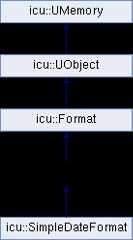
Converting from the internal representation (milliseconds since midnight, January 1, 1970) to text is known as "formatting," and converting from text to millis is known as "parsing." We currently define only one concrete subclass ofDateFormat:SimpleDateFormat, which can handle pretty much all normal date formatting and parsing actions.
DateFormat helps you to format and parse dates for any locale. Your code can be completely independent of the locale conventions for months, days of the week, or even the calendar format: lunar vs. solar.
To format a date for the currentLocale, use one of the static factory methods:
DateFormat* dfmt =DateFormat::createDateInstance();UDate myDate =Calendar::getNow();UnicodeString myString;myString = dfmt->format( myDate, myString );static U_I18N_API UDate getNow()Returns the current UTC (GMT) time measured in milliseconds since 0:00:00 on 1/1/70 (derived from the...static U_I18N_API DateFormat * createDateInstance(EStyle style=kDefault, const Locale &aLocale=Locale::getDefault())Creates a date formatter with the given formatting style for the given const locale.
If you are formatting multiple numbers, it is more efficient to get the format and use it multiple times so that the system doesn't have to fetch the information about the local language and country conventions multiple times.
UnicodeString myString;UDate myDateArr[] = { 0.0, 100000000.0, 2000000000.0 };// test valuesfor (int32_t i = 0; i < 3; ++i) {myString.remove();cout << df->format( myDateArr[i], myString ) << endl;}
To get specific fields of a date, you can useUFieldPosition to get specific fields.
DateFormat* dfmt =DateFormat::createDateInstance();FieldPosition pos(DateFormat::YEAR_FIELD);UnicodeString myString;myString = dfmt->format( myDate, myString );cout << myString << endl;cout << pos.getBeginIndex() <<"," << pos. getEndIndex() << endl;
To format a date for a differentLocale, specify it in the call tocreateDateInstance().
DateFormat* df =DateFormat::createDateInstance( DateFormat::SHORT,Locale::getFrance());static U_COMMON_API const Locale & getFrance()Useful constant for this country/region.
You can use aDateFormat to parse also.
UErrorCode status =U_ZERO_ERROR;UDate myDate = df->parse(myString, status);
UsecreateDateInstance() to produce the normal date format for that country. There are other static factory methods available. UsecreateTimeInstance() to produce the normal time format for that country. UsecreateDateTimeInstance() to produce aDateFormat that formats both date and time. You can pass in different options to these factory methods to control the length of the result; from SHORT to MEDIUM to LONG to FULL. The exact result depends on the locale, but generally:
- SHORT is completely numeric, such as 12/13/52 or 3:30pm
- MEDIUM is longer, such as Jan 12, 1952
- LONG is longer, such as January 12, 1952 or 3:30:32pm
- FULL is pretty completely specified, such as Tuesday, April 12, 1952 AD or 3:30:42pm PST.
You can also set the time zone on the format if you wish. If you want even more control over the format or parsing, (or want to give your users more control), you can try casting theDateFormat you get from the factory methods to aSimpleDateFormat. This will work for the majority of countries; just remember to checkgetDynamicClassID() before carrying out the cast.
You can also use forms of the parse and format methods withParsePosition andFieldPosition to allow you to
- Progressively parse through pieces of a string.
- Align any particular field, or find out where it is for selection on the screen.
User subclasses are not supported. While clients may write subclasses, such code will not necessarily work and will not be guaranteed to work stably from release to release.
Member Enumeration Documentation
◆ EField
Field selector forFieldPosition forDateFormat fields.
- Obsolete:
- ICU 3.4 use UDateFormatField instead, since this API will be removed in that release
◆ EStyle
Constants for various style patterns.
These reflect the order of items in the DateTimePatterns resource. There are 4 time patterns, 4 date patterns, the default date-time pattern, and 4 date-time patterns. Each block of 4 values in the resource occurs in the order full, long, medium, short.
- Stable:
- ICU 2.4
| Enumerator | |
|---|---|
| FULL | These constants are provided for backwards compatibility only. Please use the C++ style constants defined above. |
Constructor & Destructor Documentation
◆ ~DateFormat()
| virtual |
Destructor.
- Stable:
- ICU 2.0
◆ DateFormat()[1/2]
| protected |
Default constructor.
Creates aDateFormat with noCalendar orNumberFormat associated with it. This constructor depends on the subclasses to fill in the calendar and numberFormat fields.
- Stable:
- ICU 2.0
◆ DateFormat()[2/2]
| protected |
Copy constructor.
- Stable:
- ICU 2.0
Member Function Documentation
◆ adoptCalendar()
| virtual |
Set the calendar to be used by this date format.
Initially, the default calendar for the specified or default locale is used. The caller should not delete theCalendar object after it is adopted by this call. Adopting a new calendar will change to the default symbols.
- Parameters
calendarToAdopt Calendar object to be adopted.
- Stable:
- ICU 2.0
Reimplemented inicu::SimpleDateFormat.
◆ adoptNumberFormat()
| virtual |
Allows you to set the number formatter.
The caller should not delete theNumberFormat object after it is adopted by this call.
- Parameters
formatToAdopt NumberFormat object to be adopted.
- Stable:
- ICU 2.0
Reimplemented inicu::SimpleDateFormat.
◆ adoptTimeZone()
| virtual |
Sets the time zone for the calendar of thisDateFormat object.
The caller no longer owns theTimeZone object and should not delete it after this call.
- Parameters
zoneToAdopt theTimeZone to be adopted.
- Stable:
- ICU 2.0
◆ clone()
| overridepure virtual |
Clones this object polymorphically.
The caller owns the result and should delete it when done.
- Returns
- clone, or nullptr if an error occurred
- Stable:
- ICU 2.0
Implementsicu::Format.
Implemented inicu::SimpleDateFormat.
◆ createDateInstance()
| static |
Creates a date formatter with the given formatting style for the given const locale.
- Parameters
style The given formatting style. For example, SHORT for "M/d/yy" in the US locale. As currently implemented, relative date formatting only affects a limited range of calendar days before or after the current date, based on the CLDR <field type="day">/<relative> data: For example, in English, "Yesterday", "Today", and "Tomorrow". Outside of this range, dates are formatted using the corresponding non-relative style. aLocale The given locale.
- Returns
- A date formatter which the caller owns.
- Stable:
- ICU 2.0
◆ createDateTimeInstance()
| static |
Creates a date/time formatter with the given formatting styles for the given locale.
- Parameters
dateStyle The given formatting style for the date portion of the result. For example, SHORT for "M/d/yy" in the US locale. As currently implemented, relative date formatting only affects a limited range of calendar days before or after the current date, based on the CLDR <field type="day">/<relative> data: For example, in English, "Yesterday", "Today", and "Tomorrow". Outside of this range, dates are formatted using the corresponding non-relative style. timeStyle The given formatting style for the time portion of the result. For example, SHORT for "h:mm a" in the US locale. Relative time styles are not currently supported. aLocale The given locale.
- Returns
- A date/time formatter which the caller owns.
- Stable:
- ICU 2.0
◆ createInstance()
| static |
Create a default date/time formatter that uses the SHORT style for both the date and the time.
- Returns
- A date/time formatter which the caller owns.
- Stable:
- ICU 2.0
◆ createInstanceForSkeleton()[1/3]
| static |
Creates a date/time formatter for the given skeleton and locale.
- Parameters
calendarToAdopt the calendar returnedDateFormat is to use. skeleton The skeleton e.g "yMMMMd." Fields in the skeleton can be in any order, and this method uses the locale to map the skeleton to a pattern that includes locale specific separators with the fields in the appropriate order for that locale. locale The given locale. status Any error returned here.
- Returns
- A date/time formatter which the caller owns.
- Stable:
- ICU 55
◆ createInstanceForSkeleton()[2/3]
| static |
Creates a date/time formatter for the given skeleton and locale.
- Parameters
skeleton The skeleton e.g "yMMMMd." Fields in the skeleton can be in any order, and this method uses the locale to map the skeleton to a pattern that includes locale specific separators with the fields in the appropriate order for that locale. locale The given locale. status Any error returned here.
- Returns
- A date/time formatter which the caller owns.
- Stable:
- ICU 55
◆ createInstanceForSkeleton()[3/3]
| static |
Creates a date/time formatter for the given skeleton and default locale.
- Parameters
skeleton The skeleton e.g "yMMMMd." Fields in the skeleton can be in any order, and this method uses the locale to map the skeleton to a pattern that includes locale specific separators with the fields in the appropriate order for that locale. status Any error returned here.
- Returns
- A date/time formatter which the caller owns.
- Stable:
- ICU 55
◆ createTimeInstance()
| static |
Creates a time formatter with the given formatting style for the given locale.
- Parameters
style The given formatting style. For example, SHORT for "h:mm a" in the US locale. Relative time styles are not currently supported. aLocale The given locale.
- Returns
- A time formatter which the caller owns.
- Stable:
- ICU 2.0
◆ format()[1/10]
| pure virtual |
Formats a date into a date/time string.
This is an abstract method which concrete subclasses must implement.
On input, theFieldPosition parameter may have its "field" member filled with an enum value specifying a field. On output, theFieldPosition will be filled in with the text offsets for that field.
For example, given a time text "1996.07.10 AD at 15:08:56 PDT", if the given fieldPosition.field is UDAT_YEAR_FIELD, the offsets fieldPosition.beginIndex and statfieldPositionus.getEndIndex will be set to 0 and 4, respectively.
Notice that if the same time field appears more than once in a pattern, the status will be set for the first occurrence of that time field. For instance, formatting a UDate to the time string "1 PM PDT (Pacific Daylight Time)" using the pattern "h a z (zzzz)" and the alignment field DateFormat::TIMEZONE_FIELD, the offsets fieldPosition.beginIndex and fieldPosition.getEndIndex will be set to 5 and 8, respectively, for the first occurrence of the timezone pattern character 'z'.
- Parameters
cal Calendar set to the date and time to be formatted into a date/time string. When the calendar type is different from the internal calendar held by thisDateFormat instance, the date and the time zone will be inherited from the input calendar, but other calendar field values will be calculated by the internal calendar. appendTo Output parameter to receive result. Result is appended to existing contents. fieldPosition On input: an alignment field, if desired (see examples above) On output: the offsets of the alignment field (see examples above)
- Returns
- Reference to 'appendTo' parameter.
- Stable:
- ICU 2.1
Implemented inicu::SimpleDateFormat.
◆ format()[2/10]
| virtual |
Formats a date into a date/time string.
Subclasses should implement this method.
- Parameters
cal Calendar set to the date and time to be formatted into a date/time string. When the calendar type is different from the internal calendar held by thisDateFormat instance, the date and the time zone will be inherited from the input calendar, but other calendar field values will be calculated by the internal calendar. appendTo Output parameter to receive result. Result is appended to existing contents. posIter On return, can be used to iterate over positions of fields generated by this format call. Field values are defined in UDateFormatField. Can be nullptr. status error status.
- Returns
- Reference to 'appendTo' parameter.
- Stable:
- ICU 4.4
Reimplemented inicu::SimpleDateFormat.
◆ format()[3/10]
| overridevirtual |
Format an object to produce a string.
This method handlesFormattable objects with a UDate type. If a theFormattable object type is not a Date, then it returns a failing UErrorCode.
- Parameters
obj The object to format. Must be a Date. appendTo Output parameter to receive result. Result is appended to existing contents. pos On input: an alignment field, if desired. On output: the offsets of the alignment field. status Output param filled with success/failure status.
- Returns
- Reference to 'appendTo' parameter.
- Stable:
- ICU 2.0
Implementsicu::Format.
◆ format()[4/10]
| virtualU_I18N_APIUnicodeString& icu::Format::format |
Format an object to produce a string.
This is a pure virtual method which subclasses must implement. This method allows polymorphic formatting ofFormattable objects. If a subclass ofFormat receives aFormattable object type it doesn't handle (e.g., if a numericFormattable is passed to aDateFormat object) then it returns a failing UErrorCode.
- Parameters
obj The object to format. appendTo Output parameter to receive result. Result is appended to existing contents. pos On input: an alignment field, if desired. On output: the offsets of the alignment field. status Output param filled with success/failure status.
- Returns
- Reference to 'appendTo' parameter.
- Stable:
- ICU 2.0
◆ format()[5/10]
| virtualU_I18N_APIUnicodeString& icu::Format::format |
Format an object to produce a string.
Subclasses should override this method. This method allows polymorphic formatting ofFormattable objects. If a subclass ofFormat receives aFormattable object type it doesn't handle (e.g., if a numericFormattable is passed to aDateFormat object) then it returns a failing UErrorCode.
- Parameters
obj The object to format. appendTo Output parameter to receive result. Result is appended to existing contents. posIter On return, can be used to iterate over positions of fields generated by this format call. status Output param filled with success/failure status.
- Returns
- Reference to 'appendTo' parameter.
- Stable:
- ICU 4.4
◆ format()[6/10]
| overridevirtual |
Format an object to produce a string.
This method handlesFormattable objects with a UDate type. If a theFormattable object type is not a Date, then it returns a failing UErrorCode.
- Parameters
obj The object to format. Must be a Date. appendTo Output parameter to receive result. Result is appended to existing contents. posIter On return, can be used to iterate over positions of fields generated by this format call. Field values are defined in UDateFormatField. Can be nullptr. status Output param filled with success/failure status.
- Returns
- Reference to 'appendTo' parameter.
- Stable:
- ICU 4.4
Reimplemented fromicu::Format.
◆ format()[7/10]
| U_I18N_APIUnicodeString& icu::Format::format |
Formats an object to produce a string.
- Parameters
obj The object to format. appendTo Output parameter to receive result. Result is appended to existing contents. status Output parameter filled in with success or failure status.
- Returns
- Reference to 'appendTo' parameter.
- Stable:
- ICU 2.0
◆ format()[8/10]
| U_I18N_APIUnicodeString& icu::DateFormat::format | ( | UDate | date, |
| UnicodeString & | appendTo | ||
| ) | const |
Formats a UDate into a date/time string.
If there is a problem, you won't know, using this method. Use the overloadedformat() method which takes aFieldPosition& to detect formatting problems.
- Parameters
date The UDate value to be formatted into a string. appendTo Output parameter to receive result. Result is appended to existing contents.
- Returns
- Reference to 'appendTo' parameter.
- Stable:
- ICU 2.0
◆ format()[9/10]
| U_I18N_APIUnicodeString& icu::DateFormat::format | ( | UDate | date, |
| UnicodeString & | appendTo, | ||
| FieldPosition & | fieldPosition | ||
| ) | const |
Formats a UDate into a date/time string.
On input, theFieldPosition parameter may have its "field" member filled with an enum value specifying a field. On output, theFieldPosition will be filled in with the text offsets for that field.
For example, given a time text "1996.07.10 AD at 15:08:56 PDT", if the given fieldPosition.field is UDAT_YEAR_FIELD, the offsets fieldPosition.beginIndex and statfieldPositionus.getEndIndex will be set to 0 and 4, respectively.
Notice that if the same time field appears more than once in a pattern, the status will be set for the first occurrence of that time field. For instance, formatting a UDate to the time string "1 PM PDT (Pacific Daylight Time)" using the pattern "h a z (zzzz)" and the alignment field DateFormat::TIMEZONE_FIELD, the offsets fieldPosition.beginIndex and fieldPosition.getEndIndex will be set to 5 and 8, respectively, for the first occurrence of the timezone pattern character 'z'.
- Parameters
date UDate to be formatted into a date/time string. appendTo Output parameter to receive result. Result is appended to existing contents. fieldPosition On input: an alignment field, if desired (see examples above) On output: the offsets of the alignment field (see examples above)
- Returns
- Reference to 'appendTo' parameter.
- Stable:
- ICU 2.0
◆ format()[10/10]
| U_I18N_APIUnicodeString& icu::DateFormat::format | ( | UDate | date, |
| UnicodeString & | appendTo, | ||
| FieldPositionIterator * | posIter, | ||
| UErrorCode & | status | ||
| ) | const |
Formats a UDate into a date/time string.
- Parameters
date UDate to be formatted into a date/time string. appendTo Output parameter to receive result. Result is appended to existing contents. posIter On return, can be used to iterate over positions of fields generated by this format call. Field values are defined in UDateFormatField. Can be nullptr. status error status.
- Returns
- Reference to 'appendTo' parameter.
- Stable:
- ICU 4.4
◆ getAvailableLocales()
| static |
Gets the set of locales for which DateFormats are installed.
- Parameters
count Filled in with the number of locales in the list that is returned.
- Returns
- the set of locales for which DateFormats are installed. The caller does NOT own this list and must not delete it.
- Stable:
- ICU 2.0
◆ getBestPattern()
| static |
Returns the best pattern given a skeleton and locale.
- Parameters
locale the locale skeleton the skeleton status ICU error returned here
- Returns
- the best pattern.
- Internal:
- Do not use. This API is for internal use only. For ICU use only.
◆ getBooleanAttribute()
| virtual |
Returns a boolean from thisDateFormat May return U_UNSUPPORTED_ERROR if this instance does not support the specified attribute.
- Parameters
attr the attribute to set status the error type
- Returns
- the attribute value. Undefined if there is an error.
- Stable:
- ICU 53
◆ getCalendar()
| virtual |
Gets the calendar associated with this date/time formatter.
The calendar is owned by the formatter and must not be modified. Also, the calendar does not reflect the results of a parse operation. To parse to a calendar, useparse(const UnicodeString&, Calendar& cal, ParsePosition&)
- Returns
- the calendar associated with this date/time formatter.
- Stable:
- ICU 2.0
◆ getContext()
| virtual |
Get the formatter's UDisplayContext value for the specified UDisplayContextType, such as UDISPCTX_TYPE_CAPITALIZATION.
- Parameters
type The UDisplayContextType whose value to return status Input/output status. If at entry this indicates a failure status, the function will do nothing; otherwise this will be updated with any new status from the function.
- Returns
- The UDisplayContextValue for the specified type.
- Stable:
- ICU 53
◆ getNumberFormat()
| virtual |
Gets the number formatter which this date/time formatter uses to format and parse the numeric portions of the pattern.
- Returns
- the number formatter which this date/time formatter uses.
- Stable:
- ICU 2.0
◆ getTimeZone()
| virtual |
Returns a reference to theTimeZone used by thisDateFormat's calendar.
- Returns
- the time zone associated with the calendar ofDateFormat.
- Stable:
- ICU 2.0
◆ isCalendarLenient()
| virtual |
◆ isLenient()
| virtual |
Returns whether both date/time parsing in the encapsulatedCalendar object andDateFormat whitespace & numeric processing is lenient.
- Stable:
- ICU 2.0
◆ operator=()
| protected |
Default assignment operator.
- Stable:
- ICU 2.0
◆ operator==()
| overridevirtual |
Equality operator.
Returns true if the two formats have the same behavior.
- Stable:
- ICU 2.0
Implementsicu::Format.
Reimplemented inicu::SimpleDateFormat.
◆ parse()[1/3]
| pure virtual |
Parse a date/time string beginning at the given parse position.
For example, a time text "07/10/96 4:5 PM, PDT" will be parsed into a Date that is equivalent to Date(837039928046).
By default, parsing is lenient: If the input is not in the form used by this object's format method but can still be parsed as a date, then the parse succeeds. Clients may insist on strict adherence to the format by calling setLenient(false).
- See also
- DateFormat::setLenient(boolean)
- Parameters
text The date/time string to be parsed. cal ACalendar set on input to the date and time to be used for missing values in the date/time string being parsed, and set on output to the parsed date/time. When the calendar type is different from the internal calendar held by thisDateFormat instance, the internal calendar will be cloned to a work calendar set to the same milliseconds and time zone as the cal parameter, field values will be parsed based on the work calendar, then the result (milliseconds and time zone) will be set in this calendar. pos On input, the position at which to start parsing; on output, the position at which parsing terminated, or the start position if the parse failed.
- Stable:
- ICU 2.1
Implemented inicu::SimpleDateFormat.
◆ parse()[2/3]
| U_I18N_APIUDate icu::DateFormat::parse | ( | constUnicodeString & | text, |
| ParsePosition & | pos | ||
| ) | const |
Parse a date/time string beginning at the given parse position.
For example, a time text "07/10/96 4:5 PM, PDT" will be parsed into a Date that is equivalent to Date(837039928046).
By default, parsing is lenient: If the input is not in the form used by this object's format method but can still be parsed as a date, then the parse succeeds. Clients may insist on strict adherence to the format by calling setLenient(false).
- See also
- DateFormat::setLenient(boolean)
Note that the normal date formats associated with some calendars - such as the Chinese lunar calendar - do not specify enough fields to enable dates to be parsed unambiguously. In the case of the Chinese lunar calendar, while the year within the current 60-year cycle is specified, the number of such cycles since the start date of the calendar (in the ERA field of theCalendar object) is not normally part of the format, and parsing may assume the wrong era. For cases such as this it is recommended that clients parse using the method parse(const UnicodeString&, Calendar& cal, ParsePosition&) with theCalendar passed in set to the current date, or to a date within the era/cycle that should be assumed if absent in the format.
- Parameters
text The date/time string to be parsed into a UDate value. pos On input, the position at which to start parsing; on output, the position at which parsing terminated, or the start position if the parse failed.
- Returns
- A valid UDate if the input could be parsed.
- Stable:
- ICU 2.0
◆ parse()[3/3]
| virtual |
Parse a date/time string.
For example, a time text "07/10/96 4:5 PM, PDT" will be parsed into a UDate that is equivalent to Date(837039928046). Parsing begins at the beginning of the string and proceeds as far as possible. Assuming no parse errors were encountered, this function doesn't return any information about how much of the string was consumed by the parsing. If you need that information, use the version ofparse() that takes aParsePosition.
By default, parsing is lenient: If the input is not in the form used by this object's format method but can still be parsed as a date, then the parse succeeds. Clients may insist on strict adherence to the format by calling setLenient(false).
- See also
- DateFormat::setLenient(boolean)
Note that the normal date formats associated with some calendars - such as the Chinese lunar calendar - do not specify enough fields to enable dates to be parsed unambiguously. In the case of the Chinese lunar calendar, while the year within the current 60-year cycle is specified, the number of such cycles since the start date of the calendar (in the ERA field of theCalendar object) is not normally part of the format, and parsing may assume the wrong era. For cases such as this it is recommended that clients parse using the method parse(const UnicodeString&, Calendar& cal, ParsePosition&) with theCalendar passed in set to the current date, or to a date within the era/cycle that should be assumed if absent in the format.
- Parameters
text The date/time string to be parsed into a UDate value. status Output param to be set to success/failure code. If 'text' cannot be parsed, it will be set to a failure code.
- Returns
- The parsed UDate value, if successful.
- Stable:
- ICU 2.0
◆ parseObject()
| overridevirtual |
Parse a string to produce an object.
This methods handles parsing of date/time strings intoFormattable objects with UDate types.
Before calling, set parse_pos.index to the offset you want to start parsing at in the source. After calling, parse_pos.index is the end of the text you parsed. If error occurs, index is unchanged.
When parsing, leading whitespace is discarded (with a successful parse), while trailing whitespace is left as is.
SeeFormat::parseObject() for more.
- Parameters
source The string to be parsed into an object. result Formattable to be set to the parse result. If parse fails, return contents are undefined. parse_pos The position to start parsing at. Upon return this param is set to the position after the last character successfully parsed. If the source is not parsed successfully, this param will remain unchanged.
- Stable:
- ICU 2.0
Implementsicu::Format.
◆ setBooleanAttribute()
| virtual |
Sets an boolean attribute on thisDateFormat.
May return U_UNSUPPORTED_ERROR if this instance does not support the specified attribute.
- Parameters
attr the attribute to set newvalue new value status the error type
- Returns
- *this - for chaining (example: format.setAttribute(...).setAttribute(...) )
- Stable:
- ICU 53
◆ setCalendar()
| virtual |
◆ setCalendarLenient()
| virtual |
Specifies whether encapsulatedCalendar date/time parsing is to be lenient.
With lenient parsing, the parser may use heuristics to interpret inputs that do not precisely match this object's format. Without lenient parsing, inputs must match this object's format more closely.
- Parameters
lenient when true, parsing is lenient
- See also
- com.ibm.icu.util.Calendar::setLenient
- Stable:
- ICU 53
◆ setContext()
| virtual |
Set a particular UDisplayContext value in the formatter, such as UDISPCTX_CAPITALIZATION_FOR_STANDALONE.
- Parameters
value The UDisplayContext value to set. status Input/output status. If at entry this indicates a failure status, the function will do nothing; otherwise this will be updated with any new status from the function.
- Stable:
- ICU 53
Reimplemented inicu::SimpleDateFormat.
◆ setLenient()
| virtual |
Specifies whether date/time parsing is to be lenient.
With lenient parsing, the parser may use heuristics to interpret inputs that do not precisely match this object's format. Without lenient parsing, inputs must match this object's format more closely.
Note: ICU 53 introduced finer grained control of leniency (and added new control points) making the preferred method a combination ofsetCalendarLenient() &setBooleanAttribute() calls. This method supports prior functionality but may not support all future leniency control & behavior ofDateFormat. For control of pre 53 leniency,
Calendar andDateFormat whitespace & numeric tolerance, this method is safe to use. However, mixing leniency control via this method and modification of the newer attributes viasetBooleanAttribute() may produce undesirable results.
- Parameters
lenient True specifies date/time interpretation to be lenient.
- See also
- Calendar::setLenient
- Stable:
- ICU 2.0
◆ setNumberFormat()
| virtual |
Allows you to set the number formatter.
- Parameters
newNumberFormat NumberFormat object to be set.
- Stable:
- ICU 2.0
◆ setTimeZone()
| virtual |
Sets the time zone for the calendar of thisDateFormat object.
- Parameters
zone the new time zone.
- Stable:
- ICU 2.0
Field Documentation
◆ fCalendar
| protected |
The calendar thatDateFormat uses to produce the time field values needed to implement date/time formatting.
Subclasses should generally initialize this to the default calendar for the locale associated with thisDateFormat.
- Stable:
- ICU 2.4
◆ fNumberFormat
| protected |
The number formatter thatDateFormat uses to format numbers in dates and times.
Subclasses should generally initialize this to the default number format for the locale associated with thisDateFormat.
- Stable:
- ICU 2.4
The documentation for this class was generated from the following file:
- i18n/unicode/datefmt.h
