Movatterモバイル変換


[0]ホーム

URL:


Skip to main content
Academia.eduAcademia.edu
Address: Germany
less

Related Authors

Interests

Uploads

Papers by Guido Baltes

Research paper thumbnail of Die Artikel von Gerhard Kittel und Hugo Odeberg zu den biblischen Eigennamen im ThWNT
Auf dem Weg zu einer Biographie Gerhard Kittels (1888-1948), hg. von Lukas Bormann und Arie Zwiep, History of Biblical Exegesis 3 (Tübingen: Mohr Siebeck 2022), 2022
Gerhard Kittel (1888–1948) has been one of the most influential German New Testament scholars dur... moreGerhard Kittel (1888–1948) has been one of the most influential German New Testament scholars during the National Socialist regime and World War II. He described himself as a passionate antisemite and was an ardent supporter of the racist politics of the German state during that era. The first volumes of the internationally renowned Theological Dictionary of the New Testament (TDNT) were published under his editorial leadership. The Swedish scholar Hugo Odeberg (1898–1973) was the only non-German contributor to the TDNT in this early phase and was invited by Kittel as an expert for Judaism of the second temple period (at that time labelled “late Judaism”) and rabbinic literature. He shared Kittel’s outspokenly anti-jewish attitudes to a large extent, and at a later stage even cooperated with Walter Grundmann’s “Institute for the Study and Elimination of Jewish Influence on German Church life” in Eisenach. The article follows the emerging relationship between the two scholars, Hugo Odebergs characteristic constructions of the history of ancient Judaism and their impact on his articles in the Theological Dictionary.
Research paper thumbnail of Artikel "Rabbinisches Judentum"
Evangelisches Lexikon für Theologie und Gemeinde (ELThG) Band 3, 2024
Research paper thumbnail of His Tomb Is Among Us to This Day": David as a Witness to the Resurrection in Acts 2
His Tomb Is Among Us to This Day": David as a Witness to the Resurrection in Acts 2
David, messianism, and eschatology, 2020
The reception history of David in early Jewish literature has been described as a “kaleidoscope o... moreThe reception history of David in early Jewish literature has been described as a “kaleidoscope of images.”1 David’s ambiguous role as warrior, king, shepherd, poet, sinner, and more, as attested in the scriptures of Israel and post-biblical Jewish traditions, has provided subsequent generations with a wealth of options for interaction, both positive and negative. One example is the speech of Peter on the day of Pentecost (Acts 2:14–36), where reference to David and Davidic psalms is employed in a twofold way: on the one hand, the claim of the newly-emerging group of early Jesus-followers to be a fulfillment of Israel’s messianic hopes is validated by reference to Israel’s ideal king of the past. David is therefore used to elevate the status of the Jesus-followers. On the other hand, the status of David is downplayed in comparison to the now revealed Messiah. David’s role as biblical ancestor of the Davidic dynasty, and possibly also as a heavenly figure, is pushed to the background, while his role as prophet and biblical author, pointing towards the future Messiah, is moved into its place.
Research paper thumbnail of 2 The Use of Hebrew and Aramaic in Epigraphic Sources of the New Testament Era
2 The Use of Hebrew and Aramaic in Epigraphic Sources of the New Testament Era
The Language Environment of First Century Judaea
The widespread conviction among New Testament scholars that Aramaic, and not Hebrew, should be co... moreThe widespread conviction among New Testament scholars that Aramaic, and not Hebrew, should be considered the "Jewish vernacular" of the first century C.E. and therefore the "mother tongue of Jesus", was shaped in the nineteenth century by prominent scholars like Abraham Geiger and Gustaf Dalman, who were, without doubt, experts in their field. However, the textual evidence they could base their conclusions on was thin at that time: no literature, neither Hebrew nor Aramaic, was extant from the period in question and archaeological research in the land of Israel had only just begun. This chapter provides the reader with a comprehensive statistical overview of language use in the epigraphic sources. The epigraphic evidence from the first century presents a complex picture of a trilingual society in which Greek, Aramaic, and Hebrew not only exist side by side, but exist closely intertwined and in living contact with each another. Keywords: Aramaic; Epigraphic Sources; Hebrew; Jerusalem; Jesus; New Testament Era
Research paper thumbnail of Διακρίνειν als Leseaufgabe: Petrus und Kornelius zwischen ungeschriebenem Gesetz und unzuverlässiger Erzählung
Διακρίνειν als Leseaufgabe: Petrus und Kornelius zwischen ungeschriebenem Gesetz und unzuverlässiger Erzählung
New Testament Studies, 2021
The Cornelius incident (Acts 10.1–11.18) has traditionally been read as a narrative marking the a... moreThe Cornelius incident (Acts 10.1–11.18) has traditionally been read as a narrative marking the abolition or transgression of Jewish food and purity laws in early Christianity. Strong halakic statements made by Peter himself and by some of his opponents in fact seem to claim that halakic norms have been abrogated or violated. The article suggests however that these statements should not be read as accurate descriptions of facts, but instead as examples of ‘unreliable narration’: using this technique, a narrator deliberately introduces misjudgements and distorted perceptions of reality on the side of his main character in order to temporarily mislead his readers, only to unmask the deception in the later course of his narrative. It turns out that Peter's refusal of food offered in a vision as well as his halakic judgements on the ‘impurity of gentiles’ and the prohibition of table fellowship are misconceptions, based not on biblical pretexts or Jewish halakah, but purely on socia...
Research paper thumbnail of ’His tomb is among us to this day’: David as a witness to the resurrection in Acts 2
David, Messianism and Eschatology in the Book of Psalms: Ambiguity in the reception history of the Bible in Judaism, Christianity, and Islam. (ed. by David Willgren Davage and Erkki Koskenniemi, Studies in the Reception History of the Bible 10), Leiden: Brill 2020, 2020
The reception history of David in early Jewish literature has beendescribed as a “kaleidoscope o... moreThe reception history of David in early Jewish literature has been
described as a “kaleidoscope of images.”1 David’s ambiguous role as
warrior, king, shepherd, poet, sinner, and more, as attested in the
scriptures of Israel and post-biblical Jewish traditions, has provided
subsequent generations with a wealth of options for interaction,
both positive and negative. One example is the speech of Peter on the
day of Pentecost (Acts 2:14–36), where reference to David and
Davidic psalms is employed in a twofold way: on the one hand, the
claim of the newly-emerging group of early Jesus-followers to be a
fulfillment of Israel’s messianic hopes is validated by reference to
Israel’s ideal king of the past. David is therefore used to elevate the
status of the Jesus-followers. On the other hand, the status of David
is downplayed in comparison to the now revealed Messiah. David’s
role as biblical ancestor of the Davidic dynasty, and possibly also as
a heavenly figure, is pushed to the background, while his role as
prophet and biblical author, pointing towards the future Messiah, is
moved into its place.
Research paper thumbnail of ’Circumcision of the Heart’ in Paul: From a metaphor of Torah acceptance to a metaphor of Torah polemics
The Challenge of the Mosaic Torah in Judaism, Christianity and Islam (ed. Antti Laato, Studies on the Children of Abraham 7, Leiden: Brill 2020), 2020
It has often been claimed that a major difference between “Jewish Christianity” and “Pauline Chri... moreIt has often been claimed that a major difference between “Jewish Christianity” and “Pauline Christianity” was the continuation or discontinuation of male genital circumcision. Evidence for the abandonment of physical circumcision within “Pauline” circles has been drawn from Paul’s opposition against gentile circumcision in the letters to the Galatians and Corinthians, as well from his imagery of “circumcision of the heart” in Romans 2. However, a closer examination of the metaphor of “circumcision of the heart” and other images of “inward circumcision” in biblical, early Jewish and post-Pauline Christian texts shows that the Pauline use of the image stands closer to the early Jewish understanding, in which “inward” and “outward” circumcision complement each other, than to later Christian readings, in which the “inward” circumcision replaces or denigrates the “outward”. The Pauline metaphor of “heart circumcision” is therefore not an image of Tora abandonment, but rather of Tora obedience and can be placed well within the possible spectrum of other contemporary Jewish understandings of the metaphor.
Research paper thumbnail of The Prodigal Son and his Angry Brother: Jacob and Esau in a parable of Jesus?
in: Bormann, L. (Hg.): Abrahams Family: A Network of Meaning in Judaism, Christianity and Islam. WUNT I/415. Tübingen: Mohr Siebeck, 2018, 275-298, 2018
The parable of the two Sons in Luke 15:11-32 has often been interpreted as an image of Jew-Gentil... moreThe parable of the two Sons in Luke 15:11-32 has often been interpreted as an image of Jew-Gentile Relations in the New Testament and therefore as a paradigm of Jewish Christian relations: While Judaism, the "older brother" stays outside the house at the end of the story, the "younger brother", i.e. Gentile Christianity, is welcomed in by the father.

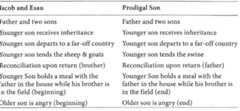
However, several features of the story point to the fact that the parable was told with the story of Jacob and Esau in the background. In light of Jewish parable teaching and midrashic reception of the Jacob/Esau tradition, the traditional reading of the parable needs to turned upside down: The younger brother, as an Image of Jacob/Israel, is an image of repentant Israel returning to her God and home. The older brother, as an image for Esau/the gentile Nations, rejects the younger brother. However, also he is invited into the house by the father, who is an image for the one God of Jews and Gentiles alike.
parable originally was a metaphor for God’s provision for Israel in times of exile.
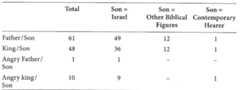
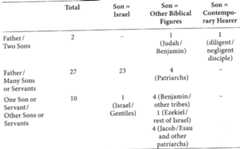
While the motif of a father and one son or of a father and many sons/ servants>® is indeed frequent in tannaitic parables, the setting of a father with two sons is very rare. Essentially there are only two instances from that early period, each of them with a doublet: the first narrates a compe- tition between the tribes of Benjamin and Judah, where in the end both  stories and declamations.”* Stories of this kind were, in his view, “far too common” to allow for any specific intertextual dependence.*? The understanding of the story therefore could only be enhanced by a general “knowledge of conventional stories of a father and two sons,” but not by any “specific text or group of texts” from biblical or early Jewish tradi- tion.24 However, in view of the tannaitic material, this verdict must be questioned:
On the other hand, the number of details that run contrary to the Jacob/ Esau story is admittedly higher than the number of parallels: the wasting of money, the famine, the gentile owner of the herd, the swine, the father (instead of the brother) offering the reconciliation, the ring, the robe, the feast, the resentment of the brother (as a result of the return, rather than a cause of the flight). All these details make it clear that the parable is not just “rewritten bible.” It is the Jacob/Esau motif, not the Jacob/Esau narrative, that lies behind Jesus’s parable.
Research paper thumbnail of Freiheit vom Gesetz: Eine paulinische Formel? Paulus zwischen jüdischem Gesetz und christlicher Freiheit
In: Der jüdische Messias Jesus und sein jüdischer Apostel Paulus, hg. Von Armin Baum, Detlef Häußer und Emmanuel Rehfeld (WUNT II/425), Tübingen: Mohr Siebeck, 2016
(english below)Die Botschaft der Freiheit vom Gesetz gilt, spätestens seit der von Martin Luthe... more(english below)
Die Botschaft der Freiheit vom Gesetz gilt, spätestens seit der von Martin Luther ins Zentrum seiner Theologie gerückten Antithese von Gesetz und Evangelium, als Kernbestandteil der paulinischen Verkündigung. Bibelausgaben der unterschiedlichsten Herkunft tragen die Formel in ihren Kapitelüberschriften zu Galater 3 und 4. In einer neueren Bibelübersetzung hat sie sogar in den Bibeltext von Gal 4,12 selbst Eingang gefunden. Eine genauere Analyse der wichtigsten Paulustexte, die Freiheit und Gesetz miteinander in Verbindung setzen (Röm 7-8; Gal 2,4; 3,22-25; 4,21-5,1), zeigt jedoch: Keiner dieser Texte spricht ausdrücklich von einer "Freiheit vom Gesetz": Röm 7-8 behauptet lediglich eine "Freiheit vom Gesetz  der Sünde und des Todes", die aber als Antithese gerade der Gebundenheit an das "Gesetz Gottes" gegenübergestellt wird. Gal 2,4 spricht von einer Freiheit gegenüber menschlichen Zwängen. Das Vokabular von Gal 3,22-25 bezeichnet, entgegen der verbreiteten Auslegung, nicht das Bild eines Gefängnisses, sondern das einer (von Sünde) umzingelten, aber dennoch temporär Schutz gewährenden Festung.  Das Bild von Hagar und Sara in Gal 4 schließlich stellt nicht "Gesetz" und "Gnade" einander gegenüber, auch nicht "Judentum" und "Christentum", sondern die Sklaverei irdischer Existenz und die Freiheit himmlischer Existenz.  Die Formel "Freiheit vom Gesetz" ist daher als solche keine treffende Beschreibung paulinischer Theologie. Präzisere Formeln, wie etwa "Freiheit vom Fluch des Gesetzes" oder "Freiheit vom Urteil des Gesetzes", beschreiben das Anliegen des Paulus treffender. 

Abstract:
“Freedom from the law” is widely held to be a core concept of Pauline theology. However, a closer look at the imagery and terminology of freedom in the letters to the Romans and Galatians casts doubt on this assessment: The formula itself is used only twice in Romans, and there in a context where two opposing laws are contrasted, the “law of sin and death”, from which mankind is freed, and “the law of God / the Spirit”, which serves as the enabler of freedom. Freedom from the law, therefore, cannot be understood in this context as a general concept that describes Paul’s attitude towards Torah. In Galatians, where the formula itself is totally absent, the Pauline images of being “enclosed by the law”, “supervised by a guardian” and the allegory of Hagar and Sara are commonly held to convey the idea of “freedom from the law”. However, on a closer look, each of these im-ages might have a different focus. For Paul, therefore, “freedom from the Law” is not a formula that describes his attitude to Tora
Research paper thumbnail of Hebrew-Language Approaches to the Gospels and their contribution to Synoptic Studies
Although discussions about Hebrew origins of the Synoptic tradition go back to the first centurie... moreAlthough discussions about Hebrew origins of the Synoptic tradition go back to the first centuries of church history, they have been widely dismissed from the scholarly debate on the Synoptic questions since the mid-1800s. However, in recent decades, new developments in synoptic, linguistic, historical Jesus and archaelogical research might allow for a fresh reassessment of the question. This paper provides a summary of my German publication "Hebräisches Evangelium und Synoptische Tradition" (WUNT II/312, Tübhingen 2011) and takes a look at four exemplary pericopes from the Synoptic tradition in order ro evaluate their possible Hebrew and Jewish background.
Research paper thumbnail of Jesus aus der Sicht des modernen Judentums
Ein Überblick über jüdische Jesus-Darstellungen des 19. und 20. Jahrhunderts zeigt sehr unterschi... moreEin Überblick über jüdische Jesus-Darstellungen des 19. und 20. Jahrhunderts zeigt sehr unterschiedliche Bilder von Jesus, die von respektvoller Ablehnung bis hin zu "Jewish Reclamation of Jesus". Für die christliche Theologie ist die Beobachtung bedeutsam, dass jüdische Forscher, bei all ihrer Unterschiedlichkeit, die Bruchlinien zwischen Jesus und dem Judentum übereinstimmend an anderen Stelle sehen als die Vertreter der christlichen Leben-Jesu-Forschung: Während diese die Unterschiede vor allem in der Lehre und Verkündigung Jesu zu begründen suchen, sehen jene den Konflikt meist viel deutlicher in der Frage seiner Person, seines messianischen Anspruchs und des christlichen Bekenntnisses zur Auferstehung.

Für die Arbeit im christlich-jüdischen Dialog stellt diese Beobachtung eine neue Herausforderung dar: Christliche Theologen sollten zum einen eine immer noch durch Abgrenzung geprägte Lesart der Verkündigung und Lehre Jesu überdenken. Zugleich jedoch sollten sie die Kernfragen des christologischen Bekenntnisses, die im Dialog meist im Hintergrund bleiben, neu zum Gegenstand des Gesprächs und ihrer eigenen historischen Forschung machen.

Erschienen in: Rolf Hille (Hrsg.): Gott als Mensch. Christologische Perspektiven. Bericht über die Theologische Studienkonferenz des Arbeitskreises für Evangelikale Theologie (AfeT) im November 2013 in Bad Blankenburg. Gießen: Brunnen 2015, S. 257-303
Research paper thumbnail of The Origins of the Exclusive Aramaic Model in the 19th Century: Methodological Fallacies and Subtle Motives.
The hypothesis that the Hebrew language had been fully replaced by Aramaic as a spoken language i... moreThe hypothesis that the Hebrew language had been fully replaced by Aramaic as a spoken language in the time of Jesus has often been accepted among New Testament scholars without further question. However, few today have any detailed knowledge of how and why this hypothesis came into existence in the nineteenth century and on what grounds it was established. Since the question of language use is considered to be of minor importance, students of the New Testament today readily accept the answers to the question provided to them by textbooks and introductions without doubting their factual correctness. In consequence, unlike in the early period of Aramaic research, the widespread acceptance of the “exclusive Aramaic hypothesis” today is increasingly based on second-hand knowledge: while relatively few scholars continue to inves tigate the linguistic, archeological and historical evidence pertaining to the language question, most others would confijine themselves to the reading of scholarly literature, reiterating the “established results” of earlier generations. This wide acceptance of established theories leads to a strangely asymmetrical situation where any claim of Aramaic prevalence or even exclusivity is accepted by biblical scholars without hesitation, while the claim of contin ued use of the Hebrew language, let alone a prevalence of Hebrew as a spo ken language, is opposed with vigor, to the point that accusations of “linguistic
Zionism” have been brought into the dis cussion. The burden of proof seems to rest fully on the “Hebrew” side of the discussion, while the “Aramaic” side is based fijirmly on the grounds of “common knowledge.” A fresh look into the
historical origins of the “Aramaic hypothesis” might therefore help to develop a better understanding of the reasons and causes that led to the establishment of the current status quo and provide a possible way out of an unnecessary stalemate in the question of language use at the time of Jesus.
Research paper thumbnail of The Use of Hebrew and Aramaic in Epigraphic Sources of the New Testament Era.
The widespread conviction among New Testament scholars that Aramaic, and not Hebrew, should be co... moreThe widespread conviction among New Testament scholars that Aramaic, and not Hebrew, should be considered the “Jewish vernacular” of the first century CE and therefore the “mother tongue of Jesus”, was shaped in the 19th century by prominent scholars like Abraham Geiger and Gustaf Dalman who were, without doubt, experts in their field. However, the textual evidence they could base their conclusions on was thin at that time: No literature, neither Hebrew nor Aramaic, was extant from the period in question and archaeological research in the land of Israel had only just begun.
This situation has changed dramatically in the course of the past century. Starting with the discoveries in the Cairo Genizah, and continuing with the Dead Sea Scrolls, the Bar Kochba letters and other documentary texts from the Judaean desert, the landscape of Hebrew and Aramaic literature from the Second Temple Period has changed dramatically. In addition, ongoing archaeological work has brought to light a vast number of inscriptions, ostraca and other epigraphical material.
While, however, the documents from the Judaean Desert have been subject to intensive study and scholarly debate not only among archaeologists and linguists, but also among biblical scholars, the inscriptions and ostraca have largely been neglected by New Testament scholarship, probably due to their meager theological content and the lack of any direct links to New Testament literature, with a few exceptions like the “Pontius Pilatus” inscription from Caesaraea, a few “qorban” inscriptions, the ossuary of “Alexander, son of Simon, from Cyrene”, or, for those with a more sensational interest, the famous “Jesus ben Joseph” ossuary from Talpiot, together with its companion, the “James Ossuary”. 
What has largely gone unnoticed, meanwhile, are the conclusions drawn by archaeologists, epigraphists and palaeographists concerning the language use in the epigraphic material discovered over the past century.
The purpose of the present study is therefore to provide the reader with a comprehensive statistical overview of language use in the epigraphic sources

Log In


or


orreset password

Enter the email address you signed up with and we'll email you a reset link.

Need an account? Click here to sign up

[8]ページ先頭

©2009-2026 Movatter.jp