Introduction:
surtvep is an R package for fitting penalized Newton’smethod for the time-varying effects model using mAIC, TIC, GIC asinformation criteria, in particular we span the parameter using basisfunctions. Utilities for carrying out post-fitting visualization,summarization, and inference are also provided. In this tutorial weintroduce the use ofsurtvep through an exampledataset.
This tutorial aims to provide a comprehensive guide on survivalestimation for the time-varying coefficient model using thesurtvep package in R. The package addresses the challengesassociated with large-scale time-to-event data and the estimation oftime-varying effects in survival analysis. By implementing acomputationally efficient Kronecker product-based proximal algorithm andincorporating various penalties to improve estimation,surtvep offers an efficient and flexible solution forhandling time-varying coefficients in survival analysis.
Throughout the tutorial, we will cover the key features andcapabilities of thesurtvep package, providing examples anduse cases to illustrate the package’s functionality. By the end of thistutorial, you will have a solid understanding of how to usesurtvep for survival estimation with time-varyingcoefficients, as well as how to leverage the package’s unique featuresto improve your analysis.
Installation:
#Install the package, need to install the devtools packages:require("devtools")require("remotes")remotes::install_github("UM-KevinHe/surtvep", ref="Lingfeng_test")Quick Start
The purpose of this section is to give users a general sense of thepackage. We will briefly go over the main functions, basic operationsand outputs. After this section, users may have a better idea of whatfunctions are available, which ones to use, or at least where to seekhelp.
First, we load the ‘surtvep’ package:
The main functions used in the package are Newton’s method ‘coxtv’and Newton’s method combined with penalization ‘coxtp’, which we willdemonstrate in this section. We load a set of data created beforehandfor illustration:
data("ExampleData")z<-ExampleData$ztime<-ExampleData$timeevent<-ExampleData$eventThe command loads an input covariate matrix ‘z’, time-to-eventoutcome ‘time’ and ‘event’ from this saved R data archive. The saveddata set is a simulation data set with continuous covariates.
We fit the Newton’s method without penalization use the most basiccall to ‘coxtv’.
fit.tv<-coxtv(z=z, event=event, time=time)#> Iter 1: Obj fun = -3.2982771; Stopping crit = 1.0000000e+00;#> Iter 2: Obj fun = -3.2916285; Stopping crit = 2.1424865e-02;#> Iter 3: Obj fun = -3.2916034; Stopping crit = 8.0884492e-05;#> Iter 4: Obj fun = -3.2916034; Stopping crit = 1.8232153e-09;#> Algorithm converged after 4 iterations!‘fit.tv’ is an object of class ‘coxtv’ that contains all the relevantinformation of the fitted model for further use. We do not encourageusers to extract the components directly. Instead, various methods areprovided for the object such asplot andtestthat enable us to execute those tasks more elegantly.
We can get the time-varying coefficients by calling theget.tvcoef method:
beta.tv<-get.tvcoef(fit.tv)head(beta.tv)#> X1 X2#> 0.000178354960296403 0.8190941 -0.07539314#> 0.000355177544950556 0.8202944 -0.07436044#> 0.000532422851851532 0.8214929 -0.07332691#> 0.0011332947259668 0.8255221 -0.06983544#> 0.00146478440156426 0.8277227 -0.06791732#> 0.00224849921081871 0.8328625 -0.06340520The first row ofbeta.tv represents the time-varyingcoefficient of x1 and x2 at time 0.00017835.
In order to get the time-varying coefficients on a new time sequence,we can modify thetimes argument inget.tvcoef.
time.new<-seq(1,2,0.1)beta.tv.new<-get.tvcoef(fit.tv, time=time.new)head(beta.tv.new)#> X1 X2#> 1 1.0753701 0.7029324#> 1.1 1.0529174 0.5242153#> 1.2 1.0039703 0.3215421#> 1.3 0.9365847 0.1039432#> 1.4 0.8590977 -0.1195252#> 1.5 0.7798461 -0.3398073We can visualize the time-varying coefficients by executing theplot method:
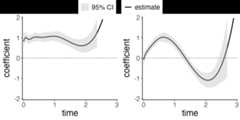
Each sub figure corresponds to a variable. It shows the time-varyingeffect of our predictors. In ourExampleData, the firstpredictor has a constant effect of 1, and the second predictor has atime-varying effect of\(\text{sin}(3\pi *t/4)\), where\(t\) is the time.The dotted line indicates the that hazard ratio is 0, which means thepredictor has no effect. Users may also wish to plot the effect ofdifferent covariates in the same plot: this can be done by settingallinone = TRUE in the plot command.
The confidence interval shown presented on the figure can becalculated using theconfint function.
ci.df<-confint(fit.tv)Note that users can draw the plots by yourself with the necessarydata given. We give some raw exampleggplot codes. Pleaserefer toplotting for moreinformation.
Next we fit the Newton’s method combined with penalization method. Wespecify a range of penalization coefficients first, then call thecoxtp function. Detailed disucussion of how to specify therange of penalization coefficients and how to choose the appropriate onewill be discussed in section Information Criteria.
lambda_all<-c(1)fit.penalize=coxtp(z=z, event=event, time=time, lambda=lambda_all, method="ProxN")#> Iter 1: Obj fun = -3.3017443; Stopping crit = 1.0000000e+00;#> Iter 2: Obj fun = -3.2954100; Stopping crit = 2.0664261e-02;#> Iter 3: Obj fun = -3.2953323; Stopping crit = 2.5346890e-04;#> Iter 4: Obj fun = -3.2953321; Stopping crit = 4.6097119e-07;#> Algorithm converged after 4 iterations!#> lambda 1 is done.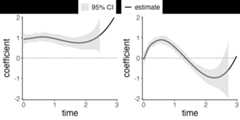
With the tools introduced so far, users are able to fit thetime-varying model. There are many more arguments in the package thatgive users a great deal of flexibility. To learn more, move on to latersection.
Structure
This section gives the flowchart for thesurtveppackage. Generally,coxtv utilizes proximal Newton’s methodto estimate the time-varying coefficients.coxtp combinesthe Newton’s approach with penalization.IC calculatesdifferent information criteria to select the best tuning parameter infront of the penalty term.cv.coxtp uses cross-validationfor tuning parameter selection..tvef.ph,tvef.ph.time andtvef.ph.zero provideshypothesis testing for the fitted model.get.tvef retrievesthe time-varying coefficients for the fitted model.confintprovides confidence intervals for these coefficients.baseline offers the baseline estimations.plotvisualizes the estimated time-varying coefficients. Other functions anddetails are provided in later sections. Ï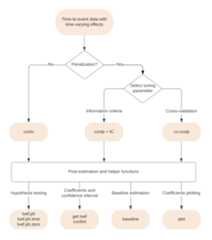
Cox non-proportional hazards model
While obtaining these estimates under the Cox proportional-hazardsmodel is relatively straightforward, the assumption of constant hazardratios is frequently violated in populations defined by an initial,acute event, such as myocardial infarction, or in studies with long-termfollow-up.
The Cox non-proportional hazards model is a flexible and powerfultool for modeling the time-varying effects of covariates in survivalanalysis, allowing for the estimation of hazard ratios that change overtime. This model can capture complex relationships between predictorvariables and the time-to-event outcome, providing a more accuraterepresentation of the underlying processes.
Let\(D_{i}\) denote the time lagfrom transplantation to death and\(C_{i}\) be the censoring time for patient\(i\),\(i=1,\ldots, n\). Here\(n_j\) is the sample size. The observed timeis\(T_{i} = \min\{D_{i},C_{i}\}\), andthe death indicator is given by\(\delta_{i} =I(D_{i} \leq C_{i})\). Let\(\boldsymbol{X}_{i}=(X_{i1}, \ldots,X_{iP})^T\) be a\(P\)-dimensional covariate vector. We assumethat\(D_{i}\) is independent from\(C_{i}\) given\(\textbf{X}_{i}\). Consider the hazardfunction\[ \lambda(t|\boldsymbol{X}_{i}) =\lambda_{0}(t)\exp\{\boldsymbol{X}_{i}^\top{\boldsymbol\beta}(t)\},%\nonumber\] where\(\lambda_{0}(t)\) isthe baseline hazard. The time-varying coefficients\(\beta(t)\) represent the effect ofpredictors on the outcome are varying through different time points.
To estimate the time-varying coefficients\({\boldsymbol\beta}(t)=\{\beta_{1}(t),\ldots,\beta_{P}(t)\}\), we span\(\boldsymbol\beta(\cdot)\) by a set of cubicB-splines defined on a given number of knots:\[\begin{eqnarray} \beta_{p}(t)=\boldsymbol\theta_{p}^\top\boldsymbol{B}(t)=\sum_{k=1}^K\theta_{pk} B_k(t), ~~ p=1, \ldots, P, \nonumber\end{eqnarray}\] where\(\boldsymbol{B}(t)=\{B_1(t), \ldots, B_K(t)\}^T\) forms a basis,\(K\) is the number of basis functions, and\(\boldsymbol\theta_{p}=(\theta_{p1}, \ldots,\theta_{pK})^T\) is a vector of coefficients with\(\theta_{pk}\) being the coefficient for the\(k\)-th basis of the\(p\)-th covariate. Detailed inforamtionabout the construction of the B-spline basis can seen in theB-spline construction.
Newton’s method
In this section we introduce the Newton’s method for estimatingtime-varying effects in detail.
With a length-\(PK\) parametervector\(\boldsymbol\theta=vec(\boldsymbol\Theta)\),the vectorization of the coefficient matrix\(\boldsymbol\Theta=(\boldsymbol\theta_{1}, \ldots,\boldsymbol\theta_{P})^T\) by row, the log-partial likelihoodfunction is\[\begin{equation} \ell(\boldsymbol\theta)=\sum_{i=1}^{n_j} \delta_{i} \left[\boldsymbol{X}_{i}^T \boldsymbol\Theta \boldsymbol{B}(T_{i}) -\log \left\{\sum_{i' \in R_{i}} \exp \{\boldsymbol{X}_{i' }^T\boldsymbol\Theta \boldsymbol{B}(T_{i}) \} \right \} \right ]\end{equation}\], where\(R_{i}=\{i': 1 \leq i' \leq n, ~T_{i'}\geq T_{i}\}\) is the at-risk set.
coxtv applies Newton’s method to solve the problem.Specifically, suppose we have current estimates\(\widetilde{\boldsymbol\theta}\), the updateis\[ \widetilde{\boldsymbol\theta} \leftarrow\widetilde{\boldsymbol\theta} + \nu \boldsymbol{\mu};\] where\[ \boldsymbol{\mu} = \left(- \nabla^2 \ell(\boldsymbol{\theta})\right)^{-1} \nabla \ell(\boldsymbol{\theta})\], and\(\nu\) is a step sizeadjusted by backtracking linesearch.\(\nabla\ell(\boldsymbol{\theta})\) and\(\nabla^2 \ell(\boldsymbol{\theta})\) is thefirst and second derivative of the log partial likelihood.
Commonly used function arguments
coxtv provides various arguments for users to customizethe fit: we introduce some commonly used arguments here.
stratais a vector of indicators for stratification.Default =NULL, (i.e. no stratification group in the data),an unstratified model is implemented.nsplinesnumber of basis functions in the splines tospan the time-varying effects, whose default value is 8. We use the Rfunctionsplines::bsto generate the B-splines.tiesa character string specifying the method fortie handling. If there are no tied events, the methods are equivalent.By default"Breslow"uses the Breslow approximation, whichcan be faster when many ties are present.toltolerance used for stopping the algorithm. Seedetails instopbelow. The default value is1e-6.iter.maxmaximum iteration number if the stoppingcriterion specified bystopis not satisfied. Default valueis 20.degreedegree of the piecewise polynomial forgenerating the B-spline basis functions—default is 3 for cubic splines.degree = 2results in the quadratic B-spline basisfunctions.methoda character string specifying whether to useNewton method or proximal Newton method. If"Newton"thenHessian is used, while the default method"ProxN"implements the proximal Newton which can be faster and more stable whenthere exists ill-conditioned second-order information of the log-partiallikelihood.gammmaparameter for proximal Newton method"ProxN". Default value is1e8.btra character string specifying the backtrackingline-search approach."dynamic"is a typical way to performbacktracking line-search. See details in Convex Optimization by Boyd andVandenberghe (2009)."static"limits Newton’s increment andcan achieve more stable results in some extreme cases, such asill-conditioned second-order information of the log-partial likelihood,which usually occurs when some predictors are categorical with lowfrequency for some categories. Users should be careful withstaticas this may lead to under-fitting.taua scalar in (0,1) used to control the step sizeinside the backtracking line-search. The default value is 0.5.stopcharacter string specifying the stopping ruleto determine convergence. Use to denote the log-partial likelihood atiteration step m."incre"means we stop the algorithm when Newton’s incrementis less than thetol."relch"means we stopthe algorithm when the is less than thetol."ratch"means we stop the algorithm when is less than thetol."all"means we stop the algorithm whenall the stopping rules"incre","relch"and"ratch"are met. Default value isratch.iter.max, if achieved, overrides any stop rule foralgorithm termination.parallelifTRUE, then the parallelcomputation is enabled. The number of threads in use is determined bythreads.threadsan integer indicating the number of threadsto be used for parallel computation. Default is2. Ifparallelis false, then the value ofthreadshas no effect.fixedstepifTRUE, the algorithm willbe forced to runiter.maxsteps regardless of the stoppingcriterion specified.
In the following sections we brefily describe these useful argumentswhen callingcoxtv.
Now we start with a relatively harsh simulated data. Here, thecovariates V1 and V2 were generated as binary variables with around 90%frequency, which is a relatively harsh setting to be estimated. Therelated true log-hazard function for each variable is\(\beta_1(t)=1\) and\(\beta_2(t)=exp(-1.5*t)\), where t denotestime.
Let’s check the data first:
data("ExampleDataBinary")table(ExampleDataBinary$x[,1])#> < table of extent 0 >table(ExampleDataBinary$x[,2])#> < table of extent 0 >z<-ExampleDataBinary$ztime<-ExampleDataBinary$timeevent<-ExampleDataBinary$eventBoth predictors are presented with frequency around 25%.
Proximal Newton’s method:method = "ProxN"
The ‘method’ parameter has two options.method="Newton" andmethod="ProxN". The proximal Newton’s methodmodified the second order derivative\(\nabla^2 \ell(\boldsymbol{\theta})\) byadding small terms\(1/\gamma\) to thethe diagonal elements. The default value of\(\gamma\) is\(10^8\), which can be modified by user. Ifthe data set have predictors with extremely low frequency, users mayconsider a smaller\(\gamma\).
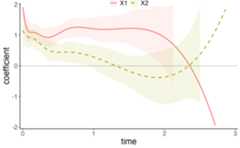
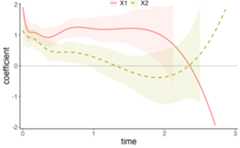
fit.newton<-coxtv(z=z, event=event, time=time, method='Newton')fit.proxN<-coxtv(z=z, event=event, time=time, method='ProxN')Then we plot the fitted methods with all the curves on the same plot.No obvious change can be oberserved here. However, we do recommandusing
Stratified Newton’s Method:strata
When the data of patients are collected from different strata, we canextend the model to a stratified version. We use\(j=1,\ldots,J\) to denote the\(J\) different centers. Let\(D_{ij}\) denote the time to death and\(C_{ij}\) be the censoring time for patient\(i\) in center\(j\),\(i=1,\ldots, n_j\), and\(j=1, \ldots, J\). Here\(n_j\) is the sample size in center\(j\). The total number of patients is\(N=\sum_{j=1}^Jn_j\), the observed time is\(T_{ij} = \min\{D_{ij},C_{ij}\}\), andthe death indicator is given by\(\delta_{ij}= I(D_{ij} \leq C_{ij})\).
Let\(\textbf{X}_{ij}=(X_{ij1}, \ldots,X_{ijP})^T\) be a\(P\)-dimensional covariate vector. We assumethat\(D_{ij}\) is independent from\(C_{ij}\) given\(\textbf{X}_{ij}\). Correspondingly, thelog-partial likelihood function is\[ \ell_{strata}(\boldsymbol\theta) = \sum_{j=1}^J \sum_{i=1}^{n_j}\delta_{ij} \left [\boldsymbol{X}_{ij}^T\boldsymbol\Theta \boldsymbol{B}(T_{ij}) -\log \left\{\sum_{i' \in R_{ij}} \exp \{\boldsymbol{X}_{i' j}^T\boldsymbol\Theta \boldsymbol{B}(T_{ij}) \} \right \} \right ],\] where\(R_{ij}=\{i': 1 \leqi' \leq n_j, ~ T_{i' j}\geq T_{ij}\}\) is the at-risk setfor stratum\(j\).
For the case with different strata, the usage is to include thestrata variable. First, we load a set of generated data with differentstratums. In our simulation, we vary the baseline for different stratumsby adding a small term to the baseline function. The small term isgenerated by uniform distribution with mean = 0 and standard deviation =0.5.
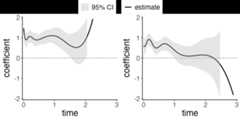
data("StrataExample")z<-StrataExample$ztime<-StrataExample$timeevent<-StrataExample$eventstrata<-StrataExample$strataThestrata is a vector of indicators for stratification.The stratified model can be easily fitted by calling
Step size adjustment:btr
btr is a character string specifying the backtrackingline-search approach."dynamic" is a typical way to performbacktracking line-search. See details in Convex Optimization by Boyd andVandenberghe (2009)."static" limits Newton’s increment andcan achieve more stable results in some extreme cases, such asill-conditioned second-order information of the log-partial likelihood,which usually occurs when some predictors are categorical with lowfrequency for some categories.
Users should be careful withstatic as this may lead tounder-fitting.
Newton’s Method with penalization:
The proximal Newton can help improve the estimation when theorigional hessian matrix is very close to a singular one, which mayoften occur in the setting of time-varying effects, however,over-fitting issue still exists. We further improve the estimation byintroducing the penalty. The basic idea of penalization is to controlthe model’s smoothness by adding a ‘wiggliness’ penalty to the fittingobjective. Rather than fitting the non-proportional hazards model bymaximizing original log-partial likelihood, it could be fitted bymaximizing\[\begin{align} \ell(\boldsymbol{\theta}) - P_\lambda(\boldsymbol{\theta}).\end{align}\]
We have different choices of\(P_\lambda(\boldsymbol{\theta})\). Potentialchoices are to use P-splines, and discrete penalties. Detaileddiscussions are provided below.
P-spline
The P-splines are low rank smoothers using a B-spline basis, usuallydefined on evenly spaced knots, with a difference penalty applieddirectly to the parameters\(\theta_{pk}\), to control functionwiggliness. When we set standard cubic B-spline basis functions, thepenalty function used for\(\beta_p\)will be\[\begin{align*} P_\lambda(\boldsymbol{\theta}) =\lambda\sum_{j=1}^P\sum_{k=1}^{K-1}\{(\boldsymbol{\theta}_{j(k+1)} -\boldsymbol{\theta}_{jk})\}^2.\end{align*}\]
It is straight forward to express the penalty as a quadratic form,\(\boldsymbol{\theta}^T\boldsymbol{S}\boldsymbol{\theta}\),in this basis coefficients:
\[\begin{align*} \sum_{k=1}^{K-1}\{(\boldsymbol{\theta}_{j(k+1)} -\boldsymbol{\theta}_{jk})\}^2 = \boldsymbol{\theta}^T \begin{bmatrix} 1 & -1 & 0 & 0 & . & . & . \\ -1 & 2 & -1 & 0 & 0 & . & . \\ 0 & -1 & 2 & -1 & 0 & 0 & . \\ . & . & . & . & . & . & .\\ . & . & . & . & . & . & .\\ \end{bmatrix} \boldsymbol{\theta}\end{align*}\]Hence the penalized fitting problem is to maximize\[\begin{align} \ell(\boldsymbol{\theta}) -\lambda\boldsymbol{\theta}^T\boldsymbol{S}\boldsymbol{\theta}\end{align}\] with respect to\(\boldsymbol{\theta}\).
Smoothing-spline
The reduced rank spline smoothers with derivative based penalties canbe set up almost as easily, while retaining the sparsity of the basisand penalty and the ability to mix-and-match the orders of spline basisfunctions and penalties.
We denote the B-spline basis as of order\(m_1\), and\(m_1= 3\) denotes a cubic spline. Associated with the spline will bea derivative based penalty\[\begin{align*} P_{\lambda} = \lambda \int_{0}^{T}\boldsymbol{\beta}^{[m_2]}(t)^2dt\end{align*}\] where\(\boldsymbol{\beta}^{[m_2]}(t)\) denotes the\(m_2^{th}\) derivative of\(\boldsymbol{\beta}\) with respect to\(t\). It is assumed that\(m_2 \leq m_1\), otherwise it makes no sensethat the penalty is formulated in terms of a derivative that is notproperly defined for the basis functions. Similarly,\(P_{\lambda}\) can be written as\(\boldsymbol{\theta}^T\boldsymbol{S}\boldsymbol{\theta}\)where\(\boldsymbol{S}\) is a bandeddiagonal matrix of known coefficients. The algebraic expression of\(\boldsymbol{S}\) is complex, as discussedin . However, this has little impact on the computation time.
Usage
The usage of Newton’s method with penalizationcoxtp isvery similar tocoxtv introduced above. The main differencecomes from the penalization tuning parameter selection.
We use the smooth spline here for penalization (default). You couldalso usespline="P-spline". For tuning parameterlambda, you could either enter a single numeric value or avector of numbers. Iflambda is entered as a vector ofnumbers, the tuning parameter can be selected based on differentcriteria (AIC, TIC or GIC) using functionIC.Alternatively, users can usecv.coxtp to select the tuningparameter\(\lambda\) based on crossvalidation.
Following is a model fit with thelambda as a vector fordifferent illustration purposes. We use the relatively harsh settingExampleDataBinary to illustrate the usage ofcoxtp,IC andcv.coxtp, thepenalization method. This setting contains binary predictors with lowfrequency, which may have ill-conditioned second-order information ofthe log-partial likelihood. Penalization plays an important role here asit helps to smooth the time-varying effects.
data(ExampleDataBinary)z<-ExampleDataBinary$ztime<-ExampleDataBinary$timeevent<-ExampleDataBinary$eventFirst we fit the penalized model with"Smooth-spline".
lambda_spline_all=c(0.01,0.1,1,10,100,1000)# fit.pspline <- coxtp(event = event, z = z, time = time, lambda=lambda_spline_all, spline = "P-spline")fit.smoothspline<-coxtp(event=event, z=z, time=time, lambda=lambda_spline_all, penalty="Smooth-spline")Then we use theIC function to select the tuningparameter.
IC<-IC(fit.smoothspline)print(IC$mAIC)#> [1] 15209.79 15205.84 15201.74 15199.47 15199.18 15199.35print(IC$TIC)#> [1] 15207.09 15203.63 15199.85 15197.89 15198.62 15199.44print(IC$GIC)#> [1] 15208.92 15205.59 15201.99 15200.02 15199.50 15199.56We can directly call theplot function to give theestimation plot.
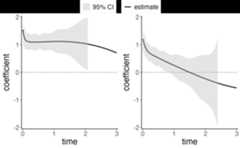
From the result above, we notice that with different selectioncriteria, the best tuning parameter\(\lambda\) selected is different fordifferent selection criteria. In this example, we use the TIC criterion.The result for this model is saved in the related criterion model andcan be accessed as follows:
model.mAIC=IC$model.mAICmodel.TIC=IC$model.TICmodel.GIC=IC$model.GICCompared to the non-penalized model, we can see that the effect of``V1” is shrunk to approximately linear in the penalized model.
Baseline estimation
The Nelson-Aalen estimator (Breslow estimator) of the cumulativefunction is given by\(\widetilde{\Lambda}(t)= \int_0^t \widetilde{\Lambda}_0(u)\), where\(\widetilde{\Lambda}(t)\) is 0 except at theobserved failure times\(t_i\), atwhich it takes the value\[\begin{align*} d\Lambda_0 = {d_i}\left\{\mathop{\sum}\limits_{\ell \in R(T_i)} \exp\{\boldsymbol{X}_{i' }^T \boldsymbol{\Theta} \boldsymbol{B}(T_{i})\}\right\}^{-1}.\end{align*}\]
The baseline estimation here refers to the baseline hazard at time twhen holding all the covariates equal to zero.
data("ExampleData")z<-ExampleData$ztime<-ExampleData$timeevent<-ExampleData$eventtime2<-round(time, digits=1)lambda_spline_all=c(0.1,1,10,100)fit.smoothspline<-coxtp(event=event, z=z, time=time2, lambda=lambda_spline_all, penalty="Smooth-spline")IC<-IC(fit.smoothspline)fit.mAIC<-IC$model.mAICbase.est=baseline(fit.mAIC)head(base.est)#> $time#> [1] 0.0 0.1 0.2 0.3 0.4 0.5 0.6 0.7 0.8 0.9 1.0 1.1 1.2 1.3 1.4 1.5 1.6 1.7 1.8#> [20] 1.9 2.0 2.1 2.2 2.3 2.4 2.5 2.6 2.7 2.8 2.9 3.0#>#> $hazard#> [1] 0.02576925 0.04632723 0.04796684 0.05258371 0.04708783 0.04544031#> [7] 0.05096521 0.03807625 0.04421912 0.05162255 0.05153851 0.06367847#> [13] 0.04167940 0.04678650 0.04840596 0.06907205 0.05280167 0.04285638#> [19] 0.02951995 0.02536585 0.02495845 0.02703002 0.03259201 0.03841546#> [25] 0.01788728 0.02645356 0.02097025 0.00000000 0.03385874 0.00000000#> [31] 0.00000000#>#> $cumulHaz#> [1] 0.02576925 0.07209648 0.12006331 0.17264703 0.21973486 0.26517517#> [7] 0.31614038 0.35421663 0.39843575 0.45005830 0.50159681 0.56527528#> [13] 0.60695468 0.65374117 0.70214714 0.77121918 0.82402086 0.86687724#> [19] 0.89639719 0.92176304 0.94672149 0.97375150 1.00634352 1.04475898#> [25] 1.06264625 1.08909982 1.11007006 1.11007006 1.14392881 1.14392881#> [31] 1.14392881As a result, we could either increase the time interval to make tiesexists or remove the points that have\(\lambda=0\). The only differences wouldresult in the baseline hazard, there is no influence on the cumulativebaseline hazard.
Hypothesis Tests for the model
In this section we provide three tests for the model. The first is totest
Testing for time-varying effect
To test whether the effects are time-varying, we use the constantproperty of B-splines, that is, if\(\theta_{p1}=\cdots=\theta_{pK},\) thecorresponding covariate effect is time-independent. Specify a matrix\(\boldsymbol{C}_p\) such that\(\boldsymbol{C}_p\boldsymbol\theta=\textbf{0}\)corresponds to the contrast that\(\theta_{p1}=\cdots=\theta_{pK}\). A Waldstatistic can be constructed by\[\begin{align*}S_p=(\boldsymbol{C}_p\boldsymbol{\widehat\theta})^T\left[\boldsymbol{C}_p \{- \triangledown^2\ell(\boldsymbol{\widehat\theta})\}^{-1}\boldsymbol{C}_p^T\right]^{-1}(\boldsymbol{C}_p\boldsymbol{\widehat\theta}).\end{align*}\]
Under the null hypothesis that the effect is time-independent,\(S_p\) is asymptotically chi-squaredistributed with\(K-1\) degrees offreedom.
tvef.ph(fit.proxN)#> chisq df p#> X1 6.889955 7 0.44042707#> X2 21.437089 7 0.00317433For the second variable, We reject the null hypothesis and claim ithas the time varying effect.
Testing for beta effect
To test whether the effects are significant or not, we use the teststatistic\(\theta_{p1}=\cdots=\theta_{pK} =0,\) the corresponding covariate effect is time-independent.Specify a matrix\(\boldsymbol{C}_p\)such that\(\boldsymbol{C}_p\boldsymbol\theta=\textbf{0}\)corresponds to the contrast that\(\theta_{p1}=\cdots=\theta_{pK} = 0\). AWald statistic can be constructed by\[\begin{align*}S_p=(\boldsymbol{C}_p\boldsymbol{\widehat\theta})^T\left[\boldsymbol{C}_p \{- \triangledown^2\ell(\boldsymbol{\widehat\theta})\}^{-1}\boldsymbol{C}_p^T\right]^{-1}(\boldsymbol{C}_p\boldsymbol{\widehat\theta}).\end{align*}\]
test.zero<-tvef.zero(fit.proxN)Under the null hypothesis that the effect is time-independent,\(S_p\) is asymptotically chi-squaredistributed with\(K\) degrees offreedom.
Testing at each time point
test.zero.time<-tvef.zero.time(fit.proxN)From the plot above, we could observe that with different knotsselected, the performance is not different so much for different knots,all the estimates are relatively close to the real function. However, inthe penalized model, the lambda is more important which is anotherreason that we need to select the best lambda before actually fittingthe model. The following plot is the performance of different lambdaselected. For the following plot, the knot was set as default, which isknot=8.
Real Data ExampleSUPPORT
In this section, we illustrate the usage of our package by analyzingthe time-varying effects on the real dataSUPPORT (Study toUnderstand Prognoses Preferences Outcomes and Risks of Treatment). Weuse the processedSUPPORT data set included in the Rpackage(Bhatnagar et al. 2020).
We study the time-varying effects of metastatic cancer as theillustration example and include
First we load the data and get the survival outcome:
data(support)time<-support$d.timedeath<-support$deathAge, cancer status and diabetes status are included as covariates andconsidered as categorical variables. Age has 4 levels, cancer status has3 levels and diabetes has 2 levels. The following codes processed thecovariates for model fitting.
#diabetes:diabetes<-model.matrix(~factor(support$diabetes))[,-1]#sex: female as the reference groupsex<-model.matrix(~support$sex)[,-1]#age: continuous variableage<-support$ageage[support$age<=50]<-"<50"age[support$age>50&support$age<=60]<-"50-59"age[support$age>60&support$age<70]<-"60-69"age[support$age>=70]<-"70+"age<-factor(age, levels=c("60-69","<50","50-59","70+"))z_age<-model.matrix(~age)[,-1]# cancer status: metastatic, yes, noca<-factor(support$ca)z_ca_mets<-as.numeric(support$ca=="metastatic")z_ca_non_mets<-as.numeric(support$ca=="yes")z<-data.frame(z_age,z_ca_mets,z_ca_non_mets,sex,diabetes)# colnames(z) <- c("age_50", "age_50_59", "age_70", "metastatic", "diabetes", "male")colnames(z)<-c("age_50","age_50_59","age_70","metastatic","non_metastatic","diabetes","male")The Kaplan-Meier (KM) plots were generated using the following codesto visualize the survival probability over time for three categoricalvariables. Analysis of the KM plot for cancer status revealed acrossover point at approximately day 200, where the survival probabilityof the non-metastatic cancer group surpassed that of the cancer group,suggesting a violation of the non-proportional hazards assumption.
library(survminer)library(survival)data<-data.frame(time,death,z)fit1<-survfit(Surv(time,death)~metastatic+non_metastatic, data=data)fit2<-survfit(Surv(time,death)~diabetes, data=data)fit3<-survfit(Surv(time,death)~age_50+age_50_59+age_70, data=data)ggsurvplot(fit1, data=data, legend.labs=c("non-cancer","non-metastatic cancer","metastatic cancer"))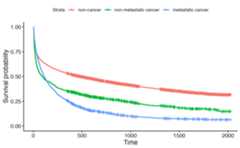
ggsurvplot(fit2, data=data, legend.labs=c("diabetes","non-diabetes"))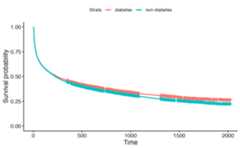
ggsurvplot(fit3, data=data, legend.labs=c("60-69","70+","50-59","<50"))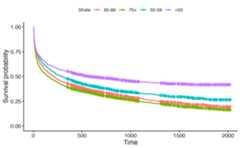
Fit the Newtons’ Method usingcoxtv:
fit.coxtv<-coxtv(event=death, z=z, time=time, nsplines=10)#> Iter 1: Obj fun = -5.7809097; Stopping crit = 1.0000000e+00;#> Iter 2: Obj fun = -5.7668975; Stopping crit = 1.9495719e-01;#> Iter 3: Obj fun = -5.7668366; Stopping crit = 8.4613404e-04;#> Iter 4: Obj fun = -5.7668365; Stopping crit = 1.5189288e-06;#> Iter 5: Obj fun = -5.7668365; Stopping crit = 1.8799714e-10;#> Algorithm converged after 5 iterations!We take a look at the estimation plots of cancer status using theplot function:
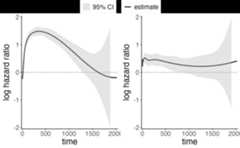
Conditioned on the diabetes status and age, we can observe aviolation of the proportional hazards assumption. A significantdifference in the hazard of death was observed between the metastaticcancer, non-metastatic cancer, and non-cancer groups. Specifically,patients with metastatic cancer exhibited a higher hazard of deathduring the initial 1500 days compared with non-cancer patients.
However, upon examination of the estimation plot for non-metastaticcancer, a decrease at the beginning followed by an increase can beobserved. The fluctuation in the plot is not deemed reliable, primarilydue to the instability of the estimation. To address this issue, apenalty term was added to improve the estimation.
fit.coxtp<-coxtp(event=death, z=z, time=time, lambda=c(1,10,100,1000))#> Iter 1: Obj fun = -5.7812444; Stopping crit = 1.0000000e+00;#> Iter 2: Obj fun = -5.7671833; Stopping crit = 1.9641947e-01;#> Iter 3: Obj fun = -5.7671236; Stopping crit = 8.3225826e-04;#> Iter 4: Obj fun = -5.7671235; Stopping crit = 1.7825937e-06;#> Iter 5: Obj fun = -5.7671235; Stopping crit = 1.4381264e-10;#> Algorithm converged after 5 iterations!#> lambda 1 is done.#> Iter 1: Obj fun = -5.7812465; Stopping crit = 1.0000000e+00;#> Iter 2: Obj fun = -5.7671838; Stopping crit = 1.9644253e-01;#> Iter 3: Obj fun = -5.7671242; Stopping crit = 8.3187556e-04;#> Iter 4: Obj fun = -5.7671241; Stopping crit = 1.7283676e-06;#> Iter 5: Obj fun = -5.7671518; Stopping crit = 3.8614177e-04;#> Iter 6: Obj fun = -5.7671241; Stopping crit = 3.8599213e-04;#> Iter 7: Obj fun = -5.7671241; Stopping crit = 1.9834684e-13;#> Algorithm converged after 7 iterations!#> lambda 10 is done.#> Iter 1: Obj fun = -5.7812812; Stopping crit = 1.0000000e+00;#> Iter 2: Obj fun = -5.7672135; Stopping crit = 1.9659361e-01;#> Iter 3: Obj fun = -5.7671540; Stopping crit = 8.3082429e-04;#> Iter 4: Obj fun = -5.7671539; Stopping crit = 1.4655789e-06;#> Iter 5: Obj fun = -5.7673043; Stopping crit = 2.1045372e-03;#> Iter 6: Obj fun = -5.7671539; Stopping crit = 2.1001131e-03;#> Iter 7: Obj fun = -5.7671539; Stopping crit = 8.0611971e-13;#> Algorithm converged after 7 iterations!#> lambda 100 is done.#> Iter 1: Obj fun = -5.7814771; Stopping crit = 1.0000000e+00;#> Iter 2: Obj fun = -5.7674171; Stopping crit = 1.9704674e-01;#> Iter 3: Obj fun = -5.7673576; Stopping crit = 8.3362394e-04;#> Iter 4: Obj fun = -5.7673575; Stopping crit = 1.3752688e-06;#> Iter 5: Obj fun = -5.7675286; Stopping crit = 2.4012175e-03;#> Iter 6: Obj fun = -5.7673575; Stopping crit = 2.3954592e-03;#> Iter 7: Obj fun = -5.7673575; Stopping crit = 1.0074129e-12;#> Algorithm converged after 7 iterations!#> lambda 1000 is done.IC.support<-IC(fit.coxtp)plot(IC.support$model.mAIC, parm=c("metastatic","non_metastatic"), ylim=c(-2,2), ylab="log hazard ratio")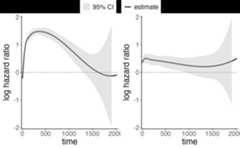
Then we provide the hypothesis testing for each covariate.
#test the proportional hazards assumptiontest.ph<-tvef.ph(fit.coxtv)print(test.ph)#> chisq df p#> age_50 46.311169 9 5.271760e-07#> age_50_59 13.208472 9 1.533978e-01#> age_70 3.338770 9 9.493378e-01#> metastatic 389.789436 9 2.064355e-78#> non_metastatic 4.168983 9 8.999424e-01#> diabetes 19.018021 9 2.504010e-02#> male 44.476142 9 1.153035e-06#test the significance of each covariatetest.zero<-tvef.zero(fit.coxtv)print(test.zero)#> chisq df p#> age_50 92.95934 10 1.384020e-15#> age_50_59 23.20617 10 1.001062e-02#> age_70 33.59559 10 2.162004e-04#> metastatic 997.76510 10 5.666717e-208#> non_metastatic 134.96747 10 4.517433e-24#> diabetes 25.96236 10 3.791138e-03#> male 48.35095 10 5.354766e-07When testing for the proportional hazards assumption, age_50,non_cancer, non_metastatic, diabetes and male has p-value < 0.05. Wereject the null hypothesis and claim that these covariates have violatedthe proportional hazards assumption.
All these covariates are significant based on the Wald test.
Then we can use the following codes to get the baseline estimationand the baseline plot.
base<-baseline(IC.support$model.TIC)plot(base)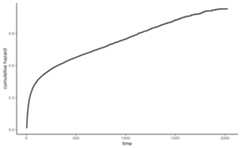
When dealing with data where ties are presented, we can also givebaseline hazard and absolute hazard for each covariate.
We utilized the Breslow’s approximation to estimate the baselinehazard at each event time. We round the unique event time first.
time.discrete<-round(support$d.time, digits=-2)fit.discrete<-coxtv(event=death, z=z, time=time.discrete, nsplines=10)#> Iter 1: Obj fun = -5.8724904; Stopping crit = 1.0000000e+00;#> Iter 2: Obj fun = -5.8627640; Stopping crit = 1.6318989e-01;#> Iter 3: Obj fun = -5.8627181; Stopping crit = 7.6917032e-04;#> Iter 4: Obj fun = -5.8627180; Stopping crit = 1.5741850e-06;#> Iter 5: Obj fun = -5.8627180; Stopping crit = 1.9209980e-10;#> Algorithm converged after 5 iterations!base.discrete<-baseline(fit.discrete)The following codes provide the absolute hazards plot.
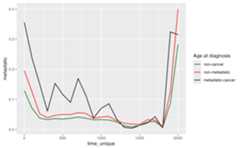
beta.abso<-data.frame(get.tvcoef(fit.discrete))time_unique<-unique(time.discrete)haz_j<-base.discrete$hazardsmooth_data<-data.frame(time_unique,haz_j)loessMod30<-loess(haz_j~time_unique, data=smooth_data, span=0.30)# 30% smoothinghaz_j_smooth30<-predict(loessMod30)exp_betax<-matrix(0,length(unique(time.discrete)),dim(z)[2])beta2<-beta.absobeta2$cancer<-0exp_betax<-exp(beta2)haz_0_betax<-haz_j_smooth30*exp_betaxlibrary(ggplot2)plot_age<-ggplot(haz_0_betax,aes(x=time_unique))+geom_line(aes(y=metastatic, color="metastatic-cancer"),size=0.6)+geom_line(aes(y=non_metastatic, color="non-metastatic"),size=0.6)+geom_line(aes(y=cancer, color="non-cancer"),size=0.6)+scale_color_manual(name='Age at diagnosis', breaks=c('non-cancer','non-metastatic','metastatic-cancer'), values=c('non-cancer'='dark green','non-metastatic'='red','metastatic-cancer'='black'))+theme(plot.title=element_text(hjust=0.2))#> Warning: Using `size` aesthetic for lines was deprecated in ggplot2 3.4.0.#>ℹ Please use `linewidth` instead.#>This warning is displayed once every 8 hours.#>Call `lifecycle::last_lifecycle_warnings()` to see where this warning was#>generated.plot_age