Movatterモバイル変換


[0]ホーム

URL:


ReadThe Diplomat,Know The Asia-Pacific

Regions
Topics
Blogs
More
Newsletter
Diplomat Brief
Weekly Newsletter
The Diplomat
ASEAN Beat

The Truth About War and Peace in Cambodia

Recent Features

What We Know About China’s Secretive Nuclear Submarine Fleet
Security

What We Know About China’s Secretive Nuclear Submarine Fleet

Beyond the Peninsula: What OPCON Transfer Means for the Indo-Pacific
Security

Beyond the Peninsula: What OPCON Transfer Means for the Indo-Pacific

Southeast Asia’s Mercenary Pipeline
Security

Southeast Asia’s Mercenary Pipeline

Winds of Change: Can Taiwan’s Offshore Wind Deliver Fair Work Too?
Economy

Winds of Change: Can Taiwan’s Offshore Wind Deliver Fair Work Too?

Conservative Bhumjaithai Party Wins Decisive Victory in Thai General Election
ASEAN Beat

Conservative Bhumjaithai Party Wins Decisive Victory in Thai General Election

Bangladesh’s Left Returns to the Ballot. Can It Escape Political Irrelevance?
Politics

Bangladesh’s Left Returns to the Ballot. Can It Escape Political Irrelevance?

What Is Greenland’s Role in China’s Arctic Strategy?
Videos

What Is Greenland’s Role in China’s Arctic Strategy?

The Plastic Pollution Crisis
Environment

The Plastic Pollution Crisis

Can Pakistan and China Revive Their ‘All-Weather Friendship’?
Diplomacy

Can Pakistan and China Revive Their ‘All-Weather Friendship’?

Asia’s Tigers Benefit When Scientists Collaborate Beyond Borders 
Environment

Asia’s Tigers Benefit When Scientists Collaborate Beyond Borders 

Machines in the Alleyways: China’s Bet on Autonomous Urban Warfare
Security

Machines in the Alleyways: China’s Bet on Autonomous Urban Warfare

China’s Cheap Oil Strategy Is Becoming a Geopolitical Liability
Economy

China’s Cheap Oil Strategy Is Becoming a Geopolitical Liability

ASEAN Beat

The Truth About War and Peace in Cambodia

Some readings of the country’s history can be deceiving.

Luke Hunt
January 05, 2019
The Truth About War and Peace in Cambodia
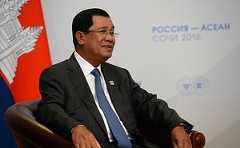
Credit:Wikimedia Commons

For decades, the official line from the United Nations and the bevy of international foreign ministers and diplomats who brokered the 1991 Paris Peace Accords was that their historical document ended the conflict that had afflicted Cambodia since the Khmer Rouge launched hostilities in 1968.

The problem for some journalists, academics, and those living on the ground in Cambodia is that that line never tallied with the realities of what actually happened. While the Paris Peace Accords were certainly significant for Cambodia, the country’s transition from tragic war to troubled peace actually took several more years to forge. More generally, memory of war and peace in Cambodia tends to be a more contested affair than is often appreciated, with certain aspects and dates commemorated by some more than others in line with their interests.

A case in point was last week, as evidencedby the marking 20 years of peace in Cambodia with days of celebration starting December 29 dating back to 1998, instead of 1991 when the Paris Peace Accords were signed. Statues were erected, books published, and elaborate ceremonies were planned to commemorate a date in 1998 that some overlook in Cambodia’s often troubled history, marking a peace that finally arrived seven years after it was declared in Paris.

To be sure, the 1991 Paris Peace Accords achieved much. They paved the way in for peacekeepers with the UN Transitional Authority in Cambodia (UNTAC) in 1992, enabled democratic elections a year later, and injected much needed billions into a failed economy.

But the problem for supporters of the Paris Peace Accords was that UNTAC failed to disarm the genocidal Khmer Rouge and – as unfathomable as it sounds – negotiations were underway for their inclusion in the future political landscape.

There was no peace and a low-intensity civil war continued after Prince Norodom Ranariddh of Funcinpec won the 1993 ballot and became First Prime Minister and entered a power sharing arrangement with Second Prime Minister Hun Sen of the Cambodian People’s Party (CPP).

Both sides armed-up and the relationship between the pair turned acrimonious, resulting in a major showdown in mid-1997 – described by some as a coup, others as simply another battle in a long running conflict.

According to CPP Honorary Chairman Heng Samrin, in his recently released book Cambodia Reborn,Ranariddh was preparing to cut a deal with the Khmer Rouge hoping to combine military forces in an effort to outgun Hun Sen, triggering viscous response. Old scores were settled, hundreds were killed and Ranariddh was routed.

His father King Norodom Sihanouk then pardoned him and offered Khmer Rouge cadre amnesties in return for their defection as government troops pushed into the northwest and surrounded what was left of Pol Pot’s strongholds along the Thai border.

Surviving Khmer Rouge leaders Nuon Chea and Kheu Samphan, recently convicted of genocide, surrendered on Christmas Day, 1998, the final shots were fired on December 28, and the Khmer Rouge formally surrendered a day later when Hun Sen met with both leaders at his compound outside of Phnom Penh.

That historical take doesn’t always sit well with the well-meaning supporters of the Paris Peace Accords, who insist the war ended with its signing. The military realities are often ignored, along with the fact that they were born out of a peace deal that failed to disarm the Khmer Rouge.

Instead, face-saving declarations that the events that followed their signing were simply illegal and a violation of the accords were common. That is neither reasonable or fair, and insulting for the soldiers who fought and died while dealing the final blow that ended the maniacal Khmer Rouge.

Many at that time feared final surrender would simply prove, like the Paris Peace Accords, to be another false dawn. For years, speculation persisted that the Khmer Rouge were still armed and ready, but those suspicions were finally laid to rest by the genocide trial.

Cambodia has a long tradition of commemorating military anniversaries, including Pol Pot’s victory over Lon Nol forces in 1975, the Vietnamese invasion that ended his slaughter, end of Vietnamese occupation ten years later, the signing of the Paris Peace Accords, and even Pol Pot’s death eight months before his chief lieutenants formally surrendered in Hun Sen’s compound. And unsurprisingly, those are remembered differently by different actors, and their meaning has evolved with time.

But among these, it is striking that the Khmer Rouge capitulation before Hun Sen on December 29, 1998, was a date less emphasized among international observers in particular, in part because it was overshadowed by the historical significance attached to the Paris Peace Accords.

Of course, remembering that date comes with its own series of questions, including the nature of Cambodia’s troubled peace and Hun Sen’s governance of the country. But given that it did mark the start of two decades of a sometimes troubled peace, and given this country’s tragic history at war, surely it is worth some attention. And if part of understanding history rests in comprehending how various groups of people interpret the past – no matter how selectively – we ought to look at the dates that are given significance in the countries themselves in addition to those by outside actors.

Luke Hunt can followed on Twitter @lukeanthonyhunt
Latest Stories

Takaichi’s Landslide Victory Draws Mixed Responses in South Korea

Takaichi’s Landslide Victory Draws Mixed Responses in South Korea

BNP Wins Election, Tarique Rahman to Take Oath as Bangladesh’s Next Prime Minister

BNP Wins Election, Tarique Rahman to Take Oath as Bangladesh’s Next Prime Minister

India’s Defense Ministry Clears Purchase of 114 Rafale Fighter Jets

India’s Defense Ministry Clears Purchase of 114 Rafale Fighter Jets

Cambodian Reporter Detained After Photographing Raid on Scam Center

Cambodian Reporter Detained After Photographing Raid on Scam Center

Diplomat Brief

Weekly Newsletter

Get briefed on the story of the week, and developing stories to watch across the Asia-Pacific.

Get the Newsletter

Related

Hun Sen Slams Cambodia’s ‘Foreign Servants’ at World Economic Forum

Hun Sen Slams Cambodia’s ‘Foreign Servants’ at World Economic Forum

ByLuke Hunt
Prime minister's outburst follows warnings of war if his party loses elections.
The Trouble With Cambodia’s Two-Party System

The Trouble With Cambodia’s Two-Party System

ByDavid Hutt
The lack of a formidable third party is hurting the country's opposition.

Counting the Costs of Sam Rainsy’s Failed Return to Cambodia

Counting the Costs of Sam Rainsy’s Failed Return to Cambodia

ByLuke Hunt
The opposition leader’s thwarted bid to return to the country is not without its costs, irrespective of whatever benefits it may generate.
What Next for Democracy in Cambodia?

What Next for Democracy in Cambodia?

ByTej Parikh
Hun Sen has remained defiant since eradicating his political opposition. How should the world respond?

Most Read

Japan After the Landslide: Takaichi’s Supermajority and the Trump Challenge

Japan After the Landslide: Takaichi’s Supermajority and the Trump Challenge

ByTakahashi Kosuke
Takaichi has the largest majority of any Japanese PM since World War II. Now she must decide how to tackle Japan’s difficult strategic environment.
What Is Greenland’s Role in China’s Arctic Strategy?

What Is Greenland’s Role in China’s Arctic Strategy?

Trump’s obsession with Greenland could actually create the result he is so afraid of: increasing China's Arctic presence.

Inside China’s Rerouted Supply Chains

Inside China’s Rerouted Supply Chains

ByHannah Pedone
New data shows that Chinese exporters are increasingly transiting goods through lower-tariff trade partners. But is the practice legal? 
Why EU-India Trade Deal Could Be Bad News for Bangladesh

Why EU-India Trade Deal Could Be Bad News for Bangladesh

ByMd Obaidullah
India has secured tariff-free access to the EU’s garment market even as Bangladesh’s loss of preferential status looms.

Features

What We Know About China’s Secretive Nuclear Submarine Fleet

What We Know About China’s Secretive Nuclear Submarine Fleet

ByRick Joe
With the 09IIIB class and future 09V class, China’s development of nuclear-powered (and nuclear capable) submarines is at an inflection point.
Beyond the Peninsula: What OPCON Transfer Means for the Indo-Pacific

Beyond the Peninsula: What OPCON Transfer Means for the Indo-Pacific

ByClint Work
Wartime OPCON transition would have implications for a more regionally-oriented U.S. force posture and South Korea’s broadening responsibilities.

Southeast Asia’s Mercenary Pipeline

Southeast Asia’s Mercenary Pipeline

ByMunira Mustaffa
Russia is recruiting increasing numbers of fighters from the region, using deceptive practices pioneered by Southeast Asia-based online scam operations.
Winds of Change: Can Taiwan’s Offshore Wind Deliver Fair Work Too?

Winds of Change: Can Taiwan’s Offshore Wind Deliver Fair Work Too?

ByPeter Bengtsen
Workers report debt-linked recruitment. Companies, financiers, and Taiwan’s government face a test of remedy.

Latest Stories

Takaichi’s Landslide Victory Draws Mixed Responses in South Korea

Takaichi’s Landslide Victory Draws Mixed Responses in South Korea

ByYoonki Lee
Takaichi’s tenure got off to a promising start with South Korea, but concerns remain that Japan’s rightward shift might upend the relationship.
BNP Wins Election, Tarique Rahman to Take Oath as Bangladesh’s Next Prime Minister

BNP Wins Election, Tarique Rahman to Take Oath as Bangladesh’s Next Prime Minister

BySaqlain Rizve
Although the BNP has secured a two-thirds majority, it faces several challenges, including stabilizing the law and order situation in the country and reviving the economy.

India’s Defense Ministry Clears Purchase of 114 Rafale Fighter Jets

India’s Defense Ministry Clears Purchase of 114 Rafale Fighter Jets

ByAjai Shukla
This will cost India more than $280 billion, the price for each aircraft having risen by 60 percent since 2015.
Cambodian Reporter Detained After Photographing Raid on Scam Center

Cambodian Reporter Detained After Photographing Raid on Scam Center

BySebastian Strangio
The government's treatment of reporters covering Cambodia's cyber-fraud epidemic raises questions about the nature of its current anti-scam crackdown.

[8]ページ先頭

©2009-2026 Movatter.jp