

Story: Traditional Māori songs – waiata tawhito
Waiata have always played a vital part in Māori life, recording the deeds of ancestors, lamenting losses, calling to a lover or marking the birth of an important child. Traditionalwaiata are still sung today, while newwaiata are composed reflecting the issues of the day.
Story by Rawinia Higgins and Arini Loader
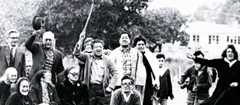
Main image: Whānau singing a waiata tawhito


Story summary
Māori have an extensive tradition of song and dance, with a broad range of styles. Waiata were written to mark important events such as the birth of a child or the death of a chief.
Waiata serve many functions. They can be used to support awhaikōrero (formal speech) or sung to express grief after a death.Waiata were used to help teach children, to urge people to take up a cause, or to mourn in times of loss.Waiata can record a tribe’s past by referring to ancestors, events and places. They are sometimes used to settle historical debates.
Traditionalwaiata are still sung on marae and at gatherings. Newwaiata continue to be written, often about current concerns.
Origins of waiata
Like many aspects of Māori culture,waiata are associated with myth. A woman who was skilled at performingwaiata was compared to the goddess Hineruhi. Hineruhi is found at dawn, and her dance is the sparkle of light on morning dew. Hineruhi’s companion, Tānerore, is credited with the origin of haka.
The chief Tinirau was betrayed by his tohunga, Kae, who killed Tinirau’s pet whale. Tinirau got revenge on Kae after sending women to entertain him withwaiata.
Raukatauri is the atua (deity) of music and Raukatamea is theatua of entertainment.
Types of waiata
Waiata can be grouped according to form and function. The three main types of traditionalwaiata are oriori (lullabies),waiata tangi (laments) andwaiataaroha (love songs).Waiata tangi are laments about issues such as illness, death, loss of land or a wrecked canoe.Waiataaroha often focus on the sad aspects of love, such as a husband away at war or loss of a lover.Waiataaroha were composed for a broad range of topics, including a daughter married into another tribe, traditional lands and guns.
Oriori were traditionally composed for children of rank, and were used as part of their early education.
Other classes ofwaiata include pātere – songs composed by women in reply to jealousy or insults; kaioraora – cursing songs; ruri – amorous songs; and mata – prophetic songs.
Haka
Haka are a large subclass ofwaiata. Peruperu, performed on the battlefield with weapons, is the fiercesthaka.Haka taparahi is a ceremonial dance performed without weapons.Hakapōwhiri are performed during a welcome – usually by men, although the women of Ngāti Porou and Te Whānau-a-Apanui also perform thesehaka.
How to cite this page
Rawinia Higgins and Arini Loader, Traditional Māori songs – waiata tawhito, Te Ara – the Encyclopedia of New Zealand, https://teara.govt.nz/en/traditional-maori-songs-waiata-tawhito (accessed 14 February 2026).
Story by Rawinia Higgins and Arini Loader, published 8 June 2017.