

Story: Tā moko – Māori tattooing
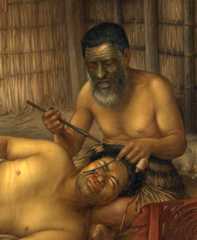
The tattooing practised across Polynesia developed unique forms in New Zealand, with deeply grooved scars and spiral motifs. While facialmoko became less common after European settlement, from the late 20th century there was a renaissance of both the full-facemoko worn by men and themoko kauae (chin tattoos) of women.
Story by Rawinia Higgins
Main image: 'Tohunga ta moko at work', 1915


Story summary
Origins
Tattooing is common throughout the Pacific Islands. In New Zealand, Māori developed techniques to cut deeply into the skin, producing grooved scars. The spiral motifs are distinctively Māori.
Moko originated in rituals of mourning for the dead. Women would haehae (cut) themselves with shells or obsidian and put soot in the wounds.
In tradition, tāmoko was brought from the underworld by a chief called Mataora, who married a tūrehu (spirit) called Niwareka. She fled to the underworld after he hit her. He followed and was taught tāmoko techniques by her father, Uetonga.
Technology
The pigment used in tāmoko was usually made from charcoal mixed with oil or liquid from plants. Known as wai ngārahu, it was stored in special containers.
Uhi (chisels) for tattooing were traditionally made from the bones of sea birds. Māori also had comb-like instruments for putting pigment into skin. Metal chisels were used after European arrival, and by the First World War needles were used. From the later 20th century most tattooists used tattoo machines.
Tohunga tā moko
The process of tāmoko was highly skilled, andtohunga tāmoko (tattoo experts) were greatly respected. They were paid with treasures such as weapons, cloaks and greenstone. The process was very ritualised andtapu (sacred), and the person being tattooed was fed using a special funnel.
Status
Moko represented a person’smana (status), and some chiefs who signed the Treaty of Waitangi reproduced theirmoko as signatures. However, some people of very high rank were considered sotapu that they could not be tattooed.
Moko today
During early European settlement, preserved tattooed heads were sold as souvenirs and collectors’ items. Māori withmoko were sometimes killed for their heads, leading to a decline in the practice of tāmoko. Some Māori killed their slaves and then tattooed them. These heads, called mokomōkai, were sold to overseas museums. From the 1980s many mokomōkai were brought back to New Zealand.
Māori women continued to receivemoko kauae (chin and lip tattoos) into the 1950s. From the 1970s Māori gang members woremoko as part of their gang insignia. From the 1980s the Māori renaissance encouraged tāmoko as a way to express Māori or tribal identity.
How to cite this page
Rawinia Higgins, Tā moko – Māori tattooing, Te Ara – the Encyclopedia of New Zealand, https://teara.govt.nz/en/ta-moko-maori-tattooing (accessed 14 February 2026).
Story by Rawinia Higgins, published 20 December 2016.