

Story: Scandinavians
There’s a piece of New Zealand in Finland – a solitary rock from Pourewa Island in Tolaga Bay commemorating the landing there of the first Finn to reach these shores. In New Zealand there are few signs of the hardy Scandinavians who followed, literally clearing the way: swinging an axe and milling the timber for the new colony. The founders of Dannevirke and Norsewood bade ‘farvel’ to their homelands long ago, and all too soon to their cultures as well.
Story by Carl Walrond
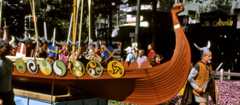
Main image: Scandinavian parade, Wellington, 2003


Story summary
Seafarers
Sweden, Norway, Denmark and Finland have long coastlines, so the first Scandinavian visitors were often great sailors. When they reached New Zealand, some left their whaling and trading ships to search for gold.
In the 1920s and 1930s Norwegian whalers, as fearless as their Viking ancestors, chased the giants of the southern ocean.
Pioneers of the bush
Courage and stamina were also needed to slash and clear the dense forests of Manawatū for settlement. Some Danes tackled this task in the 1860s, and more Scandinavians were recruited in the 1870s.
In return for land, they opened up the native bush from Wairarapa to Hawke’s Bay. This helped later settlers, but life for these trailblazers was harsh – sharing rough huts, facing hunger and fever. One little girl aged eight, Inger Jacobsen, had to work like a man. Constant toil quickly aged the men and women.
Later immigrants
Forests provided more work in the 1950s and 1960s, triggering a small wave of Finnish immigrants who worked in pulp and paper factories in Tokoroa and Kawerau.
In the same period many young Danes arrived as government-assisted immigrants.
From the 1990s Swedes and other Scandinavians began to choose to live in New Zealand because of work, marriage or lifestyle.
Communities and culture
From the 1870s to the 1920s, Dannevirke, Norsewood and Palmerston North had a Scandinavian flavour. For relaxation, the ‘Skandies’ gathered to drink coffee or dance the polka. On Sundays many attended the Lutheran Church. But their languages and customs often died with the older immigrants, and the next generation quickly adopted new ways. Even so, around a dozen Scandinavian clubs are still active today.
How to cite this page
Carl Walrond, Scandinavians, Te Ara – the Encyclopedia of New Zealand, https://teara.govt.nz/en/scandinavians (accessed 15 February 2026).
Story by Carl Walrond, published 4 March 2009, updated 1 September 2024.