

Story: Pacific Islands and New Zealand
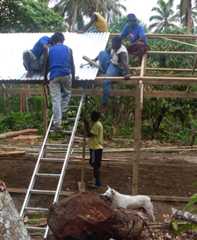
As an island nation in the South Pacific, New Zealand has long had strong cultural, economic and political links with other Pacific islands. Western Samoa, the Cook Islands and Niue were under New Zealand administration in the 20th century, and substantial waves of migration since the Second World War have resulted in a large Pasifika population in New Zealand.
Story by Jon Fraenkel
Main image: Building a soap factory, Vanuatu, 2008


Story summary
Although a small nation in international terms, New Zealand is relatively large and powerful in the Pacific. Foreign policy has focused on achieving or sustaining political stability, and on trade, development aid and managing political crises. The Pacific Islands Forum, the main regional political body, was set up in 1971.
Immigration and aid
After the Second World War, close links, job opportunities and population pressure on some islands led many Pacific people to migrate to New Zealand. During the 1970s the government clamped down on people overstaying their visas, particularly targeting Pacific peoples.
In 2011 about 8% of New Zealand’s population were of Pacific descent, and over half of New Zealand foreign aid went to the Pacific.
Colonisation and trade
The ancestors of Māori came to New Zealand from Polynesia around 1250–1300 CE. Pacific-bound whaling ships visited New Zealand from around 1800, and in the 19th century many politicians advocated colonising Pacific islands.
Samoa
After Germany withdrew from the Pacific during the First World War, Western Samoa came under New Zealand control. From 1927 the Mau movement pushed for self-government. New Zealand reacted harshly, arresting Mau supporters and firing on a peaceful protest in 1929, killing at least nine Samoans. New Zealand later supported Western Samoan independence, which was achieved in 1962.
Cook Islands and Niue
Cook Islands and Niue became New Zealand’s first Pacific colonies in 1901. From 1965 Cook Islands was self-governing; so was Niue from 1974. Cook Islanders and Niueans remained New Zealand citizens.
Tokelau
Tokelau came under New Zealand control in 1926. In the 2020s it remained a dependent territory. Tokelauans are New Zealand citizens.
Fiji
From the 19th century Fiji supplied unprocessed sugar to New Zealand factories. A British colony from 1874, Fiji became an independent democracy in 1970. New Zealand was involved in attempts to stabilise Fiji after military coups in 1987, 2000 and 2006.
Tonga
In 2006 New Zealand troops were sent to Tonga after riots in Nuku’alofa. In 2010 King George Tupou V agreed to new democratic arrangements.
Melanesia
- In the 19th century, New Zealand missionaries were active in Melanesia.
- During the Second World War, New Zealand troops fought against the Japanese in Solomon Islands.
- In the 1990s, New Zealand helped broker a peace agreement in the Bougainville region of Papua New Guinea.
- After a coup in Solomon Islands in 2000, New Zealanders attempted to resolve the crisis. From 2003 until 2017 New Zealanders served in a multinational force in Solomon Islands.
How to cite this page
Jon Fraenkel, Pacific Islands and New Zealand, Te Ara – the Encyclopedia of New Zealand, https://teara.govt.nz/en/pacific-islands-and-new-zealand (accessed 15 February 2026).
Story by Jon Fraenkel, published 12 June 2012.