

Story: Kūmara
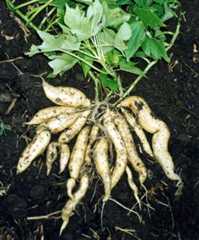
Before European arrival in New Zealand, carbohydrates were hard to find. Māori placed great value on the kūmara, a sweet potato they had brought from Polynesia. The remains of their early gardens and storage pits can still be seen around the country.
Story by Peter Adds
Main image: Taputini kūmara


Story summary
The arrival of kūmara
The Polynesian ancestors of Māori brought kūmara (sweet potato) with them as a food plant when they arrived in New Zealand in the 13th century.
In the late 20th century it was believed that early Polynesians had voyaged to South America and taken kūmara from there to Polynesia. By the 2020s it was thought more likely that voyagers from South America had brought kūmara to Polynesia
Kūmara in New Zealand
The climate in New Zealand was much cooler than the tropical islands of Polynesia. Kūmara would not grow in the winter – instead, it had to be stored and planted out again when the weather warmed up. Some areas were too cold to grow it at all.
The other food plants that people brought from Polynesia did not grow well in the new, cooler country. So kūmara became very important.
The red and yellow kūmara that we eat today are a different variety from traditional Māori kūmara – they came to New Zealand later, from North America.
Gardens
Māori developed large kūmara gardens, often on sloping, sunny land. They grew the plants in mounds of soil, adding sand and gravel to make it drain better. Fences protected the gardens from wind and pūkeko birds. The plants were sometimes attacked by caterpillars of the kūmara moth, and Māori kept tame seagulls to eat the caterpillars.
Eventually, suitable land for kūmara gardens became harder to find.
Storage
Kūmara tubers were harvested around March. They were stored in underground pits over winter, so some could be eaten and the rest planted out in the next spring.
Eating
Kūmara were cooked inhāngī (earth ovens), boiled, or steamed. Small tubers were sometimes dried in the sun.
Religious aspects
Rongomātāne (Rongo) was the god of kūmara and other cultivated plants. When the kūmara was planted, prayers were said. Sometimes an offering was made – often a bird. The priest placed atapu (religious restriction) on the crop until it was ready to be harvested.
Stone images or carved wooden sticks were believed to protect themauri (life force) of the growing kūmara.
How to cite this page
Peter Adds, Kūmara, Te Ara – the Encyclopedia of New Zealand, https://teara.govt.nz/en/kumara (accessed 14 February 2026).
Story by Peter Adds, published 24 November 2008.