

Story: Insurance
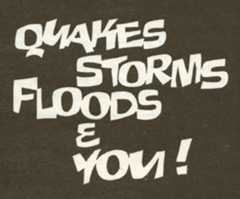
With its risks of drowning, shipwrecks and fires, as well as unsafe workplaces, early colonial New Zealand was fertile ground for insurance companies. The government set up insurance firms to compete with private insurers.
Story by Alan Henderson
Main image: Natural disasters leaflet, 1970s


Story summary
There are two main types of insurance business:
- life insurance, which is paid out when the insured person dies or has a serious illness
- general insurance, which covers risks to property, motor vehicles and health.
Early life insurance
Life in early colonial New Zealand was risky: shipwrecks, fires at sea and workplace accidents were common. The insurance industry grew quickly. The first life insurance companies were mostly local branches of Australian companies.
Not everyone could afford life insurance, and some insurance companies were not financially stable, so the government set up Government Life Insurance in 1869.
Early fire and general insurance
Fire was a constant danger in early New Zealand, as most buildings were wooden and fire services were inadequate. Companies were set up to insure people against fire. The companies worked together to standardise their premiums (the price of a policy). This kept premiums high, so the government set up the State Fire Insurance Office, with lower prices, in 1903.
Accident insurance
- Vehicle insurance covers motor accidents and theft of vehicles.
- Medical insurance covers injury and illness. The government provides free hospital care and an old-age pension, and private medical insurance is also available.
- Workplace accident insurance covers employees who are injured or killed at work. In 1972 the government set up the Accident Compensation Commission (later Corporation), which compensates accident victims.
Disaster insurance
Following the huge San Francisco earthquake of 1906, some insurance companies went bankrupt. After this, most companies stopped insuring for earthquake damage, and much of the damage from the 1931 quake in Napier was not covered by insurance. Then, just before the Second World War, insurance companies decided not to cover war damage. The New Zealand government set up the War Damage Commission. This became the Earthquake and War Damage Commission, which covered damage from floods, landslides, volcanoes and tsunamis, as well as from earthquakes and war. It was renamed the Earthquake Commission Kōmihana Rūwhenua (EQC) in 1993 and became the Natural Hazards Commission Toka Tū Ake in 2024.
Changes to the industry
Over time, smaller companies were taken over by larger ones. The government-owned companies Government Life and State were sold to private owners. In the early 21st century there were fewer branches, as people bought insurance over the phone or on the internet. Many banks also sold insurance.
In 2007–8 the insurance industry earned a gross income of more than $3 billion.
How to cite this page
Alan Henderson, Insurance, Te Ara – the Encyclopedia of New Zealand, https://teara.govt.nz/en/insurance (accessed 15 February 2026).
Story by Alan Henderson, published 4 March 2010.