


Two officials of the US Centers for Disease Control and Prevention (USCDC) based in Thailand arrived in Taiwan yesterday to help study the cause of Taiwan's three atypical pneumonia cases.
The USCDC officials are Scott Dowell, director of the International Emerging Infections Program, and Sonja Olsen, chief of the epidemiology section of the program.
Both attended a press conference in Taiwan's Center for Disease Control (CDC) yesterday afternoon with Twu Shiing-jer (
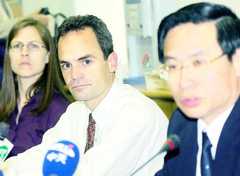
PHOTO: LIAO RAY-SHANG, TAIPEI TIMES
Dowell and Olsen made no comments yesterday on the three cases of atypical pneumonia Taiwan has already experienced.
Chen, however, quoted the US officials as saying that according to the medical history and clinical status of the three cases, the cause of their illness is "probably the same" as that of the atypical pneumonia cases in other southeast Asian countries.
According to Chen, blood and saliva specimens taken from the three patients will be sent to the USCDC for further examination.
Meanwhile, with three atypical pneumonia cases reported on Friday and Saturday, the DOH called yesterday for the public to remain calm and not to be in a rush to buy surgical masks.
The first two cases, a China-based Taiwanese businessman and his wife, were admitted to National Taiwan University Hospital and the third case, a 64-year-old woman, was sent to Ilan Hospital.
Twu said the hospitals and the CDC are in the process of verifying which virus caused the three cases.
Both the businessman and the 64-year-old woman were traveling in China's Guangdong Province in February. Twu said it was yet to be decided whether their sickness was related to their trips.
"Both began to have symptoms about a week after their return to Taiwan. The incubation period for their disease is different from ordinary flu," Twu said.
The CDC said it had reported the three cases to the World Health Organization (WHO) and asked people to avoid trips to Hong Kong, China, Vietnam and Singapore.
The Geneva-based WHO said that in the past week it had received more than 150 reports worldwide of the atypical pneumonia, which it has called "Severe Acute Respiratory Syndrome (SARS)."
The WHO issued an emergency travel advisory to travelers and airlines on Saturday.
According to the statement, the WHO has received reports of more than 150 new suspected cases of SARS from Canada, China, Hong Kong, Indonesia, Philippines, Singapore, Thailand and Vietnam over the past week.
The statement advised travelers including airline crew to be aware of the following symptoms and signs of SARS: a high fever (above 38?C) and one or more respiratory symptoms, including cough, shortness of breath, difficulty in breathing, and one or more of the following: close contact with a person who has been diagnosed with SARS or recent history of travel to areas reporting cases of SARS.
"In the unlikely event of a traveler experiencing this combination of symptoms they should seek medical attention and ensure that information about their recent travel is passed on to the health care staff," the statement said.
"Any traveler who develops these symptoms is advised not to undertake further travel until they have recovered," said the statement.
Chen yesterday urged the public, hospital staff, airlines and travel agencies to abide by the WHO's advisory.
Twu said yesterday that though Taiwan had asked for help from the WHO, the organization had refused Taiwan's request. This was unfair not only for the people of Taiwan but, given the transnational nature of the infection, the people of the world at large, Twu said.
Chen said the three cases were all staying in isolation wards. According to Chen, many hospitals across the island have advanced isolation wards that can handle similar infectious cases.
To contain the infectious disease, National Taiwan University Hospital has upgraded isolation measures in the couple's ward to biosafety level 3 (BSL3).
According to the USCDC's definition, BSL3 is applicable to clinical or diagnostic facilities in which "work is done with indigenous or exotic agents which may cause serious or potentially lethal disease as a result of exposure by the inhalation route."
Chen said that the CDC had obtained a budget to develop wards that can handle BSL4 -- the ultimate level -- conditions. Currently, only a few countries possess such advanced wards.
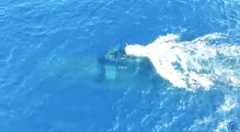
CSBC Corp, Taiwan (台灣國際造船) yesterday released the first video documenting the submerged sea trials of Taiwan’s indigenous defense submarine prototype, the Hai Kun (海鯤), or Narwhal, showing underwater navigation and the launch of countermeasures.The footage shows the vessel’s first dive, steering and control system tests, and the raising and lowering of the periscope and antenna masts.It offered a rare look at the progress in the submarine’s sea acceptance tests.The Hai Kun carried out its first shallow-water diving trial late last month and has since completed four submerged tests, CSBC said.The newly released video compiles images recorded from Jan. 29 to
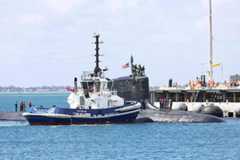
Washington and partners hope demonstrations of force would convince Beijing that military action against Taiwan would carry high costs The US is considering using HMAS Stirling in Western Australia as a forward base to strengthen its naval posture in a potential conflict with China, particularly over Taiwan, the Wall Street Journal reported on Saturday. As part of its Indo-Pacific strategy, Washington plans to deploy up to four nuclear-powered submarines at Stirling starting in 2027, providing a base near potential hot spots such as Taiwan and the South China Sea. The move also aims to enhance military integration with Pacific allies under the Australia-UK-US trilateral security partnership, the report said. Currently, US submarines operate from Guam, but the island could
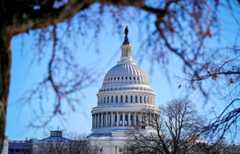
Should China’s actions pose any threat to Taiwan’s security, economic or social systems, China would be excluded from major financial institutions, the bill says The US House of Representatives on Monday passed the PROTECT Taiwan Act, which states that Washington would exclude China from participating in major global financial organizations if its actions directly threaten Taiwan’s security.The bill, proposed by Republican Representative Frank Lucas, passed with 395 votes in favor and two against.It stipulates that if China’s actions pose any threat to Taiwan’s security, economic or social systems, the US would, “to the maximum extent practicable,” exclude Beijing from international financial institutions, including the G20, the Bank for International Settlements and the Financial Stability Board.The bill makes it clear that China must be prepared

Taiwanese trade negotiators told Washington that Taipei would not relocate 40 percent of its semiconductor production to the US, and that its most advanced technologies would remain in the nation, Vice Premier Cheng Li-chiun (鄭麗君) said on Sunday.“I told the US side very clearly — that’s impossible,” Cheng, who led the negotiation team, said in an interview that aired on Sunday night on Chinese Television System. Cheng was referring to remarks last month by US Secretary of Commerce Howard Lutnick, in which he said his goal was to bring 40 percent of Taiwan’s chip supply chain to the USTaiwan’s almost


 RSS
RSS