 Streaming Learning Center Where Streaming Professionals Learn to Excel
- How to Build an Encoding Ladder: What You Need to Know
- David Ronca Details VCAT Beta 4.0 with VVC Decode
- Lies, Damn Lies, and Estimated Bandwidth Savings
- My Three Take Evolution in Vibe Coding
- Per‑Title Before New Codecs: Fixing Your H.264 Baseline
- Beyond H.264. Why Codec Choices Now Carry Legal and Financial Risk
Lies, Damn Lies, and Estimated Bandwidth Savings
Jan OzerFebruary 3, 2026Articles,Encoding,FFmpegLeave a comment355 Views
Related Articles


When a codec researcherdeclares that a newer codec is up to 40% more efficient than the baseline codec, they are making a highly accurate, well-defined claim. However, much like the EPA fuel economy ratings on a new car’s window sticker, these white papers should include a disclaimer stating,“actual bandwidth savings almost certainly will vary.”

Given that bandwidth savings are a top priority when adopting a new codec, the difference between theoretical and actual savings is crucial, especially now that codecs may carry hefty royalty obligations.
In this article, I’ll detail why encoding studies don’t accurately predict actual bandwidth savings, and what you need in order to make an accurate prediction. Of course, if you’ve benchmarked codecs even a little bit, you already know most of this. If that’s you, you might find this article useful for the newbies on your team, or for finance types expecting the 40% savings promised in some newsletter they subscribe to.
Contents
Research vs. Real World Results
Table 1 details several factors that differentiate the results achieved by researchers and the actual bandwidth savings a publisher will realize when implementing the codec.

Codec researchers use reference codecs that include all encoding tools in the standard. Encoding times are often irrelevant and can be glacial. Commercial encoders pick and choose which tools to include and craft commercially relevant presets, enabling developers to present their customers with meaningful trade-offs between quality and encoding time. As you would guess, this all-tools vs. selected-tools and differential in encoding times produce significant variability in encoding efficiency between reference codecs and commercial encoders.
There is also significant variability in quality among commercial encoders. Table 2 is from a Streaming Learning Center article titled “There are no codec comparisons.” There are only codec implementation comparisons. It shows the results of three codec comparisons, with x265 normalized to 100% efficiency in all.
The differences in comparative efficiency, even between the same codecs, are numerous and apparent. In the review of FFmpeg codecs, x264 required 1.71x the bandwidth of x265 to deliver the same quality; in the MSU comparison, it required 2.46x, a difference of approximately 50%.

In the Moscow State University (MSU) comparison, x265 was at 100% while the Tencent H265 was at 43.2%, or more than 50% more efficient than x265. Neither of these would align with the researcher’s findings in Figure 1, but Tencent would deliver over 50% more savings than x265.
In the MSU Hardware study, the most efficient AV1 implementation was 17%less efficient than the most efficient HEVC hardware implementation. In the MSU software study, the opposite was true: the most efficient AV1 implementationoutperformedthe most efficient HEVC implementation. The point of that article was clear; commercial codec implementations show very clear differences in performance, and these translate directly into your ROI.
Beyond differences in codec implementation, research studies use CQ-based encoding techniques because reference encoders may not have bitrate control. Your encoder uses VBR, CBR, or CRF, and bitrate control is absolutely essential.
Researchers use pristine 10-second clips in YUV format. Unless you’re Netflix or Amazon, you’re encoding (hopefully) lightly encoded mezzanine files in H.264 or HEVC format.
Clip Genres and Quality
Beyond the format, unless the researcher’s test clips match your test clips, your results could vary significantly from their findings. I recently ran some tests using the same encoding parameters for x264, VP9, x265, and SVT-AV1. Table 3 shows the results for five sports clips.

Table 4 shows the results for movies that are radically different. Clearly, ESPN would test with completely different clips than the Movie Channel.

Comparison Model
Researchers also use a completely different comparison model. Specifically, to compute BD-Rate results, researchers compare full-resolution clips at different quality levels. In contrast, publishers distribute videos in encoding ladders with rungs of decreasing resolution and quality. How much difference does this make? Quite a bit, because codec differences are usually more pronounced at higher resolutions.
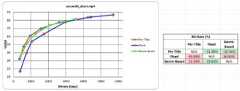
Table 5 presents a VP9 vs. HEVC comparison from aBitmovin study, with research-style fixed-resolution results on top and bitrate-ladder results on the bottom. Looking at the fixed-resolution VMAF results, x265 was 8% more efficient than VP9 and delivered a 56.75% reduction in bitrate compared to x264. With the full ladder, efficiency compared to x264 dropped to 38.7%, and x265 was actually less efficient than VP9.

For the record, the results shown in Tables 3 and 4 are from full-encoding ladders, not from fixed-resolution clips.
The Impact of Ladder Distribution
Beyond these basics, several other factors play a key role in the actual bandwidth savings a codec will deliver in situ. One is the actual rung distribution your users retrieved.Like many insightful concepts in streaming, this factor first surfaced in a white paper co-authored byYuriy Reznik, then of Brightcove and now ofStreaming Labs. In the article titled “Optimizing Mass-Scale Multi-Screen Video Delivery,” the authors discussed how different distribution patterns should affect ladder construction, using thethree example models shown in Figure 2.

Since reading this article back in 2020 or so, I’ve used this allocation concept to compute bandwidth savings in many codec comparisons, including thisLCEVC study, and the per-title comparison study releasedhere.
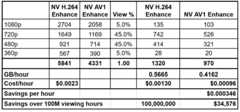
How much does distribution impact savings? Tables 6 and 7 are from a recent consulting project in which I projected the cost savings of AV1 over H.264 for live streams produced by an NVIDIA live transcoder. There’s a lot of math in the table, but the bottom line is this.
Table 6 shows a top-rung heavy distribution (see the View % column) where AV1 delivers $62,944 of bandwidth savings per 100M hours of viewing. This would represent an IPTV scenario.

What happens if the distribution is more mobile-centric and shifts to the middle rungs? As shown in Table 7, the savings drop to $34,576, a 45% decrease.

What happens if the publishers’ cost per GB is $0.01 instead of the $0.0023 the client claims? Bandwidth savings in both instances increase by slightly more than 4x.
What happens if the publisher doesn’t want to distribute AV1 video to viewers without hardware decoding? Viewing hours drop precipitously and savings along with them.
None of these factors is considered in codec studies, and all are critical to the savings your organization will realize.
The Bottom Line
Please don’t get me wrong. Encoding vendors are doing their jobs when they cite efficiency data for their encoders. Patent pools are doing their jobs when they publishpapers that estimate savings or increased income from new codecs. They are not picking numbers out of the air or misrepresenting the data in any way.
The problem is that there is no one-size-fits-all analysis. Every publisher’s scenario is so unique that, unless you’re computing bandwidth savings using:
- Your encoder
- Your clips
- Your distribution patterns
- Your encoding cost
- Your distribution cost
You’re essentially guessing. That might have been acceptable before codec decisions came with royalty obligations that could exceed nine figures over five years. But it’s not now.
That is the focus of my new course, Beyond H.264. We work through how to establish solid H.264 baselines, evaluate HEVC, AV1, and VP9 with your own content and ladders, and connect rate‑distortion results to bandwidth, compute, and licensing costs so that codec choices hold up as capital-allocation decisions.
If you want a structured way to move beyond H.264, compare next‑generation codecs on your own terms, and document the financial impact of those decisions, you can learn more and sign up to be notified when the course launches here: Beyond H.264.

About Jan Ozer

Check Also
Netflix’s Masterclass: Engineering Live Streaming at Scale
As a technologist and part-time couch potato, I appreciate Netflix on many levels. During the …

What the Access Advance / Via LA Deal Doesn’t Change About Codec Adoption
The acquisition of Via Licensing Alliance’s HEVC and VVC programs by Access Advance is being …

What I Learned About Deploying AV1 from Two Deployers
I recently hosted a Streaming Media Connect panel titled “Benefits and Trade-Offs of Adopting and …
Leave a ReplyCancel reply