|  |

| ||||
| ||||
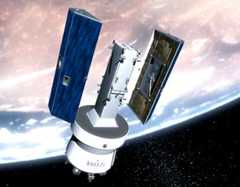
These satellites will enable researchers tocarry out gravimetric measurements of the Earth with an unprecedentedaccuracy. For the first time this will make it possible to detect minorchanges in the gravity field caused by the circulating magma in the Earth'sinterior or by melting glaciers or changing ocean currents. Grace is basedon the German geophysical satellite Champ (Challenging MinisatellitePayload) launched in July 2000. Champ and Grace were built by the Europeanspace company Astrium in Friedrichshafen. Both projects are based on the newsatellite concept "Flexbus" developed by Astrium. It allows an extremelycost-effective and fast production of satellites.
Researchers are just about to understand this complex natural interaction,the balance of which is the basis of our existence. Satellites play adecisive role in the investigation of the system Earth, since only they canobserve the globe completely and over a long period. Particular progress hasbeen made by scientists in the measurement of trace gases in the atmospheresuch as ozone, CFC and nitric oxides. As far as the processes in the Earth'sinterior and the effects on the oceans and the atmosphere are concerned,research is still in a primary stage. Champ and Grace are two epoch-makingmissions started by geoscientists in cooperation with Astrium spaceengineers.
Moreover, there are irregularities which are hidden within the Earth butnevertheless they are of major importance for the system Earth in severalrespects. Such anomalies, as researchers call them, have different origins:they may occur in areas with very dense and heavy stones resulting in astronger gravity. In other areas the crust material is lighter which meansthe gravity and thus the force of attraction is lower. Each of these irregularities has an effect on the gravity of the Earth. Ifthe global gravity field is represented in a three-dimensional map, theEarth looks like a potato. For geophysicists such a map forms the basis for further research. Itallows, for example, to achieve a better understanding of the ocean currentswhich are of great importance for our climate. In the same way, theexplosive question to what extent the sea level rises can only be answeredif the gravity condition of the Earth is known in detail. This is the majortask of Champ. Grace will also allow to measure even minor modifications ofthe gravity field and their changes in the course of the years.
Geophysicists in particular hope to be able to "look" into the Earth withthe aid of Champ. Irregularities in the liquid core of the Earth areparticularly interesting. Furthermore, scientists want to find out howliquid magma circulates in the Earth mantle. This is a very slow processwhich is, however, decisive for the development of the Earth's magneticfield.
Compared to Champ, Grace will be able to increase the sensitivity once moreby ten to one hundred times. Grace is thus also suitable for the monitoringof climatic changes. Due to the extremely high measurement accuracy,researchers are planning to use Grace for the study of a variety ofphenomenon:
For a period of five years, Grace satellites with a size of 3.1 by 1.9 metres and a weight of 475 kilograms will orbit the Earth. Researchers regard Champ and Grace as a new building block in the field of remote earth observation and hope to be able to regularly study the Earth in this way in the future. The prospects to achieve this goal are good, since the European Space Agency ESA approves the construction of Goce (Global Ocean Circulation Experiment). It would also be used to measure the Earth's gravity field and could be launched in 2005, i.e. immediately after the end of the Grace mission.
Compared to traditional construction methods, the costs for Champ could be reduced by more than 50 % without any loss of quality, which is confirmed by the scientists who are entirely satisfied with the mission process: 'With its Flexbus system, Astrium has gained a fantastic position on the world market", says Professor Christoph Reigber of GFZ Potsdam, the Principal Investigator (PI) of Champ and Co PI of Grace. This has already been demonstrated impressively by Astrium on the occasion of the Grace contract awarded by NASA. Thanks to Flexbus and the missions with a similar profile, large parts of the hardware, the documentation and the software could be used reducing the development efforts considerably. In addition to the development of the satellite platforms, Astrium is responsible for the tests in Ottobrunn and for the integration of the two satellites. The German aerospace centre (DLR), providing the ground stations for mission control and the launcher rocket, is also involved in the project. After environmental tests in Ottobrunn, the satellites will be transported to the Russian launch site Plesetsk situated 800 km north of Moscow. In November 2001, the duo is to be launched into space with a Rockot launcher. Eurockot Launch Services, a holding company of Astrium, is responsible for the launch. | | | |   | |||