

The Uruguayan Agency for International Cooperation (AUCI)
South-South & Triangular Cooperation Featured Partner
About AUCI
The Uruguayan Agency for International Cooperation (AUCI by its Spanish acronym) was created in 2010 (Law 18719) as the organization in charge of Uruguay’s cooperation policy. The Agency’s responsibilities include planning, designing, monitoring, administrating, coordinating, executing, evaluating, following-up and disseminating international cooperation activities, projects and programs to comply with the country’s development policies.
It has a Board of Directors comprised of its President, appointed by the President of the Republic; the Minister of Foreign Affairs; and the Director of the Office of Planning and Budget. It also has an Executive Director.
Based on the principles of solidarity, complementarity, equality, non-conditionality and respect for sovereignty, AUCI’s main strategic objectives are the following:
- Plan, monitor, coordinate and evaluate international cooperation to ensure it is aligned with and contributes to the country’s development strategy.
- Strengthen the National System for International Cooperation (SNCI by its Spanish acronym) by increasing the participation of subnational governments, nongovernmental organizations (NGOs) and the private sector.
- Promote the country’s South-South and Triangular Cooperation strategy.
- Democratize access to opportunities nationwide.
- Position Uruguay’s dual role (recipient and provider) in the global scenario.


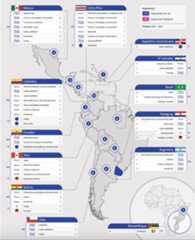
Uruguay especially values mutual learning, bidirectionality, knowledge sharing and the exchange of best practices to improve the population’s well-being in the framework of the 2030 Agenda. In this context, AUCI’s specific objectives focus on:
- Contributing to territorial development by promoting the active participation of second and third-level governments.
- Jointly working with international organizations, cooperation agencies and other countries, promoting institutional partnerships for international cooperation.
- Promoting Uruguay’s best practices and business units as the country’s flagship for international cooperation.
The Uruguayan government has defined its strategic priorities for international cooperation in line with the 2030 Agenda and the SDGs. These priorities guide the interaction and joint work with international organizations and national and local counterparts, in the framework of Uruguay’s dual role as an international cooperation recipient and provider.
South-South and Triangular Cooperation Strategy
Uruguay’s South-South Cooperation (SSC) is based on horizontality, respect for sovereignty and local contexts and non-interference. These principles also determine Uruguay’s SSC, both as a provider and as a recipient country. It is characterized by being innovative, focused on lessons learnt, strengths and best practices. Through this modality, the country promotes bidirectionality and the generation of mutual learning processes.
SSC’s best practices are increasingly being recognized by developing countries as valuable instruments to achieve the SDGs. The country’s SSC strategy is based on the need to prioritize and focus efforts, with the main objective of making this modality progressively more efficient to generate concrete results that effectively strengthen public policies.

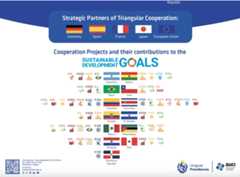
In the framework of this new approach, AUCI’s efforts to identify areas where Uruguay has accumulated experience and is willing to share lessons learned with other partner countries are noteworthy. As an SSC provider, Uruguay will focus on transferring best practices to improve its SSC effectiveness, as these initiatives have been assessed, demonstrated successful results, and will likely benefit recipient partners. Additionally, AUCI has designed structured yet flexible mechanisms to align national priorities with partner countries’ capacities.
Uruguay’s SSC strategy encourages NGO and private sector participation, requiring continued effort to facilitate their involvement. While currently focused on Latin America and the Caribbean, AUCI may expand to other regions if prioritized by the country’s foreign policy.
Uruguay and Triangular Cooperation
Uruguay has promoted and supported Triangular Cooperation modality through its strategic association with different partners. The strategy is based on the following criteria and guidelines:
Triangular Cooperation should promote synergies with South-South Cooperation initiatives
Uruguay participates in TC if its capacities will make a difference to the recipient country
Uruguay engages in Triangular Cooperation if the recipient country has been previously prioritized
Triangular Cooperation initiatives are demand-driven
Uruguay participates in Triangular Cooperation if there is a specific need and if the commitment of all stakeholders is guaranteed, at all levels and throughout the process
Uruguay’s Triangular Cooperation prioritizes, as far as possible, demands that are based on its best practices
Uruguay recognizes Triangular Cooperation as a modality that complements SSC. Hence, its TC is based on SSC’s guiding principles. In addition, the strategy considers Uruguay’s previous relations with second providers carefully, since having common criteria and working mechanisms, among other aspects, is essential for Triangular Cooperation management
SNCI and AUCI International Cooperation Efforts
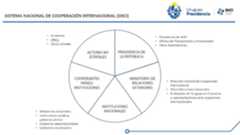
SNCI is composed of international cooperation offices from the Executive, Legislative, and Judicial branches, Autonomous Entities, Decentralized Services, subnational governments, and oversight bodies. Additionally, development agencies, funds, organizations, and Diplomatic Representations of all cooperation partners are part of the SNCI, along with civil society organizations, the private sector, and Uruguayan academic institutions.
As previously mentioned, AUCI is responsible for Uruguay’s international cooperation policy, and one of its key roles is to coordinate the SNCI as a whole. To achieve this, focal points are designated within each of these institutions to work closely with AUCI, ensuring proper follow-up on all initiatives and proposals. To strengthen this mechanism, AUCI has developed and implemented the Integrated Information System for International Cooperation (SICI-Uy, by its Spanish acronym).
A primary responsibility of these focal points is to keep their institutions informed about cooperation opportunities, as well as to provide advice and support in the negotiation, coordination, and follow-up of initiatives and activities.
The role of subnational and local governments is also crucial within this system and for the broader international cooperation policy. Therefore, promoting collaborative efforts and capacity-building is essential.
In this regard, multiple actions are undertaken, particularly through training activities tailored for this network of focal points and other experts within these institutions. These activities cover topics such as the 2030 Agenda, initiative design and management, and international cooperation in general, among others. AUCI also works to ensure a continuous exchange of up-to-date information.
More Good Practices
Good Practice of Uruguayan Cooperation, in Equality and Inclusion
Featured Publications

Fact sheets of 6 cooperation projects of the Uruguay-Mexico Fund


National Integration Plan for Migrants, Asylum Seekers and Refugees

Communication focal point, AUCI
lrecalde@auci.gub.uy