
The Germans from theBukovinaDefinitionThe Bukovina was aregion in southeastern Europe, located on the eastern slopes of the CarpathianMountains. It belonged to the Ottoman Empire until 1775 when it was annexed byAustria, and was then administered together with Galicia until 1850 when itbecame a crown land in the Austrian monarchy. In 1915, the Bukovina wasoccupied by Russia, and until its partition in 1944 it changed hands severaltimes between the Soviet Union and Rumania. Since then, the northern part hasbelonged to Ukraine and the southern part to Rumania. 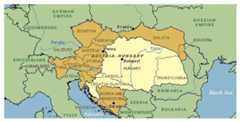 SettlementBetween the 14th and the17th century, a small group of German craftsmen and merchants lived in the areaand represented an important economic factor. However, they disappeared as aconsequence of war, disease, and gradual assimilation in the 17th century.After the Bukovina became part of Austria in 1775, German craftsmen and farmersfrom Upper Hungary, the Banat, Galicia, the Palatinate, Baden and Hessemigrated to the area. By 1786 much of the available land was occupied, andtherefore daughter colonies were founded in Galicia, Bessarabia, and theDobrudja. The Austrianadministration pursued a policy of populating the region. Immigration wasencouraged; Joseph II.'s various patents granting religious toleration, in thisaspect, attracted also non-Catholic settlers. The northern Bukovina got aRuthenian (Ukrainian) population majority, the southern Bukovina a Moldavian(Romanian) population. Significant numbers of German settlers, both Catholicsand Protestants, came into the country; in the late 19th century Germans wouldform about eight of the population. The administration would continue toencourage immigration up to World War I. While many of the immigrants werefarmers, some of the German immigrants were miners; a mining industry emergedon the slopes of the Carpathian mountains. 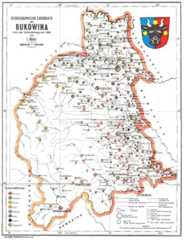 During the 19th century,the German-speaking middle class belonged to the political and intellectualelite, and the German language soon predominated as the language of administration,education, and jurisdiction. In 1910, the Bukovina had a population of about800,000 of whom 41% were Ruthenians, 31% Rumanians, eight percent were ofGerman origin, and four percent were Poles. Almost 22% of the Bukovinians hadGerman as their mother tongue, and from 1875 on its capital Czernowitz had aGerman-language university. After the dissolution ofthe Austro-Hungarian monarchy, the Bukovina—against the wishes of most of itspopulation—became a part of Rumania. German schools and cultural institutionsschools were Romanised. Many German Bukovinians emigrated between 1918 and 1948while some of those remaining sympathized with the German Reich as aconsequence of their suppression by the Rumanian government, poor economicconditions, and strong Nazi propaganda. In 1939/1940 the Reich resettled about100,000 persons to the Warthe-Gau and eastern Upper Silesia. It has beenestimated that only around 7,500 German Bukovinians still lived in theirhomeland after the War. Virtually all emigrated to Germany by 1992. Settlement in the U.S. and Western CanadaAs the population of Bukovina expanded, so did the pressures for emigration. Farmers with large families could no longer divide their homesteads among their children, and industry in Bukovina had never grown to the extent in had elsewhere in the Austrian Empire, or in the New World. The first wave of Bukovina German emigration began in the 1880's. Most of these emigrants would settle in communities among theirLandsleute. These destinations included Ellis (Kansas), Yuma County (Colorado), Naperville (Illinois), Lewis County (Washington) as well as Saskatchewan and Rio Negro (Brazil). A second wave of emigration to the Americas took place in the years preceding and following World War I. From Bukovina, theemigration of German farmers to Canada was relatively large after 1890 and was directedpredominantly to western Canada, especially to Saskatchewan. They began toarrive in Edenwold and vicinity, as well as in Vibank, in 1890, and inMariahilf-Grayson, Kennell-Craven, Markinch, Claybank, Spring Valley and Siltonin 1900. Most of them were Protestants; the Catholic minority settled in theMariahilf colony near Grayson. The Bukovinian immigrants came mostly from thearea between Czernowitz and Suczawa, in particular from Fratauz, Satulmare,Badeutz, St. Onufry, Arbora, Tereblestie, Ilischestie, Itzkany, Radautz, Rosch,Molodia, Derelui, Cuszur Mare, and from Czernowitz and Suczawa. Notes[1] "History of theBukovina," http://www.zum.de/whkmla/region/balkans/bukovina17751815.html. Accessedon March 7, 2004. [2] "Die Deutschenund ihre östlichen Nachbarn,"http://www.oestlichenachbarn.bayern.de/.Accessed on March 7, 2004. [3] "The Bukovina Society of the Americas,"http://www.bukovinasociety.org/#A%20Short%20History %20of%20Bukovina. [4] Lehmann, Heinz,TheGerman Canadians: 1750-1937. Immigration, settlement and culture.Translated,edited and introduced by Gerhard P. Bassler (St. John's, NF: Jesperson Presss,1986), p. 121. Sources1. "History of theBukovina from the earliest times on (in German),"http://www.bukowina.info/Gesch-1.html.Accessed on April 19, 2004. 2. "History of theBukovinian Germans. Geographical overview (in German)," http://www.bukowina.info/Geo-1.html.Accessed on April 19, 2004. 3. The Bukovina Society of the Americas,http://www.bukovinasociety.org/ |