Thetidycensuskr package is designed for R users who want to work with South Korean census and administrative boundary data. It aims to provide an easy-to-use interface for population, housing, and socioeconomic statistics linked with geospatial boundaries.

Installation
You can install the released version oftidycensuskr from CRAN with:
# CRANinstall.packages("tidycensuskr")# R-universeinstall.packages("tidycensuskr", repos="https://sigmafelix.r-universe.dev")To install the development version,remotes::install_github() will suffice.
# Development version from GitHubrlang::check_installed("remotes")remotes::install_github("sigmafelix/tidycensuskr")About the data
As of September 2025, this package contains two datasets: Census data (censuskor) and the corresponding geospatial data.
1. Census data
- Sigungu dataset of three census years (2010, 2015, 2020)
- The curated dataset is along table (i.e., one row per district-year-variable)
anycensus()
- The function
anycensus()allows you to query census data for specific district or province codes and types of data (population, tax, mortality, economy, housing) for three census years (2010, 2015, 2020).
# loading Seoul population datatidycensuskr::anycensus(codes="Seoul", type="population")#> # A tibble: 25 × 17#> year adm1 adm1_code adm2 adm2_code type all households_total…¹#> <dbl> <chr> <dbl> <chr> <dbl> <chr> <dbl>#> 1 2020 Seoul 11 Dobong-gu 11100 populat… 312878#> 2 2020 Seoul 11 Dongdaemun-gu 11060 populat… 332796#> 3 2020 Seoul 11 Dongjak-gu 11200 populat… 378749#> 4 2020 Seoul 11 Eunpyeong-gu 11120 populat… 458777#> 5 2020 Seoul 11 Gangbuk-gu 11090 populat… 295304#> 6 2020 Seoul 11 Gangdong-gu 11250 populat… 440022#> 7 2020 Seoul 11 Gangnam-gu 11230 populat… 509899#> 8 2020 Seoul 11 Gangseo-gu 11160 populat… 564114#> 9 2020 Seoul 11 Geumcheon-gu 11180 populat… 225594#> 10 2020 Seoul 11 Guro-gu 11170 populat… 394733#> # ℹ 15 more rows#> # ℹ abbreviated name: ¹`all households_total_prs`#> # ℹ 10 more variables: `all households_male_prs` <dbl>,#> # `all households_female_prs` <dbl>, fertility_total_brt <dbl>,#> # `fertility_15-19 (simulated)_bp1` <dbl>, `fertility_20-24_bp1` <dbl>,#> # `fertility_25-29_bp1` <dbl>, `fertility_30-34_bp1` <dbl>,#> # `fertility_35-39_bp1` <dbl>, `fertility_40-44_bp1` <dbl>, …2. Administrative boundaries
load_district()
- The function
load_district()allows you to get theSi-Gun-Gu levelsffiles for the three census years (2010, 2015, 2020). - The function requires the
tidycensuskr.sfpackage to be installed. Please install it fromR-universe usinginstall.packages("tidycensuskr.sf", repos = "https://sigmafelix.r-universe.dev").
# loading boundary sf file: 2020 boundaries are included in this packagedata(adm2_sf_2020)# tidycensuskr.sf::load_districts(year = 2020)Examples
Package vignettes are the first place to look for detailed examples. Below are some quick examples to get you started.
Simple map making
anycensus() will return an analysis-ready data.frame that can be easily merged with the corresponding boundarysf object fromload_districts(). Here is a simple example of making maps with population data.
library(tidycensuskr)#> tidycensuskr 0.2.6 (2025-12-09)#> Please install the companion data package tidycensuskr.sf to use the district boundaries.#> install.packages('tidycensuskr.sf', repos = 'https://sigmafelix.r-universe.dev')library(ggplot2)library(dplyr)#>#> Attaching package: 'dplyr'#> The following objects are masked from 'package:stats':#>#> filter, lag#> The following objects are masked from 'package:base':#>#> intersect, setdiff, setequal, unionlibrary(tidyr)library(sf)#> Linking to GEOS 3.12.2, GDAL 3.11.4, PROJ 9.4.1; sf_use_s2() is TRUElibrary(biscale)library(cowplot)sf_use_s2(FALSE)#> Spherical geometry (s2) switched offoptions(scipen=100)# load census datacensus_pop_2020<-anycensus(year=2020, codes=NULL, type="population")#> Using character codes that are convertible to integers. Automatically converting to integers...census_pop_2020<-census_pop_2020|>rename(population_total=`all households_total_prs`)# load boundariesdata(adm2_sf_2020)adm2_2020<-adm2_sf_2020# merge boundaries and census datacensus_2020_sf<-adm2_2020|>left_join(census_pop_2020, by=c("adm2_code"="adm2_code"))# plot population datacensus_2020_pop<-ggplot(census_2020_sf)+geom_sf(aes(fill=population_total), color="white", size=0.1)+theme_minimal()+labs( title="Population (2020)", fill="Population")+theme( plot.title=element_text(size=12), axis.text=element_text(size=7), legend.text=element_text(size=7), legend.title=element_text(size=8))census_2020_pop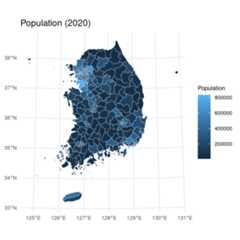
For Seoul Metropolitan Area (including Seoul, Incheon, and Gyeonggi-do), you can use a character vector incodes argument and merge the retrieveddata.frame andsf object withinner_join():
census_pop_2020_sma<-anycensus( year=2020, codes=c("Seoul","Incheon","Gyeonggi"), type="population")|>rename(population_total=`all households_total_prs`)census_2020_sf_sma<-adm2_2020|>inner_join(census_pop_2020_sma, by=c("year","adm2_code"))# plot population datacensus_2020_pop_sma<-ggplot(census_2020_sf_sma)+geom_sf(aes(fill=population_total), color="white", size=0.1)+theme_minimal()+labs( title="Population in Seoul Metropolitan Area (2020)", fill="Population")+theme( plot.title=element_text(size=12), axis.text=element_text(size=7), legend.text=element_text(size=7), legend.title=element_text(size=8))census_2020_pop_sma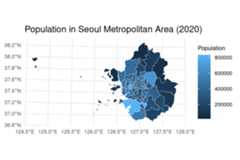
Bivariate map
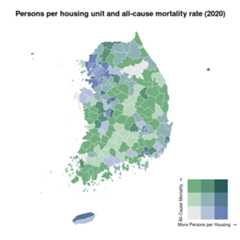
Moving on to a complex example, the code below demonstrates to generate a bivariate map with persons per housing unit and all-cause mortality rate.
census_housing_2020<-anycensus(year=2020, codes=NULL, type="housing")#> Using character codes that are convertible to integers. Automatically converting to integers...census_housing_2020<-census_housing_2020|>rename(housing_total_units=`housing types_total_cnt`)census_pop_housing_2020<-census_pop_2020|>left_join(census_housing_2020|>select(adm2_code,housing_total_units), by="adm2_code")|>transmute( adm2_code=adm2_code, persons_per_housing=population_total/housing_total_units)census_mort_2020<-anycensus(year=2020, codes=NULL, type="mortality")#> Using character codes that are convertible to integers. Automatically converting to integers...census_mort_2020<-census_mort_2020|>rename(mortality_total=`all causes_total_p1p`)census_pph_mort_2020<-census_pop_housing_2020|>left_join(census_mort_2020|>select(adm2_code,mortality_total), by="adm2_code")# merge boundaries and census datacensus_2020_sf<-adm2_2020|>left_join(census_pph_mort_2020, by=c("adm2_code"="adm2_code"))census_2020_mapbase<-biscale::bi_class(census_2020_sf, x=persons_per_housing, y=mortality_total, style="quantile", dim=3)# draw a bivariate legendlegend<-bi_legend(pal="DkCyan", dim=3, xlab="More Persons per Housing ", ylab="All-Cause Mortality ", size=6)# plot population datacensus_2020_bmap<-ggplot(census_2020_mapbase)+geom_sf(aes(fill=bi_class), color="white", size=0.1, show.legend=FALSE)+bi_scale_fill(pal="DkCyan", dim=3)+theme_minimal()+labs(title="Persons per housing unit and all-cause mortality rate (2020)")+bi_theme(base_size=10)+theme(plot.title=element_text(size=10))# combine map with legendcensus_2020_bimap<-cowplot::ggdraw()+cowplot::draw_plot(census_2020_bmap,0,0,1,1)+cowplot::draw_plot(legend,0.7,0.02,0.3,0.3)census_2020_bimap